Lollipops rarely truly expire. Stored properly, hard candy stays safe to eat for a year or more past its printed date, though the texture turns sticky or grainy and the flavor fades over time.
If you’ve ever dug an old lollipop out of a junk drawer and wondered whether it’s still fine to hand to a kid, or to sell, you’re not alone. Search interest in “do lollipops expire” spikes every Halloween and every spring when someone finally cleans out a pantry. The short version: a lollipop’s sugar base is one of the more shelf-stable foods around, but stable doesn’t mean forever, and the real answer depends on what’s inside the lollipop, how it’s wrapped, and where it’s been sitting. By the end of this guide you’ll know how long different lollipop types last, how to read the date code on the wrapper, what actual spoilage looks like versus harmless cosmetic aging, and, if you’re on the production side, how packaging and process choices extend or shorten that window.
What is a lollipop’s shelf life?
A lollipop’s shelf life is the stretch of time its sugar structure, flavor, and coating stay close to fresh, typically 12 to 24 months for a basic hard candy lollipop kept somewhere cool and dry.
That’s the part most people came here for. But “shelf life” printed on a candy bag doesn’t mean what it means on a carton of milk. Hard candy is cooked sugar and corn syrup, boiled to around 300°F (149°C) and cooled fast enough that the sugar molecules never settle into crystals. That glassy structure is what gives a lollipop its snap and shine, and it also happens to be a poor environment for bacteria. Microbes need water to multiply, and a properly cooked lollipop has almost none of it. That’s part of why food safety regulators put hard candy in the “shelf-stable” category to begin with, per the USDA’s guidance on shelf-stable foods.
Why hard candy rarely “expires”
A plain sugar lollipop can sit in a cabinet for years without becoming dangerous, and the reason comes down to water activity, a measure of how much free water is available for microbes to use. Hard candy typically sits below 0.5 on that scale, well under what bacteria, yeast, or mold need to get going. Add in the fact that a plain sugar pop has no proteins or fats to go rancid, and you’ve got a product that just doesn’t support spoilage organisms the way a cream-filled pastry would.
That doesn’t mean nothing happens over time. Two slow processes keep grinding away in the background:
- Moisture migration: sugar pulls moisture from the air, and over months this softens the surface and can make wrappers stick.
- Sugar recrystallization: the amorphous sugar glass slowly tries to revert to crystalline sugar, which is what causes that gritty texture in very old hard candy.
Neither one makes the candy unsafe. They just make it less pleasant to eat.
Best-by dates vs. expiration dates
This is where most of the confusion starts, and it’s worth getting precise because it affects everything from home storage decisions to retail return policies.
| Date label type | What it actually means | Legally required? | Applies to lollipops? |
|---|---|---|---|
| “Use by” / expiration date | Manufacturer’s estimate of when quality (not safety) starts declining | No (US federal level, except infant formula) | Rarely used |
| “Best by” / “Best before” | Peak quality window for flavor, texture, color | No | Most common label |
| Manufacture/lot code | Production batch tracking for recalls | Yes, internally | Always present |
| No date at all | Common for bulk or wholesale hard candy | Legal in most US states | Common |
In the US, outside of infant formula, there’s no federal law requiring expiration dates on candy. What you’re usually looking at on a lollipop wrapper is a “best by” date, the manufacturer’s estimate of peak quality, not a hard safety cutoff. A lollipop sitting six months past that date isn’t a hazard. It might just taste a little flatter or feel slightly softer.
Types of lollipops and how shelf life differs
Not all lollipops age the same way. A plain hard sugar pop can outlast a gum-center or sugar-free version by years, because the filling, sweetener, and coating each bring their own way of breaking down.
A lollipop is rarely just sugar anymore. Centers, coatings, and sugar substitutes each carry their own chemistry, and that chemistry decides whether you’re looking at a two-year shelf life or a two-month one.
Hard sugar lollipops (classic style)
The traditional all-sugar lollipop, think classic swirl pops or rock-candy-on-a-stick styles, is the longest-lasting category by a wide margin. With water activity under 0.5 and nothing perishable in the mix, these can stay edible for 18 to 24 months or longer if the wrapper stays sealed. The limiting factor isn’t safety, it’s appearance: the color fades under light and the surface gets tacky as it pulls in humidity.
Lollipops with centers (gum, chocolate, fruit, caramel)
This is where shelf life drops fast. A lollipop with a soft gum center, a chocolate core, or a gel filling brings fat or moisture into the mix, and both open the door to rancidity in fat-based centers or mold in higher-moisture ones. These products usually carry a 6 to 12 month best-by window, and the center is almost always the weak point, not the shell.
If you’re checking a center-filled lollipop that’s past its date, check the center first. A hard shell can look perfect while a chocolate or fruit-gel center inside has already turned.
Sugar-free / sorbitol-based lollipops
Sugar alcohols like sorbitol and isomalt behave differently from regular sugar. They’re less prone to pulling in moisture in some formulations, but they can also crystallize unpredictably, which shows up as a cloudy or grainy look faster than in sugar-based pops. Shelf life lands in a similar range to standard hard candy, 12 to 18 months, but the quality drop tends to be more visible. Cloudiness shows up well before there’s any safety concern.
| Lollipop type | Typical best-by window | Main aging factor | Safety risk if expired |
|---|---|---|---|
| Plain hard sugar | 18-24 months | Surface tackiness, color fade | Negligible |
| Gum/chewy center | 9-14 months | Center hardening or mold | Low to moderate (center only) |
| Chocolate-filled | 6-10 months | Fat rancidity, bloom | Low (quality, not safety) |
| Fruit/gel-filled | 6-12 months | Moisture migration, mold | Moderate if seal compromised |
| Sugar-free (sorbitol/isomalt) | 12-18 months | Crystallization, cloudiness | Negligible |
A review of hard candy production in PMC’s food science literature found that moisture content at the moment of cooling is the single biggest predictor of how fast hard candy ages, more so than the recipe itself. Two batches made from the same formula can end up with very different shelf lives depending on the final moisture percentage they hit during cooking.

Industry applications: how manufacturers manage shelf life
For confectionery producers, shelf life isn’t left to chance. It gets engineered through cooking temperature, moisture control, packaging choices, and storage rules long before the candy ever reaches a shelf.
If you’re on the manufacturing or co-packing side rather than just snacking, “do lollipops expire” turns into a quality-control question with real money attached to it: returns, shelf-space arguments with retailers, date-coding compliance.
Packaging and moisture barriers
The wrapper does more work than most people realize. Pick the wrong film and you can cut a lollipop’s effective shelf life in half, no matter how well the candy was cooked.
- Twist-wrap cellophane or BOPP film: the standard for individually wrapped pops, gives reasonable moisture protection but isn’t airtight at the twist points
- Heat-sealed flow-wrap: better moisture protection, common for premium or export products
- Bulk bags with desiccant packs: used for wholesale or food-service formats where pallets sit in humid warehouses for months
- Foil-laminate wrap: the best barrier, usually reserved for high-value or specialty lollipops, including medicated or CBD-infused ones
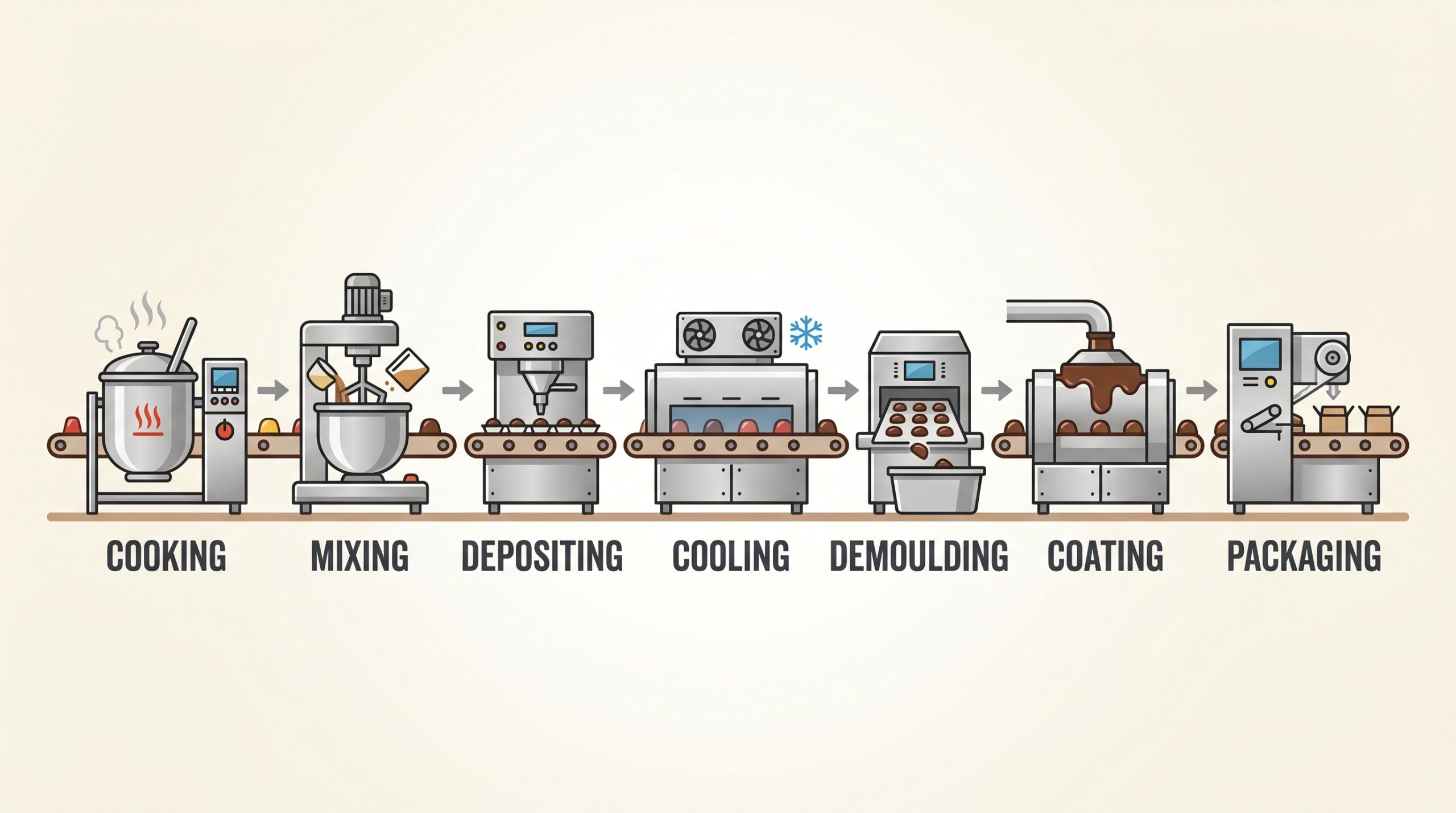
On a production line, the cooking and forming stage matters just as much as the wrap. Equipment like a continuous candy cooker controls moisture content precisely as the syrup hits its final temperature, and even half a percentage point of residual moisture at that stage can shift a lollipop’s practical shelf life by months. Producers running a candy drop roller line for hard candy and lollipops often add a short cooling tunnel right after forming, specifically to lock in that low-moisture glass state before wrapping. That’s where most of the actual shelf-life engineering happens.
Storage conditions in production and distribution
Even a perfectly cooked, perfectly wrapped lollipop can lose months of shelf life to bad storage downstream. The two culprits are heat and humidity, and they compound each other. A warehouse at 85°F and 70% relative humidity will age hard candy noticeably faster than the same product at 65°F and 40% RH.
Most confectionery QA programs aim for:
- Temperature: 60-70°F (15-21°C)
- Relative humidity: below 50%
- No direct sunlight (UV speeds up color fading and can soften surface coatings)
- Strict first-in-first-out rotation, tracked by lot code
For facilities juggling mixed inventory, including donated or bulk goods with varying date codes, this shelf life guide from Carnegie Mellon’s food pantry program lays out practical expectations across shelf-stable categories.
Quality control testing
On the production side, “does this batch still meet spec” gets answered with a handful of standard checks rather than guesswork:
- Moisture content testing, usually via Karl Fischer titration or loss-on-drying, run on samples from each batch
- Water activity measurement, confirming the product sits below the 0.5-0.6 threshold where microbial growth becomes a concern
- Accelerated shelf-life testing, storing samples at elevated temperature and humidity to predict long-term aging in compressed time
- Sensory panels, where trained tasters score color, clarity, texture, and flavor against a reference standard at set intervals
Plants running mixed product lines also rely on integrated CIP (clean-in-place) cleaning systems between batches. Residual moisture or sugar buildup in cooking equipment is a surprisingly common source of inconsistent shelf-life results from one batch to the next, since it quietly changes the concentration of the next cook.
How to tell if a lollipop has gone bad (and how to store yours)
A lollipop that’s gone bad usually shows it through stickiness, cloudiness, or an off smell from the center, not through anything that makes it dangerous to eat.
For most people asking “do lollipops expire,” the real question is: is this specific lollipop in my hand still okay? Here’s how to actually answer that.
Normal aging vs. real spoilage
| Sign | Normal aging (still fine) | Likely spoilage (discard) |
|---|---|---|
| Sticky surface under wrapper | Yes, moisture migration, common | – |
| Cloudy or grainy texture | Yes, sugar recrystallization | – |
| Faded color | Yes, light exposure over time | – |
| Mold spots, fuzzy or colored | No | Yes, discard immediately |
| Sour or rancid smell from center | No | Yes, the center has turned |
| Wrapper torn with insect activity | No | Yes, discard |
| Hardened, cracked gum center | Yes, texture loss only | Unless mold is present |
A thread on r/CandyMakers discussing hard candy shelf life lines up with what most food scientists say: plain hard candy that’s merely sticky or cloudy is a quality issue, not a safety one. Mold, off smells, and insect damage are the real red flags, and you can check for all three in a few seconds.
Storage, step by step
- Keep the original wrapper sealed until you’re ready to eat the lollipop. The wrapper is your main moisture barrier.
- Store in a cool, dry cabinet, away from the stove, dishwasher, or a sunny windowsill.
- For bulk or unwrapped pops, use an airtight container, and add a desiccant packet if you’re somewhere humid.
- If you’re buying in bulk for resale or food service, check date codes and sell older lot codes first.
- If a lollipop feels sticky through the wrapper, it’s almost always still fine. Just expect a softer texture than a fresh one.
- If you smell anything sour, musty, or off from a filled center, skip it. That’s the one real warning sign.
A slightly cloudy or sticky-looking pop that smells normal and shows no mold is almost certainly safe to eat. The texture loss is cosmetic, not microbial.

Future trends in candy shelf life (2026 and beyond)
The next round of improvements to lollipop shelf life is coming from packaging tech and clean-label formulation tweaks, not from new preservatives.
Consumer demand for “clean label” candy, fewer artificial preservatives and ingredients people actually recognize, is pushing manufacturers toward formulation and packaging fixes instead of chemical ones. A few things worth watching heading into 2026:
- Active packaging with built-in desiccants: wrapper films with a moisture-scavenging layer that extend shelf life without touching the recipe
- Natural anti-crystallization agents: invert sugar syrups or specific corn syrup ratios that slow recrystallization without artificial additives
- QR-linked date coding: some premium brands are testing QR codes on wrappers that link to batch-specific freshness data instead of one printed date
- Isomalt blends: isomalt’s lower tendency to absorb moisture is being used in hybrid recipes to push plain hard candy shelf life past 24 months in humid export markets
| Trend | Main benefit | Adoption stage (2026) |
|---|---|---|
| Active/desiccant packaging films | Adds 3-6 months of effective shelf life | Early commercial use, premium brands |
| Natural anti-crystallization syrups | Less graininess without additives | Widely adopted in newer formulations |
| QR-linked freshness coding | More transparency, less waste | Pilot programs, growing |
| Isomalt/sugar hybrid recipes | Lower moisture absorption, longer shelf life | Mainstream for sugar-free lines |
These changes mostly play out upstream, in formulation and packaging decisions. For anyone at the consumer end, the guidance in this article still holds no matter which preservation approach a given brand picks: store it cool and dry, and check for mold or off smells, not just texture.
FAQ: do lollipops expire?
Do lollipops expire if unopened?
Unopened, properly wrapped hard lollipops stay safe well past their best-by date, often 1-2 years, though flavor and texture gradually decline.
What happens if you eat an expired lollipop?
In most cases, nothing harmful. You might notice a softer, stickier texture or duller flavor, but a plain hard candy past its date isn’t a health risk unless it shows mold or an off smell.
Can Chupa Chups and other filled lollipops expire faster than plain ones?
Yes. Filled lollipops with gum, chocolate, or fruit centers usually have shorter best-by windows of 6-12 months, because the center can turn rancid or grow mold before the hard shell shows any change.
Can lollipops mold?
Plain hard sugar lollipops almost never mold, since their water activity is too low to support fungal growth. Filled centers with more moisture can mold if the wrapper seal is broken.
How long can you save a lollipop after licking it?
Once it’s been licked and exposed to saliva and air, the surface gets sticky and is no longer shelf-stable the way an unopened one is. Bacteria from your mouth can start interacting with that moist surface, so treat it as a same-day item, not something to save for later.
What does an expired lollipop look like?
Usually cloudy or grainy on the surface, maybe sticky through the wrapper, with faded color. None of that is a safety issue by itself. Mold, discolored spots, or an off smell are the actual warning signs to look for.
Do lollipops need to be refrigerated?
No. Refrigeration can introduce condensation when the candy warms back up to room temperature, which speeds up stickiness. Room-temperature, low-humidity storage works better for hard candy.
Conclusion
So, do lollipops expire? Not the way milk or meat does. A plain hard sugar lollipop is one of the more shelf-stable items in the candy aisle, able to stay safe for years thanks to its low water activity, even as its texture and color slowly drift away from fresh. Filled and sugar-free versions shorten that window because of what’s inside the shell, but the safety check stays the same in every case: look for mold, off smells, or insect damage, and treat stickiness or cloudiness as a quality issue rather than a danger sign.
If you’re buying for yourself, the printed best-by date is a guideline you can reasonably stretch. If you’re producing, packing, or distributing lollipops commercially, that same window comes down to your cooking moisture targets, your wrap material, and your warehouse climate, all of which you can control at the equipment level long before any date code gets printed.
Related Articles
- Do Candy Canes Go Bad? Shelf Life, Storage & Safety Guide (2026)
- Can Candy Expire? The Real Shelf-Life Truth Behind Every Wrapper
- Sugar Plum Candy: History, Recipe & How It’s Made Today
- Sour Tube Candy: What It Is, Flavors, How It’s Made & Why You Can’t Stop
- Soft Candy: Types, Textures, and How They’re Made (2026 Guide)
- Candy Drop Roller, Turn Sugar Into Perfect Lollipop Drops