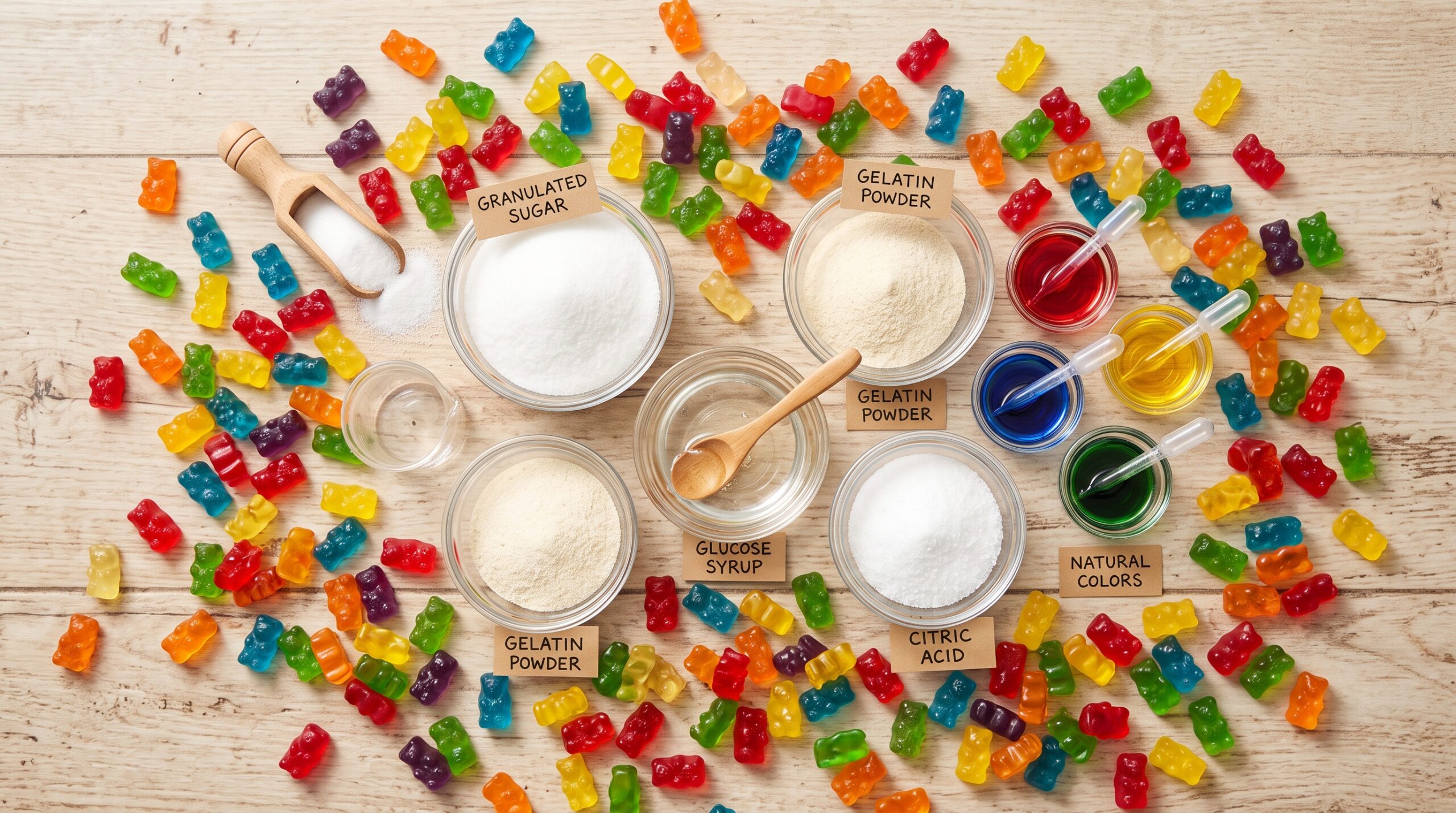
Gummy bear ingredients break into four functional groups: a gelling agent (gelatin or pectin), a sweetener syrup, an acid, and flavor/color. The ratio between them, not the ingredient names themselves, is what separates a Haribo bear from a gas-station knockoff.
Somewhere between a kid asking “wait, is this made of pig skin?” and a product developer trying to figure out why their batch won’t set, the same question keeps coming up: what’s actually in a gummy bear? The label reads like a chemistry set: glucose syrup, gelatin, citric acid, palm kernel oil. None of it explains why one brand snaps cleanly in half while another one just kind of squishes.
This breaks down gummy bear ingredients by function, not just by name. You’ll come away knowing which ingredient does what, why gelatin sourcing is more complicated than “made from animals,” what the label legally has to tell you (and what it doesn’t), and, if you’re the kind of person who eventually wants to make gummy bears at a scale bigger than your kitchen, where the ingredient list starts dictating the equipment you’d need to buy.
What Is a Gummy Bear Made Of? A Full Ingredient Breakdown
Gummy bear ingredients break into four functional groups: gelling agent, sweetener, acid, and flavor/color system. Everything else on the label is a supporting player.
Pull the wrapper off almost any commercial gummy bear and the ingredient panel reads something close to this: glucose syrup, sugar, gelatin, citric acid, natural and artificial flavors, food coloring, and a thin coat of carnauba wax or palm kernel oil for shine. That’s the skeleton. Premium brands swap a few things (tapioca syrup instead of corn glucose, fruit juice concentrate instead of dye), but the functional roles in the gummy bear ingredients list stay identical no matter the brand.
The Core Four: Gelling Agent, Sweeteners, Acids, Flavorings
Here’s what each group of gummy bear ingredients is actually doing inside the candy, not just what it’s called on the label.
- Gelling agent (gelatin, pectin, or starch): creates the chewy, elastic network that lets a gummy bear bend instead of crumble
- Sweetener syrup (glucose syrup plus sucrose, usually 60/40 to 70/30 by weight): controls sweetness, but more importantly controls moisture retention and shelf stability
- Acid (citric or malic acid): balances sweetness and, on sour gummies, delivers the tongue-puckering hit; also lowers pH slightly for microbial stability
- Flavor and color: usually a blend of natural extracts and FD&C dyes, applied either inside the gel or as an outer dusting
These four ingredients fight each other chemically. Too much acid too early in the cook and the gelatin partially breaks down before it sets, which is why professional formulations add citric acid after the batch has cooled below about 60°C, not while it’s still boiling. Get that sequencing wrong on a full batch and you end up with bears that never firm up past a syrupy blob. That’s a far more common production failure than most home bakers ever run into.
Typical Ingredient List: Haribo-Style vs. Store Brand
Not every brand’s gummy bear ingredients are built to the same spec, even when the label reads almost identically. Here’s how the two tiers typically diverge.
| Ingredient category | Premium brand approach | Store-brand approach |
|---|---|---|
| Gelling agent | Bovine or porcine gelatin, 200+ Bloom strength | Gelatin, often lower Bloom (150-180) or blended with starch |
| Sweetener | Glucose syrup + beet sugar | Glucose syrup + corn-derived sugar |
| Acid | Citric acid, sometimes lactic acid for tang | Citric acid only |
| Coating | Beeswax or carnauba wax, light dusting | Palm kernel oil, heavier coating |
| Color/flavor | Natural fruit and vegetable extracts | FD&C dyes, artificial flavor compounds |
Bloom strength matters more than most ingredient lists let on. It’s the industry measurement of gelatin’s gel strength, and it’s the single biggest reason two bears with “identical” gummy bear ingredients on the label can feel completely different in the mouth. According to Wikipedia’s overview of gummy bear composition, the core recipe has stayed remarkably stable since Hans Riegel first molded them in Germany in the 1920s: sugar, gelatin, and flavoring, full stop. What’s changed is everything downstream of that: sourcing standards, allergen labeling, and now a wave of pectin- and starch-based versions built for people who won’t touch animal gelatin.
How to Read a Gummy Bear Ingredient Label in Under 10 Seconds
Ingredient lists are ordered by weight, heaviest first, so the first two or three names on any gummy bear package tell you almost everything that matters. If glucose syrup and sugar lead the list, you’re looking at a standard high-volume formula. If gelatin sits third or fourth rather than fifth or sixth, that usually signals a higher gelatin-to-syrup ratio, and a firmer, less “melty” bite.
- Position 1-2: almost always glucose syrup and sugar, which tells you nothing brand-specific
- Position 3-4: the gelling agent. Gelatin here signals a standard formula; pectin or “vegetable gum” signals a vegan line
- Mid-list: acid type. Malic acid usually means a more tart, apple-like sourness than citric
- End of list: coating agent (carnauba wax, beeswax, palm kernel oil), a giveaway for how the bears will hold up in heat
Haribo’s own gummy bear ingredients list is a useful reference point precisely because it’s the formula most people are unconsciously comparing everything else against: glucose syrup, sugar, gelatin, dextrose, citric acid, natural flavoring, and fruit and vegetable concentrates for color, with beeswax and carnauba wax providing the light shine most competitors skip. That shine coating is a small detail, but it’s part of why Haribo bears don’t feel tacky in the bag the way some store brands do.
Gelatin, Pectin, or Starch: The Three Gelling Systems Compared
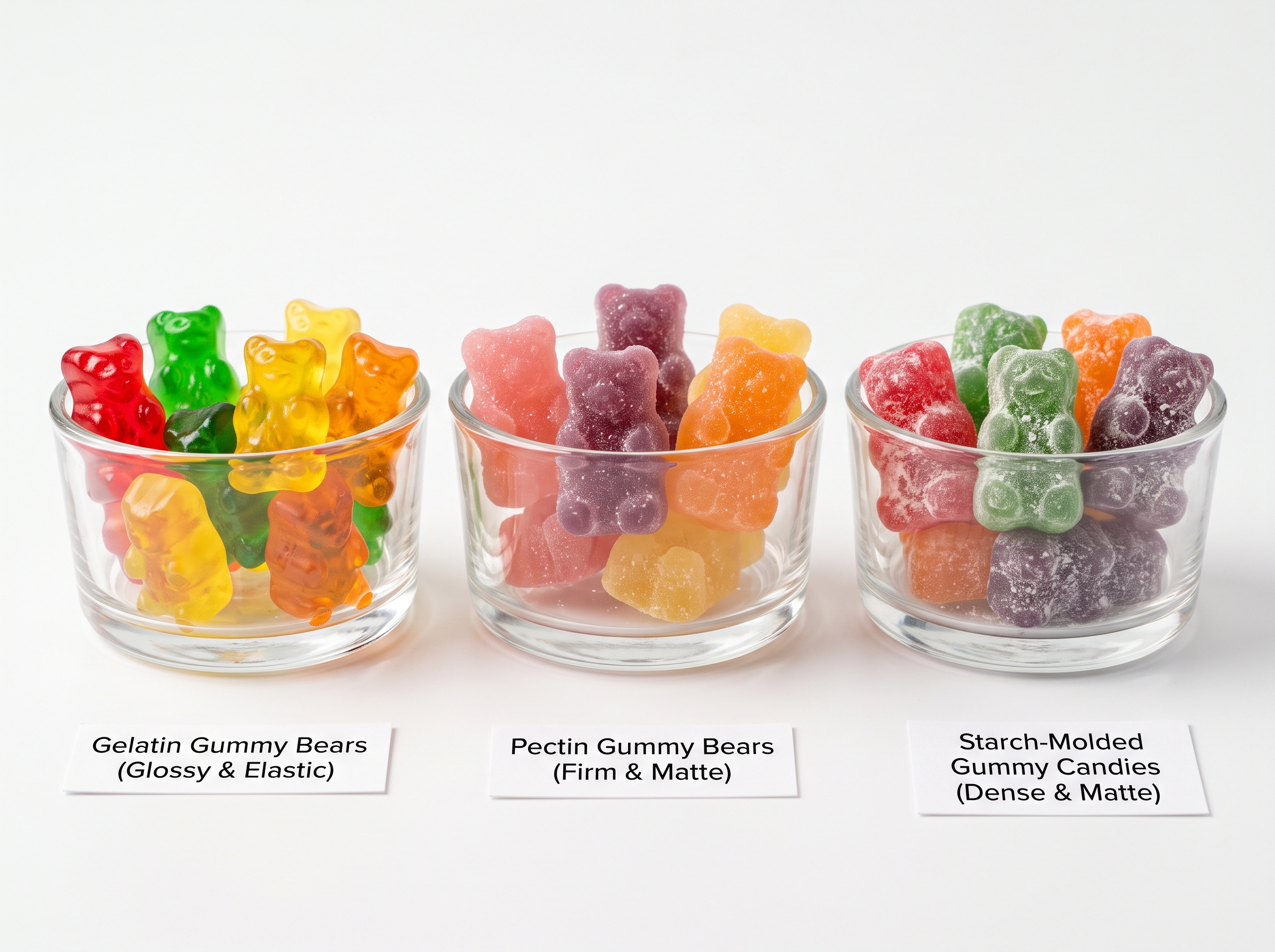
Three gelling systems dominate gummy bear ingredients today, and picking one changes the texture, shelf life, and manufacturing process, not just the “vegan or not” label on the front of the bag.
Animal Gelatin (Bovine, Porcine, Fish): Why It’s the Industry Default
Gelatin remains the default among gummy bear ingredients for one blunt reason: nothing else gives that specific melt-in-mouth snap at this price point. It’s derived from collagen, the connective tissue in animal skin, bones, and cartilage, through a hydrolysis process that breaks the collagen down into a water-soluble protein.
In practice we’ve found that bovine (cattle-derived) and porcine (pig-derived) gelatin behave almost identically in a gummy formulation, with porcine typically running slightly higher Bloom strength for the same cost. Fish gelatin sets at a lower temperature and has a shorter gel time, which makes it attractive for halal- and kosher-certified lines but trickier to run on standard depositing equipment calibrated for mammalian gelatin. In our experience, formulators switching between gelatin sources mid-production without re-testing Bloom strength are the single most common cause of a “this batch feels wrong” complaint reaching the QA desk.
Pectin-Based Vegan Gummies: What Changes in the Recipe
Pectin, extracted from citrus peel or apple pomace, is the most common substitute among gelatin-free gummy bear ingredients. Swapping it in isn’t a one-for-one substitution, though. Pectin needs a specific sugar-to-acid ratio to gel at all, and it sets faster and firmer than gelatin at the same concentration.
That’s the part most home recipes skip past. A pectin gummy needs its acid added at a precise moment in the cook: too early and it won’t gel properly, too late and you get a grainy, uneven set. Commercial pectin-gummy lines run tighter temperature and pH control loops than gelatin lines specifically because of this narrow window, and that tighter tolerance is exactly why pectin gummies cost more to manufacture even though the raw ingredient itself isn’t dramatically more expensive.
Starch-Molded Gummies: The Budget and Industrial Route
Modified corn starch, deposited into starch molds in the traditional “starch mogul” process, is the oldest industrial method for turning gummy bear ingredients into a finished shape, and it’s still the most cost-efficient at high volume. It produces a firmer, less elastic texture than gelatin, closer to jelly beans than Haribo bears, but the equipment and raw-material costs run meaningfully lower.
| Gelling system | Texture | Relative cost | Best production scale |
|---|---|---|---|
| Animal gelatin | Elastic, chewy, clean snap | Moderate | Small to large batch |
| Pectin (vegan) | Firm, slightly brittle set | Higher (pectin costs more per kg) | Small to mid batch, tighter process control |
| Starch (mogul process) | Dense, jelly-like | Lowest | High-volume industrial |
We’ve watched formulators default to gelatin simply because it’s forgiving. Among common gummy bear ingredients, it has the widest processing window and tolerates minor recipe drift without a full batch failure. Pectin and starch systems punish sloppy technique in ways gelatin doesn’t, which is worth knowing before you scale a kitchen recipe up to production volume.
Agar-Agar and Other Lesser-Known Gelling Options
Agar-agar, extracted from red algae, is the gelling agent that gets asked about far less than pectin but shows up in a surprising number of Asian-market gummy bear ingredients lists. It sets at room temperature, no refrigeration required, and produces a firmer, more brittle bite than either gelatin or pectin, closer to a firm jelly than a chewy candy.
That firmness is exactly why agar rarely appears in mainstream Western gummy bear ingredients: consumers expect a chew, and agar’s texture reads as “wrong” to a palate calibrated on Haribo. Where agar does work well is in halal- and kosher-certified production, since it carries none of the animal-sourcing questions that complicate gelatin certification, and it doesn’t require the tighter acid-timing discipline that pectin demands.
Are Gummy Bears Made From Pig Skin? Sourcing and Allergen Facts
Yes, some gummy bear gelatin is sourced from pig skin, but the label isn’t required to say so. Most gummy bear ingredients panels simply list “gelatin” without naming the animal source.
This is the single most-searched question tied to gummy bear ingredients, and most ingredient panels dodge it entirely. Under current U.S. labeling rules, “gelatin” can legally appear on a package without disclosing whether it’s bovine, porcine, or fish-derived. Manufacturers know the source; consumers usually have to ask, call, or check a brand’s allergen statement directly.
Where Gelatin Actually Comes From: Bovine vs. Porcine vs. Fish
- Bovine gelatin: extracted from cattle hides and bones; the most common source among gummy bear ingredients in North American and European production
- Porcine gelatin: extracted from pig skin; widely used, cost-competitive, and common in many international brands
- Fish gelatin: extracted from fish skin, primarily used for halal, kosher, or pescatarian-friendly formulations
According to USDA’s gelatin sourcing review, roughly 98% of bovine gelatin used in the U.S. market comes from domestically inspected plants, with strict BSE (mad cow disease) safeguards applied to imported material. That inspection chain is part of why gelatin, despite sounding unregulated as a category of gummy bear ingredients, is one of the more tightly monitored animal-derived food ingredients on the market. The sourcing paperwork behind a bag of gummy bears is considerably more rigorous than the short ingredient line on the wrapper suggests.
Gelatin itself isn’t an unregulated additive floating in a legal gray zone, either. It carries Generally Recognized as Safe (GRAS) status under 21 CFR 182.70, the FDA’s formal classification for food-grade gelatin, which is the regulatory basis manufacturers rely on before they can legally list it among a product’s gummy bear ingredients in the first place.
Common Allergens in Gummy Bears
Gelatin itself isn’t one of the FDA’s major recognized allergens, but gummy bear ingredients frequently carry allergen risk from other directions. The FDA’s food allergen guidance lists the major allergens that must be disclosed on U.S. packaging, and several intersect with typical gummy formulations.
- Gluten: rare in standard gummies, but cross-contamination happens on shared production lines, which is why gluten-free certified lines exist separately
- Artificial dyes: FD&C Red 40 and Yellow 5 are linked to sensitivity reactions in a subset of consumers, particularly children
- Corn derivatives: glucose syrup and citric acid are often corn-derived, which matters for corn-allergic consumers
- Tree nut or soy cross-contact: depends entirely on the specific factory’s shared-line practices
If you’re formulating for a specific dietary claim (vegan, halal, gluten-free, allergen-free), the gelling agent decision has to happen before anything else, because it constrains which sweeteners, colors, and even which factory line can touch the rest of the gummy bear ingredients in the batch.
From Kitchen Recipe to Factory Batch: How Ingredient Ratios Change at Scale
A gummy bear recipe that works in a saucepan does not survive a straight scale-up to industrial volume. The ratios between gummy bear ingredients, the cook temperatures, and the set times all shift once you’re running continuous batches instead of a single pot.
Home Recipe Ratios vs. Industrial Formulation
A typical home gummy bear recipe, the kind circulating on recipe videos, uses roughly 3 parts gelatin to 1 part water to 1 part flavored liquid, with sugar to taste. That works fine for twelve bears set in a silicone mold overnight, and it’s a reasonable way to learn how the core gummy bear ingredients behave before touching anything industrial.
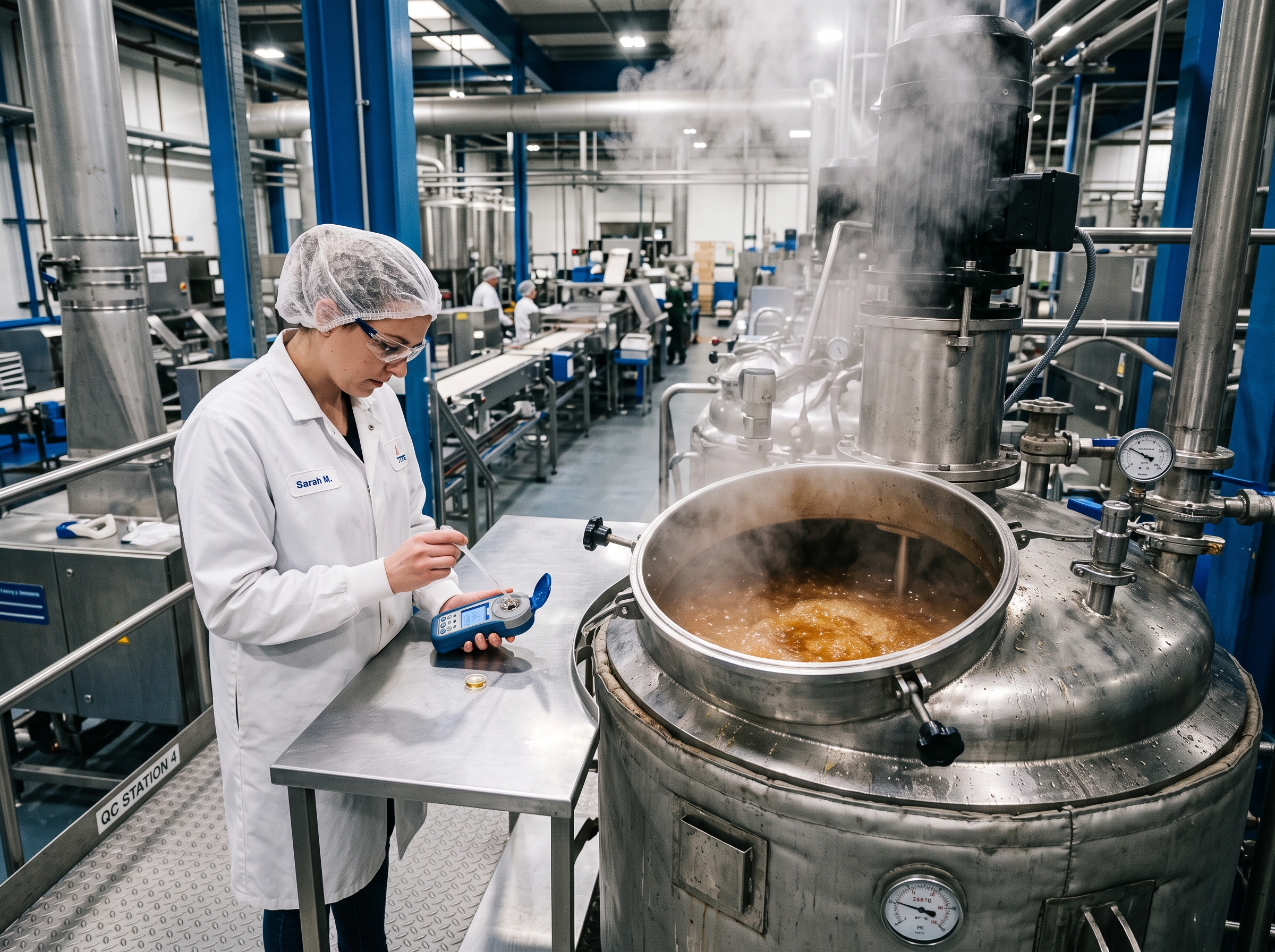
Industrial formulation looks nothing like that. Commercial batches are built around Brix (sugar concentration) and Bloom strength targets, not “parts.” A typical commercial gummy runs 75-78° Brix with gelatin at 180-220 Bloom, cooked to a precise end temperature (usually 118-122°C) and then flash-cooled before depositing. Get the Brix wrong by even a couple of points and the finished bears either sweat sugar on the shelf or turn rock-hard within weeks. The same underlying gummy bear ingredients, badly mismeasured, produce a completely different, and unsellable, product.
Common Mistakes When Scaling a Gummy Recipe
We’ve seen the same mistakes trip up nearly every team moving from small-batch to production volume.
- Adding acid too early: citric acid dropped into a still-hot gelatin mixture partially hydrolyzes the gelatin, weakening the final set; it needs to go in during the cooling/depositing stage, not the cook
- Ignoring Bloom strength consistency: swapping gelatin suppliers without re-testing Bloom strength is the number-one cause of “why did this batch turn out different” complaints
- Underestimating dry time: home recipes set in a fridge overnight; industrial lines need calibrated drying tunnels because ambient humidity swings wreck consistency at volume
Why Formula Choice Determines the Production Line You Need
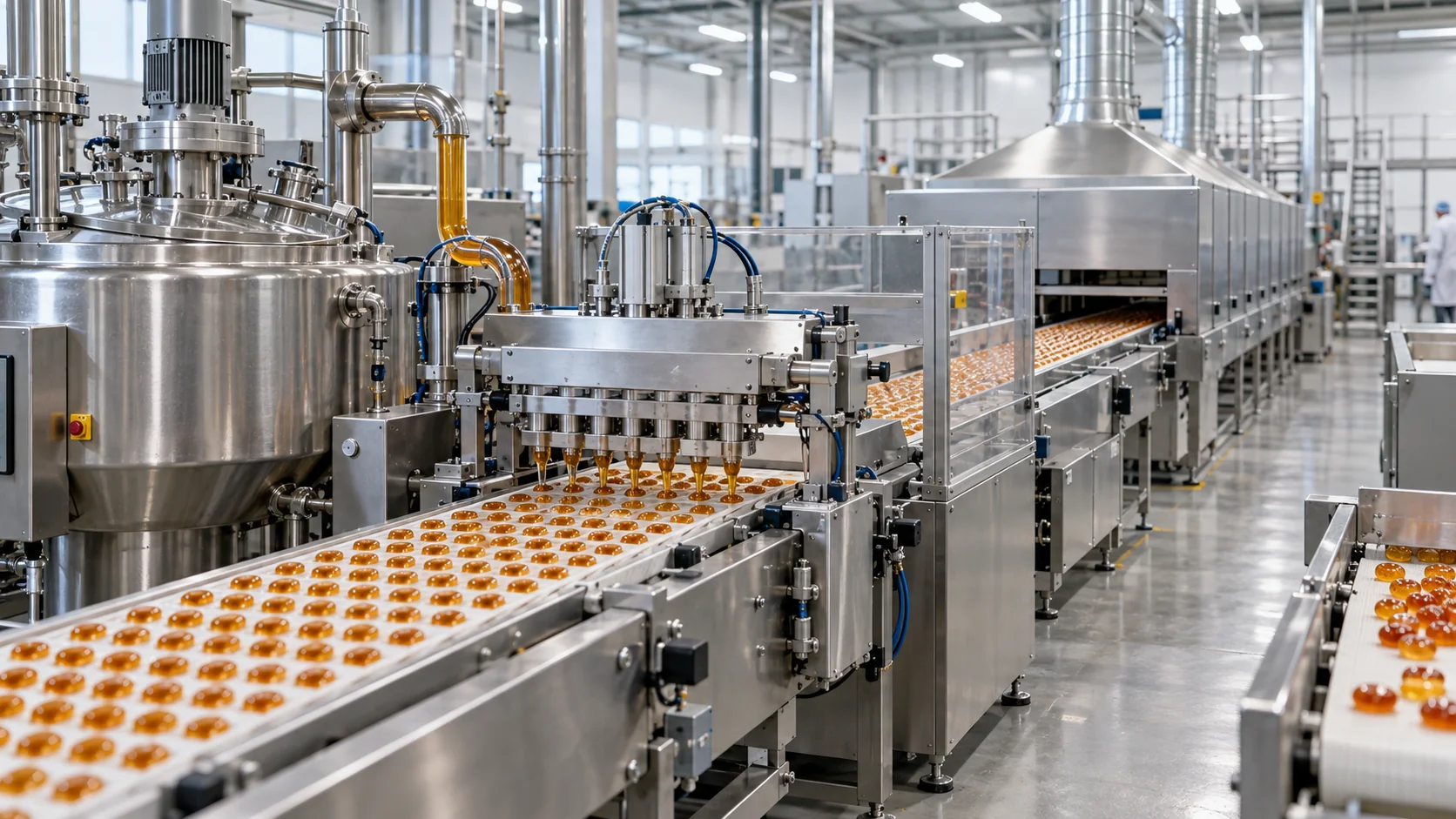
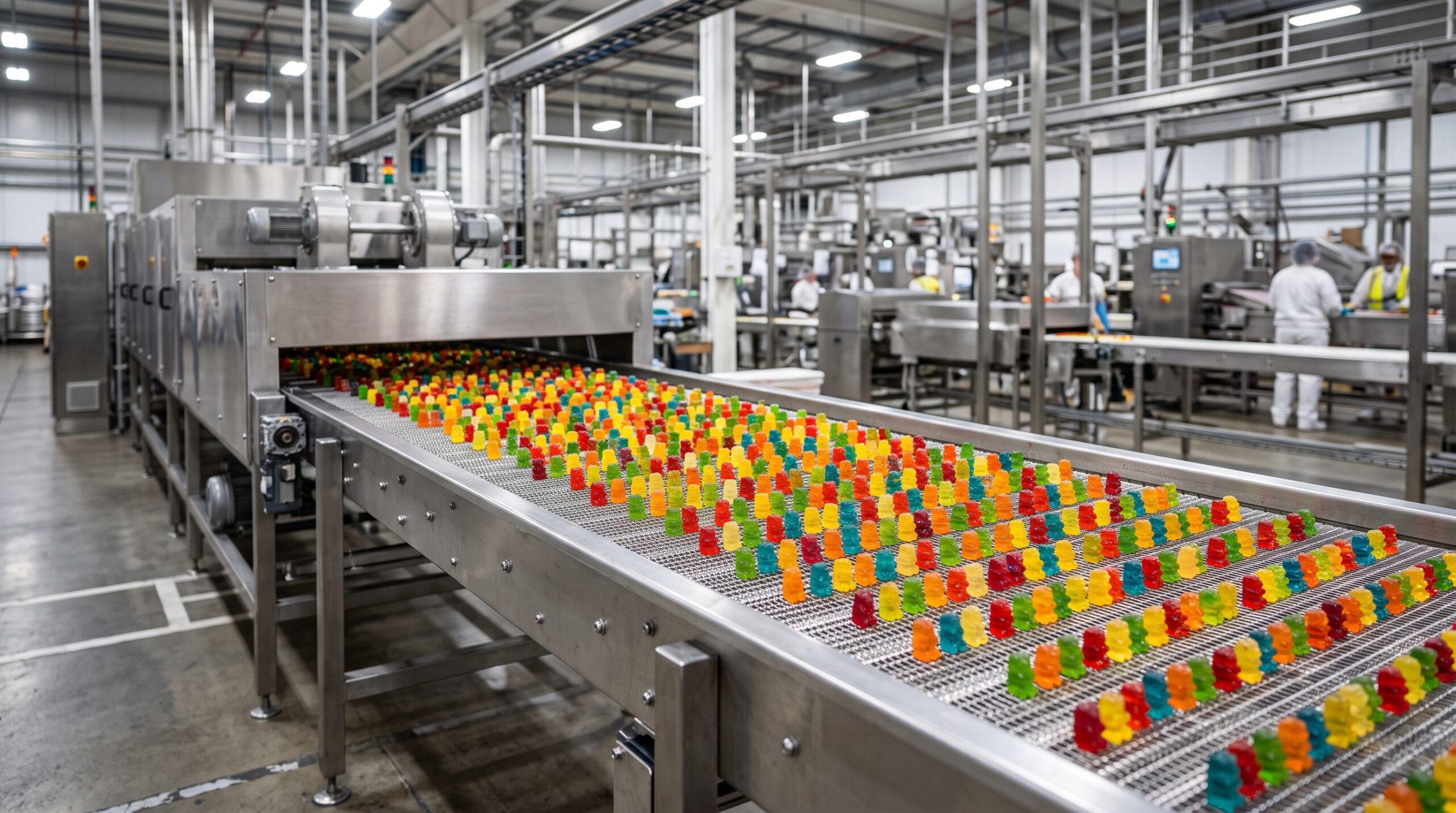
Here’s where the gummy bear ingredients conversation stops being theoretical for anyone actually manufacturing candy. A gelatin-based recipe, a pectin-based recipe, and a starch-mogul recipe each require meaningfully different equipment. Gelatin and pectin formulations typically run on flexible depositing lines, while starch-mogul production needs dedicated mogul systems with tray-handling and starch-recovery stages built in.
That’s not a small detail if you’re moving from R&D to a real production run. Teams that lock in their gelling-agent decision before sourcing a gummy production line avoid the expensive mistake of buying equipment calibrated for one gelling system and then discovering their chosen formula doesn’t actually run on it. The recipe isn’t just a recipe. It’s a spec sheet for the machine, and the two decisions really need to happen in the same conversation, not one after the other.
What a Professional Gummy Recipe Actually Documents
A professional recipe looks less like a list and more like a lab protocol. Where a home recipe says “add gelatin,” a production formulation sheet specifies exact percentages by weight, target Brix at three checkpoints in the cook, gelatin Bloom strength with an acceptable tolerance range, cook time at each temperature stage, and a depositing temperature window measured in single degrees.
That level of detail exists for one reason: repeatability. A home cook can eyeball a batch and adjust by feel. A factory running the same formula across multiple shifts, multiple operators, and different ambient humidity conditions needs the recipe to produce the same bear every single time, which is why professional documentation reads as almost absurdly precise to anyone used to a kitchen recipe card. Formulation drift that’s invisible in a single batch compounds into a real quality problem across a full production run.
The Future of Gummy Bear Ingredients (2026 and Beyond)
Clean-label gelling agents and functional add-ins are the two biggest shifts reshaping gummy bear ingredients heading into 2026.
Clean-Label and Plant-Based Gelling Agents Gaining Share
Consumer demand for recognizable ingredient names is pushing formulators away from generic “artificial flavor” and toward named fruit and vegetable extracts. Pectin and agar-based systems are seeing continued growth in the vegan and flexitarian segment among gummy bear ingredients, even though they still trail gelatin in total volume by a wide margin.
That growth is happening against a genuinely large backdrop. The confectionery market overview from Statista puts total global category revenue at roughly $648 billion in 2026, with a projected 5.63% annual growth rate through 2031. That’s a market large enough that even a niche vegan-gummy segment built on alternative gummy bear ingredients represents real commercial volume, not a fringe experiment.
Sugar-Reduction and Functional Add-Ins
The second trend is additive, not substitutive. Brands are layering vitamins, electrolytes, protein, and even cannabinoid compounds into the same base gummy bear ingredients, rather than replacing the core formula. Sugar-reduction is the harder problem: sugar in a gummy isn’t just sweetness, it’s structural, contributing to texture and shelf stability, so most “reduced sugar” gummies substitute with sugar alcohols or allulose rather than simply removing sugar outright.
| Trend | Driver | 2026 status |
|---|---|---|
| Plant-based gelling agents | Vegan/flexitarian demand | Growing share, still minority of volume |
| Functional add-ins (vitamins, protein) | Wellness-candy crossover | Fast-growing, especially in gummy vitamins |
| Sugar reduction | Health-conscious reformulation | Technically difficult, slower adoption |
| Allergen-free certified lines | Retailer/regulatory pressure | Expanding in mid-size manufacturers |
FAQ
Are gummy bears vegan?
Most are not. Standard gummy bear ingredients include animal-derived gelatin, so vegan versions specifically substitute pectin, agar, or starch as the gelling agent. Always check the label for “gelatin” versus “pectin.”
What’s the difference between Haribo and generic gummy bear ingredients?
The functional categories are the same, but Haribo uses higher Bloom-strength gelatin and a tighter sugar-to-syrup ratio, which is why the texture snaps rather than squishes. Generic brands often blend in more starch among their gummy bear ingredients to cut cost.
Do gummy bears contain gluten?
Standard gummy bear ingredients don’t include gluten-containing components, but cross-contamination on shared factory lines is common, so anyone with celiac disease should look for a certified gluten-free label rather than assuming.
Are gummy bears made from pig skin?
Some are. Porcine gelatin, sourced from pig skin, is one of three common gelatin types used among gummy bear ingredients, alongside bovine and fish. The exact source usually isn’t disclosed on standard packaging.
How much sugar is in a typical gummy bear?
Sugar and glucose syrup typically make up 60-70% of gummy bear ingredients by weight, which is why sugar reduction is structurally difficult. Sugar isn’t just flavor here, it’s part of the gel’s stability.
Can I make gummy bears without gelatin?
Yes. Pectin and agar-agar both work as gelatin-free gummy bear ingredients, though pectin needs a specific acid-to-sugar ratio to set properly and agar produces a firmer, less elastic texture.
What gives gummy bears their sour coating?
Sour gummies get their coating from a dry mix of citric or malic acid combined with fine sugar, dusted onto the gummy’s surface after it’s set and dried. The acid dissolves quickly on the tongue, which creates the sharp initial hit.
Why do some gummy bears melt faster than others?
Lower Bloom-strength gelatin and higher glucose-syrup ratios in the gummy bear ingredients both lower melting resistance, which is why bargain-brand gummies often turn sticky in warm weather faster than premium ones.
Choosing the Right Ingredients for Your Next Gummy Bear Batch
The honest answer to “what’s in a gummy bear” isn’t one ingredient list. It’s four functional roles, filled by different gummy bear ingredients depending on cost target, dietary claim, and texture goal. Gelatin remains the default for a reason, but pectin and starch systems are real alternatives with their own tradeoffs, not just substitutes for people avoiding animal products.
If you’re testing recipes at home, that’s the end of the story. If you’re moving toward production volume, the gummy bear ingredients decision is really the first equipment decision you’re making, whether you realize it or not. It’s worth locking down before you spec out a line, not after the first batch comes out of the mold looking wrong.
Related Articles
Gluten Free Gummy Bears: What’s Inside, Top Brands, and How They’re Made
Types of Candy & Confectionery Machines: The Complete Names List
Gummy Candy Production Line Equipment
Fruit Tea Boba: Flavors, Recipes, and Everything You Need to Know
Sugar Plum Candy: History, Recipe & How It’s Made Today
Can Candy Expire? The Real Shelf-Life Truth Behind Every Wrapper