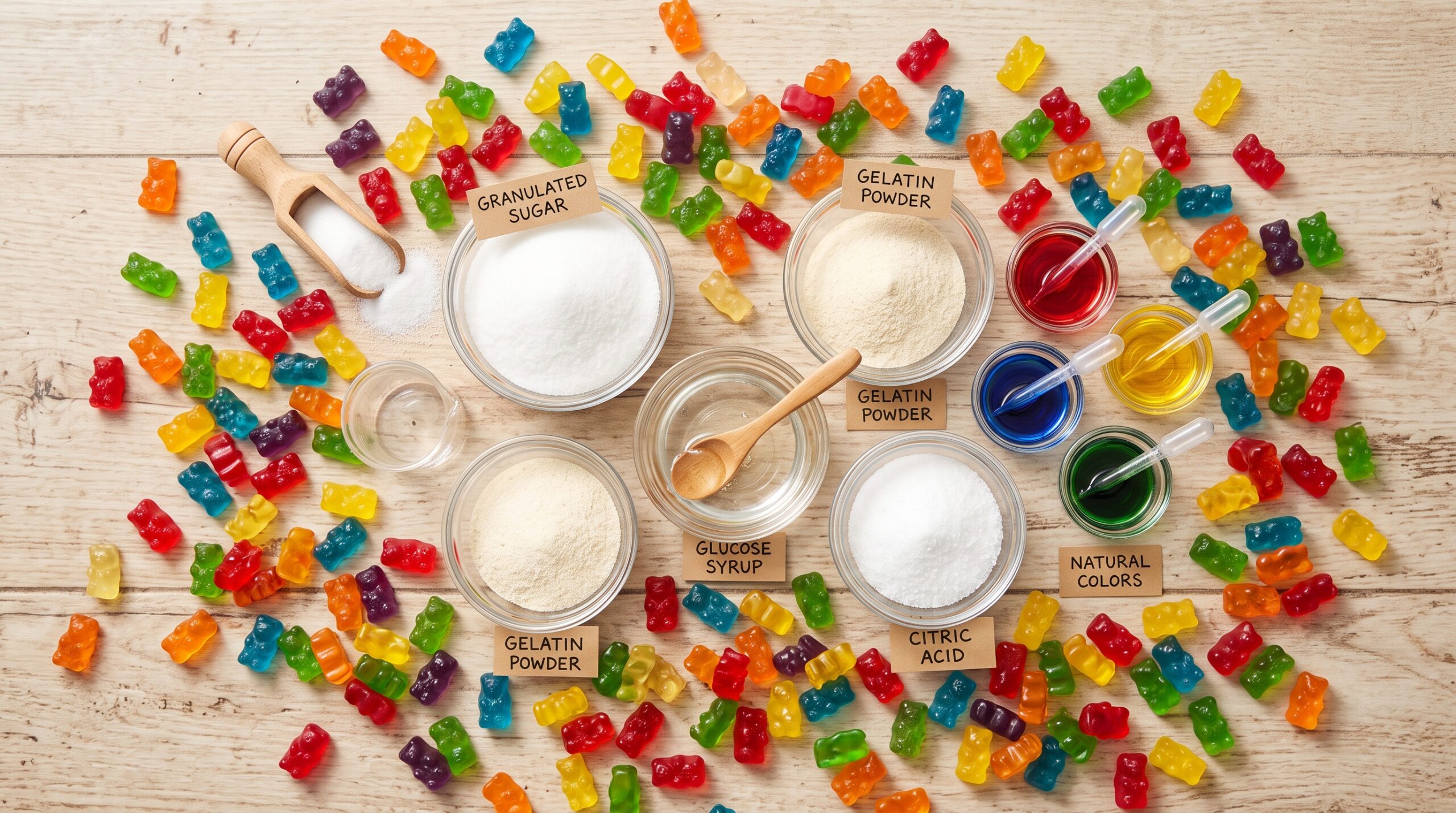
Green apple candy gets its tart bite from malic acid balanced against sugar, with apple-ester flavoring (not actual apple) carrying the aroma.
Pop a green apple Jolly Rancher or a sour apple gummy in your mouth and the first thing that hits is the sour punch, half a second before the sweetness even registers. That ordering isn’t an accident. It’s a formulation choice, and it’s the reason green apple candy tastes nothing like biting into a real Granny Smith, yet somehow reads as “more apple” than the red apple version sitting right next to it on the shelf.
We’ve spent years on the manufacturing side of confectionery — watching cookers, depositors, and coating drums turn raw syrup into the candy that ends up in checkout-aisle bins — and green apple is one of the trickiest flavors to get right at scale. Too much acid and the batch turns metallic. Too little and it tastes like sugar with green food coloring. This guide breaks down what’s actually in green apple candy, the different formats it comes in, how factories control the sour-to-sweet ratio, and where the category is headed in 2026.
Most of what’s written about green apple candy online is either a product listing page or a one-line trivia answer. Neither tells you why the flavor works the way it does, or why a factory running the same recipe twice can still end up with two noticeably different batches. That gap is exactly what this guide fills — the formulation logic, the production controls, and the failure modes that separate a clean sour-apple snap from a flat, gritty, or metallic-tasting batch.
What Is Green Apple Candy?
Green apple candy is a sour-leaning confection flavored with malic acid and synthetic or natural apple esters, colored green, and built on a sugar or gelatin base. It’s almost never made with real apple juice or puree — the flavor is a constructed approximation, not an extraction.
That distinction matters more than most shoppers realize. Real apples are mostly sugar, water, and a faint, perishable aroma that degrades the moment it’s exposed to heat — and candy cooking runs hot, often 145–160°C (293–320°F) for hard candy syrup. Actual apple flavor would cook off long before the syrup set. So manufacturers reverse-engineer the idea of apple instead: tart-forward, slightly synthetic-sweet, unmistakably green.
This is also why green apple candy reads as “more apple-like” to most tasters than red apple candy does, even though both are equally synthetic. Green apple varieties — Granny Smith being the reference point nearly every flavor house uses — are genuinely tarter than red dessert apples, so a sourer candy profile matches consumer expectation more closely. Red apple candy, by contrast, has to lean almost entirely on sweetness and a rounder, less acidic ester blend to read as “ripe” rather than “sour,” which is a harder flavor target to hit convincingly. That’s part of why red apple candy often gets criticized as tasting more like generic fruit punch than green apple candy does — the sourness is doing real perceptual work, not just adding bite.
Flavor Profile: Sour, Sweet, and “Green”
The defining trait of green apple candy is front-loaded sourness that fades into sweetness, unlike red apple candy’s smoother sweet-to-tart curve. Flavor chemists lean on malic acid, the same acid naturally found in apples, just isolated and concentrated, because it delivers a sharper, faster sour hit than citric acid, which is more common in citrus-flavored candy.
The “green” note itself usually comes from a blend of fruity esters. Hexyl acetate and ethyl 2-methylbutyrate are common building blocks in commercial green apple flavor compounds; they read as crisp and slightly grassy rather than ripe or syrupy, which is what separates “green apple” from a generic “apple” flavor on a shelf tag.
Natural vs Synthetic Apple Flavoring
Here’s where most product copy gets vague, so we’ll just lay out the actual difference:
| Attribute | Natural Apple Flavoring | Synthetic Apple Flavoring |
|---|---|---|
| Source | Distilled/extracted from apple or related fruit esters | Lab-synthesized ester blends (food-grade) |
| Cost per kg | 3–6x higher | Baseline |
| Flavor stability under heat | Degrades above ~120°C | Stable through hard-candy cooking temps |
| Batch-to-batch consistency | Varies with crop/harvest | Highly consistent |
| Typical use case | Premium gummies, “natural” label claims | Hard candy, mass-market gummies, sour belts |
In practice, the candy you’re most likely to grab from a gas-station shelf (Jolly Rancher–style hard candy, sour gummy worms, sanded apple rings) runs on the synthetic blend almost every time, simply because synthetic esters survive the cook. “Natural flavor” claims tend to show up on premium small-batch gummies that are deposited at lower temperatures, where the aroma compounds don’t break down.
There’s a middle tier worth knowing about, too: flavor houses sell what’s typically called a “WONF” blend — With Other Natural Flavors — where a natural apple extract base is fortified with a small percentage of synthetic esters to boost intensity and heat stability without losing the ability to label the product “natural flavor” under most regional food-labeling rules. It’s a compromise that’s become the default for mid-market green apple gummies that want a cleaner label without eating the full cost premium of an all-natural formulation.
Types of Green Apple Candy
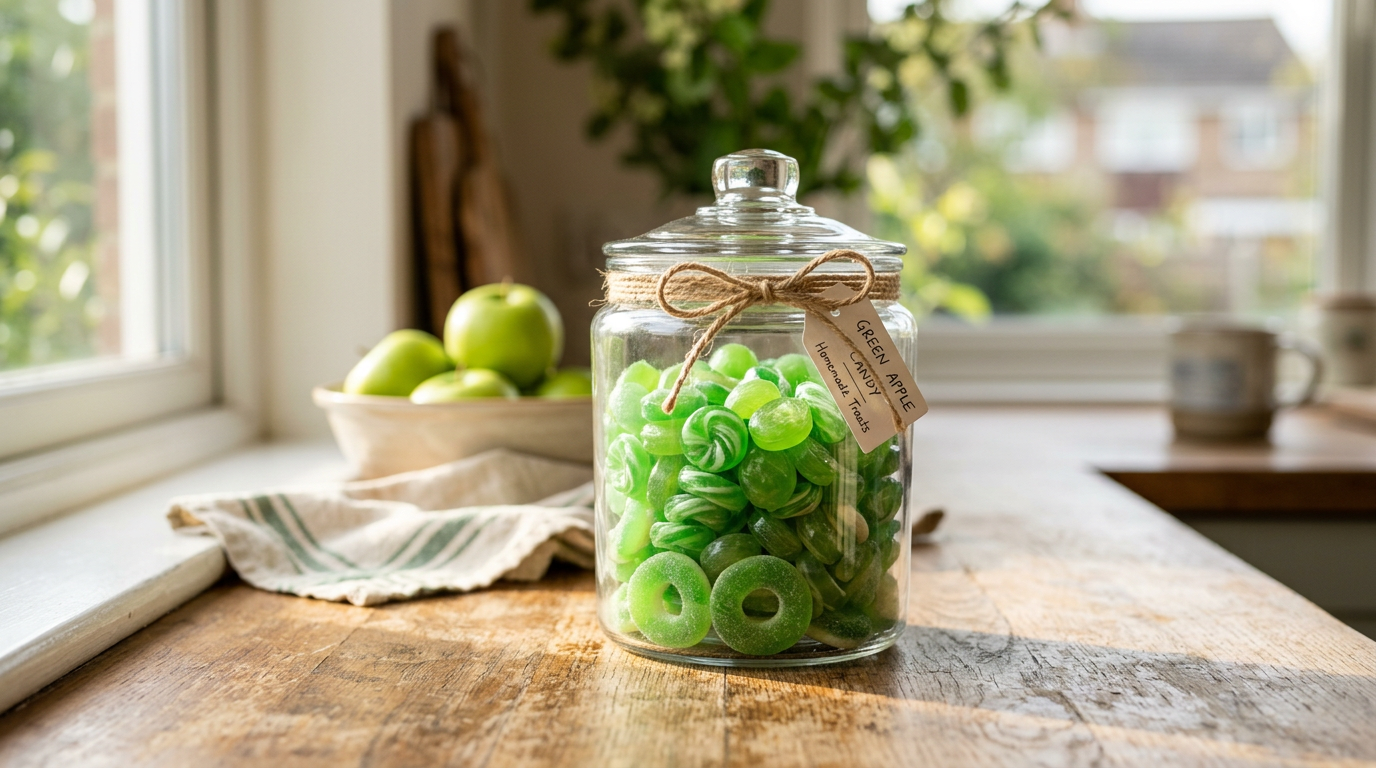
Green apple candy comes in three dominant formats (hard candy, chewy/gummy, and sour-sanded), and each demands a different production approach. The flavor stays roughly the same; what changes is the base, the cook temperature, and how the sourness gets delivered to your tongue.
Hard Candy & Drops
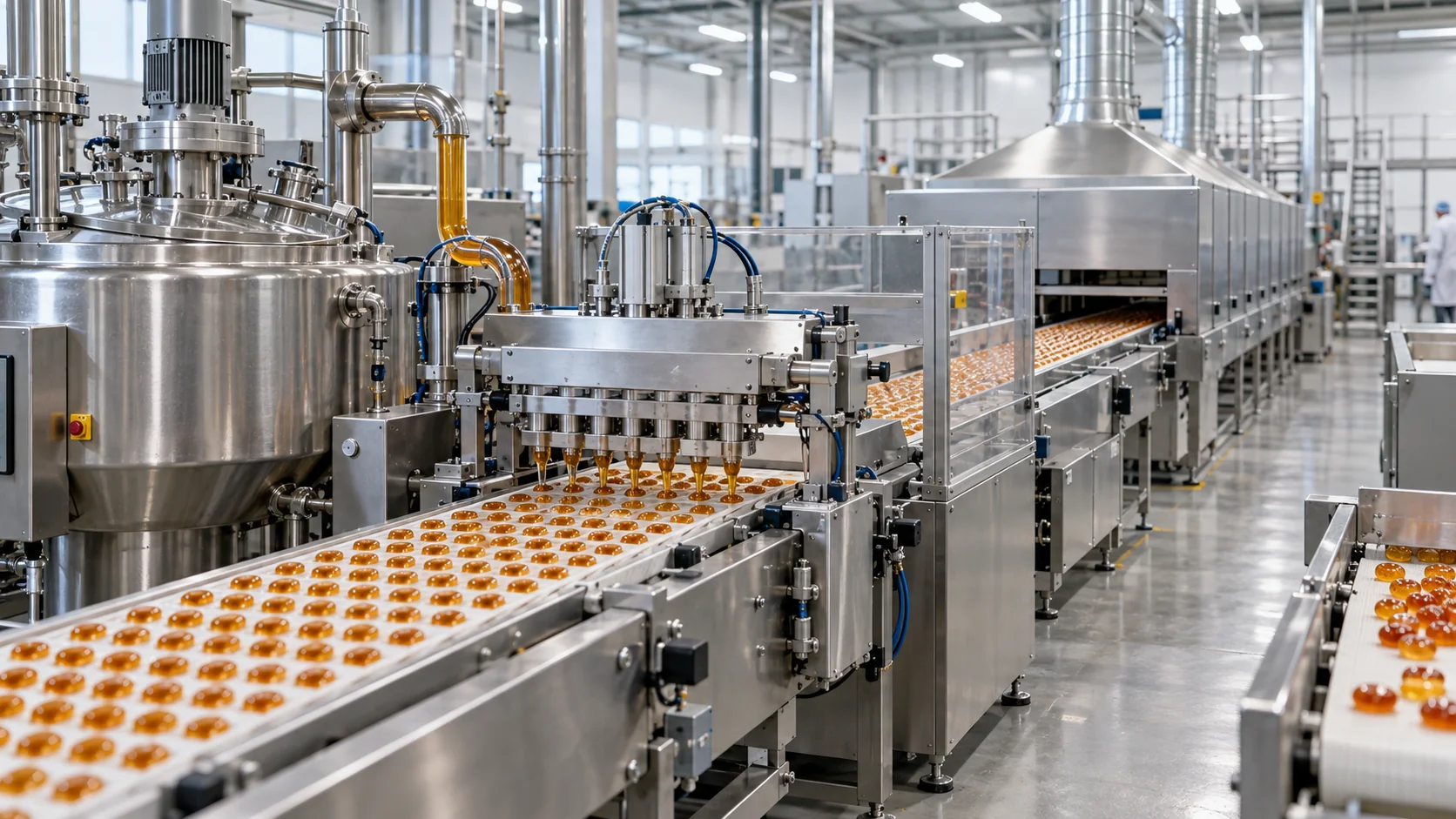
This is the oldest and still the most recognizable format — think Jolly Rancher green apple, or the classic boiled apple drop. Hard candy is cooked sugar syrup taken to the “hard crack” stage (around 150°C / 300°F), then flavored, colored, and deposited into molds or cut into pillow shapes before cooling.
Because the syrup hits high heat, flavor and acid have to go in at the very end of the cook, off the fire, to avoid scorching the malic acid (which can turn slightly bitter if overheated) and to keep the volatile ester flavor from flashing off. On a continuous line, this means the flavor/acid injection point sits right before the forming or depositing stage — never upstream in the main cooker — and the line speed has to be tuned so the syrup spends only seconds, not minutes, between dosing and cooling.
Texture is the other variable shoppers rarely think about. A well-cooked green apple drop should shatter cleanly with a “hard crack,” not bend or stick to a tooth. Get the moisture endpoint even slightly wrong and the candy either turns brittle and crumbly (overcooked, too little moisture) or soft and tacky (undercooked, too much residual moisture) — both of which a consumer will read as “stale” even on a fresh batch.
Gummies and Chewy Candy
Gummy green apple — bears, worms, rings — uses a gelatin or pectin base set at much lower temperatures than hard candy, typically 80–95°C during cooking and well under that during depositing. That lower heat window is exactly why gummies can sometimes carry natural flavoring without it cooking off, and it’s also why gummy textures are more forgiving for acid dosing; you can coat sour gummies in a dry acid-sugar blend after setting instead of cooking the acid into the gel itself.
Pectin-based gummies behave differently from gelatin-based ones here, which matters more than most recipe writeups let on. Pectin sets through a pH-dependent reaction, so adding acid too early in a pectin gummy batch can trigger premature gelling in the cooking pot rather than in the mold — a mistake that shows up as lumpy, uneven gummies rather than a clean, glossy batch. Gelatin gummies don’t have that pH sensitivity, which is part of why gelatin remains the default base for sour gummy lines even as pectin gains ground in vegan-labeled product runs.
Sour Coatings & Sanding Sugar
Sour sanding is the dry acid-and-sugar dusting applied to the outside of a candy after it’s formed, and it’s responsible for most of the “extra sour” green apple products on shelves. Per Wikipedia’s overview of sour sanding, the technique mixes citric or malic acid crystals with fine sugar and tumbles the finished candy through it, giving an intense initial sourness that the base candy itself doesn’t carry.
This is also the format most prone to going wrong in storage: sanding sugar is hygroscopic, meaning it pulls moisture out of the air, clumps, and can make a bag of sour green apple gummies turn into a sticky brick within weeks if the packaging seal is poor.
| Format | Cook temp | Acid delivery | Shelf stability | Typical product |
|---|---|---|---|---|
| Hard candy | ~150°C | Cooked into syrup | High (low moisture) | Jolly Rancher–style drops |
| Gummy/chewy | 80–95°C | Cooked in or post-coated | Moderate | Green apple gummy rings, worms |
| Sour-sanded | Varies by base | Dry-dusted after forming | Low–moderate (humidity-sensitive) | Sour apple belts, sour rings |
Packaging format tends to track with shelf stability more closely than most brands plan for upfront. Hard candy’s low moisture content lets it sit in a simple flow-wrap or bag for months without quality loss, which is why it’s the format most often sold loose by weight in bulk bins. Sour-sanded candy, by contrast, almost always needs a foil-lined or high-barrier bag — a standard poly bag lets in enough ambient humidity over a few weeks to visibly dull the sour-sanding effect, even before the candy itself looks affected.

How Manufacturers Actually Make Green Apple Candy
Industrial green apple candy production runs through four stages: syrup cooking, flavor/acid/color dosing, forming, and cooling or coating — each one a control point where the final taste can drift. This is the part most consumer-facing pages skip entirely, and it’s where the real differentiation between a good batch and a mediocre one happens.
Cooking and Crystallization Control
Sugar syrup destined for hard candy is cooked to a precise moisture endpoint — usually below 2% residual moisture for a proper hard-crack texture. Miss that endpoint and you get one of two failure modes: a grainy, crystallized candy (too much moisture pulled out, sugar re-crystallizes) or a sticky, hygroscopic candy that won’t hold its shape (not enough moisture removed). Continuous vacuum cookers have largely replaced open-pan batch cooking in mid-size and large factories specifically because they hold that moisture endpoint more consistently across a multi-hour production run.
A second control variable that rarely makes it into consumer-facing writeups is the sugar-to-glucose-syrup ratio in the base recipe, typically somewhere around 100 parts sucrose to 40–60 parts glucose syrup (corn syrup or its regional equivalent) for hard candy. Glucose syrup is what’s called a “doctoring agent” — it interferes with sucrose’s tendency to recrystallize during cooling, which is exactly the graininess problem mentioned above. Push the glucose ratio too high, though, and the finished candy turns soft and won’t hold a hard-crack snap; push it too low and you’re back to crystallization risk. Getting that ratio dialed in for a specific cooling environment — ambient humidity matters here — is usually a few production runs of trial and adjustment, not a single recipe card.
Acid and Flavor Dosing
Industry tip: Malic acid is added at the lowest practical temperature in the process — right before forming, not during the main cook — because prolonged heat exposure breaks down both the acid’s sharpness and the ester flavor compounds riding alongside it.
According to a peer-reviewed review of hard candy production parameters published via PMC/NCBI, moisture content, cooking temperature, and the timing of acid/flavor addition are among the most cited quality-control variables across commercial hard candy manufacturing — and dosing error at this stage is one of the leading causes of batch-to-batch flavor inconsistency. We’ve seen this firsthand on production floors: a flavor doser running even 5–8% off target acid concentration produces a green apple candy that tasters will describe as “flat” or “off,” even though nothing else in the recipe changed.
Coloring and Compliance
Green apple candy’s color comes from approved food-grade dyes — commonly a blend reading as green (often a yellow + blue combination rather than a single dye) — and every batch has to track against regional food additive regulations. Malic acid itself is a long-approved food acid; the USDA’s technical report on L-malic acid documents its petitioned use and safety classification in food processing, which is part of why it’s the default sour-candy acid worldwide rather than a niche choice.
Compliance gets more complicated for export-facing manufacturers, since approved color additive lists differ between major markets — a dye combination cleared for the US market isn’t automatically cleared for the EU or certain Asian markets, and vice versa. Factories running multi-region SKUs typically maintain separate color formulations per destination market rather than trying to find one blend that clears every regulatory list simultaneously, which adds a layer of batch-tracking complexity that’s easy to underestimate when scoping a new production line for export.

Common Mistakes in Green Apple Candy Production
The three most common failure points in green apple candy manufacturing are acid overdose, moisture mismanagement, and flavor-color mismatch — and all three are preventable with tighter dosing controls. If you’re sourcing or running production equipment for this category, these are the things to interrogate before they show up as customer complaints.
- Acid overdose (“metallic” or “chemical” aftertaste): Happens when malic acid concentration runs high relative to sugar solids — often from an uncalibrated doser rather than a recipe error. Fix: recalibrate dosing pumps on a fixed schedule, not just when output looks wrong.
- Moisture mismanagement (stickiness or premature crystallization): Cooking endpoint drifts with ambient humidity and steam-jacket wear. Fix: inline moisture/Brix sensors rather than relying solely on cook time as a proxy.
- Flavor-color mismatch (“smells like apple, looks wrong” or vice versa): Color batches sourced from a different supplier lot can shift hue enough that consumers perceive the flavor as off, even when the flavor dosing is correct — taste and color expectation are linked in how people perceive sourness.
- Inconsistent cooling rates on hard candy lines: Candy that cools too fast at the edges and too slowly at the center of a large-format drop can set with internal stress that causes it to crack or “sweat” in storage. This is a cooling-tunnel airflow problem more often than a recipe problem, and it’s easy to misdiagnose as a flavor or moisture issue when the real fix is rebalancing tunnel zones.
- Under-trained operators on manual dosing stations: Even a well-designed recipe fails if the person adding acid and flavor by hand doesn’t hit the timing window consistently shift to shift. This is the single most common root cause we’ve seen behind “the recipe is fine but the product tastes different depending on which shift made it.”
Equipment Selection for Small vs Large Batches
For smaller confectionery operations producing a few hundred kilograms a day, batch cookers with manual flavor injection are still workable, provided the operator is trained to add acid and flavor at the right cook-down point every time. Above roughly 500 kg/day, the labor-driven inconsistency in manual dosing starts costing more in rework than an automated continuous cooking and dosing line would cost to install — that’s usually the practical threshold at which it’s worth upgrading the line rather than adding another shift of manual labor.
The upgrade path most factories follow isn’t an all-or-nothing swap. A common middle step is keeping a batch cooker but adding an automated metering pump for acid and flavor dosing — a relatively low-cost retrofit that removes the single biggest source of operator-driven variance without the capital outlay of a full continuous line. Only once daily volume and SKU count both climb — running multiple flavors across multiple shifts — does the full continuous cooking, depositing, and cooling line typically pencil out, because that’s when changeover time and labor cost per kilogram start to outweigh the equipment’s higher upfront price.
Future Trends in Green Apple Candy (2026 and Beyond)
Clean-label sourcing, reduced-sugar reformulation, and functional add-ins are the three trends reshaping green apple candy through 2026. None of these are hype-cycle fads — they’re responses to retailer label-reading pressure and shifting snacking habits that have been building for several cycles now.
Clean-Label and Natural Acid Sourcing
More mid-tier brands are shifting toward “natural flavor” labeling even on hard candy formats, which pushes manufacturers toward heat-stable natural ester blends rather than fully synthetic ones — closing some of the cost gap noted earlier in this guide as natural-flavor suppliers scale up.
Functional and Reduced-Sugar Formats
Sugar-reduced and allulose- or stevia-blended green apple candies have moved from a niche health-food shelf into mainstream candy aisles. The texture challenge is real: sugar isn’t just sweetness, it’s also structure, and reformulating a hard candy recipe around a bulking sugar substitute changes how the syrup sets, which is why reduced-sugar hard candy still lags gummy formats in market share — gummies tolerate substitution better.
Allulose in particular has become the substitute of choice for hard candy reformulation over the past couple of cycles, mainly because it caramelizes and sets more like sucrose than older substitutes such as maltitol or erythritol did, which means less retooling of cook time and temperature. It isn’t a perfect swap — allulose hard candy tends to run slightly softer and less glassy than a full-sucrose batch at the same cook temperature, so some manufacturers nudge the cook a few degrees hotter to compensate. Sour-acid dosing also needs a small adjustment alongside a sugar-substitute swap, since perceived sourness shifts slightly when the background sweetness level changes — a recipe that tastes balanced with full sugar can taste sharper or flatter once the sugar is cut, even with the acid level unchanged.
| Trend | Driver | Production impact |
|---|---|---|
| Clean-label natural flavoring | Retailer/consumer label scrutiny | Requires heat-stable natural ester sourcing |
| Reduced-sugar reformulation | Health-conscious snacking shift | Changes syrup structure, favors gummy over hard candy |
| Functional add-ins (vitamin C, electrolytes) | Cross-over with sports/wellness snacking | Adds a second active-ingredient dosing step |
We’d put a finer point on it: the brands winning shelf space in this category right now aren’t the ones with the most “natural” claim — they’re the ones that solved the texture problem reduced sugar creates, because nobody re-buys a green apple gummy that turned out gritty.
FAQ
Is green apple candy made from real apples?
No. Green apple candy almost always uses synthetic or natural apple-ester flavor compounds plus malic acid for sourness — real apple juice doesn’t survive candy-cooking temperatures.
Why does green apple candy taste more sour than red apple candy?
Green apple formulations dose malic acid at a higher concentration to mimic the tartness of underripe or Granny Smith-style apples, while red apple candy is formulated sweeter to match riper apple varieties.
What gives green apple candy its color?
A food-grade green dye blend, typically combining approved yellow and blue colorants, applied during the flavor/color dosing stage of production — not derived from the apple flavor compound itself.
Is malic acid in candy safe to eat?
Yes. Malic acid is a long-approved food acid used widely across sour candy, and regulatory bodies including the USDA have documented its safety classification for food processing use.
Why do some green apple candies taste “metallic”?
That’s almost always an acid-dosing issue — malic acid added in excess relative to sugar solids, or added at too high a cooking temperature, can read as metallic or chemical rather than cleanly sour.
What’s the difference between green apple and sour apple candy?
“Sour apple” usually signals an added dry acid-sugar sanding coat on top of a green-apple-flavored base, delivering a sharper initial sourness than a standard green apple candy without that coating.
Can green apple candy be made with natural flavoring?
Yes, but it’s more common in gummy and chewy formats cooked at lower temperatures, since natural ester flavors degrade faster than synthetic ones under hard-candy cooking heat.
Why does green apple candy sometimes turn sticky in the bag?
That’s almost always a moisture problem — either an undercooked syrup batch that never hit the proper hard-crack moisture endpoint, or sour-sanding sugar absorbing ambient humidity through a weak packaging seal.

Conclusion
Green apple candy works because it commits to an idea rather than an imitation — sharp malic-acid sourness, a constructed green-apple aroma, and a color cue that tells your brain “apple” before your tongue has even confirmed it. None of that happens by accident on a production line; it’s the result of dosing the right acid at the right cook temperature, choosing a base format that matches the flavor delivery method you want, and catching the moisture and color drift that turns a good batch into a customer complaint.
None of this is exotic chemistry — every variable described in this guide (acid timing, glucose ratio, moisture endpoint, cooling airflow) is controllable with the right equipment and a consistent process. What separates a candy brand that gets repeat customers from one that doesn’t usually comes down to whether those controls are designed into the line from day one, or bolted on after the complaints start arriving. The recipe rarely changes between a good batch and a bad one; the process discipline around it does.
If you’re evaluating equipment for hard candy, gummy, or sour-sanded production, the acid-and-flavor dosing stage covered above is the highest-leverage place to get right — it’s cheaper to spec a continuous cooker with accurate inline dosing now than to rework a year of inconsistent batches later. Our team works with confectionery manufacturers on exactly this kind of candy production line setup, from cooker selection through forming and coating, if you’re scoping a new or upgraded line.
Related Articles
- How Are Skittles Made? The Full Factory Process Explained (2026)
- Does Sour Patch Have Gelatin? The Complete Ingredient Breakdown
- Tropical Skittles Gluten Free: Ingredients, Safety & Complete Guide 2026
- White Gummy Candy: What It Is, How It’s Made, and Why It Sells
- Can Candy Expire? The Real Shelf-Life Truth Behind Every Wrapper
- Candy Production Line Services