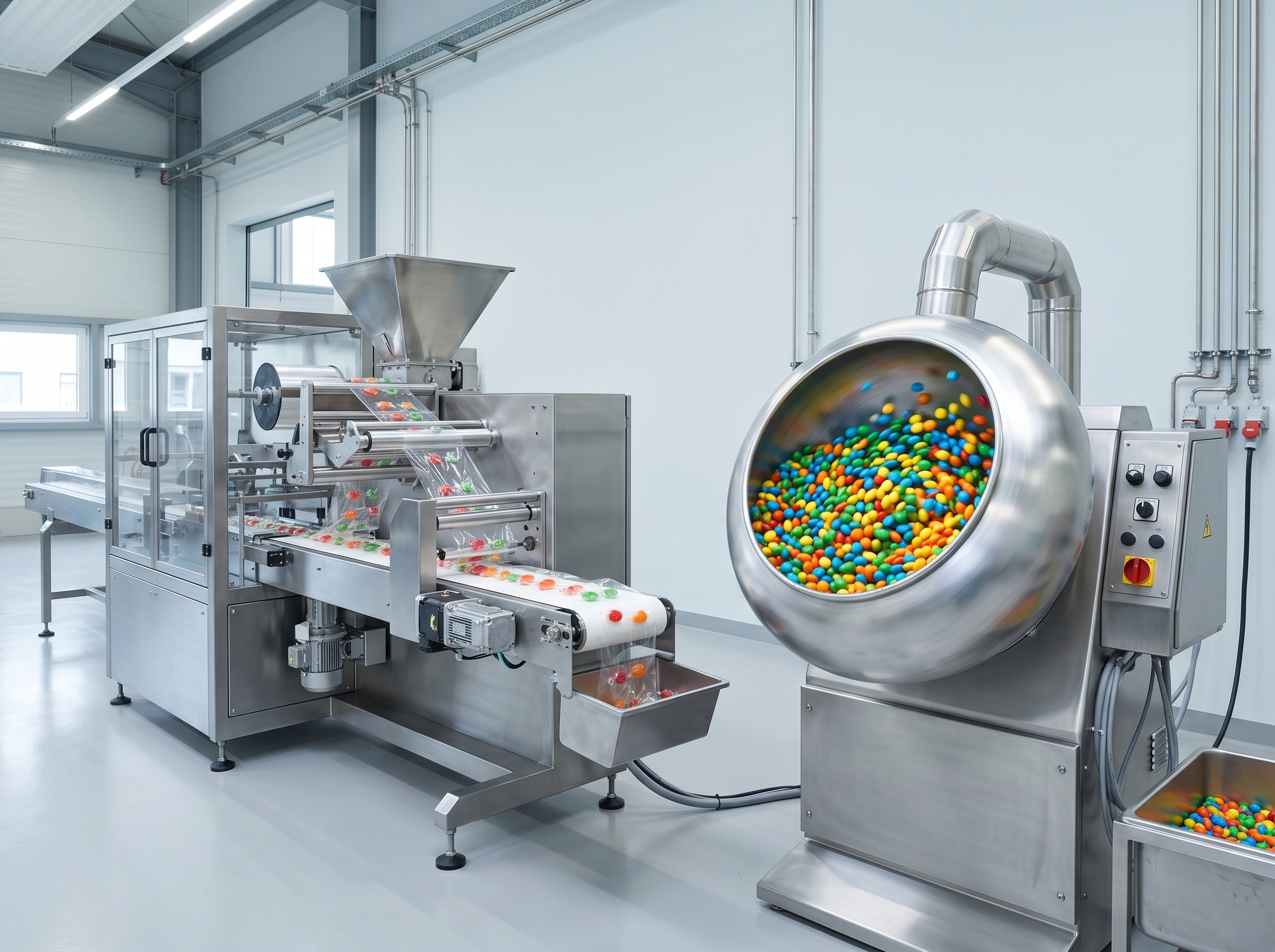
Types of Candy & Confectionery Machines: The Complete Names List (100+ Machines with Pictures)
By the JY Machine (Junyu) engineering team — confectionery & bakery equipment manufacturer since 1993 · Last updated June 2026 · 9-minute read
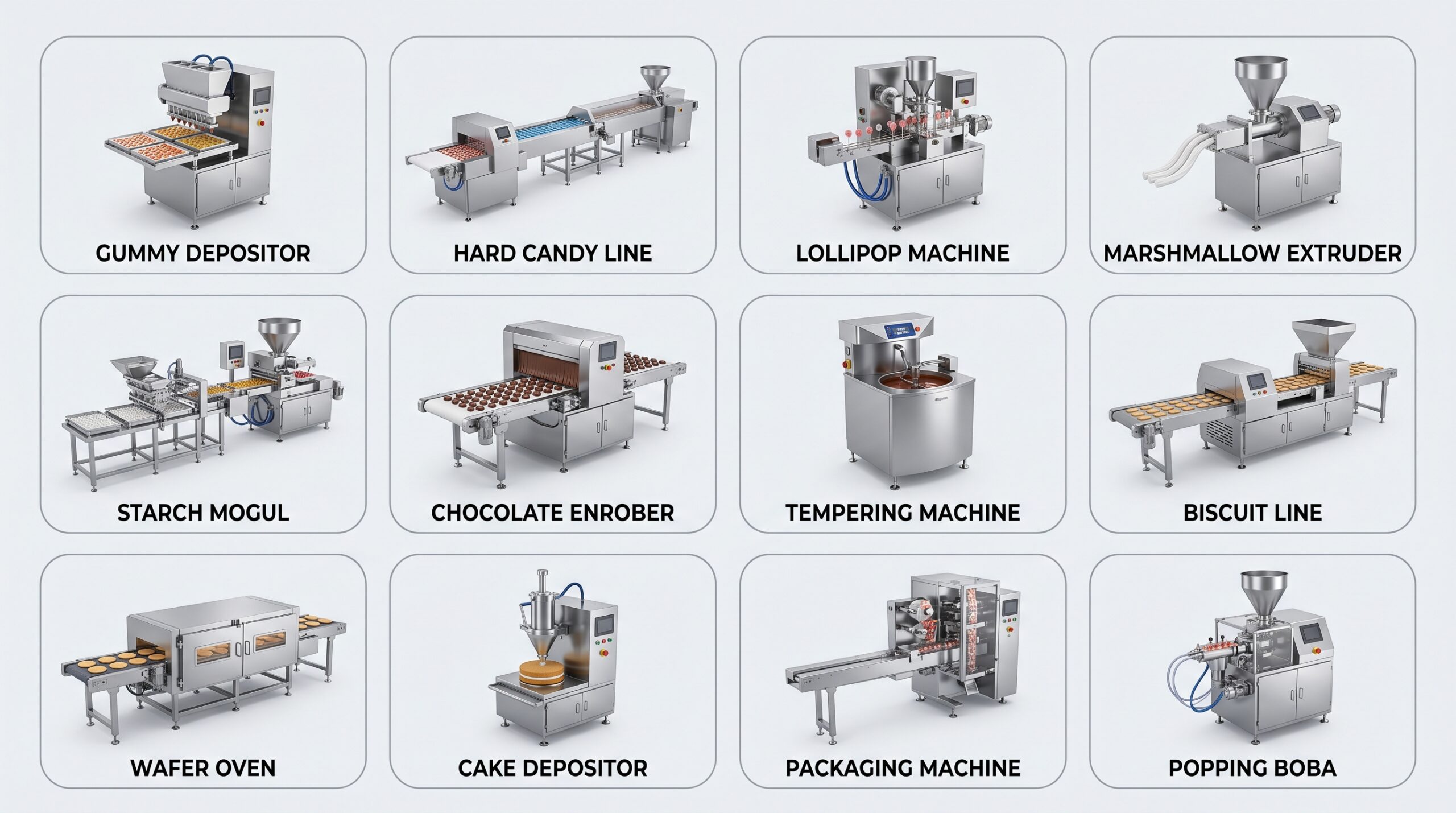
A complete, categorised list of more than 100 types of candy, chocolate and bakery machines — organised by confectionery line and by production stage, each named, pictured and briefly explained. Use it as a sourcing reference whether you are planning a new factory, expanding a line, or learning the equipment names.
Quick answer: Confectionery machines are grouped by the product they make — hard candy, gummy and jelly, toffee and caramel, chocolate, and bakery (biscuit, wafer, cake) — and by the stage they perform: cooking, mixing, depositing, cooling, demoulding, coating and packaging. The list below names 100+ of them.
Key takeaways- Confectionery equipment is named two ways: by product line (candy, gummy, chocolate, bakery) and by production stage (cooking → packaging).
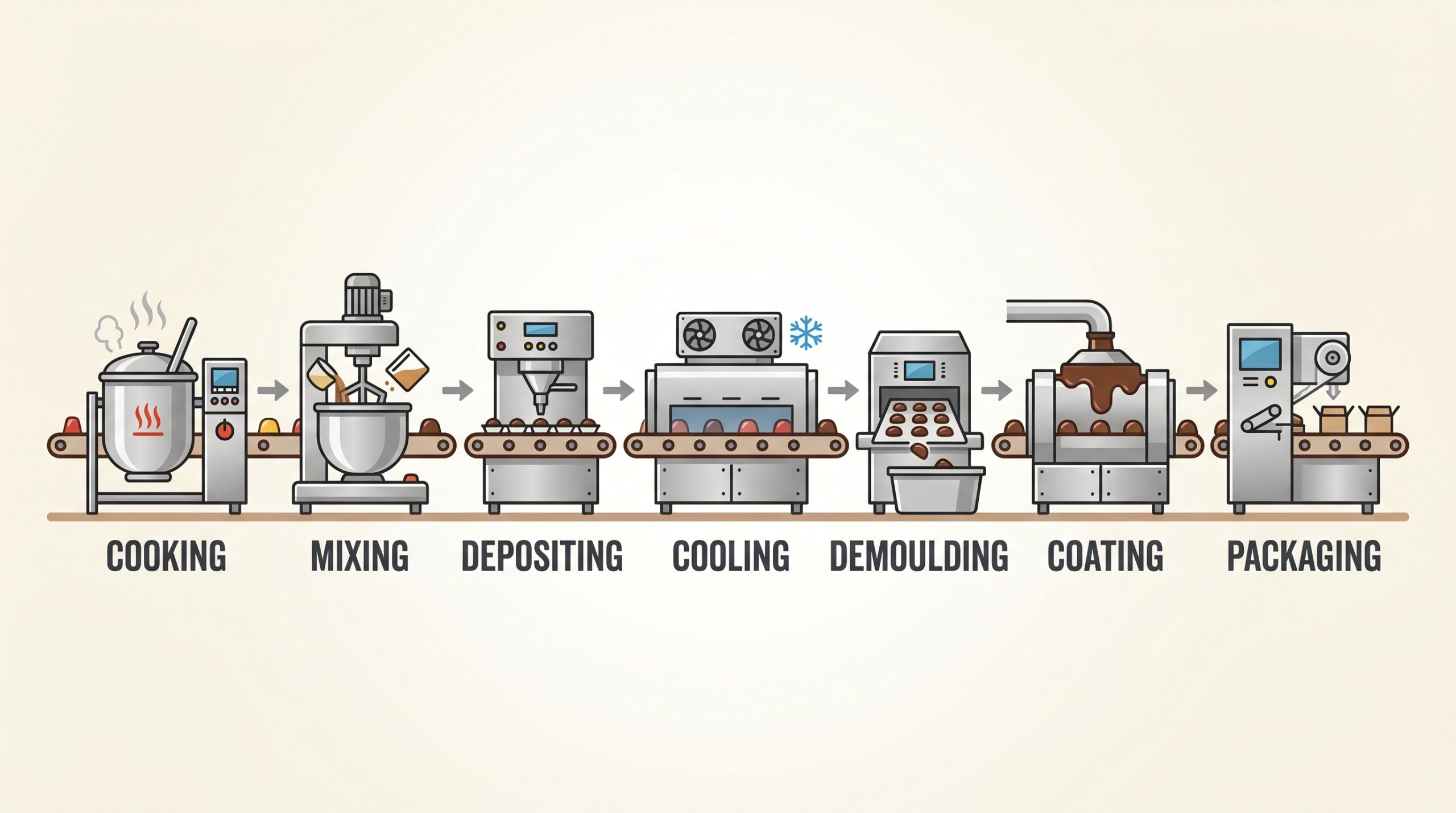
- Every sugar-confectionery line shares the same seven stages: cooking, mixing, depositing, cooling, demoulding, coating and packaging.
- A modern gummy depositing line can run starch-free in silicone moulds at 80–300 kg/h; a biscuit line reaches 500+ kg/h.
- The four most-specified machines are the depositor, the cooking system, the cooling tunnel and the packaging machine.
- When sourcing, match the machine to your product, capacity (kg/h), automation level and after-sales support — not price alone.
Hard candy & lollipop machines
The hard candy line turns boiled sugar syrup into clear or filled candies and lollipops.

- Sugar dissolving tank — melts sugar and glucose into a uniform syrup.
- Batch cooker — boils syrup to temperature in batches.
- Continuous vacuum cooker — cooks syrup continuously under vacuum for clear hard candy.
- Micro-film cooker — a thin-film cooker for fast, precise high-boil candy.
- Sugar mass mixer — blends colour, flavour and acid into the cooked mass.
- Batch roller — forms the candy mass into a tapered cone for sizing.
- Rope sizer / batch former — draws the cone into an even rope.
- Die forming machine — stamps the rope into shaped hard candies.
- Hard candy depositor — deposits syrup into moulds for clear, glossy candies.
- Ball candy machine — forms round drops and balls.
- Pillow candy machine — forms pillow-shaped sweets.
- Cut-and-wrap machine — cuts and twist-wraps individual candies in one pass.
- Lollipop depositing line — deposits hard candy into lollipop moulds with sticks.
- Flat lollipop former — forms flat, disc-shaped lollipops.
- Ball lollipop former — forms round ball lollipops.
- Stick inserter — inserts sticks automatically into each lollipop.
- Lollipop wrapping machine — wraps finished lollipops.
- Candy cooling tunnel — cools formed candies on a conveyor before packing.
Gummy, jelly & marshmallow machines
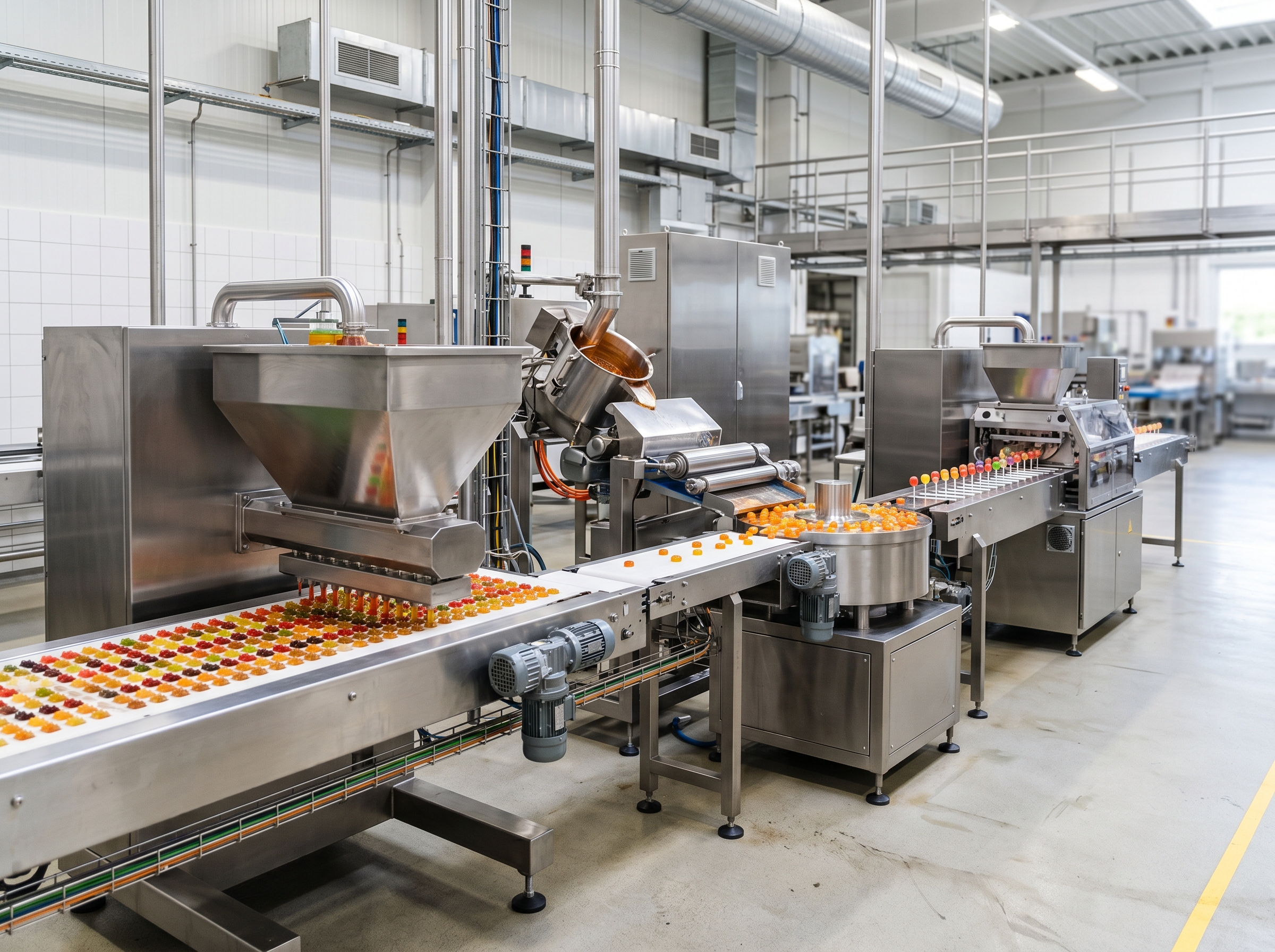
The gummy production line makes gelatin, pectin and agar jellies, including vitamin and functional gummies.
- Gelatin melting tank — dissolves gelatin or pectin into the base.
- Gummy cooking machine — cooks the slurry to the right solids content.
- Blending / mixing tank — homogenises the gummy syrup.
- Colour & flavour dosing system — meters colour, flavour and acid inline.
- Gummy depositing machine — deposits the syrup into moulds; the heart of the line.
- Starch mogul line — deposits into starch-filled trays, the traditional method.
- Starch buck / tray — holds the moulding starch for the mogul.
- Starch-free silicone mould depositor — deposits into reusable silicone moulds.
- Gummy demoulding machine — releases set gummies from the moulds.
- Conditioning / drying room — cures gummies to the target texture.
- Oiling drum — applies a thin oil/wax shine to finished gummies.
- Sanding / sugar-coating drum — coats sour or sugar gummies.
- Center-filled gummy depositor — deposits a liquid centre inside the gummy.
- Two-colour / 3D gummy depositor — deposits multi-colour and 3D shapes.
- Jelly candy machine — produces soft jelly cups and shapes.
- Marshmallow extruder — aerates and extrudes marshmallow rope.
- Marshmallow depositor — deposits shaped marshmallows.
- Marshmallow cutting machine — cuts extruded marshmallow to length.
Toffee, caramel, liquorice & specialty candy machines
- Toffee cooking machine — cooks milk, sugar and fat into toffee.
- Toffee / caramel depositor — deposits soft toffee and caramel.
- Caramel cutting machine — cuts and wraps chewy caramels.
- Fudge machine — cooks and forms fudge slabs.
- Nougat line — aerates and forms nougat with nuts.
- Liquorice extruder — extrudes liquorice ropes and shapes.
- Liquorice cutting machine — cuts extruded liquorice to length.
- Jelly bean machine — builds layered jelly beans by panning.
- Chewing gum line — mixes, rolls and scores gum.
- Fondant machine — produces fondant centres and creams.
- Aerated candy machine — whips candy for light, aerated textures.
- Cotton candy machine — spins sugar into floss.
Chocolate machines
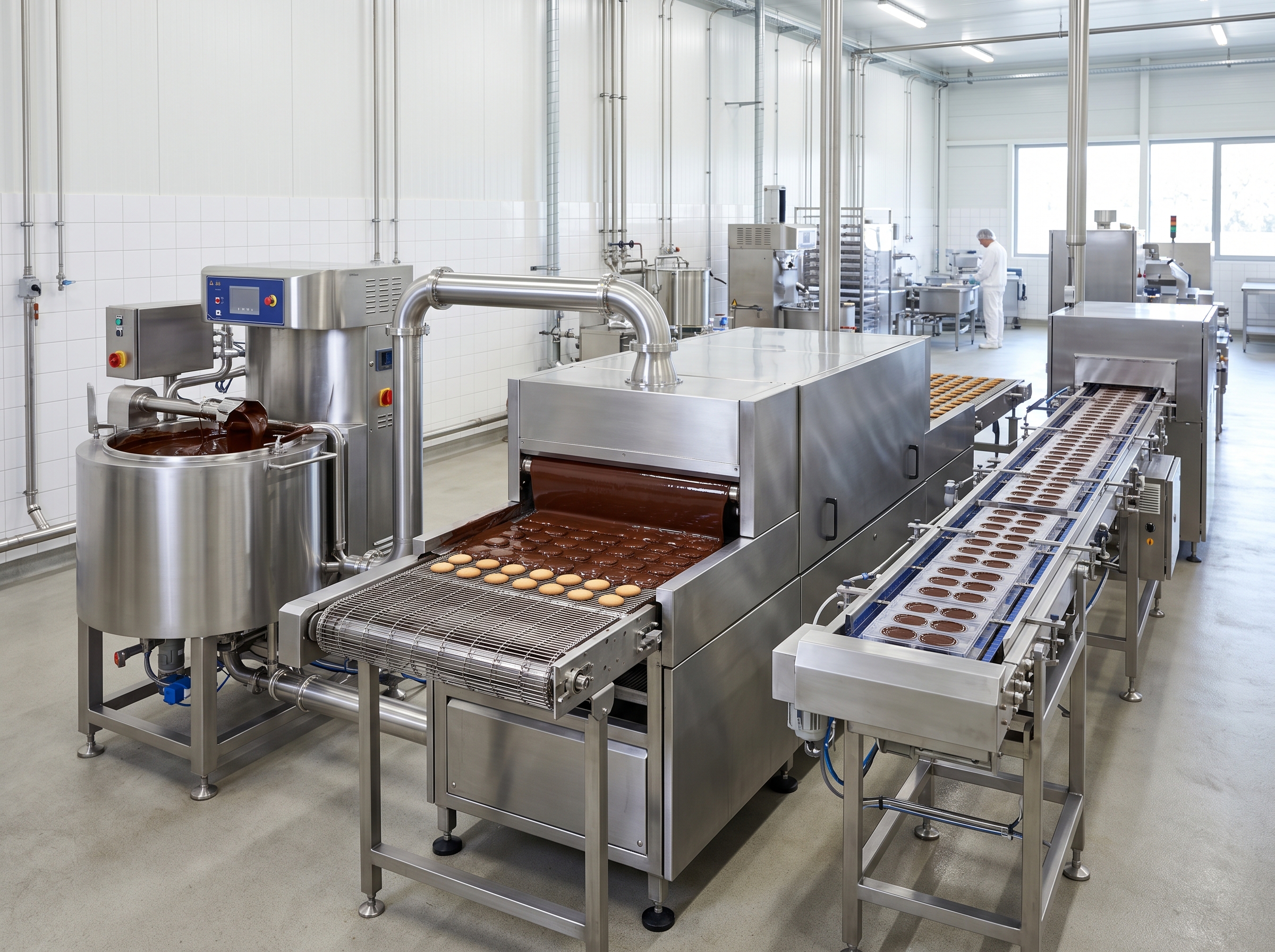
The chocolate line refines, tempers and moulds or enrobes chocolate.
- Chocolate melting tank — melts and holds couverture at working temperature.
- Chocolate refiner (ball mill) — grinds the mass to a fine particle size.
- Roll refiner — a five-roll refiner for fine chocolate.
- Conche machine — develops flavour and smoothness over hours of mixing.
- Chocolate tempering machine — controls crystallisation for snap and shine.
- Holding / storage tank — keeps tempered chocolate ready to use.
- One-shot depositor — deposits shell and filling in a single shot.
- Chocolate moulding line — fills, vibrates and cools chocolate moulds.
- Vibrating table — removes air bubbles from filled moulds.
- Chocolate enrobing machine — coats centres under a chocolate curtain.
- Cooling tunnel — sets enrobed and moulded chocolate.
- Chocolate bar line — produces solid and filled bars.
- Hollow chocolate machine — spins moulds for hollow figures.
- Chocolate chip depositor — deposits drops and chips.
- Chocolate coating pan — panel-coats nuts, raisins and centres.
- Dragee / panning machine — builds layered dragees.
- Chocolate ball machine — forms and coats chocolate balls.
- Chocolate packaging machine — wraps bars and pralines.
Bakery & biscuit machines
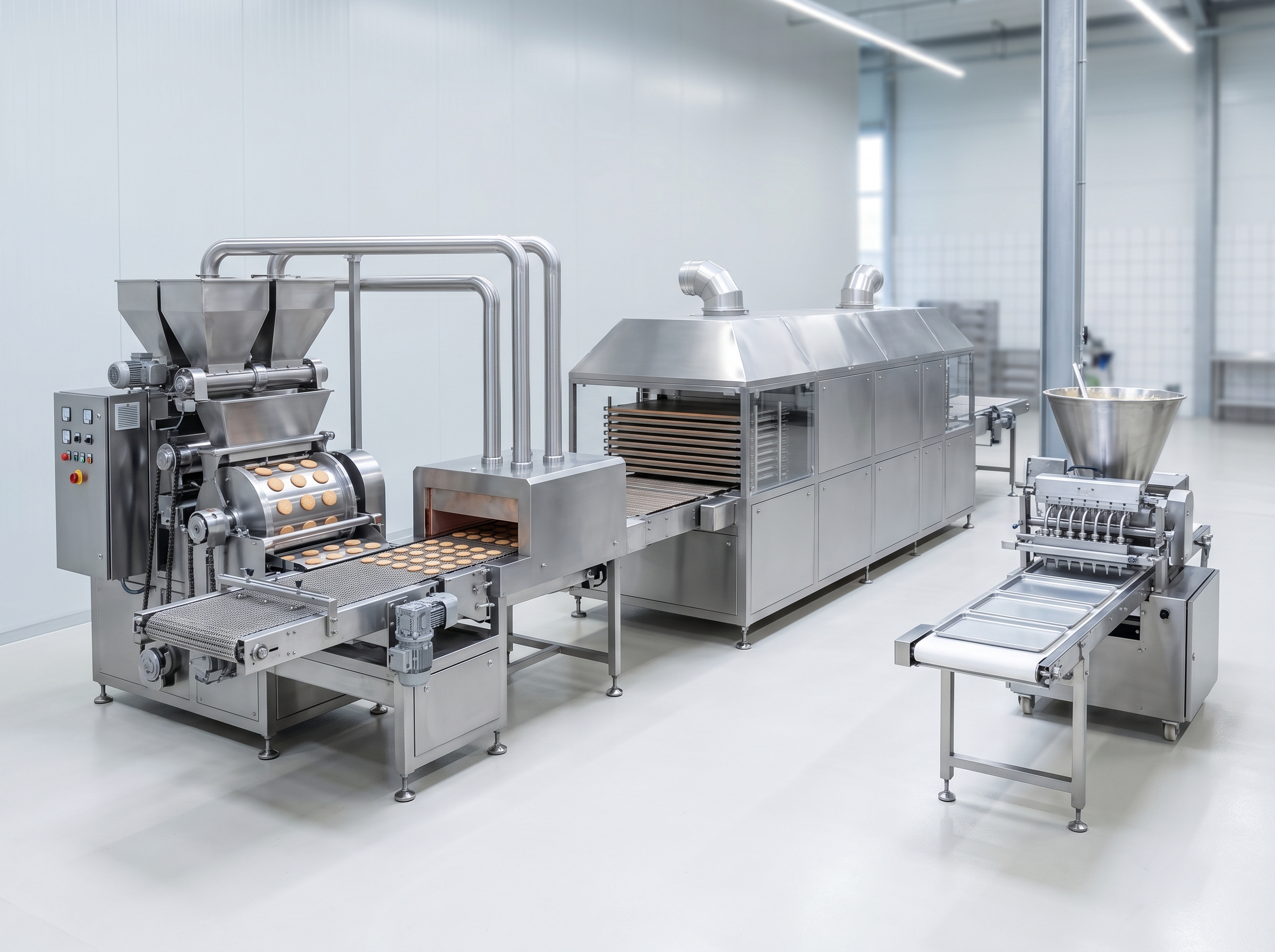
The bakery line covers biscuits, wafers and cakes.
- Dough mixer — mixes biscuit and bread dough.
- Flour sifter — sifts and aerates flour before mixing.
- Rotary moulder — moulds hard, short-dough biscuits.
- Rotary cutter — cuts soft-dough biscuits and crackers.
- Wire-cut machine — deposits and cuts cookies and drop biscuits.
- Dough laminator — layers dough for crackers and puff biscuits.
- Biscuit tunnel oven — bakes biscuits continuously.
- Biscuit sandwiching machine — fills and sandwiches cream biscuits.
- Wafer batter mixer — mixes thin wafer batter.
- Wafer baking oven — bakes wafer sheets between plates.
- Wafer cream spreader — spreads cream between wafer sheets.
- Wafer cooling tower — cools filled wafer books.
- Wafer cutting machine — cuts wafer blocks into bars and fingers.
- Cake depositor — deposits cake batter into trays or cups.
- Cake baking oven — bakes sponge and layer cakes.
- Cake cream filling machine — injects and fills cream centres.
- Swiss roll line — bakes, creams and rolls Swiss rolls.
- Cake enrobing machine — coats cakes in chocolate or glaze.
- Bread production line — mixes, proofs and bakes bread.
- Proofer — controls humidity and temperature for dough rising.
Coating, packing & auxiliary machines
Finishing and packaging machines coat, wrap and protect the product.
- Sugar coating pan — applies hard or soft sugar shells.
- Polishing pan — adds a glossy finish to coated candies.
- Film coating machine — applies a thin protective film.
- Flow-wrap (pillow) machine — wraps individual products in film.
- Biscuit packaging machine — stacks and wraps biscuits on edge.
- Vertical form-fill-seal machine — bags loose candies and snacks.
- Multihead weigher — weighs precise portions for bagging.
- Counting machine — counts pieces into packs.
- Bagging machine — fills and seals pouches.
- Cartoning machine — erects and fills cartons.
- Case packer — packs cartons into shipping cases.
- Double-twist wrapping machine — twist-wraps candies at both ends.
- Fold-wrap machine — envelope-wraps chocolates and toffees.
- Conveyor system — links machines into a continuous line.
- Bucket elevator / hoist — lifts product between stages.
- Metal detector — screens for metal contamination.
- Water chiller — supplies cooling water to the line.
- Air compressor — drives pneumatic machine functions.
- CIP cleaning system — cleans tanks and pipes in place.
Specialty & trending machines
- Popping boba machine — forms juice-filled popping pearls.
- Konjac pearl machine — produces konjac jelly pearls.
- Tapioca pearl machine — forms bubble-tea tapioca pearls.
- Jelly cup filling machine — fills and seals jelly cups.
- Fruit jelly line — produces fruit jelly snacks.
- Functional / vitamin gummy line — doses actives into gummies.
- 3D candy printing machine — prints custom 3D candy shapes.
The 7 stages of a confectionery production line
However different the products, almost every sugar-confectionery line follows the same seven stages. Understanding them makes it easier to match machines to a process.
| Stage | What happens | Typical machines |
|---|
| 1. Cooking | Sugar syrup is boiled to the target solids. | Batch cooker, vacuum cooker, gelatin melter |
| 2. Mixing | Colour, flavour, acid and actives are blended in. | Mixer, dosing system |
| 3. Depositing | The mass is dosed into moulds or onto a belt. | Depositor, mogul, extruder |
| 4. Cooling | The product sets and firms up. | Cooling tunnel, conditioning room |
| 5. Demoulding | Set product is released from the moulds. | Demoulding machine |
| 6. Coating | Oil, sugar, sour or chocolate finish is applied. | Oiling drum, coating pan, enrober |
| 7. Packaging | Product is wrapped, bagged and cased. | Flow-wrap, weigher, cartoner |
How to choose a confectionery machine
For a new line or an expansion, the same factors decide the right equipment:
- Product type. Match the machine to exactly what you make — gelatin vs pectin gummies, hard vs soft biscuits, moulded vs enrobed chocolate.
- Capacity. Specify output in kg/h or pieces/min; gummy lines typically run 80–300 kg/h, biscuit lines up to 500+ kg/h.
- Automation level. Choose semi-automatic for flexibility and lower cost, or fully automatic for high volume and labour savings.
- Footprint and utilities. Confirm floor space, power, steam, compressed air and chilled water.
- Changeover and moulds. Check how fast the line switches recipes and shapes; silicone moulds enable starch-free, fast changeovers.
- Certification and after-sales. Look for CE/ISO build quality, installation, commissioning, operator training and spare-parts support.
Planning a candy, chocolate or bakery line?
Tell us your product, capacity and budget — we’ll design a turnkey line and quote factory-direct.
Request a quoteFrequently asked questions
What are the main types of candy-making machines?
The main types are cooking machines, mixers, depositors, starch moguls, extruders, cooling tunnels, coating pans and packaging machines. Each confectionery line — hard candy, gummy, chocolate or bakery — combines these into a continuous process.
What machine is used to make gummy bears?
Gummy bears are made on a gummy depositing line: a cooking and mixing system prepares the syrup, a depositor fills the moulds (starch trays or silicone moulds), a cooling or conditioning room sets them, and an oiling drum gives the finish.
What is a starch mogul?
A starch mogul is the traditional machine for moulding gummies and jellies. It prints shapes into trays of dry starch, deposits the syrup into them, and later demoulds and de-dusts the set candies.
What is the difference between depositing and a starch mogul line?
A starch mogul moulds into starch-filled trays, while a starch-free depositing line deposits directly into silicone or metal moulds. Depositing is cleaner, faster to change over and better for clear, high-detail gummies.
What machines are needed to make chocolate?
A chocolate line typically needs a melting tank, a refiner and conche for smoothness, a tempering machine, and then either a moulding line or an enrobing machine with a cooling tunnel.
What is a chocolate enrobing machine?
An enrobing machine coats centres — biscuits, wafers or candies — by passing them under a continuous curtain of tempered chocolate, then sets the coating in a cooling tunnel.
How much does a confectionery production line cost?
Cost depends on product, capacity and automation. A semi-automatic line is the most affordable entry point, while a fully automatic high-capacity line costs more but lowers labour and improves consistency. Request a quote with your target output for an accurate figure.
What capacity can a candy machine run?
Capacity varies by machine and product. Gummy depositing lines commonly run 80–300 kg/h, hard candy lines from 150 kg/h, and biscuit lines up to 500+ kg/h. Capacity is specified to match your production target.
References & further reading
This guide draws on established references for confectionery products and processes: