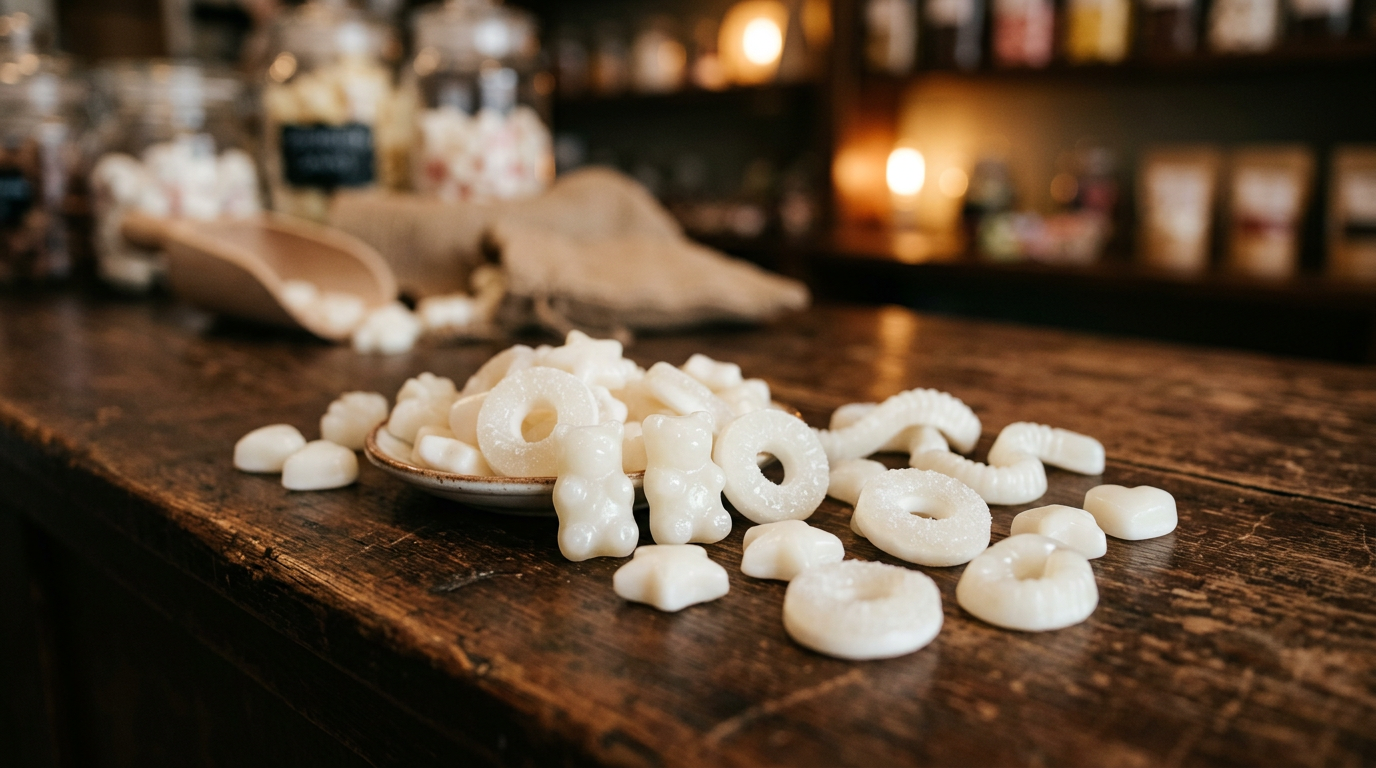
White gummy candy is a soft, chewy confection made from gelatin or pectin, colored white with titanium dioxide or yogurt powder, and flavored with lychee, coconut, peach, or vanilla.
Walk into any Asian convenience store or specialty candy shop in 2026 and the white gummy is almost always in the top row. It looks understated — pale, almost ghostly next to neon-red strawberry bears — but it outsells them in several markets. Buyers describe the flavor as “delicately sweet,” “creamy,” and “different from every other gummy.” Manufacturers love it because white gummy formats command a premium SKU position while using largely the same production lines as standard gummies.
This article covers what white gummy candy actually is, what goes into it, how it is manufactured at scale, the major product categories, and what machinery the production requires. If you are sourcing white gummy products, planning to launch a white gummy SKU, or evaluating candy production equipment, you will leave here with the full picture.
What Is White Gummy Candy?
White gummy candy is a gelatin- or pectin-based chewy confection whose defining characteristic is a pale white or off-white color, achieved through opacifying agents rather than fruit-derived pigments.
Standard gummy candy gets its color from fruit juice concentrates or synthetic dyes. White gummy takes a different route: the base is intentionally left unpigmented or whitened, which shifts the flavor profile away from citrus tartness toward gentler, creamier notes. The result is a candy that tastes distinctly different from its colored counterparts even when the gummy base recipe is nearly identical.
How White Gummy Differs from Regular Gummy Candy
The difference is mostly about what’s absent. Regular gummies use color as a flavor signal — red means cherry or strawberry, orange means orange, green means apple. White gummy breaks that association. It can carry flavors that have no natural “color equivalent” in candy convention: lychee, longan, coconut milk, yogurt, vanilla cream. The flavor can be surprising because the white color doesn’t prime any flavor expectation the way red or yellow would.
Texturally, white gummies often trend slightly softer than standard gummies. Many manufacturers reduce the gelatin concentration slightly and add a yogurt or milk powder component, which gives a creamier chew. Some formats — particularly Japanese-style white peach gummies — aim for a specific “melt-then-chew” texture that requires careful balance of gelatin, starch, and sorbitol ratios.
From a manufacturing standpoint, white gummies are slightly more demanding to produce consistently. The white coloring agents (discussed in the next section) can affect bloom strength, surface sheen, and shelf stability in ways that red or orange dyes do not.
| Feature | Standard Colored Gummy | White Gummy |
|---|---|---|
| Coloring agent | Synthetic dye or fruit juice concentrate | Titanium dioxide, yogurt powder, or milk solids |
| Typical flavors | Cherry, strawberry, orange, apple | Lychee, coconut, vanilla, white peach, yogurt |
| Texture target | Firm, bouncy | Often softer, creamier |
| Flavor cue | Color signals flavor directly | No color-flavor convention; flavor is a discovery |
| Premium positioning | Mid-tier | Frequently positioned as premium or specialty |
Key Ingredients in White Gummy Candy
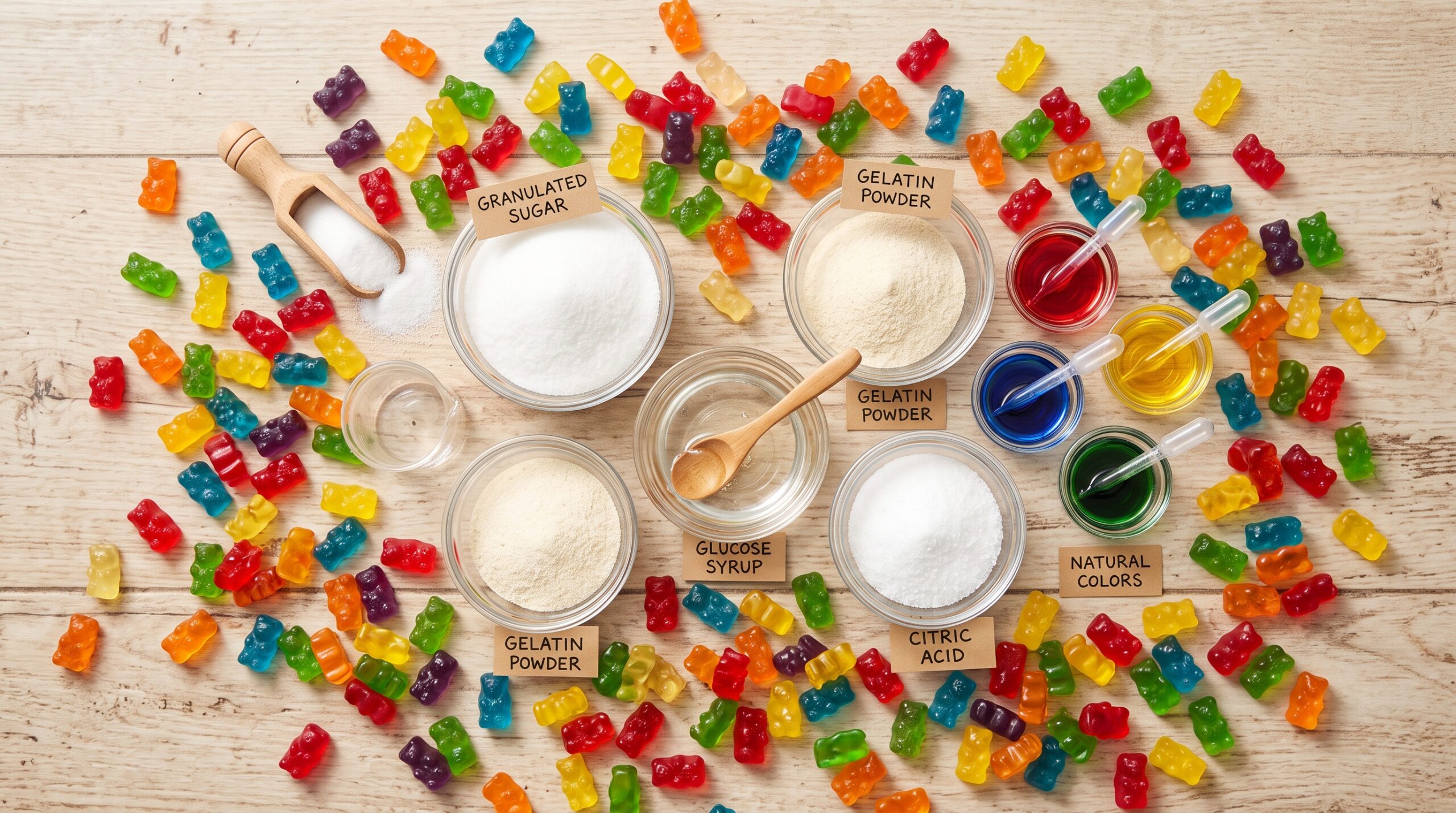
White gummy candy requires four core ingredient groups: a gelling agent, a sweetener base, a white opacifying agent, and a flavor system — each choice cascades into texture, shelf life, and production behavior.
Getting the ingredients right on a white gummy is more nuanced than on a standard colored gummy, precisely because the white base is unforgiving. A greenish tint from certain gelatins, or a yellowish tone from caramelization during cooking, ruins the visual. The ingredient choices are made with both flavor and color stability in mind.
Gelatin vs. Pectin: Choosing the Gelling Agent
Most white gummies use porcine or bovine gelatin at bloom strengths between 180 and 240. Higher bloom produces a firmer chew; lower bloom softens it. The gelatin concentration in the final product typically runs 6–9% by weight. Gelatin gives the characteristic “snap then melt” chew and is the industry default because it is cost-effective and easy to work with in depositing systems.
Pectin is the alternative for halal, kosher, and vegan formulations. Pectin gummies have a different texture — often described as more “fruit-leather-like” — and they require a different pH window (typically 3.0–3.5) to gel properly. For white gummies, pectin creates a challenge: the lower pH needed to gel pectin can interact with white colorants and shift flavor toward tart, undermining the “creamy” character that defines most white gummy products. Formulators often use high-methoxy pectin with calcium additions to achieve a softer set at slightly higher pH.
Agar-agar appears in some Asian-market white gummies, particularly in the “jellied” style popular in China and Vietnam. Agar sets firmer and more brittle than gelatin and is heat-stable. Some Chinese-market white gummies use agar as a lower-cost vegan alternative to pectin.
White Coloring Agents
The choice of white colorant is arguably the most critical ingredient decision in white gummy manufacturing:
| Colorant | Color Brightness | Impact on Texture | Regulatory Status | Common Use Case |
|---|---|---|---|---|
| Titanium dioxide (TiO₂) | Brilliant white | Neutral | Restricted in EU (E171 banned), allowed in US/Asia | US, Asian mass-market gummies |
| Yogurt powder | Off-white, creamy | Adds fat, softens chew | Universally permitted | Premium, natural-positioned white gummies |
| Milk solids / condensed milk powder | Warm white | Adds fat and dairy flavor | Universally permitted | Milk-flavored white gummies |
| White carnauba wax (surface only) | Surface sheen | Polishing agent only | Permitted globally | Polishing layer on finished gummies |
| Corn starch (in mogul process) | Slight opacity | Used in mogul molding | Permitted globally | Traditional mogul-molded white gummies |
Important for export formulation: As of 2026, the European Union continues to prohibit titanium dioxide (E171) as a food additive following a 2021 EFSA ruling that it could not be established as safe for food use. Manufacturers targeting EU markets must reformulate white gummies to use yogurt powder, milk solids, or rice starch as the white base.
Flavors and Sweeteners
The sweetener base for white gummies typically mirrors standard gummy formulations: sucrose + glucose syrup at roughly a 1:1 ratio. Glucose syrup (typically 42 DE) controls crystallization and affects chewiness. Some manufacturers incorporate isomalt or erythritol for reduced-sugar positioning.
For flavors, the classic white gummy flavor palette includes:
– Lychee — the most popular white gummy flavor in East and Southeast Asian markets, with floral, subtle sweet notes
– White peach — dominant in the Japanese-style gummy category (think Kasugai Gummy Candy)
– Coconut — tropical, creamy, pairs well with the mild sweetness of the white base
– Vanilla cream / milk — simpler, crowd-pleasing for Western and children’s markets
– Longan (dragon eye) — popular in Southeast Asian markets, similar profile to lychee but earthier
Citric acid loading in white gummies is usually low (0.3–0.8%) compared to standard sour gummies (1–3%). The white gummy’s appeal is mild sweetness and aroma, not tartness.
How White Gummy Candy Is Manufactured
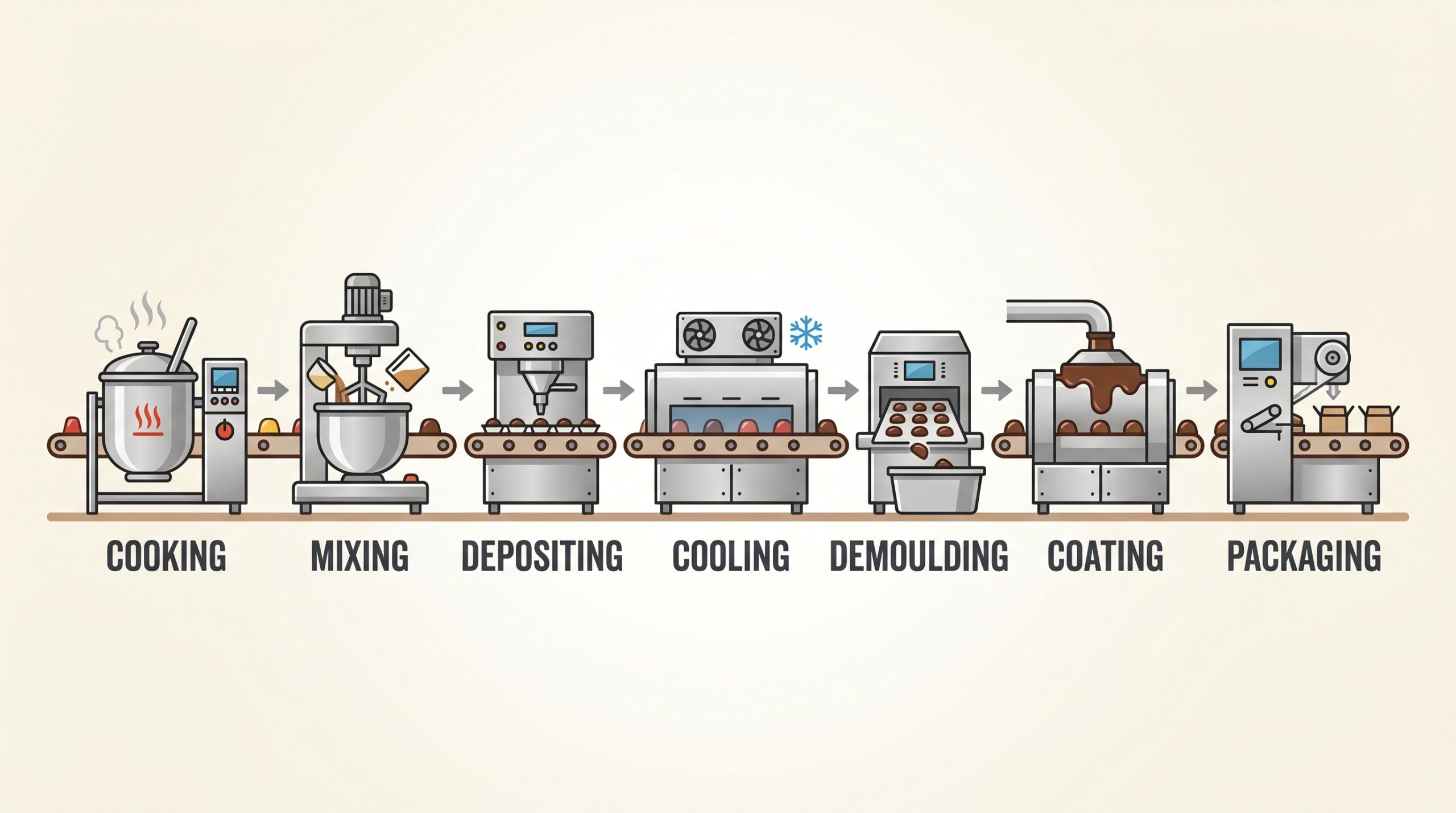
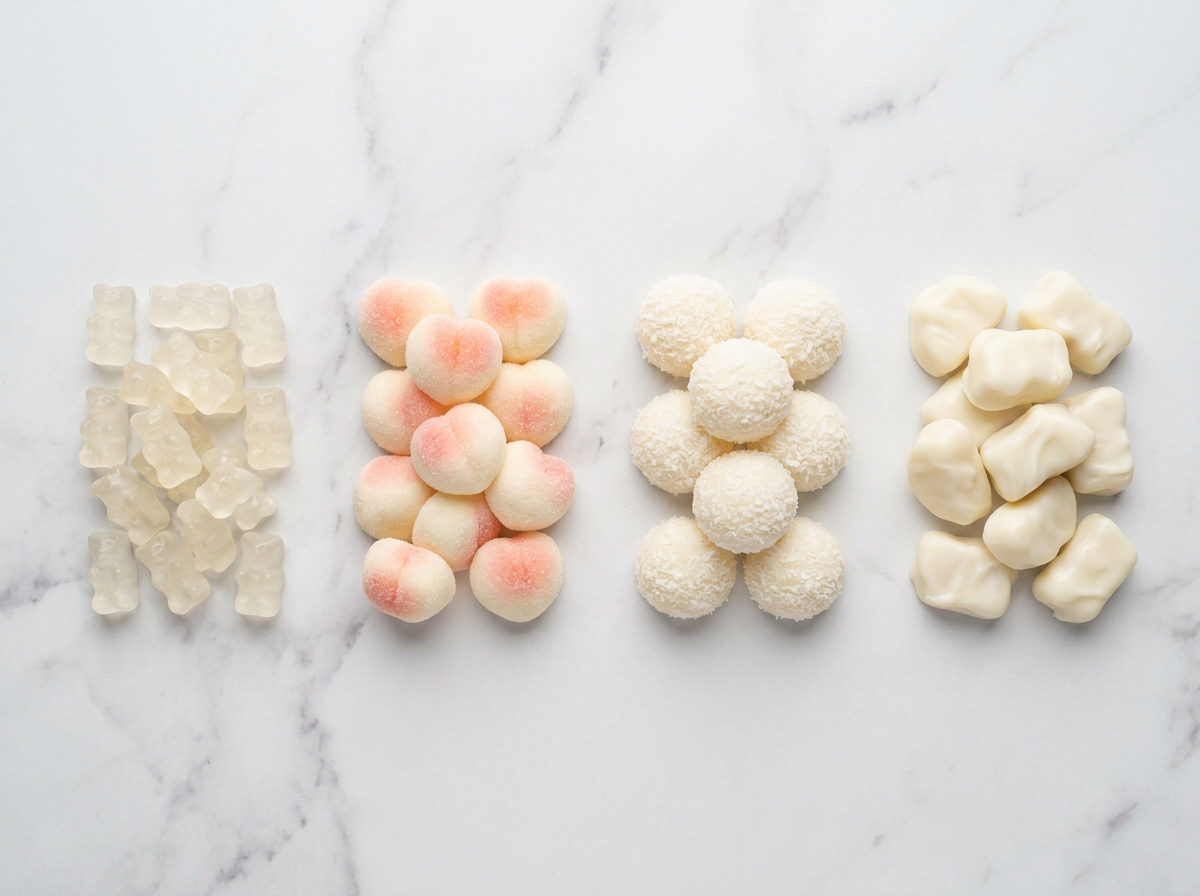
White gummy candy is made through a four-stage process: dissolving and cooking the gummy base, depositing into molds, cooling and demolding, and surface finishing — each stage has parameters that differ from standard colored gummies.
Understanding the manufacturing process matters whether you are evaluating a contract manufacturer, sourcing finished product, or planning your own production line. The steps are essentially the same as any gummy candy, but the white coloring requirement adds process-critical details at the cooking and finishing stages.
Stage 1: Dissolving and Cooking the Gummy Base
The process begins by hydrating the gelatin in cold water, then dissolving sugar and glucose syrup separately with heat. The dissolved sugar solution is cooked to around 107–112°C to reach the target Brix (typically 75–80°Bx). The temperature determines final candy moisture — higher cooking temperature = lower moisture = firmer, longer-shelf-life candy.
After cooking and partial cooling to around 80°C, the gelatin solution is blended in. The white colorant (titanium dioxide slurry, yogurt powder dispersion, or milk solids) is added at this stage. Critical control point: if the mass is too hot when the colorant is added, titanium dioxide can agglomerate and cause visible white specks rather than uniform opacity; yogurt powder can partially denature, affecting both flavor and color. Most facilities add colorants below 85°C.
Citric acid and flavor concentrate are added last, after the mass cools further to 65–70°C, to prevent flavor degradation and premature acidification of the gelatin.
Stage 2: Depositing into Molds
Two main molding systems are used for white gummies:
Starch Mogul System: The hot gummy mass (60–70°C) is deposited by a mogul machine into impressions formed in trays of corn starch. Starch absorbs surface moisture, forms a dry skin, and acts as a natural release agent. White gummies made in a mogul often have a slightly matte, dusted finish. The starch must be kept very dry (moisture < 5%) to prevent surface sticking. Mogul lines are capital-intensive but extremely flexible — one machine can run hundreds of shape variations by swapping impression boards.
Hard Mold (Silicone or Polycarbonate) Depositing: Newer lines deposit directly into silicone or polycarbonate molds without starch. This gives a glossier surface and requires no starch-removal step, but demands precise temperature control to demold cleanly. Some white gummy formats — particularly the pillow-shaped white peach gummies — are almost exclusively produced this way because starch mogul leaves a powdery exterior that buyers of premium products reject.
Stage 3: Cooling, Demolding, and Drying
After depositing, molds move through a cooling tunnel. Standard mogul process: trays spend 24–48 hours in a controlled humidity room at 15–20°C before demolding. Hard-mold lines can cool and demold in 30–60 minutes with forced-air chilling.
After demolding, white gummies typically require a conditioning / drying step of 12–24 hours to standardize moisture content across the batch. Inconsistent drying leads to stickiness (too much surface moisture) or excessive hardness (too dry). For white gummies specifically, this step also equalizes the white coloring — during cooling, titanium dioxide can migrate slightly, and conditioning allows the color to stabilize throughout the piece.
Stage 4: Surface Finishing
Most commercial white gummies go through at least one surface treatment:
Oiling: A light coating of vegetable oil (palm, sunflower) or beeswax in a rotating drum prevents pieces from sticking together and gives the gummy a subtle sheen. White gummies that use oiling rather than wax coating have a slightly translucent, “wet” gloss that is visually distinctive.
Wax Polishing: Carnauba wax dissolved in a solvent is applied in a rotating polishing drum, giving a bright, lacquer-like surface. The glossy finish is the default for premium white gummy SKUs. It also extends shelf life by reducing surface moisture exchange.
Sugar Sanding: Some white gummy formats are tumbled in fine granulated sugar. The granular white exterior reinforces the “white gummy” identity and adds a mild textural contrast. Common in Japanese-style white gummies.
Yogurt or Milk Coating: A separate coating category — the gummy is enrobed in a white compound (similar to white chocolate without cocoa butter) or a yogurt-flavored sugar shell. This produces the dual-texture “yogurt gummy” category popular in Europe and North America.
Types of White Gummy Candy
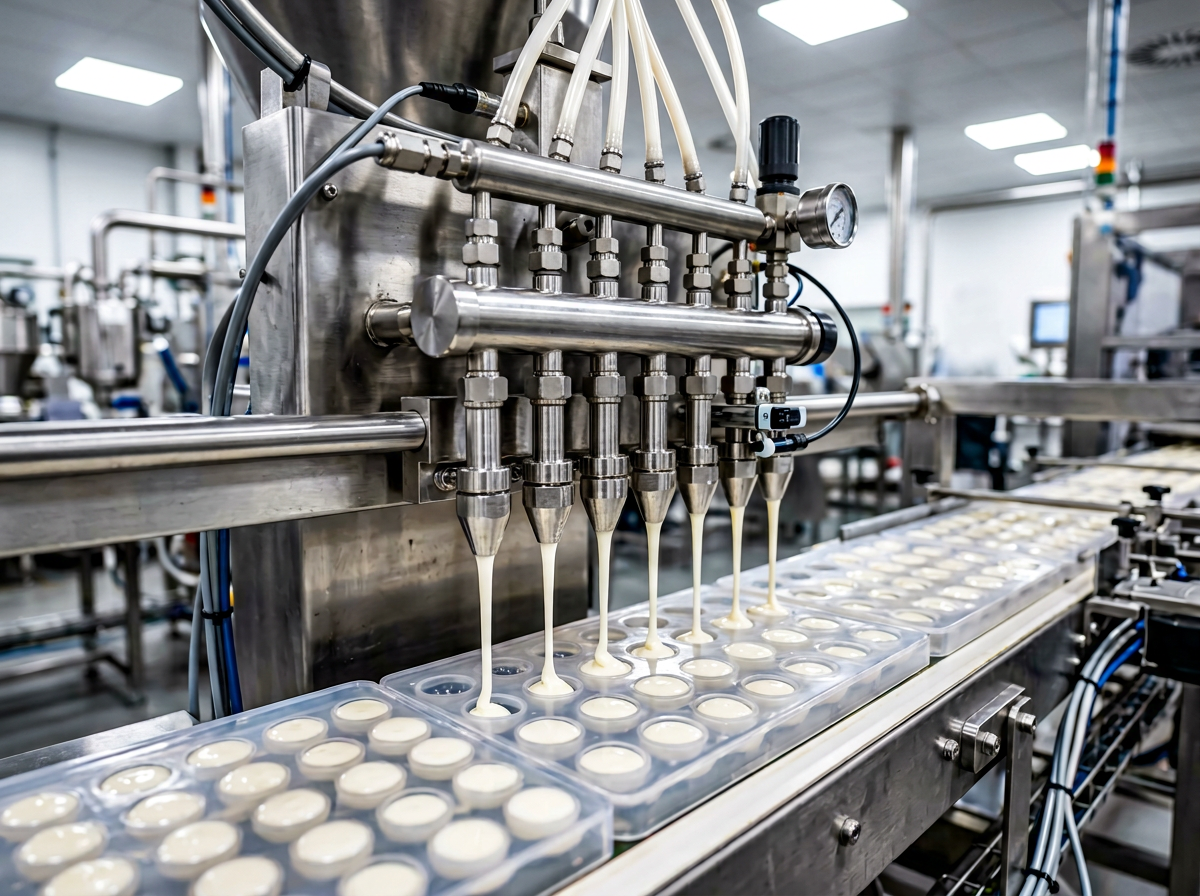
White gummy candy falls into four main commercial categories: standard white gummy bears and shapes, white peach gummies, yogurt-coated gummies, and agar-based white jellies — each targeting different markets and occasions.
Knowing which category you are buying or producing matters because the production equipment, ingredients, and shelf-life requirements differ significantly between them.
White Gummy Bears and Classic Shapes
The baseline product. White gelatin gummy in bear, ring, worm, or sour worm format, typically flavored with vanilla, lychee, or coconut. These are the direct “white version” of standard gummy bears and are commonly sold in mixed bags where the white piece has a reputation as the “best flavor” (a claim fiercely contested by red gummy fans, but consistently observed in market research).
The production machinery is identical to standard colored gummies — the only change is ingredient substitution. This makes white gummy a low-barrier entry point for manufacturers who want to diversify their SKU lineup.
White Peach Gummies (Japanese Style)
This category deserves its own mention because it dominates the premium white gummy market in East Asia and has grown significantly in North America and Europe since the early 2020s. The white peach gummy — originally pioneered by Japanese brands — uses a specific flavor profile (white peach, sometimes with a hint of nectarine or peach blossom) and a very specific texture: soft, almost foam-like center with a firmer outer gel layer.
The dual-texture requires either a co-depositing system (two different gel formulations deposited simultaneously) or a starch-mogul process with a specific cooling curve that creates a skin differentiation. According to confectionery industry data cited by the National Confectioners Association, fruit-flavored gummies were the fastest-growing candy segment in 2025, with Asian-inspired flavors including white peach accounting for significant share gains.
The Kasugai brand’s white peach gummy is the canonical reference point — any buyer who specifies “white peach gummy” in procurement is typically benchmarking against the Kasugai texture and flavor profile.
Yogurt-Coated and Foam-Based White Gummies
Yogurt gummies are a distinct category: a standard gummy (often a sour gummy for contrast) coated in a white yogurt compound. The compound is sugar-based with yogurt powder and vegetable fat. The result is a tangy gummy encased in a sweet, slightly chalky white shell that dissolves differently from the inner gummy layer.
Foam-based white gummies — the “white foam shrimp” or “white foam banana” familiar in European pick-n-mix — are not traditional gummies at all. They use a whipped gelatin-sugar foam (similar to marshmallow but denser) set in molds. The white color is natural (from the foam whipping process incorporating air) or enhanced with titanium dioxide. Foam candy requires different processing equipment: a whipping / aeration tank rather than a standard batch cooker.
| Category | Gelling Agent | Key Texture | Primary Markets | Equipment |
|---|---|---|---|---|
| White gummy bears/shapes | Gelatin or pectin | Firm, bouncy | Global mass market | Standard depositor |
| White peach (Japanese style) | Gelatin (dual ratio) | Soft center, firm skin | Japan, East Asia, premium global | Mogul or co-depositor |
| Yogurt-coated gummies | Gelatin inner + compound coating | Gummy + chalky shell | Europe, North America | Depositor + enrober |
| Agar-based white jelly | Agar | Firm, brittle | China, Southeast Asia | Jelly depositor |
| White foam candy | Whipped gelatin | Soft, airy, foam | UK, Europe | Aerating / whipping line |
White Gummy Candy Production Machinery
Producing white gummy candy at scale requires a depositing system matched to your output volume and format, plus finishing equipment — the major capital decision is between starch-mogul systems and starchless hard-mold lines.
This is the machine question that confectionery manufacturers face when launching or scaling a white gummy line. Both systems can produce excellent white gummies. The choice depends on volume, format diversity, and capital budget.
Starch Mogul Depositing Lines
A starch mogul is a continuous depositing system where a tray of corn starch has impressions formed in it by a pattern board, then the hot gummy mass is deposited into those impressions. After conditioning, the tray re-enters the machine, the starch is separated from the gummies, recycled, and dried for reuse.
Mogul lines are the standard for high-volume white gummy production. A mid-size line runs 400–800 kg/hour. The main operational cost beyond ingredients is energy for the conditioning room and starch drying system. Mogul lines are format-flexible: changing shapes requires only swapping the pattern boards (cost: a few thousand USD per set), versus entirely new molds for hard-mold systems.
The downside for white gummies specifically: the starch dusting that coats mogul-produced gummies requires careful removal (sieving, brushing, or air-jet cleaning) before oiling/polishing. If starch removal is incomplete, the final white gummy will look dusty and uneven rather than the clean, glossy white premium buyers expect.
Starchless Hard-Mold Depositing Lines
Starchless systems deposit directly into silicone or polycarbonate molds. No conditioning room is needed — pieces demold in 30–60 minutes. The surface finish is inherently cleaner and glossier, which is an advantage for white gummy aesthetics.
The trade-off is capital cost and format inflexibility. Silicone molds for a production-scale line cost $5,000–$20,000 per shape set. Running 20 shapes requires a significant mold inventory. For manufacturers focused on a small number of high-volume SKUs (such as a single white peach gummy as the hero product), this is a very good trade. For manufacturers running a broad shape catalog, the mold cost becomes prohibitive.
Coating and Polishing Equipment
After demolding, white gummies need surface treatment. The standard equipment is a rotating polishing drum (or “coating pan”) — a tumbling vessel where oiling agent, wax solution, or compound coating is applied while the gummies rotate. Most lines use a variable-speed drum that can run both oiling passes (fast tumble, light oil) and wax polishing passes (slow tumble, wax solution sprayed in).
For yogurt-coated white gummies, an enrober — a conveyor running beneath a falling curtain of liquid coating compound — is required. The compound must be tempered (white yogurt compound typically 28–32°C) for proper coating adhesion and snap. A 400mm enrober handles roughly 300–500 kg/hour of finished pieces.
For foam-based white gummies, the key equipment is the aerating / whipping unit, typically a continuous pressure beater that injects air into the gelatin-sugar solution to the specified density (foam candy typically 0.3–0.5 g/cm³ versus 1.2–1.4 g/cm³ for standard gummies).
Regardless of format, all white gummy lines benefit from an inline color measurement system — a spectrophotometer on the final conveyor that flags batches outside the target whiteness range (CIE L* > 85 is typical for premium white gummies). Batch color consistency is the top customer complaint in white gummy manufacturing, and inline measurement catches it before the product ships.
Market Trends in White Gummy Candy (2026 & Beyond)
White gummy candy is growing faster than the broader gummy market, driven by three converging trends: rising demand for halal/vegan formats, the global spread of Asian-inspired flavors, and clean-label reformulation away from synthetic dyes.
The confectionery machinery market reflects this demand. Inquiries for gummy depositing lines specifically configured for white gummy — starchless systems and dual-depositor lines for the white-peach-style dual-texture format — have increased significantly. Here’s what is driving it.
Trend 1: Halal and Vegan White Gummies
The growth of halal-certified confectionery markets in Southeast Asia, the Middle East, and Muslim-majority communities in Europe is pushing white gummy formulation toward pectin and agar alternatives. White gummy is particularly well-suited to halal reformulation because its flavor profile (lychee, coconut, vanilla) does not rely on flavors derived from alcohol-based concentrates, and the white coloring can be achieved with milk solids or rice starch without animal-derived gelatin.
Vegan gummies using pectin have grown from a niche product to a mainstream SKU in Western Europe. As of 2026, major German and UK confectionery retailers require at least one vegan gummy SKU from each supplier, and white gummy — with its “clean” visual and cream-adjacent flavor — is often the chosen format for vegan line extension.
Trend 2: Asian Flavor Expansion in Western Markets
The K-beauty and J-food waves of the early 2020s brought Asian-inspired candy flavors to mainstream Western retail. White peach gummies went from an import aisle product to a Target and Walmart shelf staple in the US between 2022 and 2024. Lychee-flavored white gummies are now standard SKUs in European H-Mart equivalents and are appearing in specialty candy sections of mainstream grocers.
According to market research from Mintel, lychee and white peach were among the top-growing flavor descriptors in confectionery new product launches globally in 2024–2026. For white gummy, this trend is structural rather than cyclical: it reflects the normalization of East Asian flavor palettes in Western confectionery retail.
Trend 3: TiO₂ Reformulation and Clean Label
The EU titanium dioxide ban (E171, confirmed in 2022 and fully in effect since 2023) has forced reformulation across all markets that export to the EU or that position products as “clean label.” The reformulation challenge for white gummies is achieving the same brilliant whiteness with alternative opacifiers that have more complex behavior in the gummy matrix.
As of 2026, the best-performing TiO₂ alternatives for white gummy candy are:
– Rice starch — gives neutral flavor, moderate opacity, good color stability; requires slightly higher usage level (4–7% vs. 0.5–1% for TiO₂)
– Calcium carbonate — high whiteness, but can affect texture and requires acid management
– Yogurt powder — best flavor synergy, but off-white rather than pure white; ideal for yogurt-positioned SKUs
| Trend | Timeline | Impact on White Gummy |
|---|---|---|
| Halal/Vegan demand | Ongoing, accelerating | Drives pectin/agar gummy line investment |
| Asian flavor expansion in West | 2022–2026+, mainstream | White peach/lychee SKUs become standard |
| TiO₂ reformulation | EU-mandated since 2023 | Rice starch and yogurt powder replace TiO₂ |
| Reduced-sugar gummies | Growing since 2022 | Isomalt/erythritol white gummies emerging |
| Functional gummies (collagen, vitamin) | 2024–2026+ | White base ideal for collagen positioning |
The collagen gummy trend is worth noting separately: white gummy is the logical visual format for collagen supplement gummies (collagen = skin = white), and this overlap between confectionery and nutraceutical markets is driving investment in white gummy production lines specifically designed for active ingredient incorporation.
Frequently Asked Questions About White Gummy Candy
What does “white gummy” mean in candy terms?
White gummy is a gelatin or pectin candy with a white or off-white color, flavored with lychee, coconut, vanilla, or white peach. Unlike colored gummies, the white format uses opacifiers (titanium dioxide, yogurt powder, or milk solids) rather than fruit dyes. The absence of color pigments allows for flavors that don’t map to standard gummy colors — the “white” itself is part of the product identity.
Why is the white gummy bear considered the best flavor?
Many candy fans rate white gummy bears as their favorite because the flavor — usually vanilla, lychee, or pineapple — is milder and less predictable than the bold fruit flavors of red or orange gummies. The white color provides no flavor priming, so the taste is a slight surprise, which contributes to the “premium” experience. In informal polls, white ranks first or second in multi-color gummy bear packs across multiple demographic groups.
Are white gummies made with gelatin?
Most commercial white gummies use porcine or bovine gelatin as the gelling agent, making them non-halal and non-vegan by default. However, halal-certified white gummies using halal-certified bovine gelatin are widely available in Asia and the Middle East. Vegan white gummies use pectin or agar. Always check the label for specific certifications if dietary compliance is important.
What flavor is white gummy candy?
White gummy candy has no single standard flavor — it varies by brand and market. In Asian markets (Japan, Korea, China, Southeast Asia), white gummy is most commonly lychee or white peach. In Western markets, vanilla, cream, or coconut is more typical. Some white gummies are intentionally unflavored to carry a neutral sweetness.
Can I make white gummy candy without titanium dioxide?
Yes. Yogurt powder, rice starch, and milk solids are the most effective TiO₂-free white colorants for gummy candy. Yogurt powder (4–8% inclusion) gives the warmest, most opaque white with a pleasant creamy flavor contribution. Rice starch at 4–6% provides a cleaner white with no flavor impact. Neither achieves the brilliant-white brightness of TiO₂, but both pass EU E171 restrictions and clean-label audit criteria.
What machinery do I need to produce white gummy candy?
A white gummy production line requires at minimum: a batch cooker or continuous cooker, a depositing machine (starch mogul or starchless), a conditioning room or cooling tunnel, and a polishing drum for surface finishing. For white peach-style dual-texture gummies, a co-depositing system or specialty mogul with dual nozzles is also needed. Output capacity ranges from 100 kg/hour on small batch lines to 1,500+ kg/hour on continuous production systems.
How is white gummy different from marshmallow?
White gummy is a dense, chewy gel-based candy; marshmallow is a whipped foam candy with a very different texture. Both are gelatin-based and both can appear white. The key difference is density and texture: marshmallow incorporates a large amount of air (density ≈ 0.15–0.3 g/cm³) for a pillowy, melting texture, while white gummy is fully dense (1.2–1.4 g/cm³) with a firm, chewy bite. White foam candies (white foam shrimp, for example) are closer to marshmallow in production than to standard gummy.
Conclusion
White gummy candy is not a gimmick or a trend waiting to peak. It is a genuinely distinct confectionery category with a specific manufacturing logic, a loyal consumer base, and accelerating retail presence in both Asian and Western markets.
For candy buyers, the key takeaway is that white gummy flavor and texture vary significantly by category — a white gummy bear is not the same product as a Japanese-style white peach gummy or a yogurt-coated foam piece. Understanding those differences helps you specify correctly and avoid quality surprises. For manufacturers and machinery buyers, white gummy production adds modest complexity to a standard gummy line (primarily in colorant handling and finishing standards) but positions your facility to serve a premium, fast-growing segment of the candy market. The machinery infrastructure — starch mogul or hard-mold depositor, polishing drum, cooling system — is largely shared with standard gummy production, making line extension relatively low-risk.
If you are evaluating machinery for white gummy or broader confectionery production, the best starting point is to specify your target format (white peach dual-texture, simple white bear, yogurt-coated), your regulatory market (EU vs. non-EU affects colorant choice), and your target output. From there, equipment selection follows clearly.