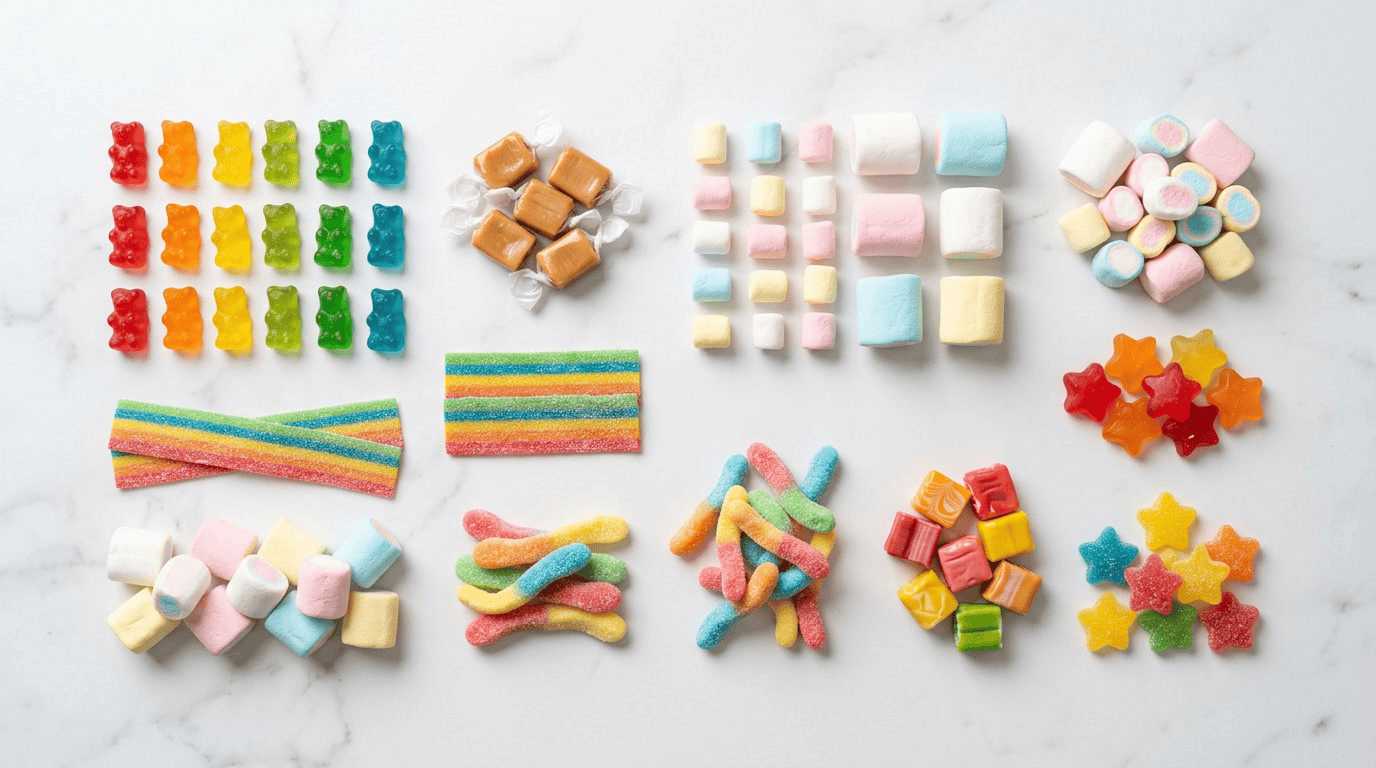
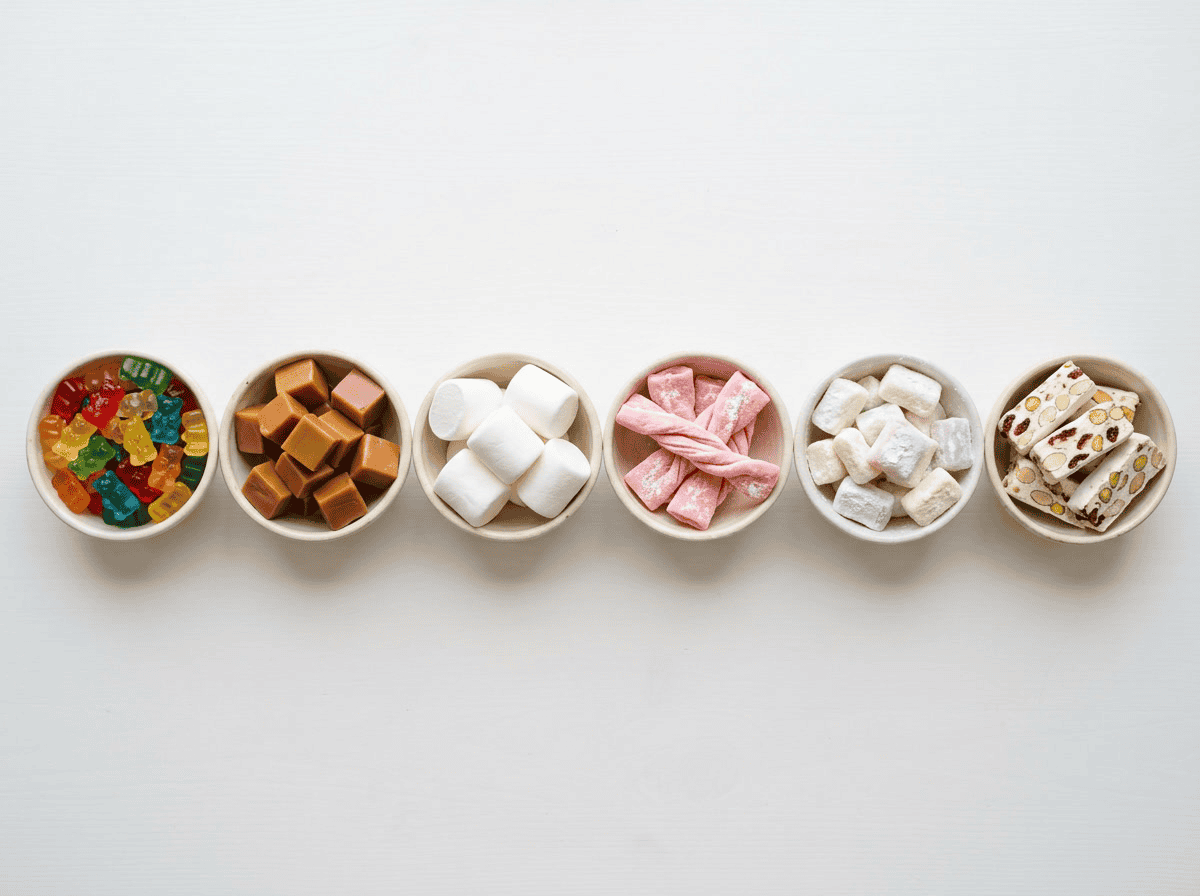
Soft candy is any confection with a tender, yielding texture — gummies, caramels, marshmallows, taffy, and fudge are the most popular categories.
Picture this: you reach into a bag of your favorite soft candy and pull out a perfectly chewy piece. It yields under the slightest pressure, releases a burst of flavor, and dissolves slowly as you chew. That experience — the one that turns ordinary candy into something almost meditative — is no accident. It’s the result of precise ingredient ratios, temperature control, and manufacturing techniques refined over more than a century.
If you’ve ever wondered what separates a perfectly tender gummy from a rubbery one, why some caramels melt on your tongue while others pull fillings, or how industrial machines produce millions of identical soft candy pieces every hour, this guide covers all of it. We’ll go from the molecular science of soft texture all the way to full-scale production equipment.
What Is Soft Candy? Definition and Texture Science
Soft candy is a confection with a moisture content and sugar crystallization level that produces a tender, pliable bite — as opposed to hard candy, which is brittle and glassy, or semi-soft candy, which sits somewhere in between. The category is broad: a gummy bear and a piece of handmade fudge are both technically soft candy, yet their textures feel completely different in your mouth.
The technical definition comes down to water activity (aw) and texture mechanics. Most soft candies have an aw between 0.55 and 0.75, which keeps them pliable without becoming wet or sticky to the touch. According to food science research published on ScienceDirect, the relationship between moisture migration and candy texture is one of the central challenges in confectionery shelf-life engineering.
The Science Behind Soft Texture
Three factors determine whether a candy is soft or hard:
Sugar crystallization state. When sugar molecules form large, ordered crystals, you get a crunchy or hard texture. When they’re forced into a disordered, amorphous state — either by rapid cooling or by adding interfering agents like glucose syrup or invert sugar — you get a softer, more pliable structure. Fudge makers “work” their sugar deliberately to create tiny, uniform crystals that produce a smooth, soft bite.
Gelling agents. Gelatin, pectin, agar, and carrageenan are the most common. Each creates a different mouthfeel. Gelatin produces the classic springy, chewy gummy texture. Pectin (more common in European-style soft candy) gives a cleaner, more fruit-like break. The concentration of gelling agent is everything — 6% gelatin makes a firm gummy bear, 2% gelatin makes a jiggly panna cotta.
Plasticizers. Ingredients like sorbitol, glycerin, and high-fructose corn syrup don’t just add sweetness — they retain moisture and keep the candy from hardening over time. Without them, most soft candy would turn brittle within a week of manufacture.
Soft Candy vs. Hard Candy: Key Differences
| Property | Soft Candy | Hard Candy |
|---|---|---|
| Moisture content | 10–20% | <3% |
| Sugar state | Amorphous or micro-crystalline | Glassy amorphous |
| Gelling agents | Often present | Absent |
| Shelf life | 6–18 months | 1–2 years |
| Processing temp | 120–150°C | 150–165°C |
| Texture sensation | Chew, yielding, elastic | Brittle, dissolves slowly |
Types of Soft Candy — A Complete Guide
Soft candy isn’t a single product — it’s a family of confections that share a texture profile while differing dramatically in ingredients, manufacturing method, and consumer appeal. Here are the major categories worth knowing.
Gummies and Gelatin-Based Soft Candy
Gummies are probably the most globally recognized form of soft candy. The modern gummy bear was invented in Germany in the 1920s by Hans Riegel of Haribo, and the format has spawned thousands of variations — gummy worms, peach rings, sour belts, fruit slices, and now functional gummies packed with vitamins or CBD.
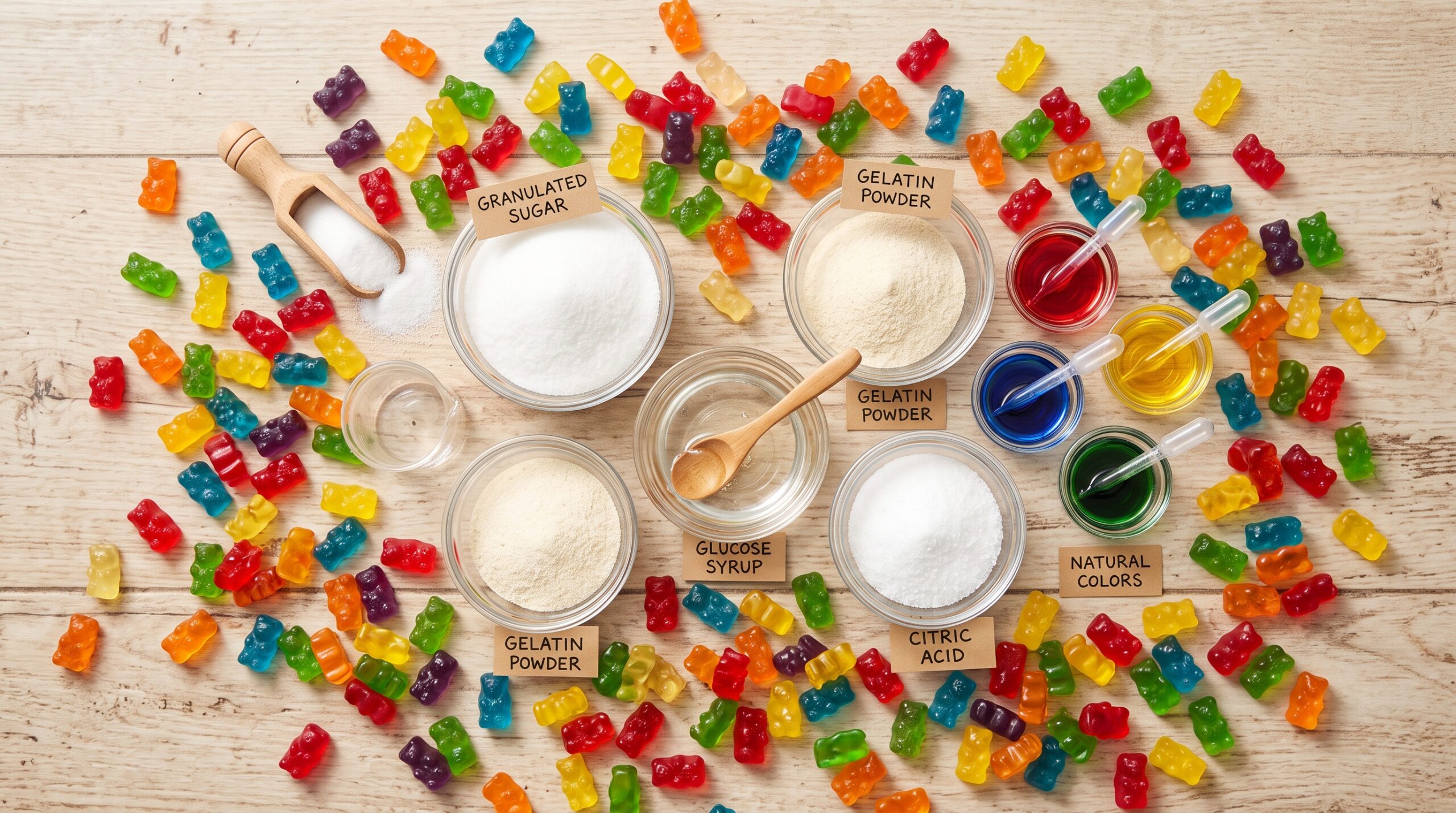
The base formula is simple: sugar, glucose syrup, gelatin, and flavoring. But executing it at scale requires precise temperature control during depositing (typically 65–70°C for the candy mass) and extended curing time (24–48 hours in climate-controlled trays). Undercure a gummy and it will be too soft and sticky; overcure it and the texture turns rubbery and dry.
Pectin-based gummies are a growing subcategory, driven by vegan and vegetarian consumer demand. Pectin sets differently from gelatin — it requires higher sugar concentration and acidic conditions to gel — which is why pectin gummies often taste slightly more tart.
Caramels and Toffees
Soft caramel is made by cooking sugar, butter, cream (or condensed milk), and corn syrup to the “firm ball” stage — around 118–120°C. The Maillard reaction and caramelization at these temperatures produce the characteristic golden color and deep, buttery flavor that define good caramel.
The difference between a soft caramel and a hard toffee is largely water content and final cook temperature. Soft caramel stays between 115–120°C and retains enough moisture to stay pliable. Toffee cooks to 140°C or above, driving out more moisture and producing a much harder, brittle result.
Modern soft caramel production uses continuous cooking systems that can produce thousands of kilograms per shift, though small-batch artisan caramels are experiencing significant growth in the premium confectionery segment.
Marshmallows
Marshmallows are an aerated soft candy — essentially a stable foam made from whipped gelatin, sugar syrup, and corn syrup. The light, pillowy texture comes from the millions of tiny air bubbles trapped in the gelatin matrix.
Traditional marshmallows are extruded as continuous ribbons, dusted with a cornstarch/powdered sugar mixture to prevent sticking, and cut to length. Specialty marshmallows — s’mores size, flavored varieties, gourmet handmade versions — may use different gelatin concentrations or include additional stabilizers.
The National Confectioners Association reports that marshmallows represent a multi-hundred-million-dollar annual category in North America alone, with seasonal demand (Halloween, Easter, winter hot cocoa season) driving significant production spikes.
Taffy and Salt Water Taffy
Taffy is a pulled soft candy made from sugar, corn syrup, butter, and flavoring. The “pulling” step — either by hand or machine — is critical: it aerates the candy and aligns the sugar crystals to produce the characteristic chewy, stretchy texture that makes taffy so satisfying.
Salt water taffy, despite the name, contains very little actual salt and typically no seawater. The small amount of salt enhances flavor by suppressing bitterness and amplifying sweetness. Atlantic City, New Jersey claims historical credit for popularizing the format in the late 1800s.
Modern taffy production uses mechanical taffy pullers — stainless steel hook-and-arm systems that fold, stretch, and re-fold the candy mass thousands of times in minutes.
Mochi and Asian-Style Soft Candy
Mochi — glutinous rice cake stuffed with bean paste, ice cream, or other fillings — has become one of the fastest-growing soft candy categories in Western markets over the past decade. Its chewy, slightly sticky texture comes from the unique properties of waxy rice starch, which gelatinizes and retrogrades differently from other starches.
Hi-Chew, the Japanese fruit chew brand, is another example of Asian-style soft candy that has taken global market share. Its texture is uniquely layered: an outer chewy shell with a slightly different inner consistency.
| Type | Base ingredient | Texture profile | Typical moisture % | Best for |
|---|---|---|---|---|
| Gummy bear | Gelatin + glucose syrup | Springy, elastic | 14–18% | All ages, everyday snacking |
| Soft caramel | Sugar + dairy + corn syrup | Smooth, creamy melt | 8–12% | Adults, premium gifting |
| Marshmallow | Whipped gelatin + sugar | Airy, pillowy | 16–22% | Kids, hot beverages, baking |
| Salt water taffy | Sugar + corn syrup | Stretchy, chewy | 6–10% | Coastal souvenir markets |
| Mochi | Glutinous rice starch | Sticky, dense chew | 35–45% | Asian cuisine enthusiasts |
| Nougat | Sugar + egg whites + nuts | Dense, chewy, varies | 5–10% | Adults, European-style confections |
Soft Candy for Special Dietary Needs and Situations
One of the most-searched subcategories of soft candy is products suitable for people with physical restrictions — orthodontic patients, elderly consumers, and those recovering from dental work. The stakes here are higher than ordinary snacking; the wrong candy choice can genuinely damage braces or cause dental injury.
Soft Candy for Braces Wearers
The orthodontist’s warning to “avoid sticky candy” exists for good reason: highly adhesive soft candy — particularly gummies, taffy, and caramel — can pull wires and dislodge brackets. That said, not all soft candy is equally risky.
Safer choices for braces: Marshmallows (minimal adhesion, dissolve quickly), soft chocolate (melts without sticking to hardware), peanut butter cups, and melt-away mints. These tend to have lower viscosity when heated to mouth temperature, reducing the pulling force on brackets.
Higher-risk soft candy for braces: Gummy bears (high gelatin elasticity creates strong adhesive force), caramels (extremely sticky when warm), taffy (the stretching action is the exact mechanism that pulls brackets), and licorice (similar adhesion profile to taffy).
The American Dental Association recommends patients with orthodontic hardware avoid sticky and chewy foods entirely. In practice, most orthodontists allow soft, low-adhesion options in moderation.
Soft Candy for the Elderly
Age-related changes in dentition — natural tooth loss, dentures, reduced bone density, and greater tooth sensitivity — make soft candy the only practical confectionery option for many older consumers. The category is large and underserved by premium brands: most “soft candy for elderly” options are generic penny candy formats rather than sophisticated, flavor-forward products.
Key criteria for elderly-appropriate soft candy: minimal stickiness (to avoid denture displacement), low hardness (under 50 Shore A durometer), predictable bite behavior (no unexpected hard bits like nut fragments), and moderate sugar content (many older consumers manage blood sugar).
Chocolate-covered creams, soft fondant centers, melt-away mints, soft licorice, and well-aged marshmallows are generally well-tolerated. Caramel can be appropriate if it’s the “melt-away” variety rather than the chewier toffee-adjacent style.
Soft Candy for Adults — Beyond the Kids’ Aisle
There’s a persistent misconception that soft candy is primarily a children’s category. The premium confectionery market tells a different story. Adult-targeted soft candy is one of the fastest-growing confectionery segments, driven by:
- Flavor sophistication: Single-origin chocolate caramels, wine-infused gummies, spiced mango taffy, and other complex flavor profiles that adult palates prefer.
- Functional ingredients: Collagen-infused gummies, CBD soft chews, vitamin C caramels, and melatonin marshmallows that serve a wellness purpose.
- Premium gifting: Handmade soft caramels in artisan packaging command $30–60 per pound at specialty retailers — a price point unthinkable in the mass-market candy aisle.
- Reduced sugar / better-for-you formats: Soft candy made with stevia, allulose, or sugar alcohols that deliver the textural experience with less glycemic impact.
How Soft Candy Is Manufactured
This is where the engineering gets interesting. Behind every soft candy is a manufacturing process that balances food chemistry, fluid dynamics, and precision engineering. Here’s how industrial-scale soft candy production actually works.
Key Ingredients That Create Soft Texture
The foundation of any soft candy formula is a combination of:
Sweeteners: Sucrose provides the primary sweetness and structural framework. Glucose (corn) syrup interferes with sucrose crystallization, keeping the candy pliable. High-fructose corn syrup adds sweetness and moisture retention. Sugar alcohols like sorbitol and maltitol are increasingly used in reduced-sugar formulas.
Texturizers: Gelatin (derived from porcine or bovine collagen) is still the dominant gelling agent for gummies globally, producing 65–70% of the world’s gummy candy volume. Pectin is preferred in vegan formulas and delivers a faster, cleaner bite. Starch — particularly modified starch — is used in Turkish Delight-style confections and as a panning base. Carrageenan and agar are used in specialty applications.
Fats: Butter, palm oil, and vegetable shortenings contribute to softness, mouthfeel, and shelf life in caramels, fudge, and toffees. The fat content and crystallization form (polymorphic state) significantly affect final texture.
Acid and flavor systems: Citric and malic acid create the tart note in sour soft candy. Natural and artificial flavors — often in concentrated emulsion form — are added at 0.1–2% of the batch weight.
According to USDA FoodData Central, a standard gelatin-based gummy candy contains approximately 330 calories per 100g, with 76–80% of that coming from carbohydrates (predominantly sugar and glucose syrup).
The Manufacturing Process Step-by-Step
Step 1: Ingredient preparation and dissolution. Dry sugar is dissolved in water under heat (typically 80–90°C) to form a clear syrup. Glucose syrup is added at this stage. Total dissolved solids at this point are typically 75–80 Brix.
Step 2: Cooking. The syrup is cooked to the target final temperature — which varies by product type. Gummy mass: 105–115°C. Soft caramel: 118–122°C. Marshmallow syrup: 120–130°C. Precise temperature control is critical; a 2–3°C deviation can shift the final texture significantly.
Step 3: Gelling agent addition. For gummies, pre-soaked gelatin is blended into the cooked syrup at temperatures that maintain gelatin activity without degrading it (typically 70–80°C). Overheating gelatin above 90°C begins to damage its gelling strength.
Step 4: Flavor, color, and acid addition. These are added in sequence at the mixing stage. Acid is typically added last (just before depositing) to minimize hydrolysis of gelatin.
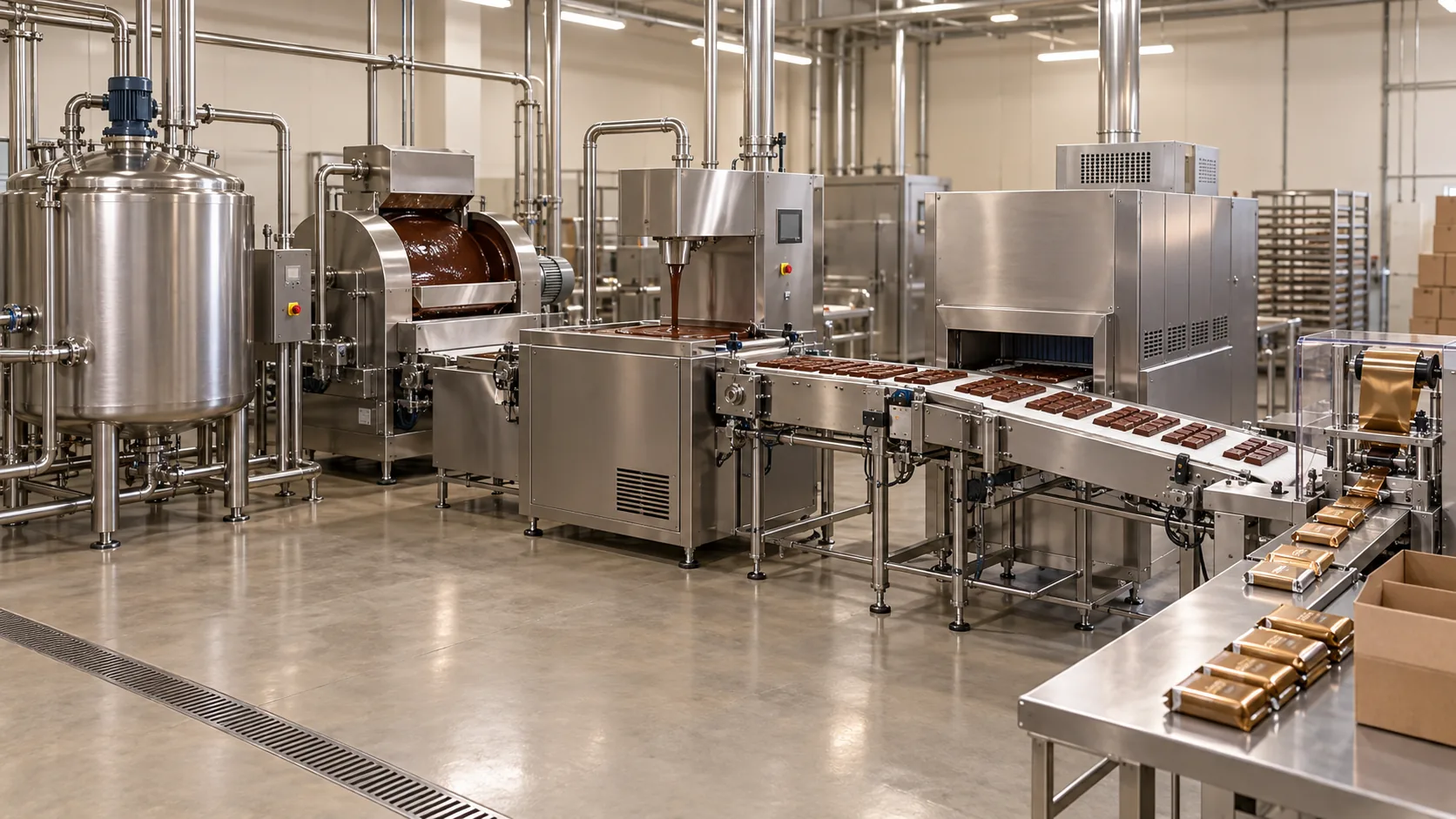
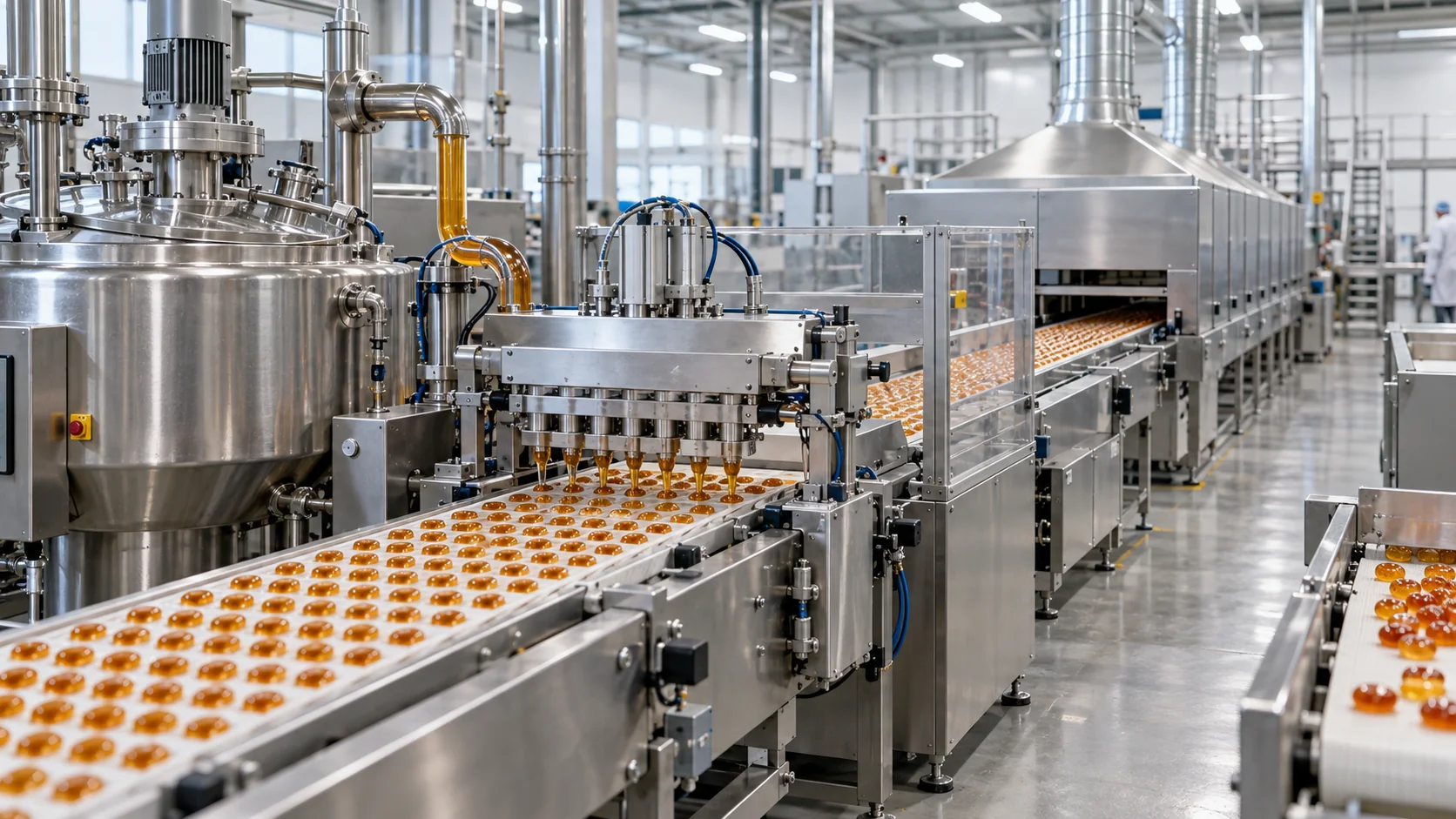
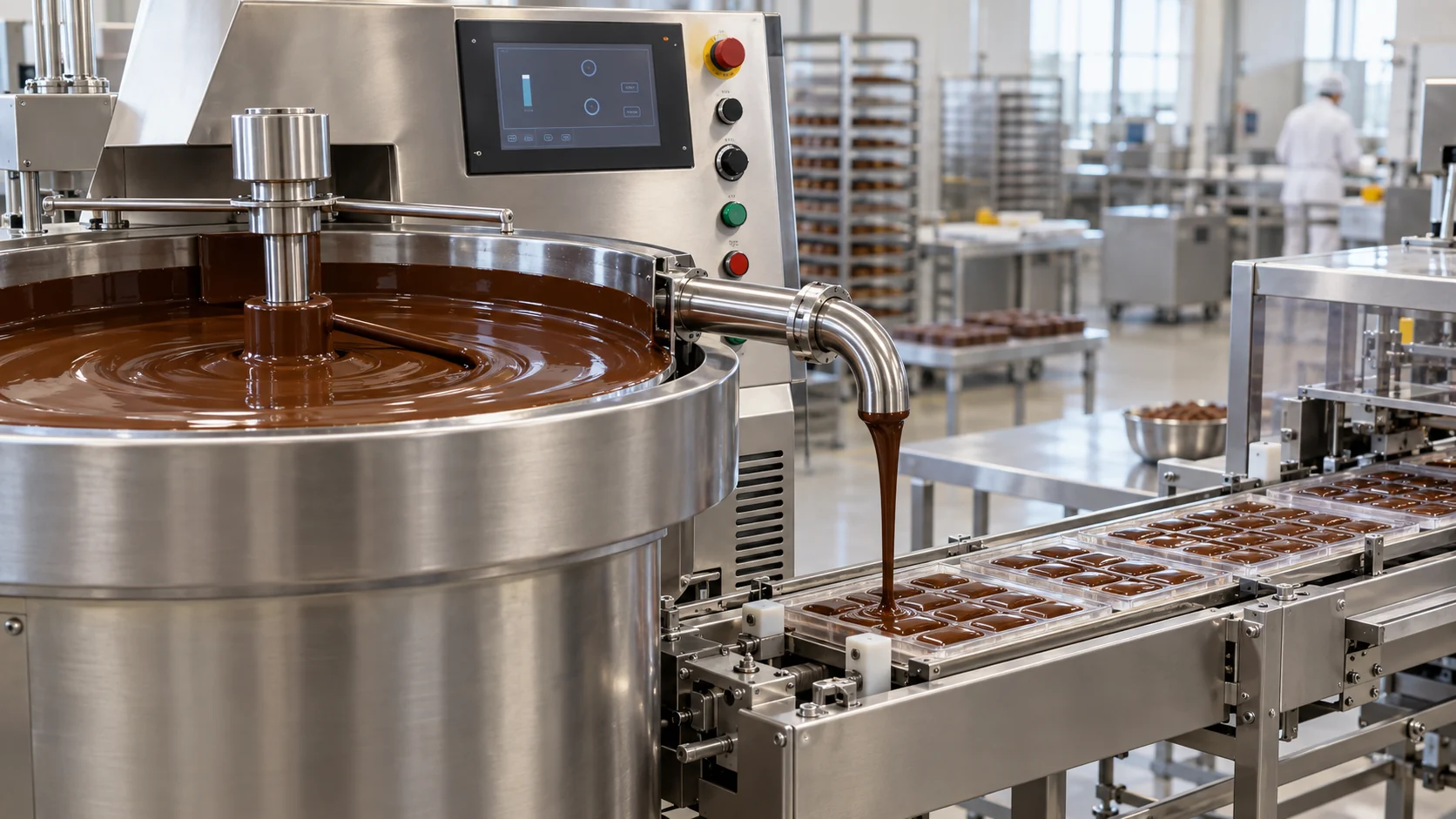
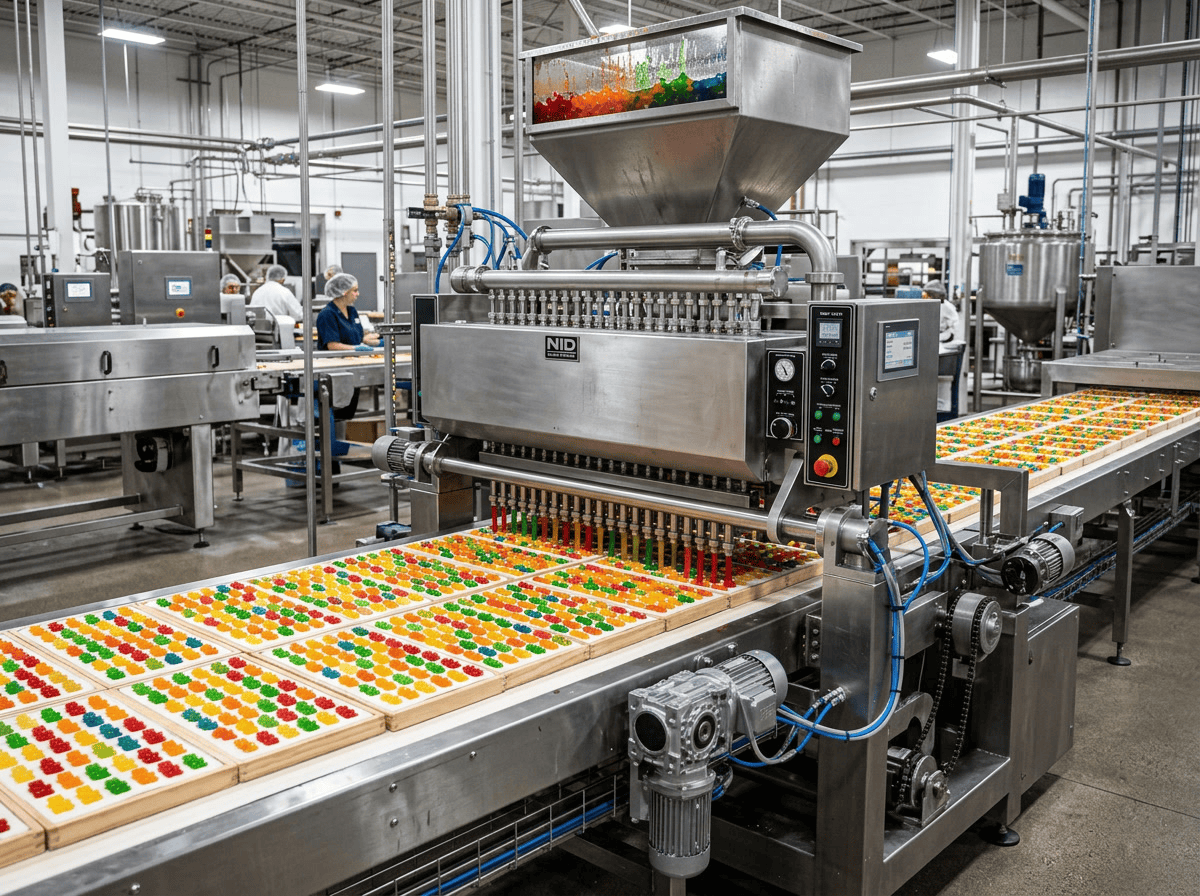
Step 5: Depositing or extrusion. Gummies are deposited into starch-molded trays using servo-controlled depositing systems that maintain precise volume per cavity. Caramels and toffees are typically extruded or slab-rolled. Marshmallows are extruded as continuous ropes. Modern depositing lines can run at 1,500–2,000 cavities per minute.
Step 6: Curing/setting. Gummies rest in climate-controlled rooms (18–22°C, 45–55% RH) for 24–48 hours to allow the gelatin to fully set and moisture to stabilize.
Step 7: De-molding, finishing, and packaging. Gummies are tumbled out of starch trays, oiled (with carnauba wax or vegetable oil) to achieve gloss and prevent sticking, and fed to automated packaging lines.
Quality Control in Soft Candy Production
| QC Parameter | Standard Range | Method | Why It Matters |
|---|---|---|---|
| Final moisture | 14–18% (gummy) | Karl Fischer titration | Directly drives texture hardness |
| Gelling agent Bloom strength | 200–260 Bloom | Bloom test | Determines gummy firmness |
| pH (gummy mass) | 3.0–3.5 | In-line pH probe | Controls gelatin crosslinking and flavor |
| Depositing temperature | 65–70°C | RTD sensor | Ensures correct viscosity for fill |
| Curing room RH | 45–55% | Humidity sensors | Prevents over-drying or moisture absorption |
| Final hardness | 30–60 Shore A | Texture analyzer | Ensures product-spec consistency |
Continuous improvement in soft candy QC increasingly relies on inline near-infrared (NIR) spectroscopy, which can measure moisture and sugar content in real time without sampling interruptions. Major equipment suppliers offer NIR-integrated depositing lines that auto-adjust formula parameters based on real-time readings.
Top Soft Candy Brands and Names Worth Knowing
The global soft candy market is dominated by a handful of mega-brands, but the artisan and premium segment is growing rapidly. Here’s how the landscape breaks down.
Mass-market leaders: Haribo (gummies, founded 1920, Germany), Trolli (gummies, particularly sour formats), Starburst (fruit chews), Swedish Fish (pectin-based fish-shaped soft candy), Skittles (chewy candy coated in a thin shell), Hi-Chew (Japanese fruit chew brand by Morinaga).
Premium and artisan: Vosges Haut-Chocolat (high-end caramel and nougat), Fran’s Chocolates (salted caramels), Li-Lac Chocolates (NYC-based fudge and caramel), Hammond’s Candies (handmade Colorado candy company), Jelly Belly (gourmet jelly beans, technically a chewy soft candy).
Private label / retail brands: Many of the largest volume soft candy products are private-label manufactured for grocery and discount retailers. The soft candy category has high private-label penetration precisely because texture (and not brand identity) is the primary purchase driver for many consumers.
Soft candy brands by format:
- Gummies: Haribo, Trolli, Black Forest, Albanese, Surf Sweets (vegan/organic)
- Caramels: Kraft (mass-market), Goetze’s Candy, Werther’s (soft caramel variant), Fran’s Chocolates
- Marshmallows: Jet-Puffed (Kraft), Dandies (vegan), Campfire, Smashmallow (artisan)
- Taffy: Laffy Taffy, Taffy Town, Zack’s Taffy (specialty)
- Mochi: Mikawaya, My/Mochi, Bubbies
Future Trends in Soft Candy (2026 & Beyond)
The soft candy category is evolving faster than at any point in its modern history. Several forces are reshaping both what consumers want and how manufacturers produce it.
Health-Forward Soft Candy Innovation
The “better-for-you” movement has arrived in soft candy. Reduced-sugar gummies using allulose or stevia, collagen peptide-infused chews, probiotic-infused soft caramels, and functional marshmallows with adaptogens are all seeing double-digit growth in North American retail.
The challenge is texture. Most sugar-reduction strategies compromise softness: sugar alcohols can cause laxative effects at high doses and often produce a cooling aftertaste; stevia can be bitter; allulose is expensive. The formulation science required to hit a premium texture target while reducing sugar by 50% is genuinely difficult, which is why most “better-for-you” soft candy products from earlier years had noticeable textural deficits.
By 2026, fiber-based bulk-sweetener systems (inulin + soluble corn fiber + allulose combinations) are delivering much closer-to-conventional texture at reduced-sugar claims, driving a new wave of product launches. According to Wikipedia’s confectionery overview, the global confectionery market is valued at over $200 billion, with healthier formats among the highest-growth subcategories.
Technology and Automation in Soft Candy Production
Manufacturing technology is transforming what’s possible in soft candy production. Key developments in 2026:
Multi-layer and dual-color depositing. Servo-controlled dual-depositing heads can produce gummies with two distinct flavors, colors, or textures in a single pass — a product format that would have required multiple production steps even five years ago.
Continuous cooking systems. Traditional batch cooking is being replaced by continuous cooker-cooler systems that produce a steady stream of cooked candy mass with tighter temperature and moisture consistency than batch kettles. This reduces batch-to-batch variation and improves yield.
Automated starch management. Mogul lines (starch-molding depositing systems) are now available with fully automated starch recycling, drying, sieving, and temperature control — reducing the labor intensity of what was historically one of the most manually demanding steps in gummy production.
Vision-based QC. In-line camera systems inspect deposited cavities for fill volume, shape accuracy, and air bubble defects at line speed, feeding data back to the depositing system for real-time correction.
For food manufacturers considering soft candy production, or scaling up existing lines, investing in equipment with these capabilities is increasingly a prerequisite for competing on quality and cost simultaneously. Modern confectionery processing lines from specialized manufacturers integrate all of these elements — cooking, depositing, curing, finishing, and packaging — in turnkey configurations that reduce commissioning time and operator training requirements.
Frequently Asked Questions About Soft Candy
What makes candy soft vs. hard?
Moisture content and gelling agents are the primary drivers. Soft candy retains 10–20% moisture and often uses gelatin or pectin to create a pliable structure. Hard candy contains less than 3% moisture and has a glassy, brittle sugar structure. The cooking temperature during manufacture largely determines which structure forms.
Is soft candy bad for your teeth?
It depends on the type. Sticky soft candy — particularly caramels, gummies, and taffy — adheres to tooth surfaces and provides a sustained acid environment as bacteria metabolize the sugar. Melt-away varieties (like marshmallows or soft chocolate) are less problematic because they clear from teeth faster. The American Dental Association recommends rinsing with water after consuming any candy and brushing twice daily.
What soft candy is safe for braces?
Marshmallows, soft chocolate without nuts or caramel, peanut butter cups, and melt-away mints are generally considered safe. Avoid gummies, taffy, caramel, licorice, and any soft candy that stretches or sticks — these can dislodge brackets and bend wires. Always check with your orthodontist for personalized guidance.
What soft candy can elderly people eat?
Soft, low-adhesion options work best. Good choices: chocolate-covered cream centers, soft mints, fondant, and melt-away caramels. Avoid hard-to-chew or sticky formats. Many elderly consumers do well with European-style nougat (the softer varieties), soft licorice, and certain mochi formats. Portion size and sugar content are also worth considering for those managing diabetes.
How long does soft candy last?
Most mass-market soft candy has a shelf life of 6–18 months when stored in cool, dry conditions (below 20°C, 50% RH). Gummies tend toward the shorter end due to moisture migration. Hard caramels and wrapped toffees last longer. Home-made soft candy without preservatives should generally be consumed within 2–4 weeks.
What is the softest type of candy?
Marshmallows are arguably the softest mainstream soft candy by texture measurement, with a Shore A hardness of 5–15. Freshly made cotton candy (candy floss) dissolves almost instantly. Among the chewier formats, fresh caramel and well-cured fruit-flavored gummies are among the most tender — the key word being “fresh,” as most soft candy hardens over time due to moisture loss.
How is soft candy different from gum?
Both involve chewing, but they’re fundamentally different products. Soft candy is designed to be consumed — it dissolves or breaks down in the mouth. Chewing gum has an insoluble gum base (natural or synthetic latex/resin) that gives it elasticity without dissolving. Gum’s flavor and sweeteners are absorbed, but the base is expelled. This means gum has a persistent chew; soft candy has a finite chew that ends with full consumption.
Conclusion
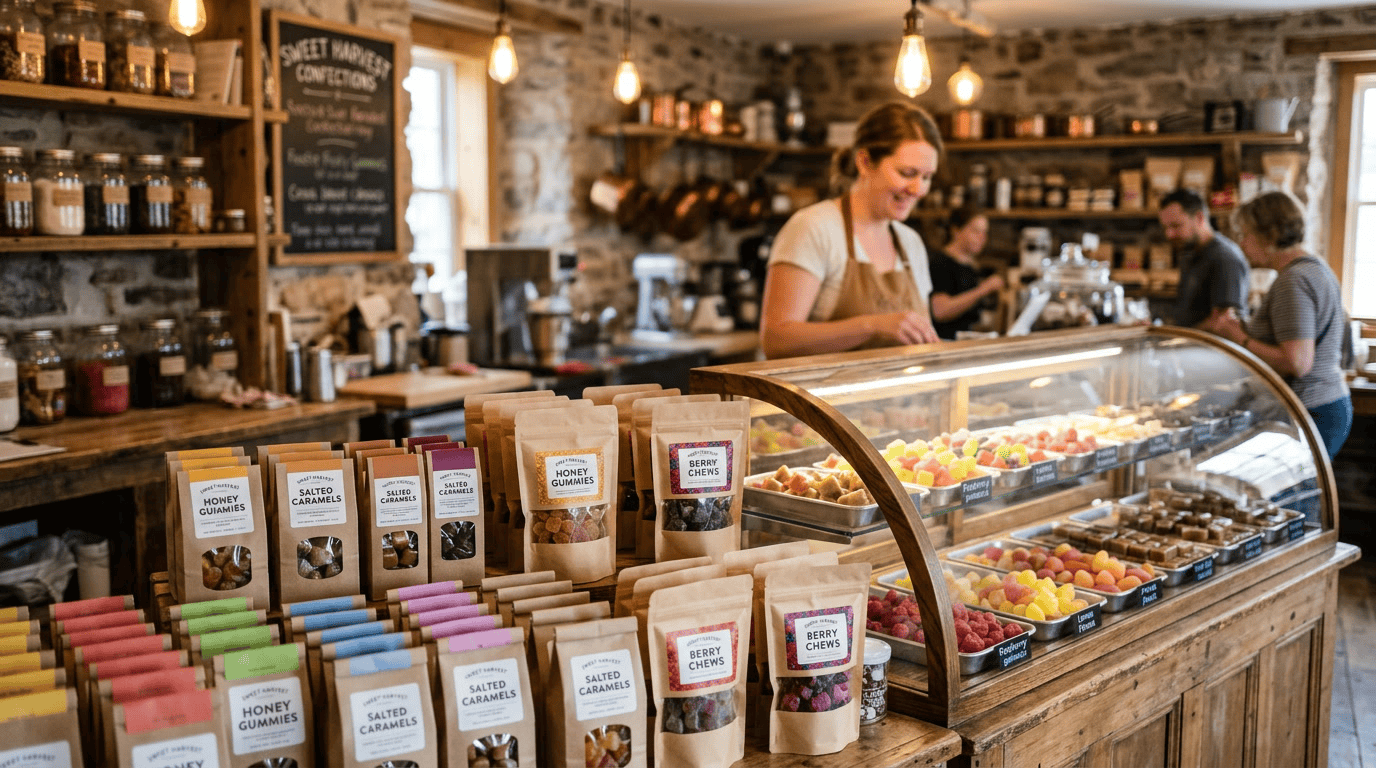
Soft candy is a category that looks simple from the outside — brightly colored, sweet, universally appealing — but is built on serious food science and precision manufacturing. The difference between a world-class gummy and a mediocre one comes down to gelatin Bloom strength, depositing temperature precision, curing room humidity, and the skill of the formulator who designed the base recipe.
Whether you’re a consumer trying to navigate which soft candy is safe for your situation, a retailer stocking a confectionery section, or a manufacturer evaluating production equipment for a new candy line, the fundamentals are the same: texture is everything, and texture is chemistry. Master the moisture content, control the gelling agent concentration, and get your cooking temperatures right — and you can produce soft candy that earns genuine loyalty from the people who eat it.
For producers looking to start or scale soft candy manufacturing, modern gummy depositing lines, continuous cooking systems, and integrated starch management equipment can dramatically lower the barrier to consistent, high-volume production. The technology exists. The consumer demand is there and growing. The question is execution.
Related Articles
- Peelable Gummy Candy: Types, Ingredients, and Production Guide
- Halloween Gummies: Types, Flavors, and How They’re Made
- Spanish Candy: Types, Traditions, and the Machinery Behind Every Bite
- French Candy: The Complete Guide to Types, Traditions & Commercial Production
- Gummy Candy Production Line
- Biscuit Production Line
- Are Skittles Gluten Free? Complete Guide 2026