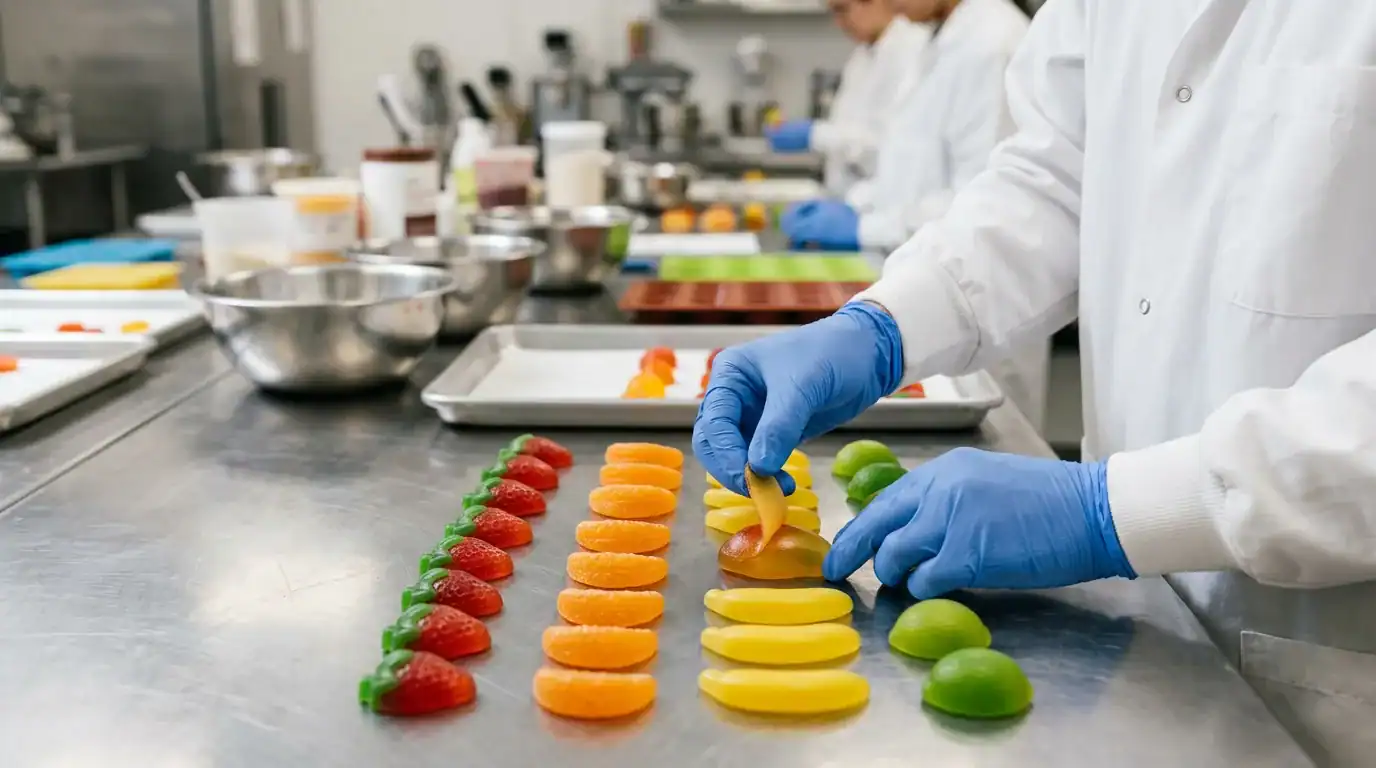
Peelable gummy candy is a dual-texture gummy designed so the outer layer peels away cleanly from a softer center before you eat it.
The reason peelable gummy candy is suddenly everywhere is simple: it turns an ordinary sweet into a tiny interactive experience. You do not just chew it. You peel it, inspect the texture, hand it to a friend, compare flavors, and then decide whether the outer shell or the soft inner core is the better part. That extra second of interaction is exactly why the format travels so well on short-form video, why retailers like it as an impulse item, and why manufacturers keep asking how to make the texture hold up at scale.
Most search results stop at the novelty angle. They show a product page, a quick ranking article, or a social clip of someone peeling a mango-shaped gummy. That is not enough if you are trying to understand the category, evaluate a private-label opportunity, compare formulations, or build a commercial production line around it. The real questions are more practical. What makes the outer layer separate cleanly? Which gelling system is stable enough for a peel effect? What packaging works best? Which quality failures show up first when you move from kitchen curiosity to factory output?
This guide answers those questions in a way the top three results do not. We will cover what this format is, how it differs from standard gummies, the core ingredient systems behind the texture, the main product formats that are selling now, and the manufacturing decisions that matter if you want a repeatable result. We will also connect the topic to commercial production, because that is where JY Machine’s gummy manufacturing resources become directly relevant.
What Is Peelable Gummy Candy?
Peelable gummy candy is gummy candy engineered with two distinct layers so the outer skin can be peeled away without tearing into mush.
At the consumer level, this style of candy feels playful and slightly odd in a satisfying way. The outer layer has enough tensile strength to lift away in strips or sheets, while the inside stays softer, juicier, and more elastic. That separation is the whole point. If the layers behave the same, it is just a gummy with a gimmicky shape. If the outer layer is too weak, it snaps. If it is too sticky, it smears. If the center is too firm, the product loses the contrast that makes the format memorable.
That is why the best-performing products are not simply “standard gummies in fruit shapes.” They are structured confections. The outside acts like a peel. The inside acts like pulp or jelly flesh. In practical terms, manufacturers are tuning solids, moisture, pectin or gelatin balance, acid timing, and cooling behavior to create that contrast. Most shoppers do not think about any of that. They just notice whether the peel comes off cleanly and whether the center still feels juicy.
Two current product references explain the market framing well. The Amos Sweets Peelerz page positions the format around real fruit juice, soft elasticity, and novelty. The Forbes Candies Peelerz listing sells the same idea with more emphasis on fun and giftability. Both tell you what the shopper sees. Neither explains why this type of candy succeeds or fails in production.
Here is the simplest way to think about the format:
| Format | Texture Goal | Consumer Experience | Production Challenge |
|---|---|---|---|
| Standard gummy | One uniform chew | Bite and chew | Consistent set and sugar balance |
| Filled gummy | Thin shell plus liquid or gel center | Burst or ooze | Shell integrity and filling control |
| 4D gummy | Visual realism and molded detail | “Looks like fruit/animal/object” | Mold release and visual consistency |
| Peelable gummy candy | Firm peel plus softer core | Peel first, then chew | Layer separation without tearing |
In practice, this is what makes the category commercially interesting. It combines three proven candy behaviors in one SKU: the visual pull of 4D gummies, the surprise factor of filled candy, and the familiar chew profile of classic gummies. That combination is stronger than most novelty launches because it gives the product more than one selling hook.
Short sentence. That matters.
Because this format sits at the intersection of novelty and texture engineering, it also works well for manufacturers that already understand gummy depositing but want a more premium or export-friendly format. If your team already makes gummy candy brands and formats, the leap into this category is not about learning candy from scratch. It is about controlling layer behavior much more tightly.
Why Peelable Gummy Candy Feels Different
Peelable gummy candy feels different because its outer layer is intentionally stronger, drier, and more cohesive than its softer center.
The most important technical difference in this product type is not the shape. It is the mechanical contrast between the two layers. The outer “peel” has to stretch just enough to lift away in one piece, but not so much that it drags the center with it. The center has to remain tender, but not wet enough to fuse back onto the peel after cooling or packaging. This is where a lot of trial batches fail. They look right in the mold, then lose the peel effect after conditioning, oiling, or bagging.
That texture contrast usually comes from some combination of:
- Different solids concentration between the outer and inner layers.
- Different gelling systems or different ratios within the same gelling system.
- Slightly different acid or flavor timing.
- Controlled moisture migration during cooling and post-cure.
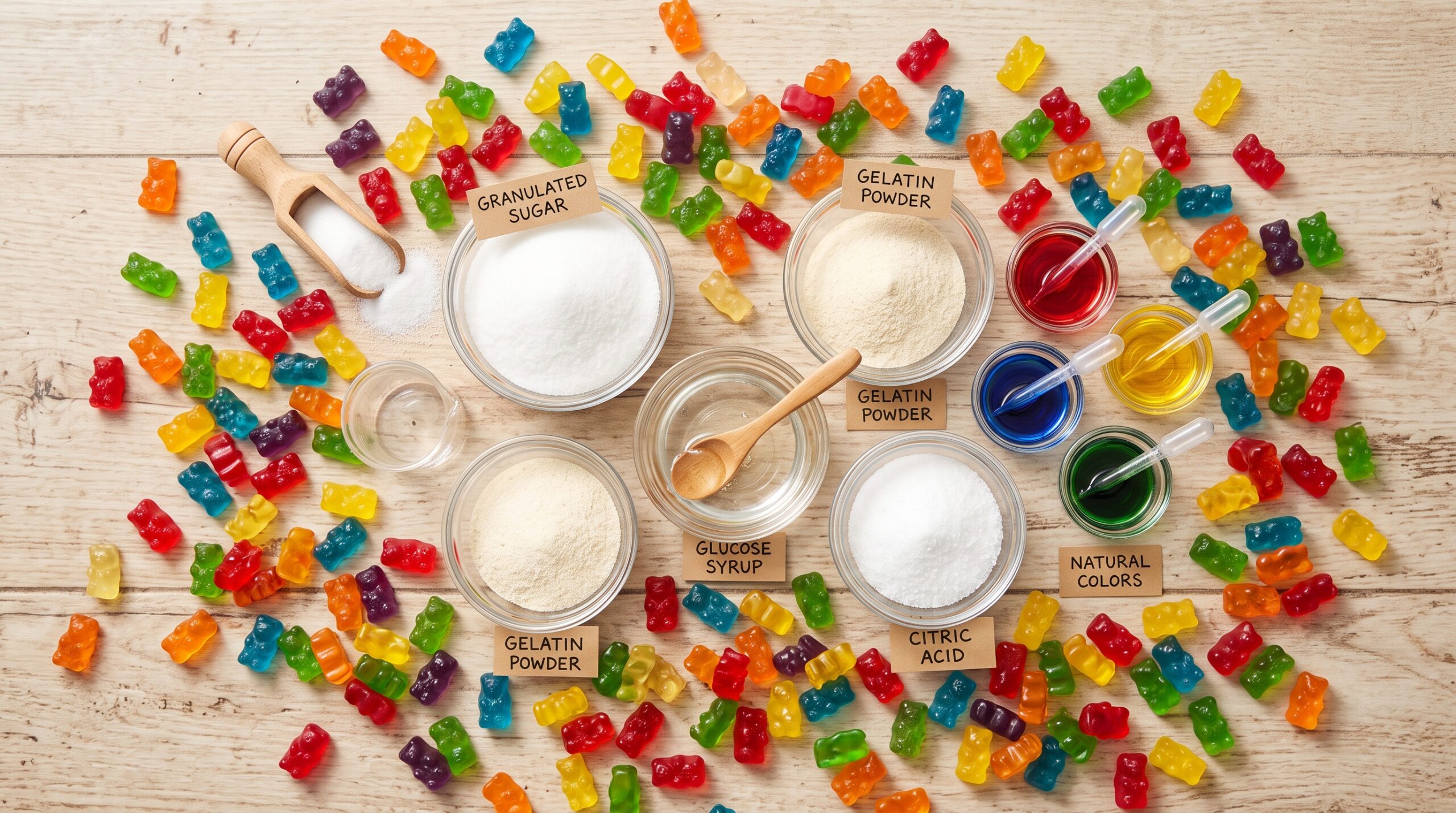
Most gummy developers begin by asking whether the format should use gelatin, pectin, starch-based systems, or hybrids. The honest answer is that there is no single correct base. Gelatin gives elasticity and pleasant bite. Pectin gives a cleaner, shorter break and better heat stability in some applications. Hybrid systems can help when the peel needs better definition but the center still needs a juicy chew. The correct choice depends on target market, climate, labeling expectations, and line speed.
Here is where regulatory and nutrition context matters. According to the FDA’s added sugars guidance, the Daily Value for added sugars is 50 grams on a 2,000-calorie diet, and 20% DV or more is considered high. That matters because this candy is almost always sold as a sweet snack with a strong sensory payoff, which means portion design becomes a commercial decision, not just a nutrition-label exercise. The FDA interactive added sugars reference also notes that each gram of sugar provides 4 calories and that many Americans exceed recommended added sugar intake. For brands, that means pack size and serving structure are doing more work in 2026 than they did a few years ago.
The baseline nutrition profile of gummies also supports that point. Using public branded records from USDA FoodData Central, common gummy candy entries land around 333 to 359 kcal per 100 g, with high sugar loads relative to serving size. One branded 27 g gummy candy example in the USDA database shows 48.1 g of added sugars per 100 g, which is enough to remind any product team that the category cannot rely on “novelty” alone. The format needs good portioning, clear labeling, and packaging that makes the serving feel intentional.
This is also why texture has to do more than just entertain. If a shopper peels one piece and thinks, “That was fun, but too sticky, too sweet, and too hard to separate,” you do not get repeat purchase. The sensory arc needs to feel controlled:
- The surface should feel dry enough to handle.
- The peel should release with light resistance.
- The center should remain elastic, not pasty.
- Flavor release should improve after peeling, not flatten out.
In practice we have found that the spec sheets rarely mention the hardest part: migration. A formula can look perfect on day one, then lose the peel effect by day ten if moisture moves too aggressively between layers or if post-pack humidity is not controlled. That is one of the central reasons this product type needs a more disciplined development cycle than ordinary one-texture gummies.
Types of Peelable Gummy Candy That Actually Sell
The best-selling peelable gummy candy formats are fruit-inspired pieces with clear peel logic, visual color contrast, and individually understandable flavors.
Consumers usually understand the format fastest when the shape tells them what to do. Banana, mango, peach, orange segment, and other fruit-inspired forms work because “peeling” already makes sense. If a product is shaped like an abstract cube, the peel function is harder to read. That may sound obvious, but it becomes a major product design filter once you start thinking about mold investment, depositor setup, and merchandising photos.
The current format families break down like this:
Fruit-format peelables
These are the category leaders. Banana-style pieces, peach-like domes, mango slices, and citrus-inspired segments all work because the peel metaphor is intuitive. Products in this family tend to perform best on social because people instantly understand the reveal.
Mini peel strips or tubes
These use long narrow forms rather than fruit replicas. The advantage is process simplicity. The downside is weaker emotional appeal. They can still work if the outer layer removes in satisfying ribbons.
Multi-piece novelty packs
These combine several shapes and flavors in one bag. The benefit is trial variety. The risk is inconsistency. If one piece peels cleanly and the next one tears, the whole assortment feels less trustworthy.
Premium giftable formats
This is the higher-end direction: clearer molds, stronger color control, cleaner bag graphics, and often a lower count per pack. In export channels or modern retail, premium versions often outperform bulk novelty because they feel more intentional and less disposable.
Here is a useful buying and development matrix:
| Type | Why It Works | Best Channel | Main Risk |
|---|---|---|---|
| Fruit-shaped peelable gummy candy | Easy to understand and visually viral | Convenience, gift, e-commerce | Mold complexity |
| Peelable strips or tubes | Straightforward production and portioning | Budget retail, multipacks | Lower novelty value |
| Mixed-shape assortments | Encourages trial and social sharing | Online bundles, club packs | Inconsistent peel performance |
| Premium small-count peelable gummy candy | Better margins and gifting appeal | Specialty retail, export | Higher expectations on finish |
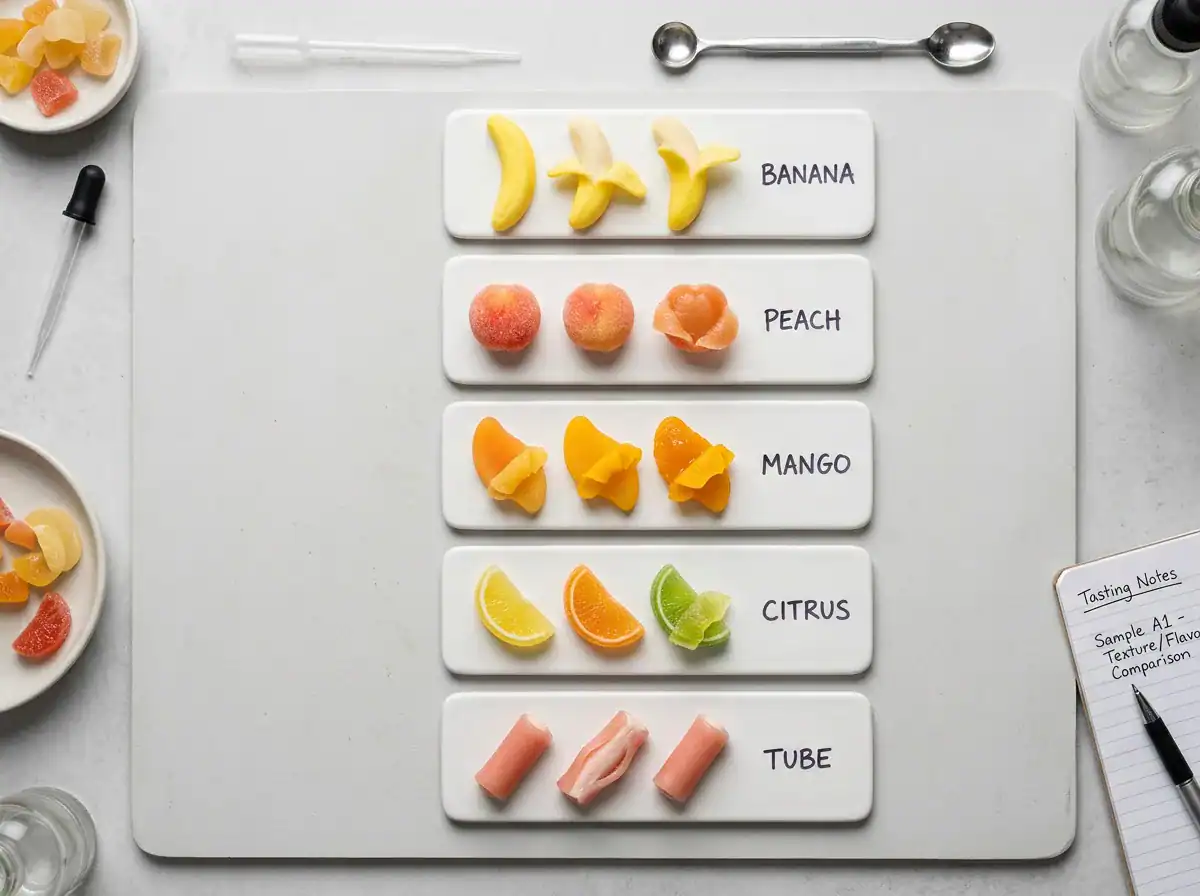
The third-ranking competitor we found, Sporked’s peelable candy roundup, is useful here because it highlights a truth product teams sometimes miss: this format is judged less like a technical candy and more like a snack toy with flavor. If the peel is fun but the taste is dull, the review suffers. If the taste is good but the peel effect feels fake, the novelty collapses. You have to win on both.
That balance is where flavor selection matters. The safest flavors are not always the most exotic ones. Mango, peach, grape, orange, strawberry, and mixed fruit do well because they match the visual cue and hide slight process variation better than delicate flavors. Lychee or yogurt-center concepts can work, but they demand tighter flavor and aroma management.
Most guides stop at the consumer angle. Here is where it gets nuanced: the winning format for a brand is not always the most fun format on camera. For many factories, the better starting point is the format with the fewest failure points. A simple fruit segment with a thick peel may beat a stunning ultra-realistic banana if the banana keeps tearing on the line.
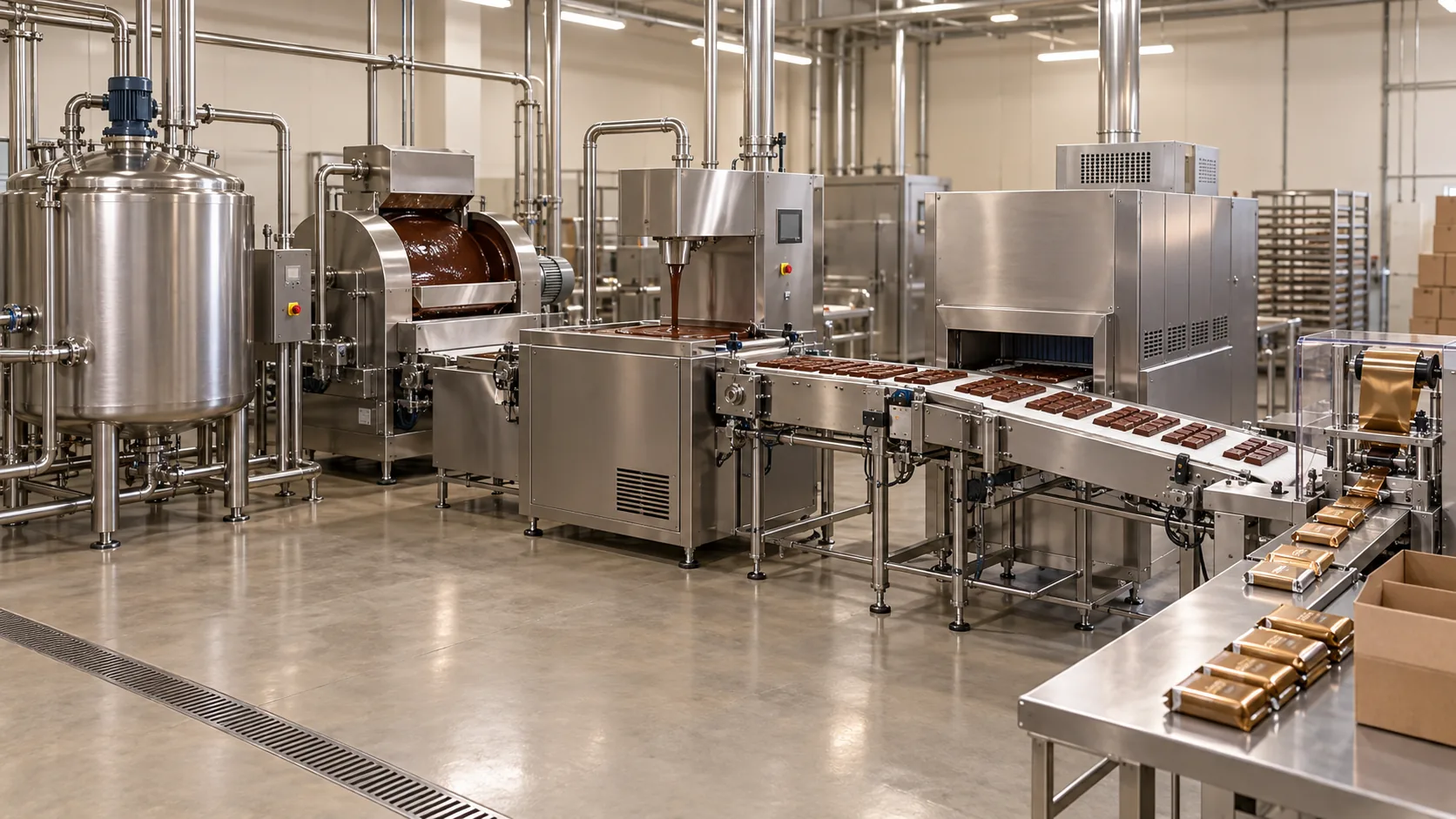
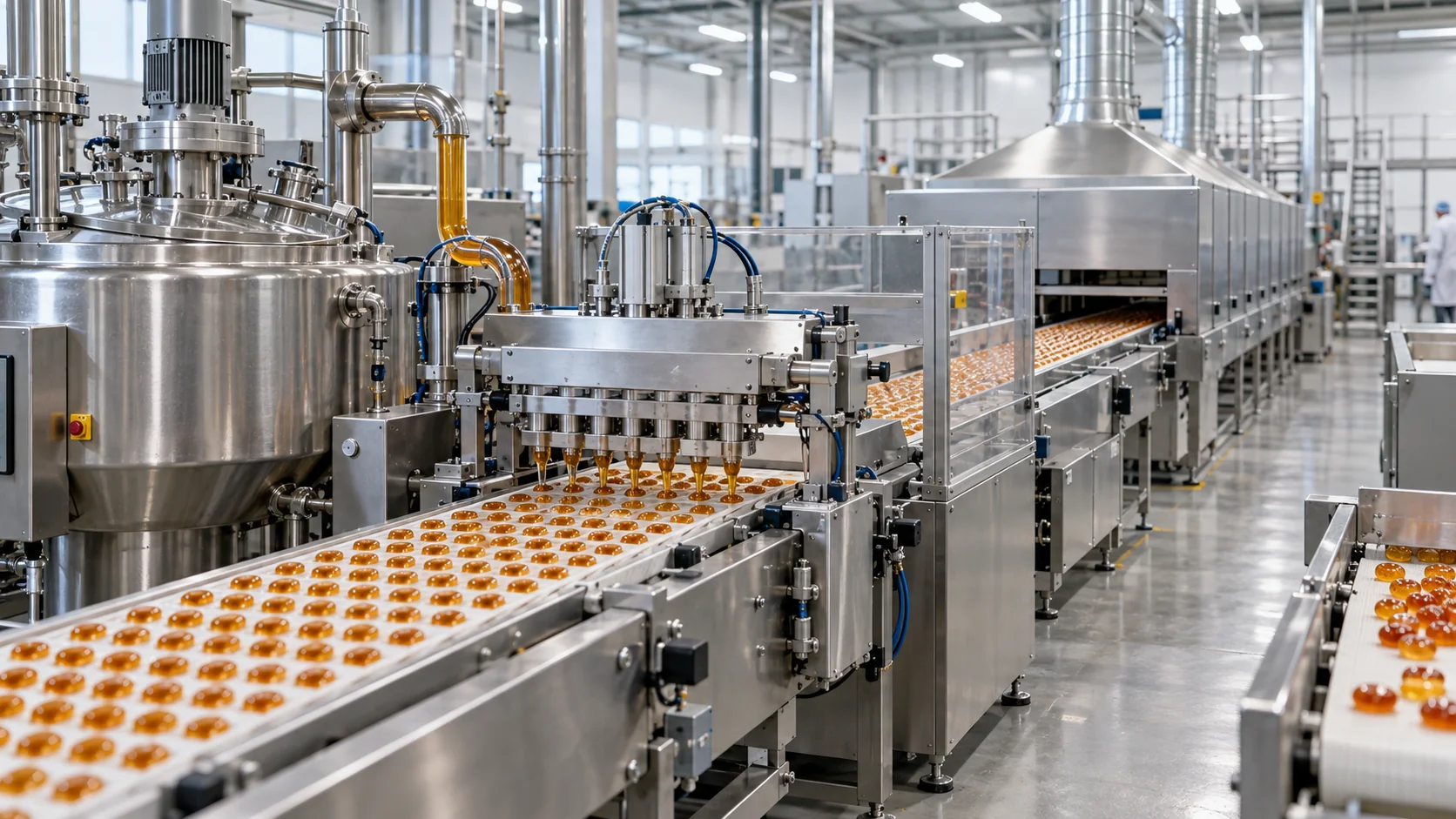
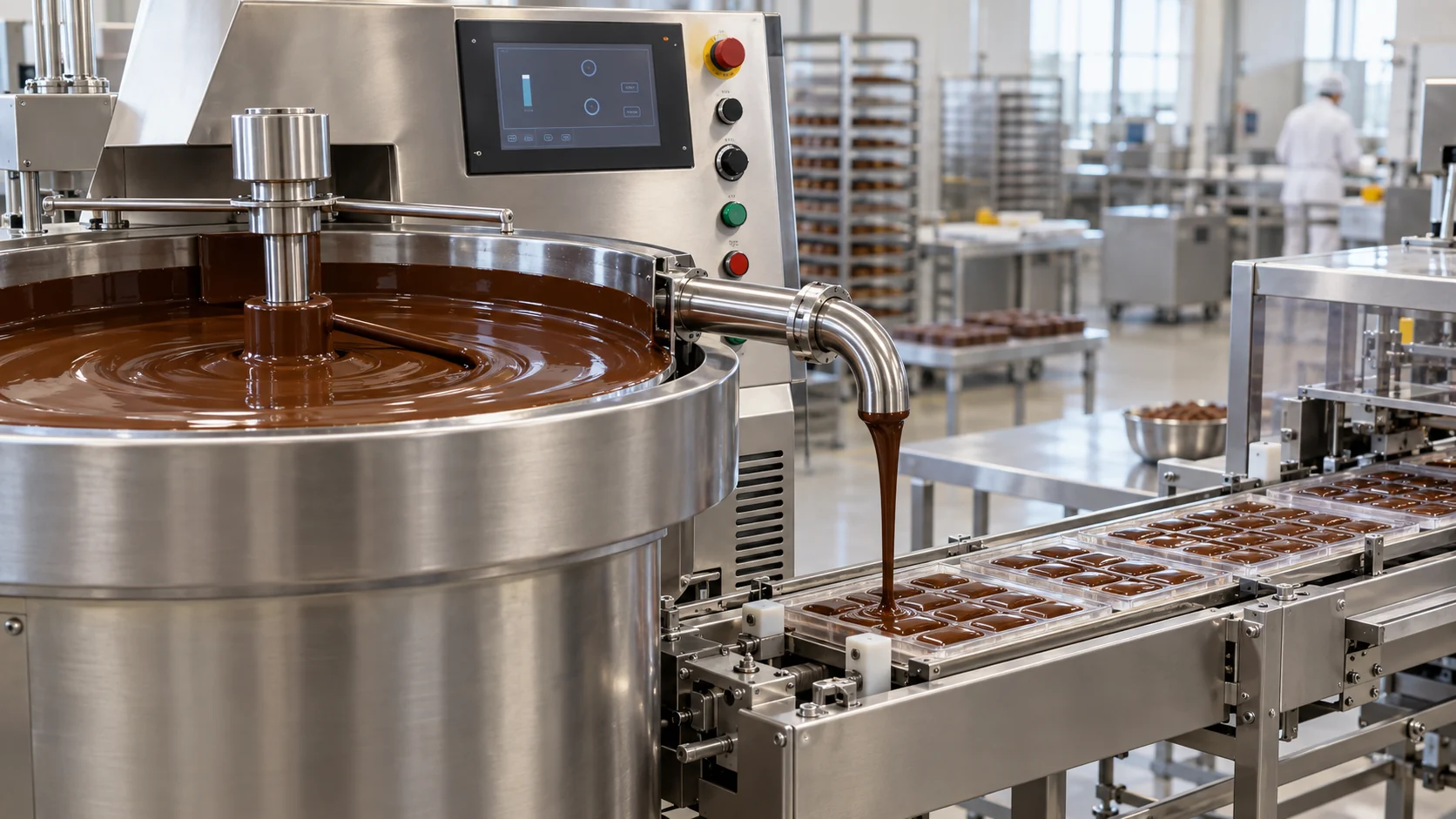
How Peelable Gummy Candy Is Made at Commercial Scale
Peelable gummy candy is made by controlling two-layer deposition, cooling, moisture balance, and gentle packaging so the peel remains separable after storage.
If you already know how gummy bears are made, the broad process for this format will feel familiar. You still need syrup preparation, cooking, depositing, cooling, demolding, conditioning, and packing. The difference is that every stage now has a layer-relationship problem attached to it.
1. Formula design and bench trials
The first job is not to build molds. It is to define the target peel behavior. Does the peel come off in one sheet? In strips? With a slight snap? With a long elastic pull? That decision shapes everything else. A project in this category usually needs more bench iterations than a standard gummy because you are not just optimizing texture. You are optimizing separation.
The core questions are:
- How thick should the peel be?
- How much force should peeling require?
- Can the center tolerate that peel force without deformation?
- Will the peel still release after 30, 60, or 90 days in pack?
2. Syrup cooking and solids control
The outer layer usually benefits from tighter solids control and more disciplined thermal consistency than the core. Small drift here creates big downstream problems. If the peel is under-set, it smears. If it is overcooked, it becomes brittle or leathery. On a commercial line, that means operators need tighter batch records and more reliable inline readings than they might accept for ordinary gummies.
3. Layered depositing or staged molding
This is the heart of the category. Some concepts can be produced with staged deposition, where one layer partially sets before the next is added. Others rely on co-depositing systems or mold strategies that define the shell mechanically. The important point is not which exact route you use. It is whether the interface between layers stays stable without over-bonding.
4. Cooling, conditioning, and demolding
Cooling is where many teams accidentally destroy good lab results. A sample that peels beautifully on a tray can fail after tunnel cooling if the line is too cold, too fast, or too humid. The peel can tighten around the center. The center can contract away from the shell. Surface tack can spike. You want enough structural setting for demolding, but not so much stress that the peel loses its clean release.
5. Oiling, sugar finishing, or surface treatment
Surface finishing has to be more selective for this type of candy. Too much oil can make the peel slippery in an unpleasant way. Too little and pieces stick in pack. Sugar sanding can look attractive, but it can also interfere with the consumer’s ability to grip and peel the outer skin. This is one of those areas where a standard gummy habit can become a category mistake.
6. Packaging and drop protection
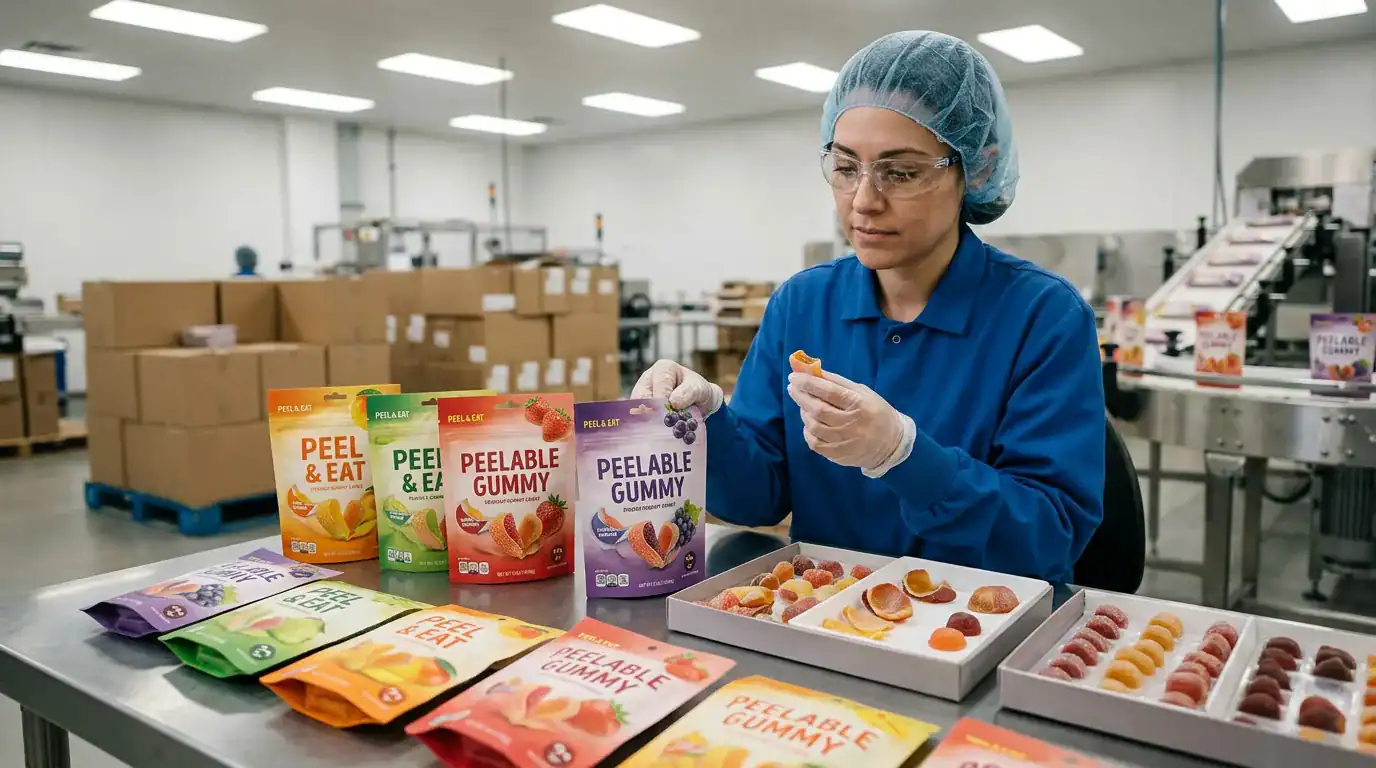
Once the piece works, packaging becomes the next make-or-break issue. These products often need packaging that protects shape detail and prevents layer distortion under compression. That is why candy packaging equipment matters so much for this category. A bagger or flow wrapper that is perfectly fine for hard candy or plain gummies can still over-handle a softer peelable format.
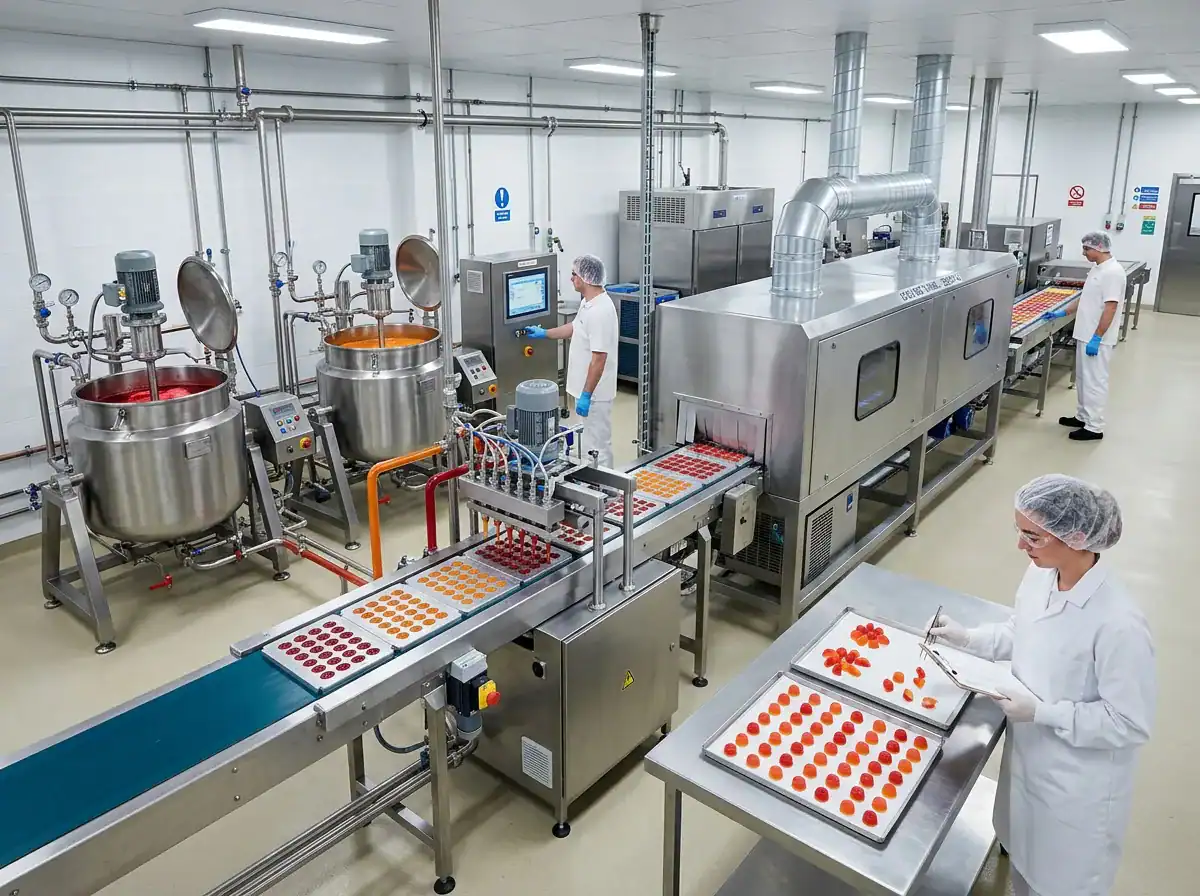
For a production line team, the process logic looks like this:
| Stage | What Matters Most | Typical Failure |
|---|---|---|
| Cooking | Stable solids and temperature | Peel too weak or too rigid |
| Depositing | Accurate layer placement | Poor peel/core definition |
| Cooling | Controlled set without stress | Peel bonds too strongly |
| Demolding | Clean release and shape retention | Surface tearing |
| Packaging | Low compression and low stick | Flattening or tack pickup |
In practice we have seen one failure mode appear again and again: a product that works as a hand-crafted sample but not as a repeatable line product. The reason is usually not dramatic. It is small uncontrolled variation multiplied across a sensitive format. A depositor running a little warm, a cooling zone a little too aggressive, or a pack line with slightly too much drop height can undo the peel effect you spent weeks developing.
That is why the smartest route for factories entering the category is phased scaling. Start with a format that can tolerate some variation. Validate peel performance after storage. Then increase complexity. It is slower at the start, but far cheaper than launching a dramatic-looking SKU that comes back in complaints because the peel does not peel.
How to Choose Peelable Gummy Candy for Retail, Private Label, or Export
The right format depends on shelf channel, target age group, bag size, and how consistently the peel effect survives distribution.
If you are a buyer, brand owner, or product manager, the question is not “Is this trendy?” It clearly is. The better question is whether your version is right for your channel.
For mass retail, you usually want:
- Clear fruit shapes.
- Fast-understood flavors.
- Moderate price point.
- Pack sizes that feel impulse-friendly.
For e-commerce or gift channels, you can support:
- More dramatic visuals.
- Larger multipacks.
- Higher novelty expectation.
- Better storytelling on packaging.
For export, the category needs even more discipline. Temperature, freight time, humidity, and bag compression all matter more than the novelty copy on the front panel. If the product is headed into warmer or less climate-controlled routes, the peel performance has to be validated under stress, not just under showroom conditions.
A practical buying checklist looks like this:
- Confirm whether the peel effect still works at end-of-shelf-life.
- Check if the product can survive compression in cartons and master cases.
- Review whether the flavor set is intuitive for the target market.
- Verify labeling, serving size logic, and added-sugars presentation.
- Assess whether the pack format supports repeat purchase, not just first-click curiosity.
This is also where the format can benefit from a manufacturing-site story. If the brand can explain not only that the candy is fun, but that it is built with reliable process control, clean packaging, and consistent flavor standards, the format feels less like a fad. That matters for B2B sales discussions, distributor confidence, and retailer reorders.
Common Problems in Peelable Gummy Candy and How to Fix Them
Most failures in this category come from over-bonding, under-setting, tack pickup, or packaging stress rather than from flavor issues.
The biggest category mistake is assuming that if a piece tastes good, the product is ready. With this format, mechanical behavior is part of the eating experience. If the peel does not behave correctly, the product is broken even when the flavor is excellent.
Here are the common failure points:
| Problem | Likely Cause | Practical Fix |
|---|---|---|
| Peel tears into small pieces | Outer layer too thin or too weak | Increase peel solids, thickness, or set strength |
| Peel will not separate | Layers bonded too strongly | Adjust interface timing and moisture balance |
| Center comes off with peel | Core too firm or interface too sticky | Soften core and reduce adhesion |
| Pieces stick in bag | Surface tack or poor finishing | Improve conditioning and packaging environment |
| Shape collapses in transit | Pack compression too high | Use gentler fill, stronger structure, or better tray support |
| Flavor seems flat after peeling | Aroma locked in peel or diluted center | Rebalance flavor loading between layers |
That table looks simple. The execution is not.
One of the subtle issues with this format is that fixes are not isolated. If you make the peel stronger, you might improve release but worsen chew. If you soften the center, you might improve contrast but reduce shelf stability. If you dry the surface more aggressively, you might reduce sticking but make the product feel stale. This is why good development needs a full matrix of peelability, chew, flavor, storage, and packaging tests rather than a single pass/fail sample review.
Another overlooked problem is consumer expectation mismatch. If the pack art suggests a dramatic full peel but the candy only peels halfway, shoppers read that as failure. In other words, the product has a promise built into its name. You have less room for ambiguity than you do in ordinary gummy products.
In practice, we have found that teams do better when they define one measurable peel target early. For example: “Outer layer should remove in one continuous strip from at least 80% of pieces after 30 days at target storage.” That kind of definition turns the concept from a vague novelty into a process goal operators can actually manage.
Peelable Gummy Candy Trends for 2026 and Beyond
The next phase of the category is less about novelty alone and more about texture precision, better packaging, and stronger premium positioning.
The first wave won attention because the format was surprising. The next wave will be judged on repeatability and line quality. That is a healthy shift. It means the category is maturing.
Several trends are already visible:
Smaller, more intentional pack sizes
Because the category is rich in sugars and sold as an experience product, smaller counts make commercial sense. They improve perceived value, help with nutrition communication, and reduce texture damage from excess pack weight.
More premium visual finishing
Clean mold lines, better color contrast, and more realistic fruit textures are becoming more important. In a crowded snack feed, a cheap-looking product loses attention fast.
Better packaging for shape protection
As more brands learn the hard way, the format is less tolerant of rough packing than standard gummies. Expect more attention on flow wrapping, tray support, and bag-fill geometry in 2026.
Cross-over with 4D and filled formats
Some of the strongest future launches will likely sit between categories: peelable shell, 4D fruit look, maybe even a softer center with stronger aroma release. That gives the format more runway than a one-trick novelty product.
More disciplined nutrition and label positioning
This part matters. FDA guidance continues to push buyers and brands toward clearer understanding of added sugars and serving context. That means brands that combine fun with clearer pack architecture will probably outperform copycat products that rely on novelty alone.
The opportunity here is real, but it is not automatic. The brands and factories that win in this segment will be the ones that treat the peel effect as a controllable manufacturing outcome, not a lucky accident.
FAQ About Peelable Gummy Candy
These are the questions buyers and shoppers ask most often when they first discover peelable gummy candy.
What is peelable gummy candy?
Peelable gummy candy is a gummy confection with a firmer outer layer that peels away from a softer center before eating. It combines novelty, texture contrast, and strong visual appeal.
How is peelable gummy candy different from normal gummies?
Peelable gummy candy uses a two-layer structure instead of one uniform chew. The peel and center are engineered to behave differently, which makes production more demanding than standard gummies.
What flavors work best for peelable gummy candy?
Fruit flavors work best because the peeling concept feels natural in banana, mango, peach, citrus, and grape formats. Matching flavor to shape helps consumers understand the product immediately.
Is peelable gummy candy harder to manufacture?
Yes. The layers must separate cleanly after cooling, storage, and packaging, so moisture, depositing, and handling control matter more than they do for ordinary gummies.
Why does peelable gummy candy sometimes not peel properly?
The usual causes are weak peel structure, excessive tack, or layers bonding too strongly. Heat, humidity, compression, and formula drift can all damage peel performance.
Is peelable gummy candy just a trend?
It started as a novelty trend, but the strongest products have repeat-purchase potential because the format combines fun with real texture differentiation. Only well-made products will last beyond the hype cycle.
What equipment matters most for peelable gummy candy?
The critical areas are accurate cooking, controlled depositing, stable cooling, and gentle packaging. Those are the points where the peel effect is either preserved or lost.
Conclusion
Peelable gummy candy works when the peel effect feels easy, satisfying, and repeatable from the first bag to the thousandth carton.
That is the key takeaway. The format is not interesting because it is weird. It is interesting because it turns texture into theater. A shopper peels it, looks at it, and talks about it. That gives the category more social energy than ordinary gummies. But for manufacturers and brand owners, the real value is not the first reaction. It is whether the product can deliver that same reaction consistently across batches, shelf life, and shipping conditions.
If you are evaluating this as a consumer product, focus on three things: clean peel behavior, strong fruit logic, and packaging that protects shape. If you are evaluating it as a factory or private-label opportunity, focus on formula control, interface stability, and packaging discipline. Those are the levers that separate a viral sample from a reliable business.
The top search results mostly show that people are curious. The bigger opportunity is what comes next: brands that want a better novelty SKU, distributors that want something giftable and social-ready, and factories that want to move into higher-value gummy formats without guessing. If that is your direction, the next practical step is to connect product concept with production reality by reviewing your gummy process, your packaging line, and your tolerance for layer-sensitive confectionery.
For deeper context on adjacent formats, review gummy candy brands, how do you make gummy bears, and candy packaging equipment. Those resources make the jump from “interesting candy trend” to “repeatable commercial product” much easier to manage.
Related Articles
- French Candy: The Complete Guide to Types, Traditions & Commercial Production
- The Complete Guide to Halal Candy: Ingredients, Certification, and How to Scale Production Right
- The Ultimate Guide to Cactus Candy: Commercial Production, Ingredients, and Industry Trends
- The Best Gummy Candy Production Line: A Complete Guide for Beginners
- Gummy Candy Production Line
- Starch-Free Gummy Depositing Machine
- Are Skittles Gluten Free? Complete Guide 2026