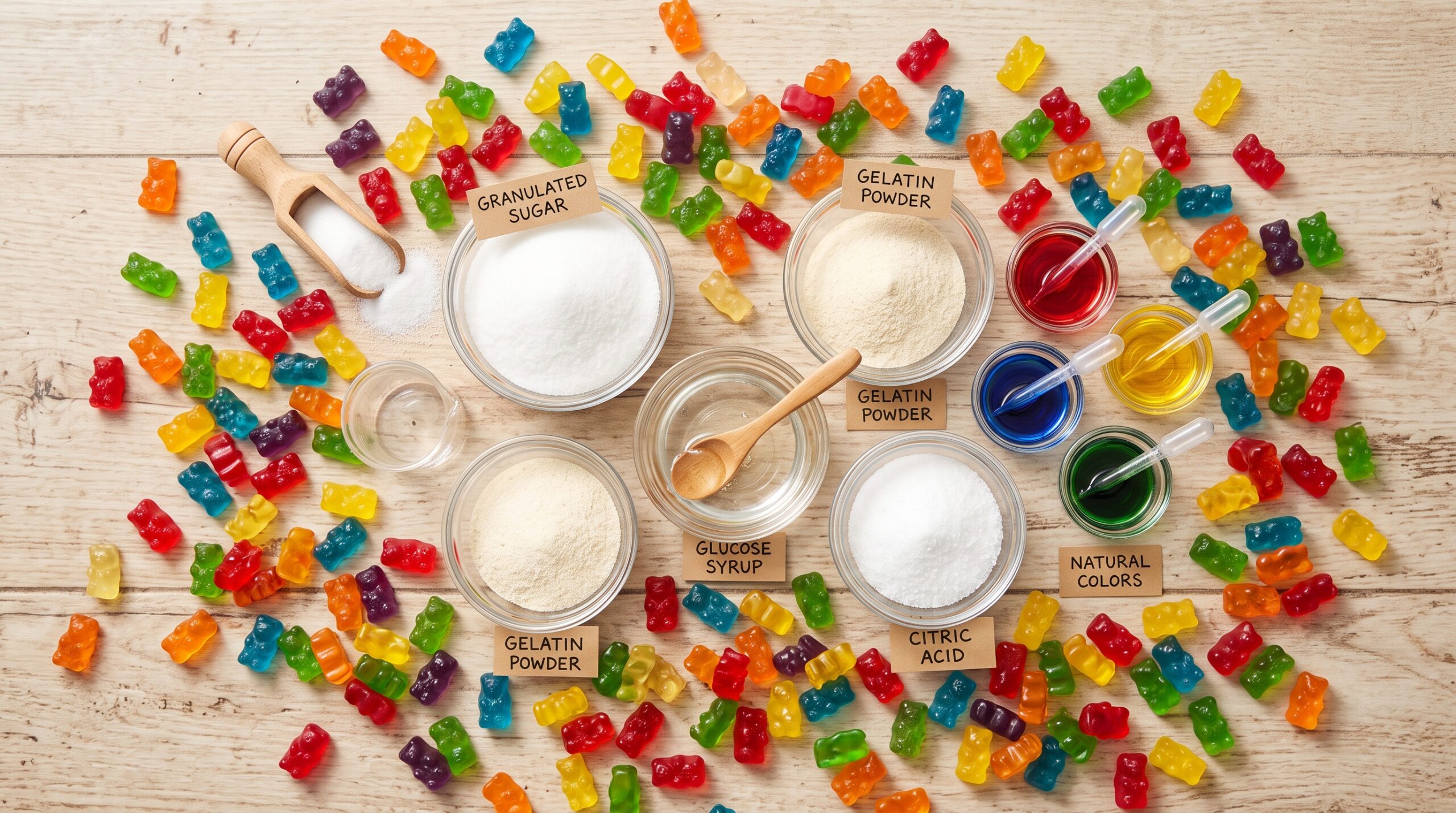
Spanish candy includes traditional sweets like turrón, polvorones, gominolas, and caramelos — each crafted with distinct ingredients and manufacturing processes that have defined Spanish confectionery for centuries.
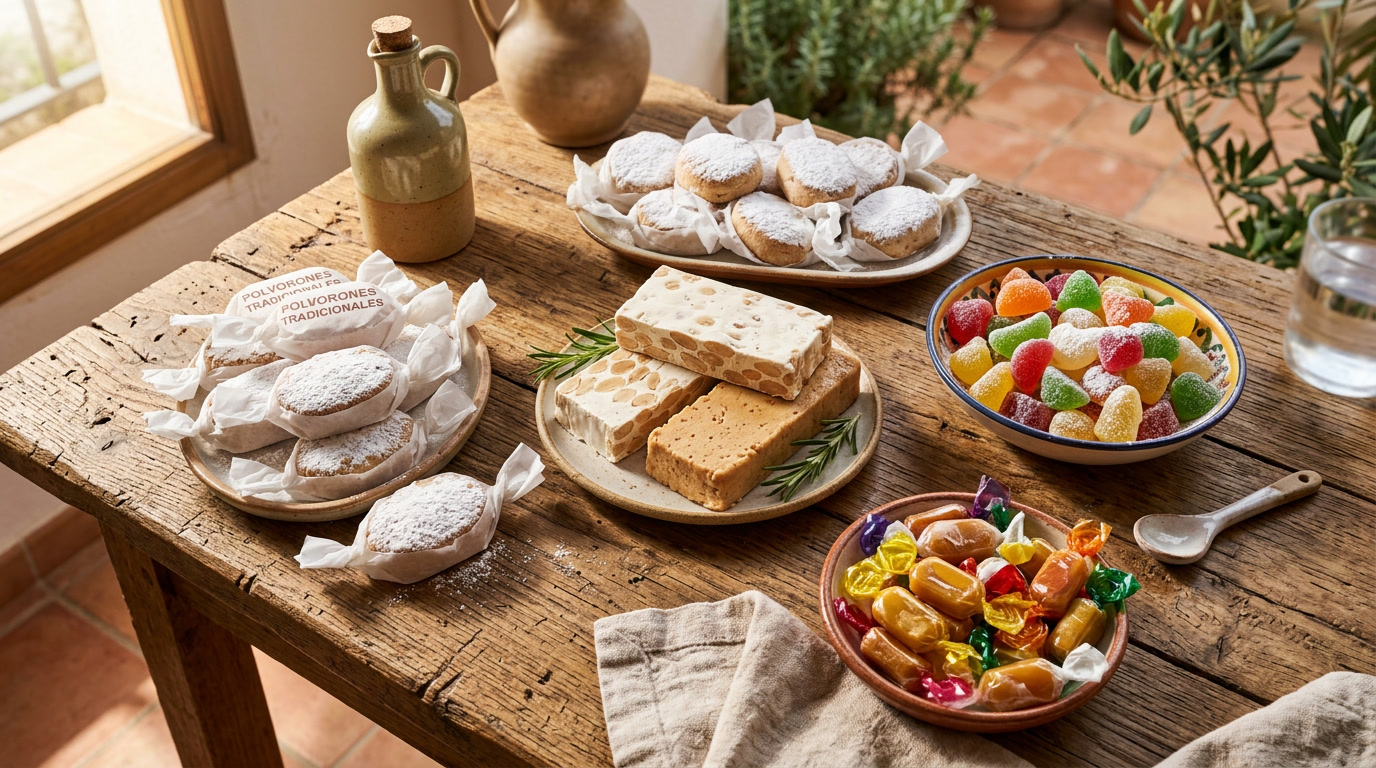
Spain’s confectionery tradition stretches back more than a thousand years, shaped by Moorish influence, centuries of trade with the Americas, and a deep regional pride that means every province has its own signature sweet. Walk into a Spanish market today and you’ll find honey-glazed almonds next to soft nougat blocks, sugar-dusted shortbreads beside vivid gummy bears, hard caramels alongside chocolate-coated figs.
For candy enthusiasts, that variety is a delight. For manufacturers and industry professionals, it represents something more: a roadmap of production techniques, ingredient choices, and machinery requirements that together define what Spanish candy actually is. This guide covers both angles — the culture and the craft — so you walk away understanding not just what Spanish candy tastes like, but how it gets made.
What Is Spanish Candy?
Spanish candy encompasses all confectionery produced in Spain or following traditional Spanish recipes. It draws from three major historical influences: the ancient Roman use of honey and nuts, the Moorish introduction of almonds, sugar, and spices during the 8th–15th centuries, and the 16th-century influx of cocoa and vanilla from the Americas. The result is a confectionery tradition with unusual depth — Spanish candy tends to rely on fewer synthetic ingredients than many modern sweets, leaning instead on regional nuts, local honey, and quality sugar.
A Thousand Years of Sweet-Making
The earliest documented Spanish candy traces to Al-Andalus, the medieval Islamic territory that covered most of the Iberian Peninsula. Moorish confectioners introduced sugar cane cultivation and refined the technique of cooking sugar to different consistencies — skills that underpin hard-candy and nougat production to this day. When Christian kingdoms reconquered Spain, they kept the recipes. Turrón (nougat) was documented in Jijona by the 15th century and has been made there continuously ever since.
Columbus’s voyages brought cacao and vanilla to Spain before anywhere else in Europe. Spanish monks and court confectioners spent decades developing chocolate recipes, turning raw cacao into something approaching the chocolate we recognize now. That early access gave Spanish candy makers a head start on chocolate confectionery that still shapes regional specialties today.
What Makes Spanish Candy Different
Most Spanish candy is defined by three characteristics:
- Nut-forward: Almonds appear in turrón, polvorones, mazapán, and dozens of regional sweets. Spain is one of the world’s leading almond producers, which makes the nut both culturally central and economically practical.
- Seasonal: Many traditional Spanish candies are explicitly tied to Christmas (Navidad), Easter, or local festivals. Polvorones and turrón are consumed almost exclusively in December. This seasonality shapes production volumes and manufacturing planning in ways that differ sharply from mass-market candy.
- Regional: Spanish candy is not monolithic. Jijona (Alicante) makes the best turrón blando. Toledo is the center for mazapán. The Basque Country produces txokolate with distinctly bitter cacao profiles. Seville is famous for its orange-peel candies. Understanding regional identity matters for anyone sourcing, producing, or marketing Spanish candy.
| Category | Key Ingredient | Region of Origin | Primary Season |
|---|---|---|---|
| Turrón | Almonds + honey | Jijona, Alicante | Christmas |
| Polvorones / Mantecados | Lard + flour + sugar | Estepa, Seville | Christmas |
| Mazapán | Almonds + sugar | Toledo | Year-round / Christmas |
| Gominolas | Gelatin / pectin + sugar | Nationwide | Year-round |
| Caramelos | Sugar + flavorings | Nationwide | Year-round |
| Peladillas | Sugar-coated almonds | Nationwide | Weddings / celebrations |
| Pralinés de chocolate | Cacao + sugar | Nationwide (Basque specialty) | Year-round |
Types of Spanish Candy
Turrón — Spain’s Most Iconic Sweet
Turrón is the undisputed king of Spanish candy. Made from almonds, honey, sugar, and egg whites, it comes in two primary textures: turrón duro (hard, crunchy — Alicante style) and turrón blando (soft, paste-like — Jijona style). Both are protected by EU geographical indication (IGP) status, which means authentic Alicante or Jijona turrón must meet strict ingredient minimums and production standards.
A genuine Alicante turrón contains at least 60% almonds. Jijona turrón goes further — up to 64% almond content — and is processed a second time through stone mills that break down the nut cells and release oils, creating that characteristic smooth, semi-solid consistency. This double-milling step is what distinguishes Jijona from simple ground-almond paste. According to data compiled by the Spanish Confectionery Industry Association, turrón and mazapán together account for roughly 45% of Spanish Christmas confectionery sales by revenue.
Production of turrón requires mixing kettles capable of handling dense, sticky masses, stone or steel refining mills, slab molds for casting, and cutting lines for portioning. The temperature window is narrow — too hot and the almond oils separate; too cool and the honey doesn’t bind properly.
Polvorones and Mantecados
Polvorones are crumbly, melt-in-your-mouth shortbreads made from rendered lard (manteca de cerdo), toasted wheat flour, sugar, and spices like cinnamon and anise. They’re so fragile they’re individually wrapped in tissue paper before packaging — a texture that’s partly the point and partly a manufacturing challenge. Mantecados are closely related; the distinction is regional branding and slight recipe variations rather than fundamentally different products.
The town of Estepa in Seville produces more than 70% of Spain’s polvorones. At peak season (October–December), its confectionery factories run 24-hour shifts. The production process involves roasting flour to a light golden color, blending with lard and sugar, forming portions, and baking at low temperatures to preserve the crumble structure. packaging machinery for polvorones must handle extremely delicate pieces without crushing them — a specialized requirement that differs substantially from standard hard-candy packaging lines.
Gominolas — Spanish Gummy Candy
Gominolas are the Spanish gummy candy — soft, gelatin- or pectin-based sweets in a range of shapes and flavors. They’re the category most Spanish children grow up eating, sold loose by weight in neighborhood shops (chucherías). Gominolas include worm-shaped gusanitos, fried-egg shapes, fruit slices, and hundreds of other forms.
The leading brand, Haribo, manufactures gummy candy in Spain alongside a robust domestic industry. Spanish gominolas often carry slightly higher gelatin content than German-style gummies, producing a firmer chew. Vegan and halal versions using pectin or agar rather than animal gelatin have grown significantly since 2020, reshaping ingredient sourcing for manufacturers.
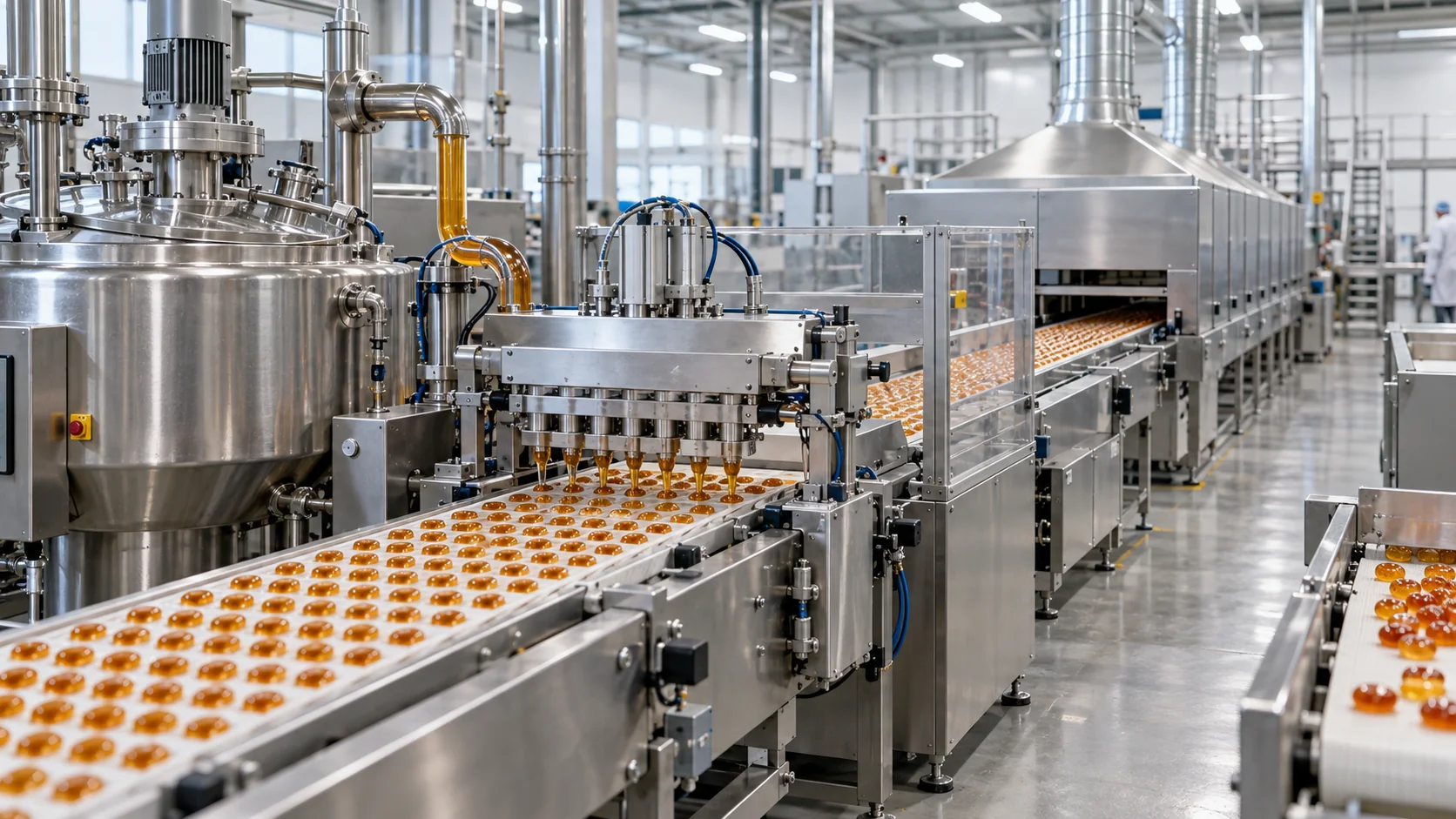
Manufacturing gominolas requires depositing machines that inject liquid candy mass into starch molds, temperature-controlled cooling tunnels, de-molding equipment, and coating drums for the sugar or oil finish. Production lines can run at 200–1,000 kg/hour depending on capacity. Starch mogul systems remain the industry standard for shaped gominolas, though newer silicone-mold depositors are gaining ground for smaller specialty runs.
Caramelos — Spanish Hard and Soft Candy
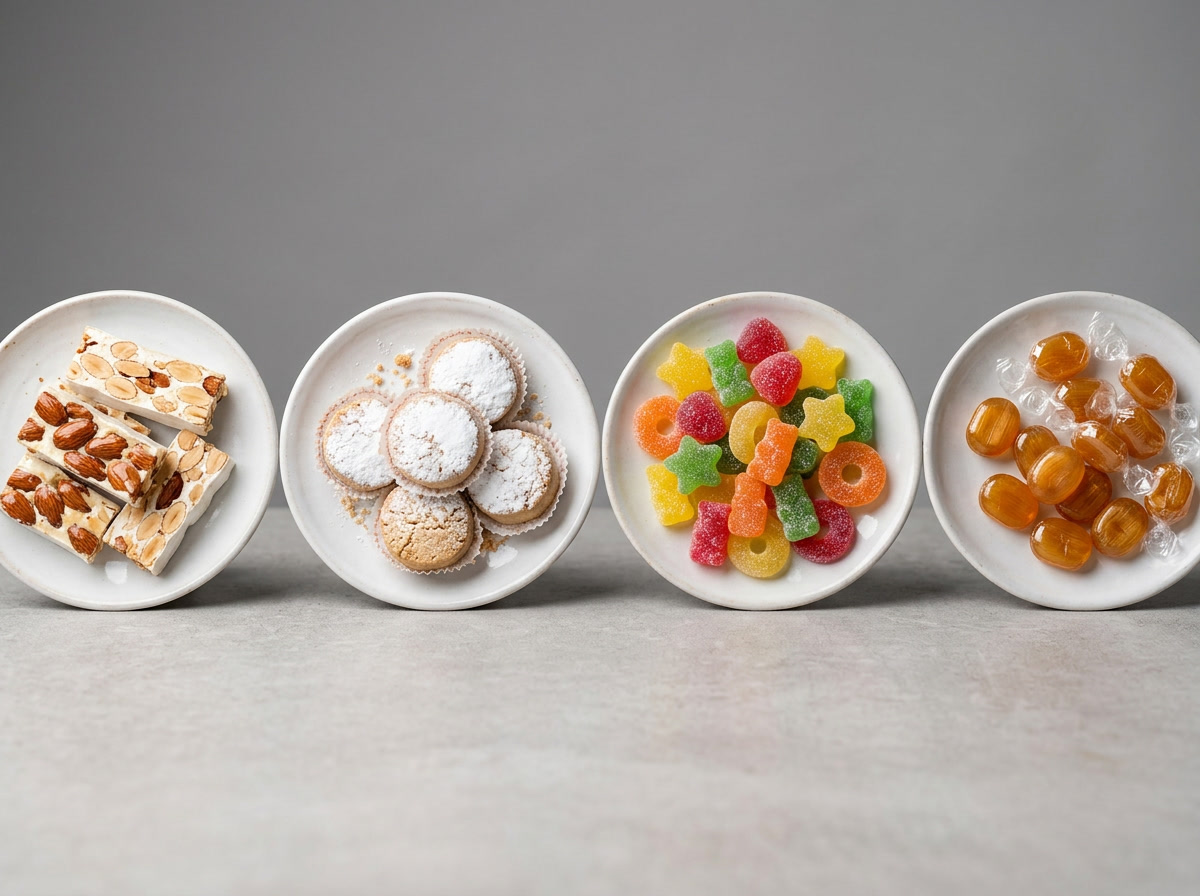
Caramelos (caramelos duros for hard candy, caramelos blandos for toffee-style soft candy) form the everyday backbone of the Spanish candy market. Regional varieties include:
- Caramelos de miel — honey-flavored hard candy, often sold at pharmacies for throat soothing
- Caramelos de café — coffee-flavored hard candy popular with adults
- Caramelos rellenos — hard candy with liquid or soft-center fills
- Toffees — buttery, chewy soft caramels often individually wrapped
Hard caramelo production uses high-boiled sugar (typically cooked to 150–160°C), flavor and color addition, forming on roller-die or drop-roller lines, and wrapping. Filled caramelos require co-extrusion systems that encapsulate a soft center within the hard shell during a single continuous forming step.
Regaliz — Spanish Licorice
Spanish licorice (regaliz) deserves its own mention. Spain is one of the few countries where the actual licorice root plant (Glycyrrhiza glabra) is widely cultivated, giving Spanish licorice a more intense and herbal flavor profile than most commercial licorice candy. Classic palitos de regaliz (licorice sticks) are simply dried root — no manufacturing needed. Processed regaliz candy uses licorice extract combined with sugar, flour, and anise to produce the familiar black rope or coin shapes.
| Spanish Candy Type | Sugar Content (approx.) | Texture | Production Complexity |
|---|---|---|---|
| Turrón duro | 25–35% | Hard, crunchy | High (almond minimum standards) |
| Turrón blando | 20–30% | Soft paste | Very high (double-milling required) |
| Polvorones | 30–40% | Crumbly, dry | Medium-high (fragile handling) |
| Gominolas | 50–65% | Soft, elastic | Medium (starch mogul system) |
| Caramelos duros | 60–80% | Hard, brittle | Low-medium (standard boiling) |
| Caramelos blandos | 45–60% | Chewy | Medium (toffee cooker) |
| Regaliz candy | 40–55% | Chewy rope/disk | Medium (extrusion line) |
How Spanish Candy Is Made — The Manufacturing Process
Core Ingredients in Spanish Confectionery
Spanish candy relies on a relatively short ingredient list, which is part of its identity. The staples:
- Sugar — refined white sugar for caramelos and gominolas; unrefined or partially refined brown sugar for polvorones and some nougat styles
- Almonds — Spanish-grown Marcona almonds are prized for turrón; Largueta varieties are used for peladillas
- Honey — Spanish honey production is significant; Mediterranean varieties (rosemary, orange blossom, thyme) influence turrón flavor
- Lard — essential for polvorones; no substitute produces the same texture
- Gelatin / Pectin / Agar — for gominolas, depending on dietary requirements
- Cacao — for chocolate-based Spanish candy and pralines
- Licorice extract — for regaliz products
No artificial preservatives appear in traditional recipes. Shelf life is managed through low water activity (hard candy, turrón) or tight packaging (polvorones), not chemical additives.
Industrial vs. Traditional Production
Small artisan producers and large industrial factories make Spanish candy in fundamentally different ways, but the product requirements stay the same. Artisan turrón makers in Jijona still use stone mills that date back generations. Industrial operations use stainless-steel refiners and automated depositors, but the essential chemistry — almond proteins reacting with sugars and honey in the presence of heat — is identical.
The practical difference lies in throughput and consistency. An artisan batch of turrón might be 50 kg; an industrial run might be 5,000 kg per shift. Achieving the same texture at industrial scale requires precise temperature control, consistent ingredient proportions, and machinery calibrated for the rheology (flow behavior) of dense almond-sugar masses.
In practice we’ve found that most Spanish candy quality failures trace back to one of three points: inconsistent sugar crystallization (especially in caramelos), incorrect moisture content in polvorones (too wet = crumbling; too dry = brittleness beyond specification), or inadequate almond grinding in turrón (leaving perceptible grain in what should be a smooth blando).
Key Machinery in Spanish Candy Production
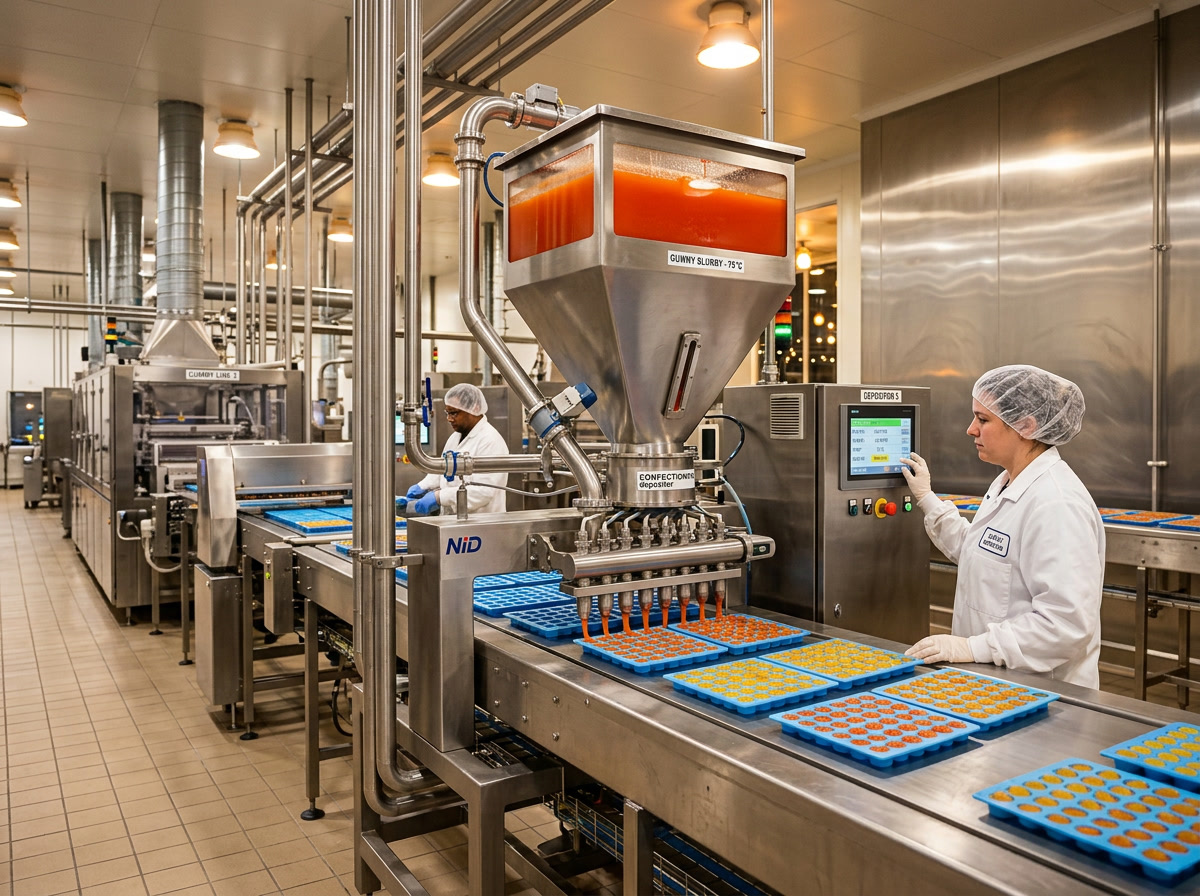
Different Spanish candy types require different production lines, but several equipment categories appear across most Spanish confectionery operations:
1. Cooking and Mixing
– Open-fire copper kettles (artisan turrón and caramelos)
– Vacuum cookers (gominolas, soft caramelos) — vacuum reduces air bubbles and controls moisture
– Sigma-blade mixers (polvorones dough — handles high-fat, low-moisture masses)
– Planetary mixers (nougat, mazapán)
2. Forming
– Stone mills and ball refiners (turrón blando)
– Starch mogul depositors (gominolas — fills starch trays, deposits liquid candy, tunnels through cooling/drying)
– Roller-die forming (turrón duro slabs, caramelos)
– Extrusion lines (regaliz, soft caramelos)
– Cold-press forming (polvorones — requires low pressure to preserve crumble)
3. Cooling and Conditioning
– Cooling tunnels (caramelos, gominolas)
– Starch drying rooms (gominolas held 24–48 hours in starch at controlled humidity)
– Temperature-controlled aging rooms (polvorones)
4. Coating and Finishing
– Sugar panning drums (peladillas — multiple coating passes to build up the sugar shell)
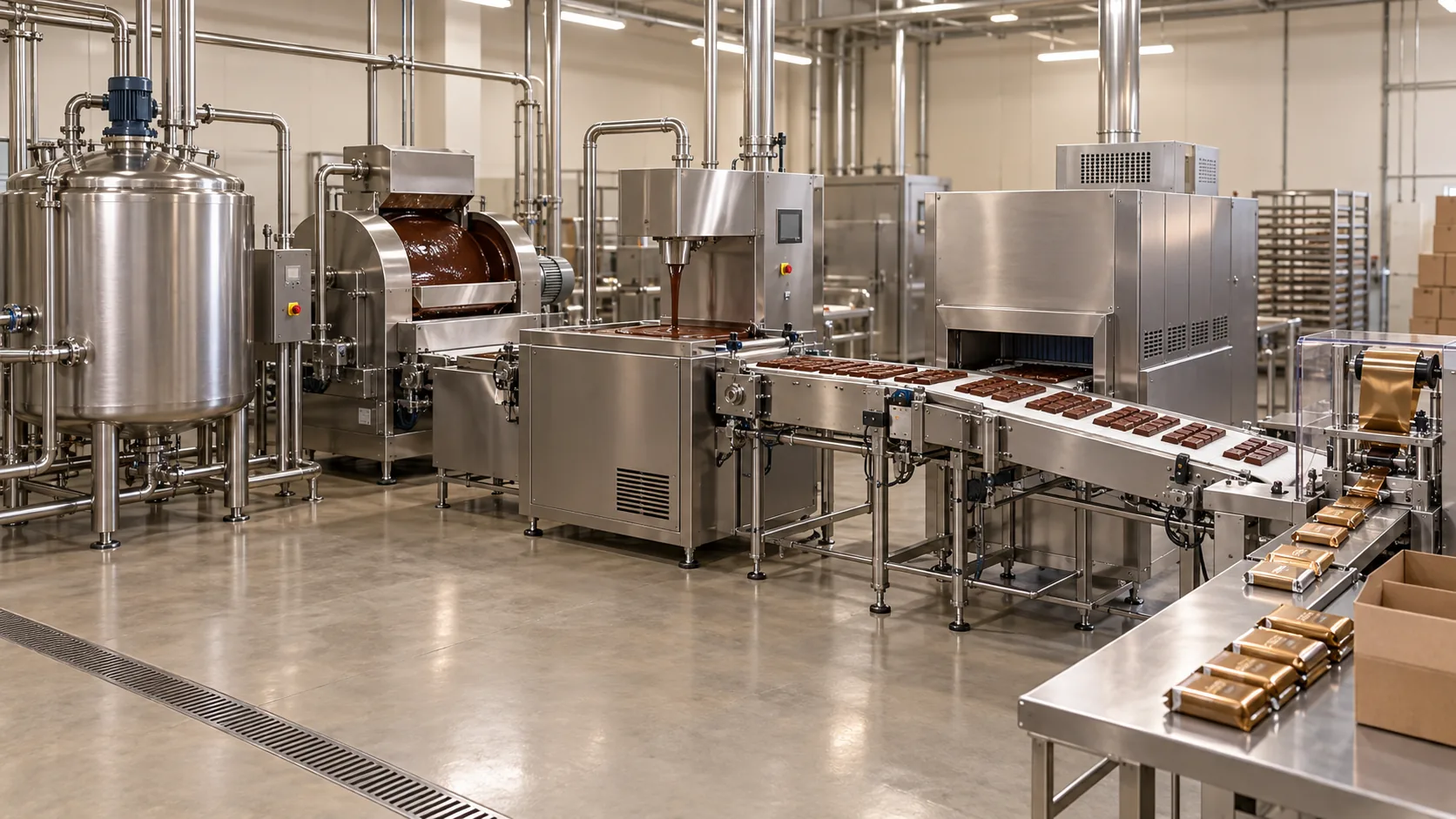
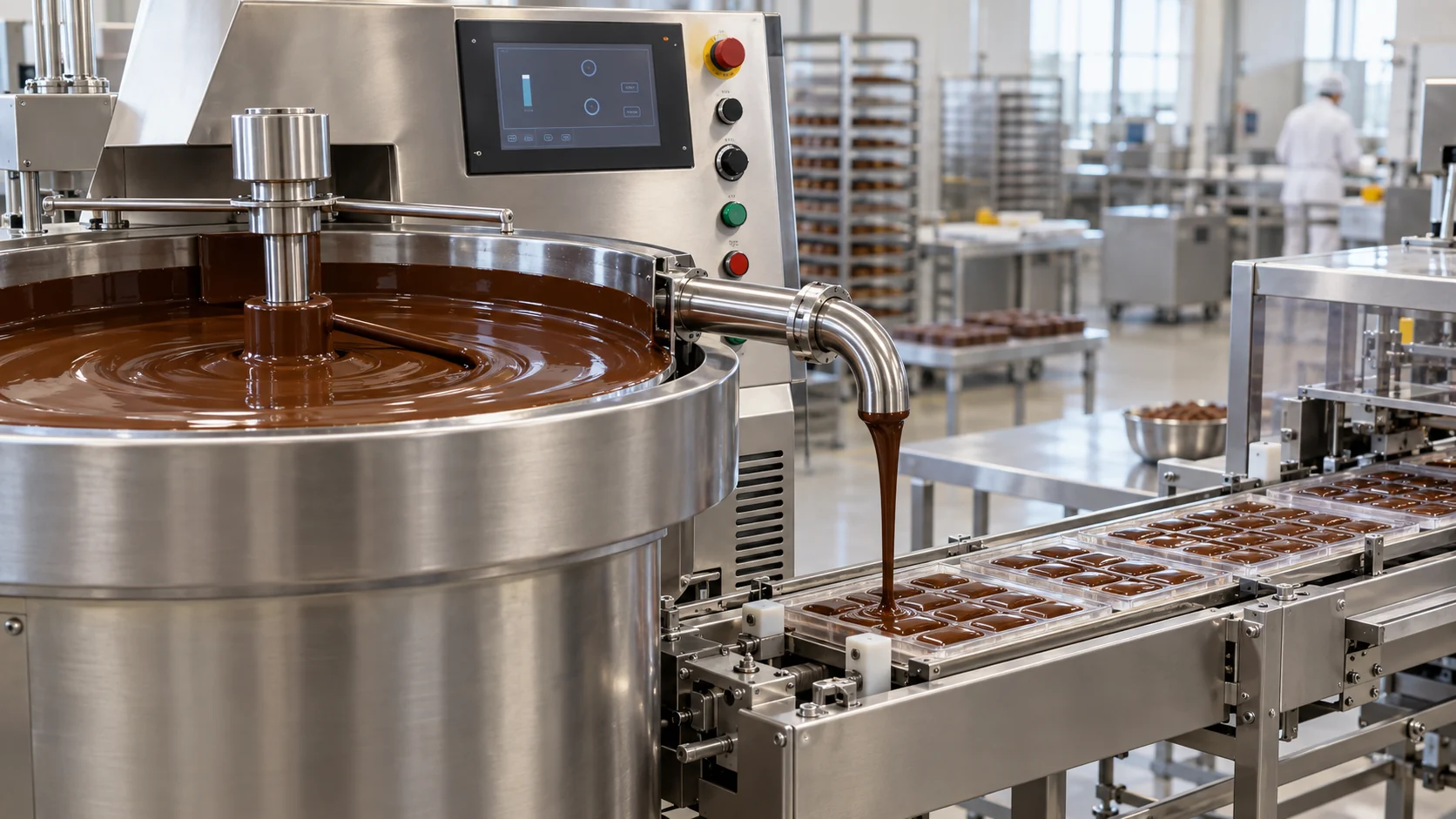
– Chocolate enrobers (chocolate-coated Spanish candy)
– Oil / wax polishing drums (gominolas final finish)
5. Packaging
– Tissue-wrapping machines (polvorones — individual wraps before box packing)
– Flow-wrap lines (turrón bars)
– Twist-wrap lines (caramelos)
– Weighing and bagging (loose gominolas, peladillas)
One standard that differentiates professional Spanish candy production lines from generic candy equipment: almond-handling capability. Almonds are abrasive, have variable fat release at different temperatures, and demand equipment surfaces that don’t impart metallic flavor. Stainless-steel contact surfaces and PTFE seals are standard expectations.
Spanish Candy Industry Applications — Equipment for Each Category
Understanding which machinery applies to which type of Spanish candy helps manufacturers plan production lines and capacity expansion. We’ve assembled the key mappings below.
| Spanish Candy Type | Core Machinery | Throughput Range | Minimum SKU Viability |
|---|---|---|---|
| Turrón duro | Mixer + slab molder + cutting line | 200–2,000 kg/hr | ~500 kg/batch |
| Turrón blando | Sigma mixer + stone/ball mill + slab former | 100–1,000 kg/hr | ~200 kg/batch |
| Polvorones | Roaster + sigma mixer + cold press + tissue wrapper | 100–800 kg/hr | ~100 kg/batch |
| Gominolas | Mogul depositor + drying room + coating drum | 200–1,000 kg/hr | ~500 kg/day |
| Caramelos duros | Vacuum cooker + roller-die line + twist wrap | 500–3,000 kg/hr | ~1,000 kg/batch |
| Caramelos rellenos | Co-extruder + cooling conveyor + wrap line | 300–1,500 kg/hr | ~500 kg/batch |
| Peladillas | Almond grader + sugar panning drum + polisher | 100–600 kg/hr | ~200 kg/batch |
gummy candy machines for Gominolas Production
The starch mogul system is the workhorse of gominola manufacturing. In this setup, a conveyor of trays filled with cornstarch passes under a multi-head depositor that stamps desired shapes into the starch and injects liquid candy mass into those impressions. The trays then move through a cooling and drying tunnel, after which the shaped candies are extracted, de-dusted, and conveyed to the coating or oiling drum.
Critical control points for gominolas:
– Depositing temperature: 65–85°C for gelatin-based masses; tighter range for pectin
– Starch moisture: 5–8% is optimal; too wet and candy won’t release cleanly
– Drying time: 24–48 hours at 40–50°C; gelatin sets, moisture equilibrates
– Brix/water activity: finished gominolas target Aw below 0.65 for shelf stability
Manufacturers expanding into halal or vegan Spanish candy substitute animal gelatin with fish gelatin, pectin, or agar — each requiring different processing temperatures and set times. Pectin-based gominolas, for example, gel at pH 3.0–3.5 and require acidification during cooking, which adds a step the gelatin process doesn’t need.
Hard Candy Lines for Caramelos
Hard candy production for Spanish caramelos runs on a continuous basis in most mid-to-large factories. Sugar and glucose syrup are dissolved in water and cooked under vacuum to 140–160°C (final moisture below 2%). The cooked mass is cooled on a table or belt to working temperature (~80–90°C), colors and flavors are incorporated, and the mass is fed into a forming machine.
Roller-die formers stamp individual caramelo shapes continuously, depositing finished pieces onto a cooling conveyor. Drop-rollers produce rounded pill shapes. Both systems can handle filled caramelos with a co-extrusion head that maintains a soft center.
Spanish consumers strongly prefer the traditional caramelo redondo (round pillow shape) for plain caramelos — a formatting preference that has kept roller-die equipment dominant in Spanish facilities even as Asian and North American producers shift toward other shapes.
Turrón and Nougat Equipment
Turrón production equipment has more in common with bakery than standard candy manufacturing. Almonds must be sorted, roasted, and sized before entering the mixing stage. Honey is typically warmed and clarified. Egg whites must be whipped to a specific foam structure before combining with cooked sugar syrup.
The critical equipment for turrón blando — the stone or ball mill — must handle an abrasive, high-viscosity mass without overheating. Traditional granite millstones cool naturally and impart no off-flavors; modern ball mills use water-cooled jackets and stainless media. Either approach must achieve a particle size below 40 microns for the paste to feel smooth rather than grainy on the palate.
Future Trends in Spanish Confectionery Manufacturing (2026+)
Health-Conscious Innovation in Spanish Candy
Spain’s candy market is shifting alongside broader European consumer trends. According to Statista’s European confectionery market data, sugar-reduced and functional confectionery represents the fastest-growing segment across the EU. Spanish candy manufacturers are responding with:
- Reduced-sugar gominolas using polyols (erythritol, isomalt) or high-intensity sweeteners (stevia, monk fruit). These require adjustment to mogul depositing parameters because polyol-based masses have different viscosity profiles.
- Protein-enriched turrón using hydrolyzed whey or pea protein — a natural fit since turrón already contains high-protein almonds.
- Vegan polvorones substituting lard with palm-free vegetable shortening. The crumble texture is harder to replicate, but several Estepa producers have succeeded with combinations of coconut oil and refined sunflower shortening.
- Functional gominolas with added vitamins, collagen, or probiotics. Probiotic additions are technically challenging because heat kills most bacterial strains — microencapsulation or cold-process incorporation is required.
The ingredient reformulation challenge is real, but the machinery impact is often underestimated. Replacing lard in polvorones requires reconsidering the mixing time and temperature because vegetable shortenings have different crystallization behavior. Reduced-sugar gominolas may require extended drying times to reach target water activity without the preservative effect of high sugar content.
Automation in Spanish Candy Manufacturing
Labor costs in Spain have risen steadily since 2015. Small and mid-size Spanish candy producers — many of them family businesses in regions like Estepa, Jijona, and Toledo — are investing in automation at rates not seen in prior decades. The automation investment priorities are:
- Automatic portion control and weight checking — reducing giveaway in polvoron and turrón packing
- Vision systems for defect rejection — detecting color variation, shape defects, or foreign material before packaging
- Robotic case packing — especially for the fragile tissue-wrapped polvorones that historically required manual handling
- SCADA integration — centralizing process data from cooking, cooling, and packaging into a single monitoring dashboard
The ROI case for these investments is clearest in packaging, where labor intensity is highest and defect rates most visible to consumers. According to community discussion on Reddit’s r/askspain thread on traditional candy production, consumers consistently notice packaging quality as a proxy for product quality — a finding that aligns with manufacturer experience.
One constraint on automation in Spanish candy is regulatory. Turrón IGP rules require human sensory assessment at several production stages. Fully automated lines must still incorporate human tasting checkpoints, which means the labor reduction is significant but not complete.
| Automation Investment Area | Est. ROI Period | Key Benefit | Barrier |
|---|---|---|---|
| Automatic weight checking | 12–18 months | Reduce giveaway | Low |
| Vision defect systems | 18–30 months | Reduce returns/complaints | Medium |
| Robotic polvoron packing | 24–36 months | Labor replacement | High (fragility) |
| SCADA integration | 24–48 months | Process consistency | Medium-high |
| Co-packing robot cells | 36–60 months | Flexible SKU switching | High |
FAQ
What is the most popular Spanish candy?
Turrón is the most popular Spanish candy by cultural recognition and seasonal sales volume. During Christmas, virtually every household in Spain consumes turrón in some form. For year-round everyday candy, gominolas (gummy candy) are the most widely consumed category, available in every grocery store, market, and neighborhood chuchería.
What is traditional Spanish candy made from?
Traditional Spanish candy relies on a short list of natural ingredients: almonds, honey, sugar, lard (for polvorones), egg whites (for nougat), and licorice root (for regaliz). Modern industrial Spanish candy adds gelatin or pectin for guminolas and cacao for chocolate-based products. Synthetic preservatives and artificial flavors are rare in traditional recipes; flavor comes from real almonds, genuine honey varieties, and regional spices.
Where can I find authentic Spanish candy?
Authentic Spanish candy is available through specialty import retailers, Spanish grocery stores, and online platforms such as Amazon’s Spanish candy selection. For the most authentic products, look for turrón with Jijona or Alicante IGP certification and polvorones from Estepa. Those labels indicate the product meets strict regional production standards.
Is Spanish candy gluten-free?
Some Spanish candy is naturally gluten-free — turrón duro and turrón blando contain no wheat. However, polvorones are made with wheat flour and are not gluten-free. Gominolas are typically gluten-free unless manufactured on shared equipment. Always check the label, as cross-contamination in facilities that produce multiple product types is common.
How is turrón different from regular nougat?
Turrón is a specific Spanish style of nougat with a protected regional identity. Spanish turrón uses higher almond content (60–64% minimum for IGP grades) and specific honey varieties compared to generic nougat. Turrón duro is harder and crunchier than French nougat; turrón blando is paste-like — closer to marzipan in texture. Regular commercial nougat typically uses lower nut percentages and more glucose syrup.
What machinery is needed to make Spanish gummy candy (gominolas) at industrial scale?
Industrial gominola production requires a starch mogul depositing system as the core piece of equipment. Supporting equipment includes vacuum cooking kettles (for the candy mass), temperature-controlled cooling tunnels, starch conditioning systems (to maintain the starch at correct moisture), oil or sugar coating drums for the final surface finish, and packaging lines. A complete gominola line from cooking to packing typically occupies 1,500–3,000 square meters and runs at 200–1,000 kg per hour depending on configuration. JY Machine Tech designs and supplies complete gominola production lines for manufacturers entering or expanding in the Spanish-style gummy candy segment.
Can traditional Spanish candy be produced at commercial scale without losing quality?
Yes, but it requires machinery matched to the specific rheology and temperature sensitivity of each product. The key principle is that commercial-scale equipment must replicate the same physical and chemical conditions as traditional methods — the same mixing shear, the same temperature curves, the same final moisture targets — at higher throughput. Turrón blando at industrial scale uses modern ball mills that achieve the same 40-micron particle size as granite millstones. Polvorones at scale use cold-press forming that preserves crumble structure. The machinery must be engineered for the product, not the other way around.
Conclusion
Spanish candy is one of the most diverse and historically rich confectionery traditions in the world. From the almond-dense nougat blocks of Jijona to the crumbly lard-based shortbreads of Estepa, each category of Spanish candy reflects centuries of ingredient knowledge and hands-on craft refined into repeatable production processes.
For manufacturers, the opportunity is clear. The top-ranking competitors for “spanish candy” searches are retail product pages — none of them provide manufacturing insight, ingredient specifications, or equipment guidance. An informational resource that bridges Spanish candy culture with production reality fills a gap the market hasn’t addressed.
Whether you’re a confectionery startup planning to produce Spanish-style gominolas, an established candy maker looking to add turrón to your seasonal line, or a machinery supplier evaluating the Spanish market, the fundamentals remain the same: match your equipment to the product’s rheology, respect the ingredient minimums that define authentic categories, and plan your production calendar around the seasonal demand peaks that drive this market. Spanish candy rewards that discipline with products that have proven their appeal across a thousand years of history.
For more information on candy production lines suited to turrón, gominolas, caramelos, and other Spanish confectionery types, explore the related: candy production machinery overview available from JY Machine Tech.
Related Articles
- French Candy: The Complete Guide to Types, Traditions & Commercial Production
- Soft Candy: Types, Textures, and How They’re Made (2026 Guide)
- Peelable Gummy Candy: Types, Ingredients, and Production Guide
- Everything You Need to Know About Gummy Candy Machines in 2025
- Gummy Candy Production Line
- Biscuit Production Line
- Are Skittles Gluten Free? Complete Guide 2026