A regular 16-ounce boba tea usually has 250-500 calories; large brown sugar, cream foam, or smoothie-style drinks can reach 600-800+ calories.
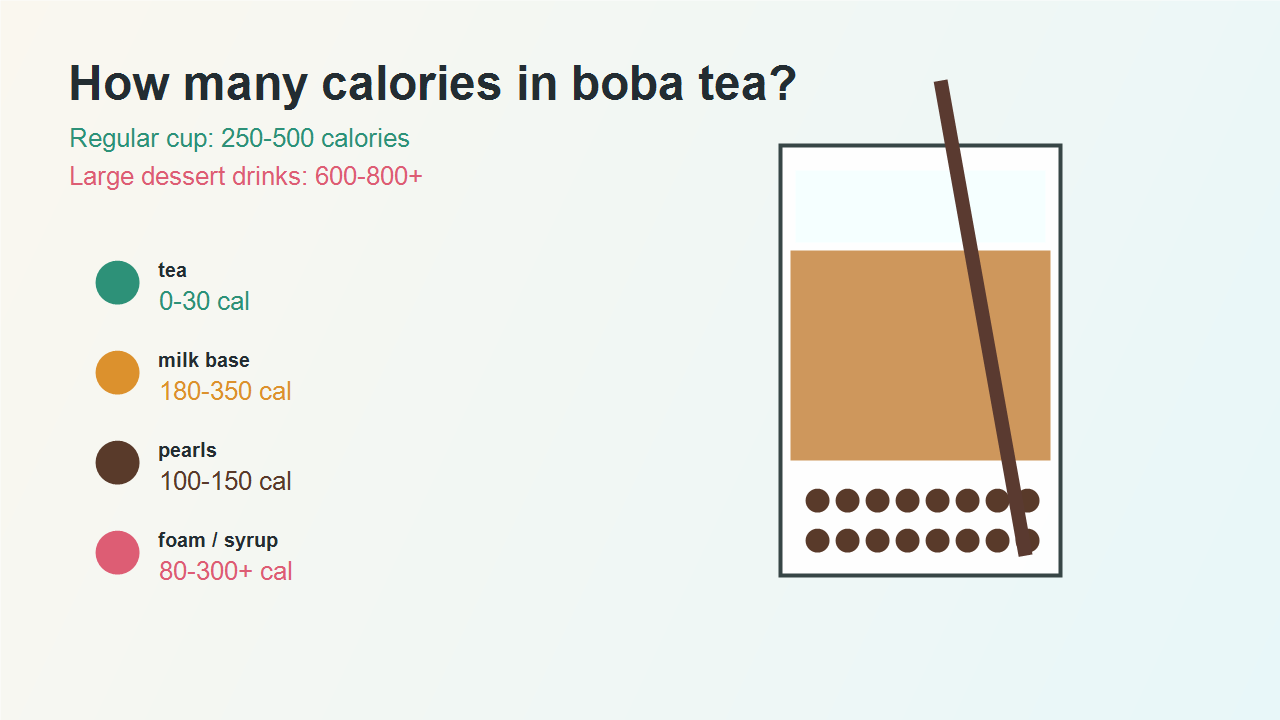
If you are wondering how many calories in boba tea, the honest answer is: it depends on the build of the cup. A plain unsweetened tea can be almost calorie-free. A large brown sugar milk tea with tapioca pearls and cream foam can be closer to a dessert or a small meal.
That wide range is why boba tea is hard to track. The menu name alone is not enough. You need to know the cup size, tea base, milk or creamer, sugar level, topping portion, and any premium add-ons.
This guide gives you a practical way to estimate the whole drink before you order. It is written for drinkers who want a realistic calorie number, and for bubble tea shops that need consistent recipes, measured toppings, and clear nutrition communication.
For a related breakdown focused specifically on pearls and toppings, see our guide to how many calories in boba.
How Many Calories Are in Boba Tea?
Most regular boba tea drinks contain 250-500 calories, but unsweetened tea can be below 50 calories and large dessert-style drinks can exceed 800 calories.
The phrase boba tea usually means bubble tea: tea, milk or fruit flavor, sweetener, ice, and toppings. Tapioca pearls are the classic topping, but the drink may also include popping boba, pudding, jelly, red bean, cheese foam, or brown sugar syrup.
Use this range as a quick starting point:
| Boba tea order | Typical calorie range | Best use for tracking |
|---|---|---|
| Unsweetened tea, no topping | 0-30 | Log as tea |
| Fruit tea, reduced sugar, no topping | 80-180 | Log as sweetened tea |
| Fruit tea with jelly or popping boba | 160-320 | Add topping separately |
| Classic milk tea, no boba | 180-350 | Base drink estimate |
| Classic milk tea with tapioca pearls | 300-500 | Most common estimate |
| Brown sugar boba tea | 450-750 | Dessert drink |
| Smoothie or slush boba tea | 400-800+ | Dessert or meal-level drink |
The range is broad because shops do not all use the same recipes. One regular cup may be 16 ounces. Another may be 22 ounces. Some shops use fresh milk; others use non-dairy creamer or sweetened powder. Some measure syrup with a pump, while others free-pour during rush periods.
In practice, when someone asks how many calories in boba tea, we first separate the drink into four calorie zones:
- Base tea
- Milk, creamer, fruit syrup, or powder
- Sugar level
- Toppings
A study published in Food Science & Nutrition analyzed boba milk tea and found a tested 16-ounce serving with tapioca pearls at 299 calories and 38 grams of sugar, according to this boba milk tea nutrition study. That number is a helpful anchor, but it is not a universal menu value. A richer drink can easily go higher.
Calories by Cup Size: 12 oz, 16 oz, 24 oz, and Large
Cup size changes boba tea calories because larger cups usually contain more milk tea, syrup, and sometimes more toppings.
Most calorie discussions focus on the regular cup, but many chains sell larger sizes. The difference between 16 ounces and 24 ounces is not just extra ice. If the recipe scales up, the calories scale too.
Here is a practical cup-size estimate:
| Cup size | Light tea order | Milk tea with pearls | Brown sugar or foam drink |
|---|---|---|---|
| 12 oz small | 40-160 | 220-380 | 350-550 |
| 16 oz regular | 80-250 | 300-500 | 450-700 |
| 22-24 oz large | 140-360 | 420-650 | 600-900+ |
| Oversized specialty cup | 200-450 | 550-800 | 750-1,000+ |
The easiest mistake is assuming a large boba tea only adds a little more tea. In reality, it may add:
- More milk tea base
- More fructose syrup
- More flavor powder
- More fruit jam
- More brown sugar syrup
- More cream foam
- A larger topping scoop
The calorie increase is usually bigger for milk tea than for plain tea. Unsweetened jasmine tea in a larger cup still stays light. A larger taro milk tea with pearls climbs much faster.
For calorie tracking, use this rule:
If the regular milk tea with pearls is 350-450 calories, the large version is often 450-650 calories unless the shop keeps toppings and syrup fixed.
That rule is conservative, and it works better than choosing a random database entry.
What Adds Calories to Boba Tea?
The main calorie drivers in boba tea are sweetener, milk or creamer, tapioca pearls, flavored powders, syrups, and premium toppings.
Tea itself is not the problem. Brewed black tea, green tea, oolong tea, and jasmine tea contribute very few calories when unsweetened. The calories arrive when the drink becomes a prepared beverage.
Tea Base
Plain brewed tea is usually close to zero calories. That is why a tea-forward order can be light even in a larger cup.
Common low-calorie bases include:
- Black tea
- Green tea
- Oolong tea
- Jasmine tea
- Unsweetened herbal tea
The base becomes more calorie-dense when it is made from sweetened concentrate, powder, juice mix, or fruit jam.
Milk and Creamer
Milk tea calories depend heavily on the creamy system. Fresh milk, evaporated milk, milk powder, non-dairy creamer, and premixed powders all behave differently.
Healthline's overview of boba nutrition makes the same broad point: the nutritional profile changes dramatically once sugar, milk, powders, and toppings are added to tea.
Fresh milk can make the ingredient list clearer, but it is not calorie-free. Non-dairy creamer can make the drink taste rich while adding fat and calories. Powdered taro, Thai tea, matcha latte powder, and chocolate powder often include sugar before the barista adds the chosen sugar level.
That is why a "0% sugar" milk tea can still have calories.
Added Sugar
Most shops offer 0%, 25%, 50%, 75%, and 100% sugar. Reducing sugar helps, but it does not remove calories already inside powders, pearls, fruit jams, and toppings.
The FDA lists 50 grams of added sugars as the Daily Value on a 2,000-calorie diet in its explanation of added sugars on the Nutrition Facts label. That benchmark matters because a full-sugar boba tea can approach a large share of that daily limit in one cup.
If you are asking how many calories in boba tea for weight management, sugar percentage is one of the first levers to adjust.
Tapioca Pearls
Tapioca pearls are usually the most iconic topping, and they are also a major calorie contributor. A normal serving often adds 100-150 calories, while extra pearls can add much more.
Public nutrition tools often trace ingredient data back to USDA's FoodData Central, where tapioca-based dry ingredients are calorie-dense because they are mostly carbohydrate. In a finished drink, cooked pearls absorb water, then often sit in syrup.
That means the cooked topping is not just starch. It is starch plus syrup handling.
Specialty Toppings
Toppings can turn a drink from moderate to heavy. Cheese foam, pudding, red bean, brown sugar pearls, and popping boba all need separate estimates.
Here is a practical topping table:
| Topping | Typical calories per serving | What to know |
|---|---|---|
| Tapioca pearls | 100-150 | Classic chewy starch topping |
| Extra pearls | 180-300 | Portion size matters most |
| Brown sugar pearls | 160-300 | Syrup raises the count |
| Popping boba | 60-120 | Sweet liquid center |
| Coconut jelly | 80-150 | Usually sweetened |
| Grass jelly | 30-80 | Often lighter |
| Egg pudding | 100-200 | Adds milk, sugar, and egg |
| Cheese foam | 80-200 | Creamy and calorie-dense |
The National University Health System's bubble tea infographic shows a milk tea with pearls at 366 calories and pearls alone at 141 calories in its bubble tea nutrition guide. That is a good reminder: toppings can account for a large share of the cup.
Milk Tea, Fruit Tea, Brown Sugar, and Smoothie Calories
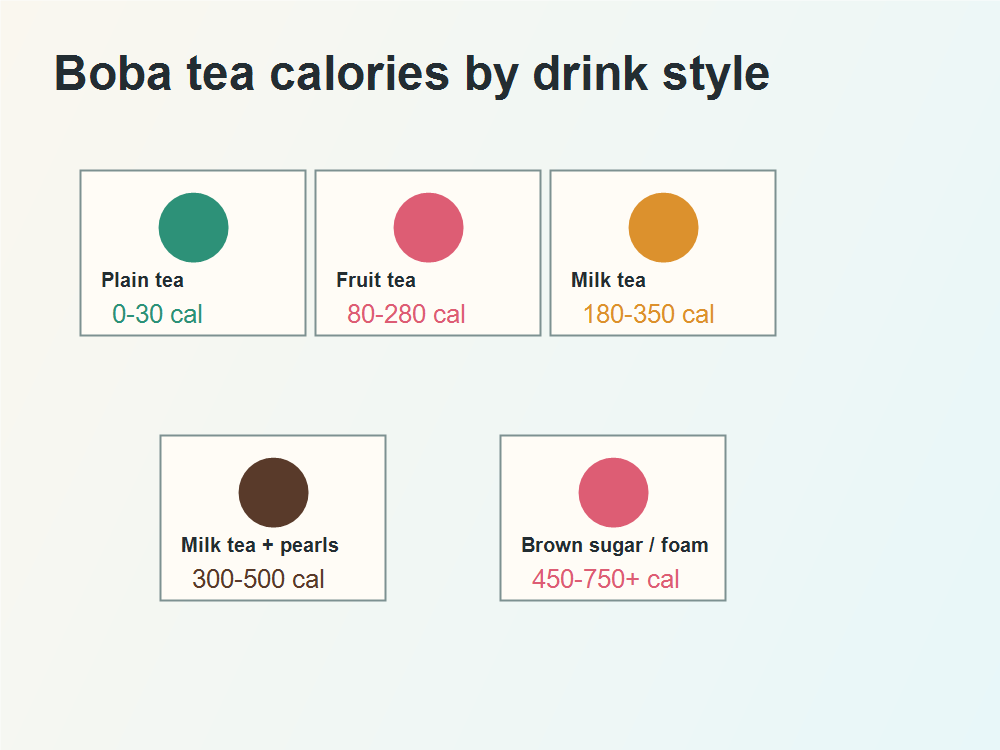
Milk tea with pearls is usually moderate to high calorie, fruit tea can be lighter, and brown sugar or smoothie boba tea is usually the heaviest.
The drink category gives you a faster estimate than the flavor name. "Strawberry" can mean tea with fruit syrup or a dairy smoothie. "Matcha" can mean unsweetened tea or a sweet matcha latte with pearls.
Classic Milk Tea
Classic milk tea is the standard comparison point. A regular cup with tapioca pearls commonly lands around 300-500 calories.
If the shop uses fresh milk and reduced sugar, the cup may sit toward the lower end. If it uses creamer, full sugar, and a heavy pearl scoop, it moves toward the higher end.
When tracking how many calories in boba tea, classic milk tea with pearls is the entry you should use for a normal creamy order.
Fruit Tea
Fruit tea can be lighter, especially without milk and without pearls. A regular fruit tea may range from 80-280 calories depending on syrup and fruit concentrate.
But fruit tea is not automatically low calorie. Mango, passion fruit, lychee, peach, and strawberry flavors often use sweetened concentrates. Popping boba or jelly adds more.
A lighter fruit tea order is:
- Green tea or oolong base
- 25-50% sugar
- No topping or one light jelly
- Regular size
Brown Sugar Boba Tea
Brown sugar boba tea is usually one of the highest-calorie menu items.
It often includes brown sugar syrup, syrup-soaked pearls, fresh milk or milk tea, and sometimes cream foam. Those ingredients overlap rather than replace one another. That is why a large brown sugar drink can reach 600-900 calories.
Order it when you want dessert. That is the clearest mindset.
Taro, Thai Tea, and Powder-Based Drinks
Taro milk tea, Thai tea, chocolate milk tea, and some matcha drinks often rely on sweetened powders or premixes. These drinks can range from 350-650 calories with pearls.
The powder is the hidden variable. If the powder already contains sugar and creamer, choosing 50% sugar only reduces the added syrup, not the full sweetness load.
Smoothie and Slush Boba Tea
Smoothies and slushes are often the heaviest because they may include fruit puree, dairy powder, sugar, ice cream-style bases, or blended sweet mixes.
A regular smoothie boba may be 400-700 calories. A large smoothie with pearls, pudding, or cream can go higher.
Kung Fu Tea's public nutrition information page is a useful example of why drink-specific nutrition matters: chain menus can vary widely across tea bases, milk caps, punches, slushes, and toppings. A single "boba tea" entry cannot cover every cup.
How to Estimate Your Boba Tea Calories in 30 Seconds
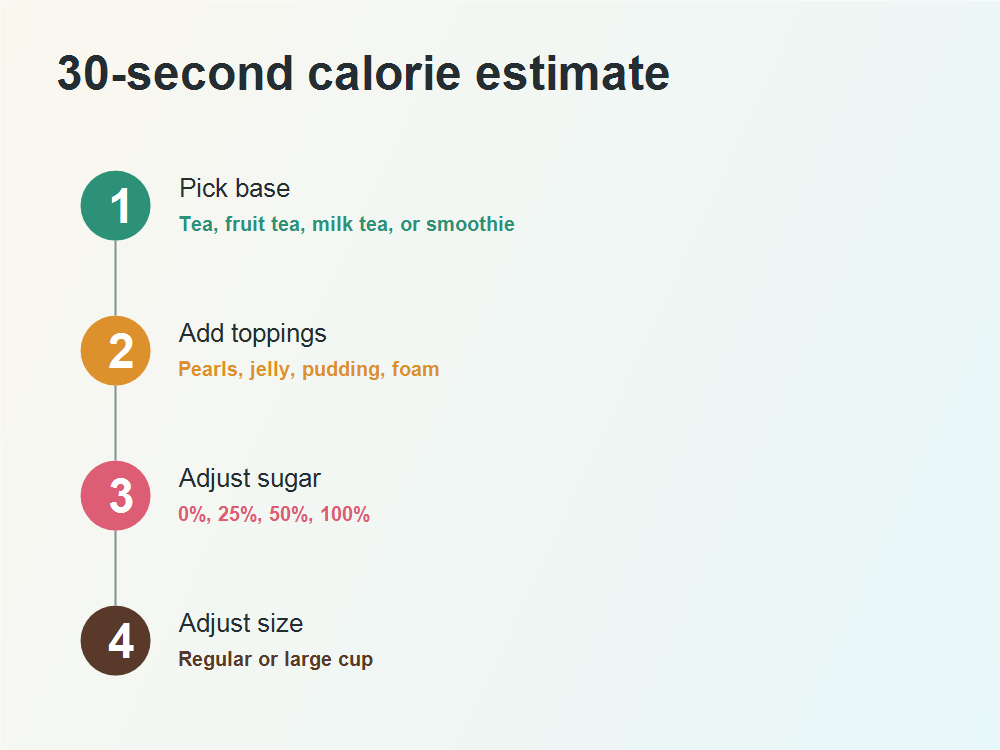
You can estimate boba tea calories quickly by starting with the drink type, adding toppings, then adjusting for cup size and sugar.
Use this calculator-style method when the menu does not list nutrition.
Step 1: Choose the Base Range
Pick the closest base:
- Plain unsweetened tea: 0-30 calories
- Light fruit tea: 80-180 calories
- Sweet fruit tea: 150-280 calories
- Classic milk tea: 180-350 calories
- Powder-based milk tea: 250-450 calories
- Smoothie/slush: 300-600 calories
Step 2: Add Toppings
Add:
- Tapioca pearls: +100-150
- Extra pearls: +180-300
- Jelly: +30-150
- Pudding: +100-200
- Cheese foam: +80-200
- Brown sugar syrup treatment: +50-150
Step 3: Adjust Sugar
Sugar adjustment is rough, but useful:
- 0% sugar: subtract 60-180 from a normal-sugar drink
- 25% sugar: subtract 40-130
- 50% sugar: subtract 25-90
- 75% sugar: subtract 10-50
- 100% sugar: use full estimate
This does not remove sugar already in powders or toppings.
Step 4: Adjust Cup Size
For a large cup, add:
- +50-120 for plain or fruit tea
- +100-200 for milk tea
- +150-300 for brown sugar, smoothie, or foam drinks
Now you have a useful estimate.
Example: 16-ounce classic milk tea, 50% sugar, pearls.
- Base: 240-320
- Pearls: 100-150
- Reduced sugar adjustment: already lower than full sugar
- Total: 340-470 calories
Example: large brown sugar boba tea with foam.
- Base and milk: 260-400
- Brown sugar pearls: 160-300
- Cream foam: 80-200
- Large size adjustment: 100-200
- Total: 600-1,100 calories
That range is wide, but it is honest. The only way to narrow it is with shop-specific nutrition data or measured recipes.
How to Order Lower-Calorie Boba Tea
The easiest lower-calorie boba tea order is unsweetened or reduced-sugar tea, regular size, with no topping or one light topping.
You do not need to quit boba tea. You need a default order that does not surprise you.
Try these swaps:
| Instead of | Order | Why it helps |
|---|---|---|
| Large full-sugar milk tea | Regular 50% sugar milk tea | Reduces size and syrup |
| Brown sugar boba milk | Classic milk tea with half pearls | Less syrup density |
| Taro milk tea with pearls | Oolong milk tea with pearls | Often less powder sugar |
| Cheese foam fruit tea | Fruit tea, 25% sugar, no foam | Cuts creamy topping |
| Extra pearls | Half pearls | Keeps texture with fewer calories |
| Smoothie boba | Fruit tea with jelly | Usually lighter |
Good lighter orders include:
- Jasmine green tea, 25% sugar, no topping
- Oolong tea, 50% sugar, aiyu jelly
- Black milk tea, 25% sugar, half pearls
- Fruit tea, 25% sugar, light coconut jelly
- Matcha with fresh milk, reduced sugar, no foam
If you want the drink to feel satisfying, keep one thing you love and reduce the rest. If pearls are the point, keep half pearls and reduce sugar. If creaminess is the point, keep milk tea but skip foam. If fruit flavor is the point, choose fruit tea and skip dairy.
That is more sustainable than ordering something you do not enjoy.
For Bubble Tea Shops: Consistent Recipes Make Calorie Claims Trustworthy
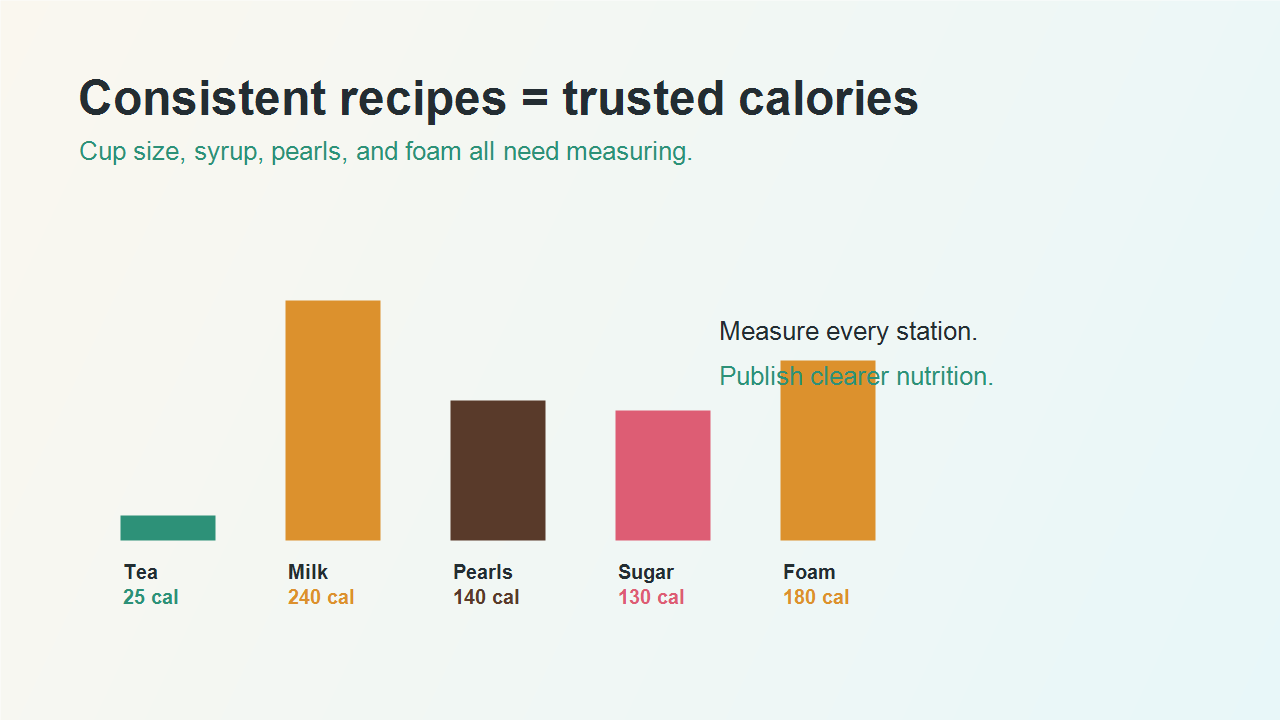
For shops, boba tea calorie accuracy depends on measured recipes, stable cup sizes, consistent syrup dosing, and repeatable topping portions.
Customers increasingly ask how many calories in boba tea before ordering. They may be tracking calories, reducing sugar, managing blood glucose, or simply comparing drinks. If your staff makes the same drink differently each time, your calorie estimate cannot be reliable.
The biggest operational variables are:
- Syrup pump amount
- Powder scoop size
- Pearl scoop weight
- Cooked pearl holding time
- Ice level
- Cup size
- Milk or creamer ratio
- Foam portion
This is where equipment and process matter. A commercial boba shop can improve consistency with:
- Automatic fructose dispensers
- Standardized measuring pumps
- Pearl cookers and warmers
- Cup sealing machines matched to fixed cup sizes
- Recipe cards by drink size
- Digital scales for powders and toppings
- Staff training around level scoops
For a machinery-focused site, this is the bridge between customer nutrition and production efficiency. Consistent equipment is not only about speed. It supports consistent taste, cost control, and more believable nutrition ranges.
If a shop wants to publish "regular milk tea with pearls: about 380 calories," the team needs to know what "regular," "milk tea," and "pearls" mean in grams or milliliters.
That is the professional version of the answer.
Common Mistakes When Counting Boba Tea Calories
Most boba tea calorie mistakes happen when people count only the tea base and forget milk, syrup, pearls, foam, or cup size.
Here are the mistakes to avoid.
Mistake 1: Logging It as Plain Tea
Brewed tea may be close to zero calories. Prepared boba tea is not plain tea. If the cup has milk, creamer, sugar, and pearls, it deserves its own entry.
When searching how many calories in boba tea, avoid database entries that say 80 calories for a creamy pearl milk tea. That is probably too low unless the serving is tiny.
Mistake 2: Treating 0% Sugar as 0 Calories
Zero added sugar does not remove milk, pearls, pudding, fruit puree, or powder calories. It only changes the added sweetener step.
A no-sugar plain tea can be almost calorie-free. A no-sugar milk tea with pearls may still be 250-400 calories.
Mistake 3: Forgetting Brown Sugar Syrup
Brown sugar syrup is not just visual decoration on the cup wall. It adds sweetness and calories, especially when pearls are soaked in it.
Brown sugar boba tea is best counted as dessert.
Mistake 4: Assuming All Toppings Are Equal
Grass jelly is usually lighter than pudding. Half pearls are lighter than extra pearls. Cheese foam is not the same as a small scoop of jelly.
If you change toppings, your calorie estimate changes too.
Mistake 5: Ignoring the Shop
Two shops can make the same named drink very differently. A chain with published nutrition data may give a tighter estimate. A small shop may make excellent drinks but use more flexible portions.
That does not mean the small shop is worse. It means you should estimate with a wider range.
How to Read a Boba Tea Nutrition Chart
A boba tea nutrition chart is useful only when you match the listed drink, cup size, sugar level, and topping choice to your actual order.
Many large chains publish calorie guides, but customers still get confused because the chart may list the base drink separately from add-ons. If you search how many calories in boba tea and then open a chain nutrition PDF, check what the number includes before you log it.
Look for five details:
- Serving size. Is the number for small, medium, regular, or large?
- Sugar level. Is it based on standard sugar or a reduced-sugar option?
- Toppings. Does the drink include tapioca pearls, or are pearls listed separately?
- Milk cap or foam. Is cream foam included in the base drink or added later?
- Regional recipe. Some chains vary recipes by country or franchise.
If the chart says a milk tea is 260 calories but pearls are listed separately at 120 calories, your actual pearl milk tea is closer to 380 calories. If the chart lists a large drink but you ordered regular, you may need to adjust downward. If it lists the drink at 100% sugar and you ordered 25%, the real number is lower, but not zero.
This is why how many calories in boba tea is not a one-line answer. The better question is: which version of the drink did the chart measure?
For shop owners, a nutrition chart only works when the back-of-house process matches it. If your recipe card says 30 ml syrup but staff sometimes pour 45 ml, the chart becomes a rough promise instead of a reliable guide. If the chart assumes 80 grams of cooked pearls but the scoop varies from 60 to 130 grams, customers will feel the difference.
Good nutrition communication starts with measured operations:
- Fixed cup sizes
- Standard syrup pump settings
- Level powder scoops
- Weighed pearl portions during recipe testing
- Recipe cards for every size
- Staff retraining when a new topping launches
That level of discipline is not only for big chains. Smaller shops can use it too, especially if they want customers to trust "less sugar," "light pearls," or "standard size" claims.
Five Realistic Boba Tea Calorie Scenarios
The easiest way to answer how many calories in boba tea is to compare real order scenarios instead of memorizing one average.
Here are five common orders and how we would estimate them.
Scenario 1: Unsweetened Jasmine Tea, No Topping
This is the lightest boba shop order. It may not feel like classic boba tea because there are no pearls, but it is still a tea shop drink.
Estimate:
- Tea base: 0-20 calories
- Sweetener: 0
- Toppings: 0
- Total: 0-20 calories
This is the right order if you want the cafe experience without turning the drink into a snack.
Scenario 2: Fruit Green Tea, 50% Sugar, Coconut Jelly
This order is moderate. The fruit syrup and jelly both add sugar, but there is no milk or cream foam.
Estimate:
- Fruit tea base: 120-220 calories
- Coconut jelly: 80-150 calories
- Total: 200-370 calories
If you choose 25% sugar or a lighter jelly, it may sit lower. If the shop uses fruit jam heavily, it may sit higher.
Scenario 3: Classic Milk Tea, 50% Sugar, Tapioca Pearls
This is the most useful baseline for how many calories in boba tea because many people mean this exact drink.
Estimate:
- Milk tea base: 220-320 calories
- Tapioca pearls: 100-150 calories
- Total: 320-470 calories
If the cup is large, move the estimate toward 450-650. If the shop uses a very light milk tea base and half pearls, move it toward 250-350.
Scenario 4: Taro Milk Tea, Full Sugar, Pearls
Taro drinks are often powder-based, which can make them heavier than plain milk tea. They are creamy, sweet, and filling.
Estimate:
- Taro milk tea base: 300-450 calories
- Tapioca pearls: 100-150 calories
- Total: 400-600 calories
This is not a bad drink. It is just not a light drink. Treat it like a dessert beverage and the math becomes easier.
Scenario 5: Large Brown Sugar Boba Tea With Foam
This is usually the heaviest common order. It combines a larger cup, sweet milk, syrup-soaked pearls, brown sugar syrup, and cream foam.
Estimate:
- Sweet milk base: 300-450 calories
- Brown sugar pearls: 160-300 calories
- Cream foam: 80-200 calories
- Large size adjustment: 100-200 calories
- Total: 640-1,150 calories
That high end will not apply to every shop, but it is possible. This is why large brown sugar drinks should be counted like dessert, not like tea.
If you remember nothing else from this article, remember this: how many calories in boba tea depends less on the word "tea" and more on the build of the cup.
2026 Trends: Lower Sugar, Better Labels, and Better Portion Control
Boba tea menus are moving toward lower-sugar options, more nutrition transparency, alternative toppings, and more standardized preparation.
The classic full-sugar pearl milk tea is still popular. It is not going away. But the market is also shifting toward tea-forward drinks, fresh milk options, lighter toppings, and customers who want to understand what they are drinking.
Trends to watch:
- 25% and 50% sugar becoming more common default recommendations
- Smaller cups for customers who want portion control
- Alternative toppings such as konjac pearls, aiyu jelly, and grass jelly
- More stores publishing nutrition charts
- Recipe standardization across locations
- Better syrup and topping portion control through equipment
- More tea-forward menus with less reliance on powders
This is good for both sides. Customers get more control. Shops get a clearer operating system.
The future of boba tea is not only about new flavors. It is about making indulgence more transparent.
FAQ
How many calories in a 16 oz boba tea?
A 16-ounce boba tea usually has 250-500 calories. Plain or reduced-sugar tea can be lower, while milk tea with pearls usually sits in the middle of the range. The bottom line: use 300-500 calories for a normal milk tea with boba.
How many calories in boba tea with tapioca pearls?
Boba tea with tapioca pearls usually has 300-500 calories in a regular cup. Pearls often add about 100-150 calories. The bottom line: log pearls separately if you want a realistic estimate.
How many calories in boba tea without boba?
Boba tea without tapioca pearls can be 80-350 calories. Plain tea is lowest, fruit tea is moderate, and milk tea is higher. The bottom line: removing pearls helps, but milk and sugar still count.
Is boba tea high in calories?
It can be high in calories, especially with milk, full sugar, pearls, and foam. A regular drink may be snack-level, while a large brown sugar drink can be dessert-level. The bottom line: drink style matters more than the name.
How many calories are in brown sugar boba tea?
Brown sugar boba tea often has 450-750 calories. Large sizes or cream foam can push it higher. The bottom line: count brown sugar boba tea as a dessert drink.
Does 50% sugar make boba tea low calorie?
50% sugar lowers calories but does not make every boba tea low calorie. Milk, powder, pearls, pudding, and foam still contribute. The bottom line: combine reduced sugar with lighter toppings for the biggest change.
What is the lowest-calorie boba tea order?
The lowest-calorie order is unsweetened tea with no topping. For something more fun, try green tea with 25% sugar and a light jelly. The bottom line: start with tea, then add only one calorie-bearing upgrade.
Conclusion
So, how many calories in boba tea? A regular 16-ounce cup usually falls around 250-500 calories, with lighter tea-based drinks below that and brown sugar, foam, or smoothie drinks above it. The best estimate comes from breaking the cup into parts: tea base, milk or creamer, sweetener, toppings, and size.
For customers, that means you can still enjoy boba tea while making smarter choices: regular size, reduced sugar, one topping, and fewer creamy upgrades. For shops, it means measured recipes and consistent equipment make nutrition claims more trustworthy. A better cup starts with better control.
Related Articles
- How Many Calories in Boba? Full Drink and Topping Guide
- How Many Calories in a Boba? Complete 2026 Calorie Guide
- Strawberry Boba Tea: The Complete Guide to Making, Customizing & Scaling
- Strawberry Milk Tea: The Ultimate Recipe Guide (Boba, No-Boba & Café Secrets)
- Popping Boba Production Line
- Konjac Pearl Making Machine
- How Are Skittles Made? The Full Factory Process