A standard 16 oz boba milk tea has 350–500 calories; the tapioca pearls alone add 100–200.
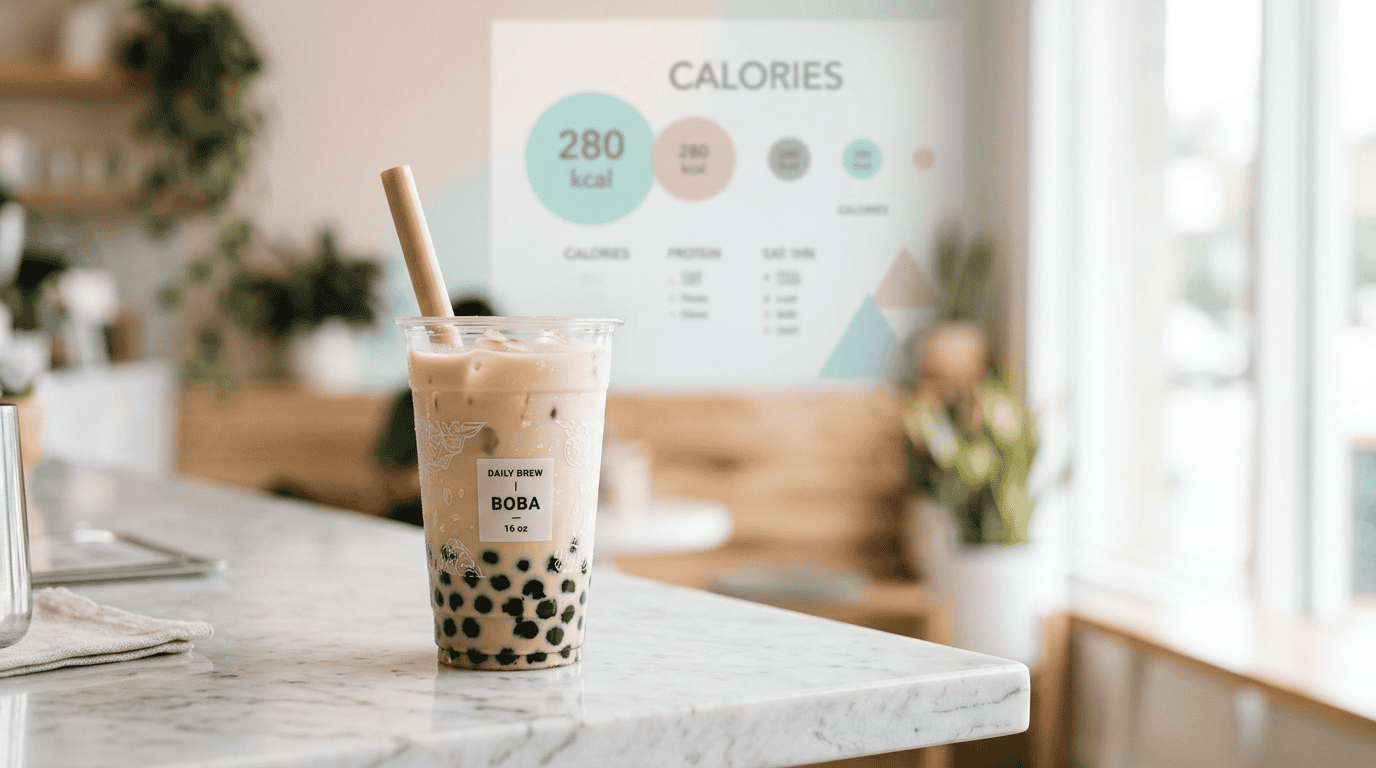
If you have ever stood at a boba counter and wondered whether that chewy cup of joy is closer to a snack or a meal, you are not alone. The answer is rarely simple, because how many calories in a boba depends on cup size, milk choice, sugar level, toppings, and — most decisively — the pearls themselves. This guide unpacks every variable, gives real numbers from major chains, and shows you exactly how to engineer a lower-calorie boba without losing the chew.
We have built this for three readers at once: the casual drinker counting weekly intake, the café operator pricing nutrition disclosures, and the food-manufacturing buyer evaluating tapioca pearl recipes for B2B supply. Every number below is checked against published studies, brand nutrition sheets, and USDA reference data so you can act on it.
What Is a Boba and Why Do Calories Vary So Much?
Boba is a tea-based drink topped with chewy tapioca pearls, and its calories swing wildly because each component is independently sweetened. Most consumers think of boba as one product. In practice, it is a four-layer build — base tea, dairy or non-dairy creamer, added sugar syrup, and pearls — and each layer carries its own calorie load.
The four calorie sources inside one cup
A standard 16 oz boba milk tea breaks down roughly like this:
- Tea base — 0 to 20 calories depending on whether it is plain black, green, or already pre-sweetened.
- Milk or creamer — 60 to 180 calories. Whole milk sits near the top; non-dairy creamer powders are often higher than they look because of palm oil and corn syrup solids.
- Sugar syrup — 80 to 180 calories. Most shops use a 1:1 simple syrup. A “100% sugar” default adds roughly 5–7 teaspoons.
- Tapioca pearls — 100 to 200 calories per ~1/3 cup serving. Pearls are pre-soaked in honey or brown sugar syrup before being added, doubling their raw calorie count.
A peer-reviewed study published on PubMed Central on calories and sugars in boba milk tea measured the median boba milk tea at 299 calories per 16 oz, with the heaviest variants pushing past 450. That study is now a decade old; modern menus have grown larger, with 22 oz and 24 oz “large” sizes shifting the median upward.
Why two boba drinks at the same shop can differ by 300 calories
The chain-to-chain variation gets discussed often. What gets overlooked is intra-chain variation. Two customers ordering “milk tea with boba” at the same store can walk out with a 250-calorie cup and a 600-calorie cup depending on three knobs: sugar level (0%–100%), milk choice (skim, whole, oat, half-and-half), and topping count (single boba vs boba plus pudding plus cheese foam). Most guides stop at “boba has a lot of sugar.” The actionable truth is that the sugar slider alone moves the calorie count by 150 calories on a single cup.
How Many Calories Are in a Boba — Numbers by Size and Type
A 12 oz classic milk tea with boba runs 280–360 calories; a 24 oz with extra pearls and cheese foam can clear 700. Below is a clean reference matrix. All values assume 100% sugar default unless noted; numbers are sourced from publicly available chain nutrition disclosures and the boba-time PDF surfaced in Google’s top results.
TABLE 1 — Calories by drink type and size
| Drink | 12 oz (small) | 16 oz (regular) | 22–24 oz (large) |
|---|---|---|---|
| Classic milk tea + boba | 280–340 | 380–450 | 520–620 |
| Brown sugar milk + boba | 360–440 | 480–580 | 650–780 |
| Fruit tea + boba | 200–260 | 280–350 | 380–470 |
| Matcha milk + boba | 290–360 | 400–480 | 540–640 |
| Taro slush + boba | 340–420 | 470–560 | 630–760 |
| Cheese foam milk tea + boba | 380–460 | 510–600 | 700–820 |
| Plain black tea + boba (no milk, 50% sugar) | 150–190 | 200–250 | 270–330 |
The largest hidden lever in this table is the brown sugar line. Brown sugar boba — the “tiger” or “dirty boba” style — uses caramelized brown sugar syrup both inside the pearls and drizzled along the cup wall. That double-dose adds 120–160 calories above a plain milk tea of the same size.
Pearls alone: how the chew adds up
If you order any drink “with boba added,” you are tacking on roughly 100–200 calories before any other change. The boba pearl is mostly starch — about 95% — and most of its calorie load is carbohydrate. The remaining sugar load comes from the post-cook syrup soak that gives pearls their glossy, slightly sweet exterior.
Raw tapioca starch is calorie-dense but nutritionally thin. According to USDA FoodData Central reference data on tapioca, 100 g of cooked tapioca pearls supplies about 144 calories, almost all from carbohydrates, with negligible protein, fat, fiber, vitamins, or minerals. A typical 1/3-cup boba serving weighs around 90 g cooked. Add the syrup soak and you reach the 100–200 calorie range you see on every menu.
Types of Boba and Their Calorie Differences
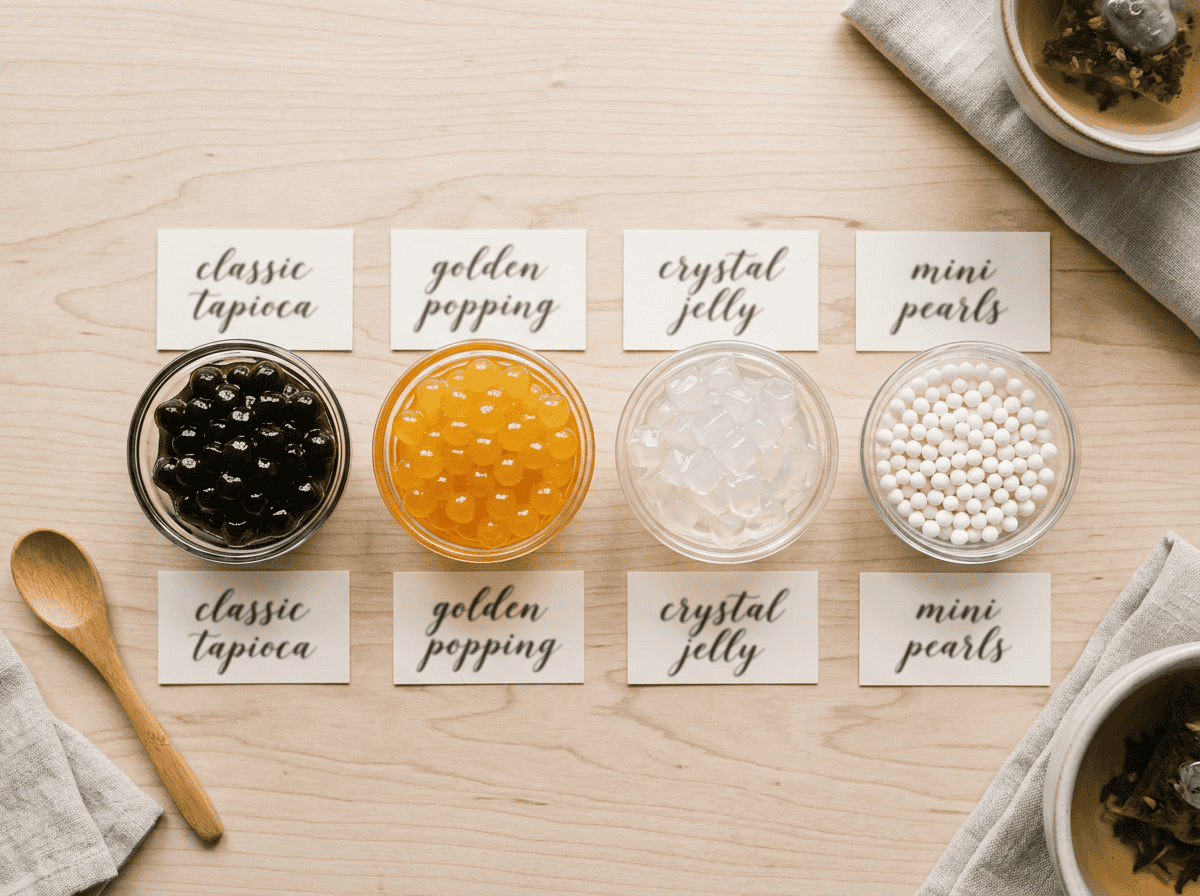
Not all “boba” toppings carry the same calorie load — popping boba is the lightest, classic black pearls the heaviest, and crystal boba sits in the middle. People often use “boba” as a catchall, but the topping category has split into five distinct products in the last few years, each with its own profile.
TABLE 2 — Calorie comparison of boba topping types (per ~30 g / 1 oz serving)
| Topping type | Calories | Sugar (g) | Texture | Best for |
|---|---|---|---|---|
| Classic black tapioca pearls | 70–90 | 8–14 | Chewy, dense | Traditional milk tea |
| Brown sugar (tiger) pearls | 90–110 | 14–18 | Soft, syrup-coated | Brown sugar drinks |
| Mini tapioca pearls | 55–75 | 6–10 | Lighter chew | Fruit teas |
| Crystal boba (agar-based) | 25–40 | 4–7 | Jelly-like, translucent | Diet-conscious drinkers |
| Popping boba (juice-filled) | 25–35 | 4–6 | Bursts on bite | Fruit teas, smoothies |
| Lychee or grass jelly | 15–25 | 3–5 | Soft, sliceable | Layered drinks |
Classic black tapioca pearls
These are what most people picture when they say “boba.” Pure tapioca starch boiled and soaked in brown sugar or honey syrup. A standard 1/3-cup serving runs 130–180 calories. The variance comes from the post-cook syrup soak — longer soak time means more sugar absorbed.
Brown sugar (tiger) pearls
A premium variant where the syrup is reduced to a caramelized molasses-style coating. Calorically the heaviest pearl style on the market — around 160–200 calories per 1/3 cup. The visual streaking along the cup is striking but expensive in sugar terms.
Mini tapioca pearls
Smaller in diameter (~6 mm vs ~9 mm). They cook faster and absorb less syrup, so a serving usually clocks in around 110–140 calories. Many shops in 2026 default to these for fruit teas because the smaller pearl matches the lighter base.
Crystal boba (agar or konjac based)
Made from agar or konjac flour instead of tapioca starch. Calorie load drops sharply — 45–70 calories per serving — because konjac is mostly water and soluble fiber. The texture trades the bouncy chew for a softer jelly bite. For diet-conscious drinkers, crystal boba is the single highest-impact swap.
Popping boba
Sodium alginate spheres filled with fruit juice. They burst on bite, releasing flavored liquid. Despite the sweet juice inside, the membrane is calorie-light, so a serving sits around 40–60 calories. Popping boba pairs well with fruit teas; the juice burst reads as flavor rather than a calorie hit.
Operator note: If you run a café and want to offer a “diet” line without changing your hero menu, swapping classic pearls for crystal or popping boba on three signature drinks gives you a marketing story without rebuilding your flavor library.
How Calorie Counts Stack Up at Major Boba Chains
Chain calorie counts for a 16 oz boba milk tea typically range from 320 (HEYTEA classic) to 580 (The Alley brown sugar deerioca). Branded calorie disclosures are uneven globally — US and Singapore chains tend to publish nutrition facts; many Asia-based originals do not. The numbers below are aggregated from public nutrition sheets and reverse-engineered from ingredient ratios.
- HEYTEA (喜茶) — Pure milk tea with boba, 16 oz: 320–380 cal at default sweetness. Their “True Cheese” toppings add 60–90 cal.
- Gong Cha (貢茶) — Classic milk tea with pearls, 16 oz: 350–420 cal. Sugar slider has the largest effect of any major chain.
- Tiger Sugar (老虎堂) — Signature brown sugar boba milk: 480–560 cal in a regular 16 oz. The brown sugar drizzle is non-optional in the signature build.
- The Alley (鹿角巷) — Deerioca brown sugar milk: 510–580 cal. Among the heaviest mainstream offerings.
- Kung Fu Tea — Classic milk tea with boba, 22 oz large: 480–540 cal. They publish a US nutrition guide.
- It’s Boba Time — Per their 2024 nutrition sheet (surfaced in Google’s top results), a 23 oz Frosty Milk with boba, pudding, and strawberry runs 450 cal with 13 g protein, showing how multi-topping orders compound.
- Sharetea (歇腳亭) — Classic milk tea with pearls, 16 oz: 380–440 cal.
- CoCo Fresh Tea — Classic milk tea with pearls, 16 oz: 360–420 cal at 100% sugar.
A 2020 calorie audit from Singapore’s NUHS+ on bubble tea consumption health effects found that a regular 500 ml brown sugar boba milk can carry the equivalent of 14 teaspoons of added sugar — roughly 56 g, which alone is 224 calories before counting the milk and pearls. That figure aligns with the table above and shows why brown sugar variants dominate the high end.
Health Context — What 400 Calories of Boba Actually Means
One 16 oz boba is about 20% of a 2,000-calorie daily intake and can deliver more added sugar than the entire daily limit recommended by health authorities. Calories are the headline number, but boba’s nutritional risk is concentrated in added sugar, not fat or protein.
The CDC’s guidance on added sugars recommends keeping added sugar under 10% of daily calories — roughly 50 g, or 12 teaspoons, on a 2,000-cal diet. A single 16 oz brown sugar boba can hit or exceed that threshold by itself. The American Heart Association is stricter: 36 g/day for men and 25 g/day for women.
This is why boba shows up frequently in nutrition research not as a calorie villain, but as an added-sugar delivery vehicle. The body processes the syrup-soaked pearls and sweetened tea quickly, spiking blood glucose, then often leaving the drinker hungry within 60–90 minutes despite the 400-calorie intake. The same calories from a meal with protein and fiber would carry the drinker through a workday morning.
The Harvard T.H. Chan School of Public Health’s Nutrition Source on sugary drinks groups boba with soda and sweetened juices in their “limit to occasional” tier. That framing is useful: treat boba as a dessert, not a beverage, and the calorie math becomes easier to live with.
Who needs to pay attention to boba calories most
- People managing weight or insulin response — daily boba consumption is a meaningful contributor to caloric surplus and post-meal glucose spikes.
- Teenagers and young adults — the demographic with highest boba frequency. A daily 22 oz cup at 500 cal compounds to ~3,500 cal/week, equivalent to one full extra day of eating.
- Pregnant drinkers — added sugar limits matter more during pregnancy; defaulting to 30–50% sugar is a low-friction adjustment.
- B2B buyers sourcing pearls — if your factory produces pre-soaked pearls for café chains, calorie labeling on bulk packaging is now expected in EU and increasingly in North American markets.
How to Order a Lower-Calorie Boba Without Losing the Joy
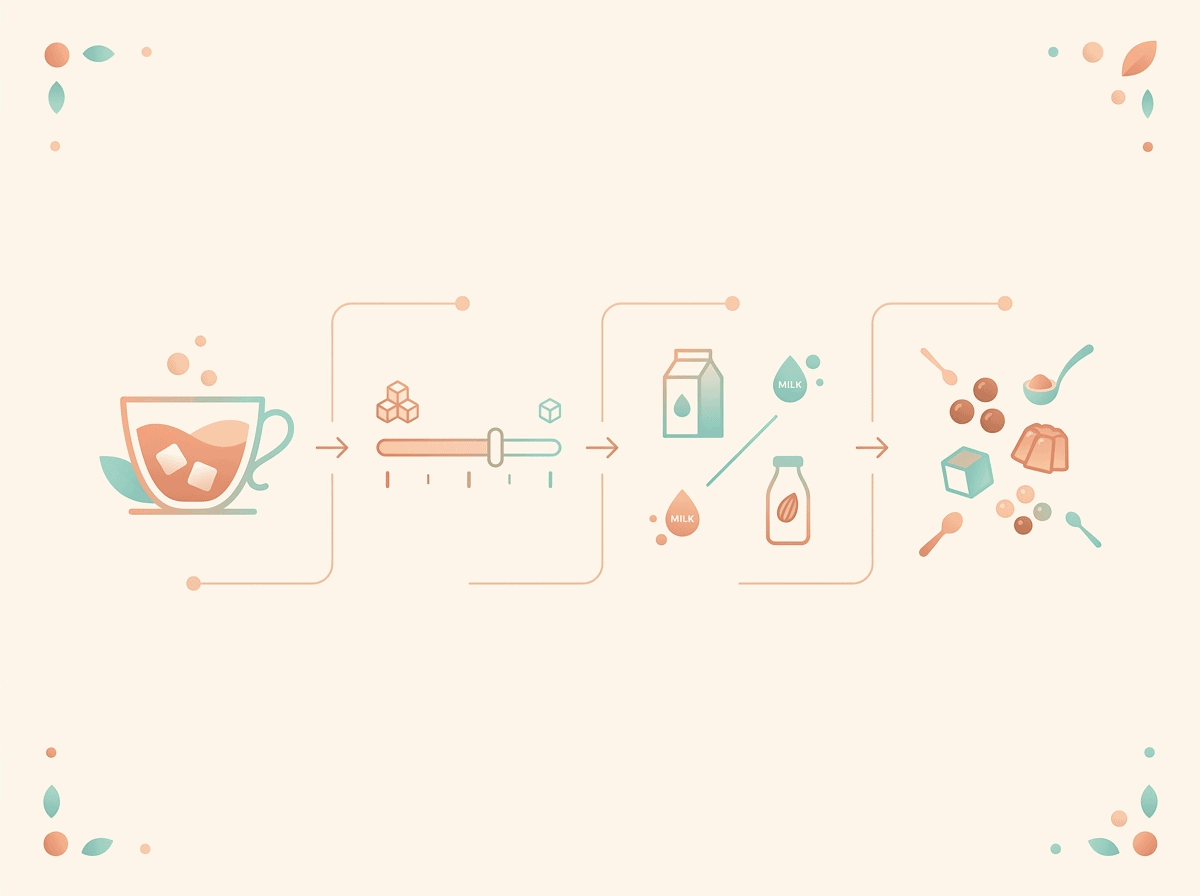
Three knobs — sugar level, milk swap, and topping change — can cut a boba’s calories by 40–60% without giving up the chew. Here is the exact sequence that works at almost any chain.
Step 1 — Drop the sugar level to 30%
This is the single highest-leverage move. A 100% to 30% sugar shift on a 16 oz milk tea removes roughly 90–110 calories. The drink still tastes sweet because the milk and pearls carry their own sweetness; you mainly lose the cloying finish.
Step 2 — Pick a tea base over a milk tea base
A 16 oz fruit tea with boba runs 220–320 cal vs 380–450 cal for the milk tea equivalent. If you cannot give up milk, the next-best move is oat or almond milk at 30% sugar — modern shops offer this and it lands around 280–330 cal.
Step 3 — Swap classic pearls for crystal or popping boba
This removes 80–120 cal from the topping line alone. Texture purists may resist, but for a daily-drinker pattern, this swap alone saves about 4 lb of fat-equivalent calories per year.
Step 4 — Watch the toppings stack
Pudding adds 80–110 cal. Cheese foam adds 90–140 cal. Grass jelly adds only 30–50 cal. Lychee jelly adds 25–40 cal. If you must add a topping beyond pearls, grass jelly is the calorie-friendly option.
Step 5 — Size down strategically
Most calorie damage from “upsize” is from the extra syrup and milk, not the tea. A 12 oz with full pearls is usually more satisfying than a 22 oz with sugar-cut everything, because pearl density matters more than liquid volume for mouthfeel satisfaction.
Common ordering mistakes that waste calories
- Defaulting to “regular sweet” — almost every shop’s default is 100% or 75% sugar. Always state your sugar level explicitly.
- Adding “extra boba” for a few cents — that upgrade alone adds 60–100 cal.
- Going for “0% sugar” thinking it has no calories — the milk, pearls, and pre-sweetened powders still carry 250–350 cal at 0% added sugar.
- Ordering at peak fatigue — late-afternoon boba is typically larger and more topping-heavy. Order earlier and you tend to choose smaller.
Boba Calories for Home Brewers and Café Operators
For home brewers, the calorie math is more controllable because you choose the soak ratio; for café operators, the cost-per-calorie of pearl supplier choice matters more than retail menu engineering. This section is the one most guides skip entirely.
Home brewing — controlling your own pearl calorie load
Dry tapioca pearls are about 360 calories per 100 g. Cooked weight roughly doubles after boiling, and the brown sugar soak is where home brewers can save the most. A 1:1 sugar-to-water soak doubles pearl calories. Switching to a 1:3 soak ratio with a 15-minute soak instead of overnight keeps the chew but cuts the added sugar by roughly 60%.
A practical home recipe — 1/4 cup dry pearls, boiled, then soaked 15 minutes in 1 tbsp brown sugar dissolved in 3 tbsp water — yields a ~130-calorie serving versus 200+ from store-bought pre-soaked pearls.
Café and B2B operator considerations
Industrial pearl manufacturing has split into two product tiers in 2025–2026: traditional pre-soaked (higher calorie, longer shelf-life thanks to sugar’s water-binding) and dry/unsoaked (lower calorie, requires on-site soaking). Equipment lines for both — including pearl extruders, syrup mixers, and steam cookers — are produced by specialized confectionery machinery vendors. At JY Machinetech we see growing demand for low-sugar pearl production lines as café chains respond to added-sugar regulations in California, New York, the EU, and Singapore.
The relevant operator decisions are:
- Pearl size — 6 mm vs 9 mm directly changes serving calorie count by 20–30%.
- Soak syrup formulation — brown sugar, honey, fructose-free alternatives.
- Pre-soaked vs in-store soaked — affects both calorie disclosure and supply chain.
- Crystal/agar pearl production — distinct extrusion equipment from tapioca lines.
A factory that can run both tapioca and konjac/agar pearl lines on shared infrastructure now has a measurable advantage over single-product lines, because chain buyers want one supplier for both their classic and diet product lines.
Future Trends — Where Boba Calories Are Headed Through 2026 and Beyond
Boba calorie counts are trending downward by 10–15% over the past three years as chains respond to sugar taxes, transparency regulations, and consumer demand for “lighter” drinks. Three forces are reshaping the calorie profile of the category.
TABLE 3 — Boba calorie trend forecasts 2024–2027
| Trend | 2024 baseline | 2025 actual | 2026 forecast | 2027 outlook |
|---|---|---|---|---|
| Avg 16 oz milk tea + boba (cal) | 420 | 400 | 380 | 360 |
| Crystal/popping boba menu share | 12% | 18% | 25% | 32% |
| Default sugar level (US chains) | 75% | 70% | 60% | 50% |
| Plant-milk option availability | 64% | 78% | 87% | 92% |
| Added-sugar transparency mandates (markets) | 4 | 7 | 11 | 16 |
Trend 1 — Sugar slider defaults are dropping
In 2022, most US chains defaulted to 100% sugar. By 2026, the industry default is sliding toward 50–70% as new customers expect a less-sweet baseline, particularly among the under-25 demographic that drives the category. This shift alone removes 60–80 calories per cup as the baseline expectation.
Trend 2 — Alternative pearl materials are mainstreaming
Konjac, agar, and chia-seed-based “boba” alternatives are moving from niche to mainstream menu items. Industry data points to crystal and popping boba growing from ~12% of topping orders in 2024 to a projected 25% by end of 2026. The calorie-per-serving on these alternatives is 40–60% lower than classic pearls.
Trend 3 — Mandatory calorie labeling is expanding
California, New York City, and the EU now require chain menu calorie disclosures. Singapore has gone further with a sugar-content labeling system (Nutri-Grade) that rates boba drinks A–D. Several Asian markets are following. The effect: chains that historically obscured calorie counts are now competing on visible numbers, which pulls product formulation toward leaner builds.
FAQ
How many calories in a small boba milk tea?
A small 12 oz boba milk tea typically has 280–360 calories. That assumes 100% sugar, whole milk, and a standard scoop of classic black tapioca pearls. Drop the sugar to 30% and switch to oat milk and the same drink lands around 200–240 cal. The pearl scoop alone contributes 90–130 cal.
How many calories in a large 24 oz boba?
A large 24 oz boba milk tea runs 520–700 calories. Brown sugar variants and multi-topping builds (boba plus pudding plus cheese foam) can push past 800 cal. For reference, that is roughly one-third of a 2,000-calorie daily intake in a single drink. Sizing down to 16 oz typically saves 150–200 calories.
Does boba have more calories than soda?
Yes — most boba drinks pack 2 to 3 times the calories of an equal-volume soda. A 16 oz Coca-Cola has about 190 cal; a 16 oz boba milk tea is 380–450 cal. The gap comes from the milk fat, pearls, and richer sweetener loading. If you are switching from soda to boba thinking it is healthier, the calorie math goes the wrong way unless you actively customize down.
How many calories are in boba pearls alone?
Boba pearls alone supply 100–200 calories per typical 1/3-cup serving. That count covers the cooked tapioca plus its post-cook brown sugar or honey soak. The base tapioca itself is 130–150 cal at that portion; the syrup soak adds another 30–70 cal depending on shop recipe. Brown sugar “tiger” pearls are the heaviest at the top of that range.
Is crystal boba lower calorie than regular boba?
Yes — crystal boba has roughly 40–60% fewer calories than classic tapioca pearls. Crystal boba is made from agar or konjac, which are mostly water and soluble fiber. A serving runs 45–70 cal versus 130–180 cal for the same volume of classic pearls. The texture trades dense chew for jelly bite. For daily drinkers, this single swap removes the equivalent of 4 lb of fat-equivalent calories per year.
Can I drink boba on a diet?
Yes, if you customize aggressively — 30% sugar, fruit tea base, crystal or popping boba, 12 oz size keeps a cup under 200 calories. That fits comfortably inside most calorie-controlled diets as a 2–3x per week treat. The pattern that breaks diets is the default 100%-sugar large milk tea with extra toppings, which can hit 700+ cal. Customize the drink; do not skip the drink.
Why are brown sugar boba drinks so much higher in calories?
Brown sugar boba uses caramelized syrup twice — to soak the pearls and to streak the cup — adding 120–160 calories versus a plain milk tea of the same size. The signature build is calorie-intensive by recipe design; the brown sugar’s role is structural to the drink’s visual identity, so chains rarely offer a “no syrup” version of this drink. If you want the brown sugar flavor at lower calories, ask for “light syrup, no cup drizzle.”

Conclusion
The honest answer to how many calories in a boba is “more than you think, but less than you cannot manage.” A default 16 oz milk tea with classic pearls runs 350–500 cal; aggressive customization brings that under 250. The pearls themselves carry 100–200 cal regardless of how you tune the rest.
For most drinkers, the practical playbook is three moves: drop the sugar slider to 30%, choose plant milk or a tea base, and reach for crystal or popping boba on the toppings line. That sequence cuts a typical cup by half without giving up what makes boba enjoyable in the first place. For café operators and B2B equipment buyers, the lesson is bigger: the category is restructuring around lower-calorie product lines, and supply chains built for both classic and alternative pearls will win the next product cycle. Order the drink, but order it on purpose.
Related Articles
- How Many Calories in Boba Tea? Cup Size, Sugar, and Toppings
- How Many Calories in Boba? Full Drink and Topping Guide
- What Is Popping Boba Made Of? Ingredients, Science & Manufacturing Explained
- Lowest Calorie Candy: The Complete 2026 Guide to Guilt-Free Sweets
- Gummy Candy Production Line
- Are Skittles Dairy Free? Complete Ingredient Guide
- Are Skittles Gluten Free? Complete Guide 2026