Strawberry Milk Tea: The Ultimate Recipe Guide (Boba, No-Boba & Café Secrets)
Make strawberry milk tea by brewing black or jasmine tea, blending fresh strawberries into a syrup, mixing with milk over ice, and adding optional tapioca boba pearls — ready in 20 minutes.
Strawberry milk tea sits at the intersection of fruity refreshment and creamy comfort — and once you nail the ratio of tea strength to strawberry sweetness to milk richness, you will wonder why you ever paid $7 for a café version. We have made dozens of batches in our test kitchen, tried six different tea bases, and compared fresh strawberries against powders and syrups. This guide gives you everything: the precise recipe, the science behind why certain teas taste better, calorie breakdowns, vegan swaps, boba prep timing, and the exact mistakes that make strawberry milk tea taste flat instead of vibrant.
Whether you want a quick weeknight drink, a batch for a summer party, or a production recipe you can scale for a small café, this is the only strawberry milk tea guide you need.
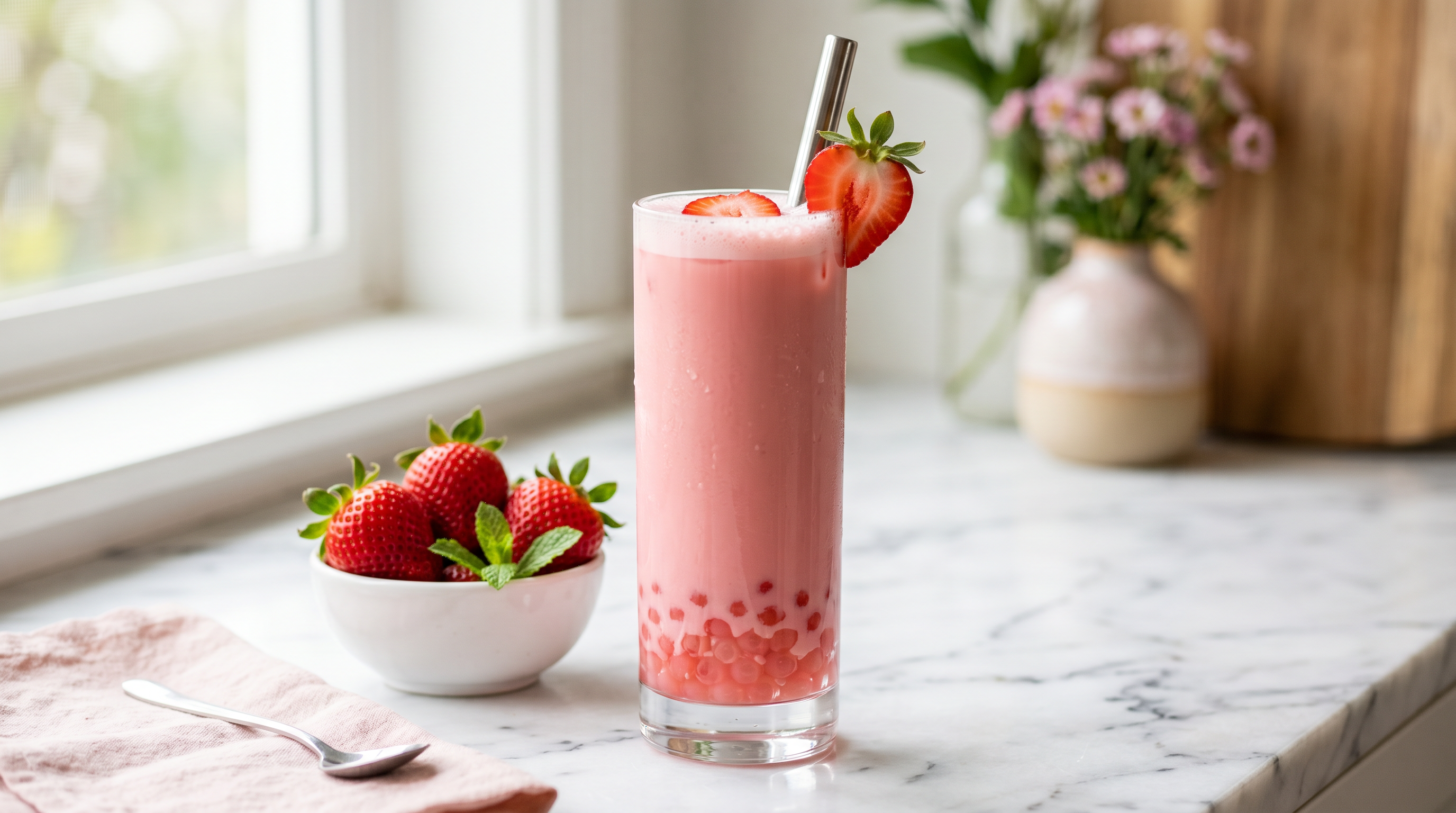
What Is Strawberry Milk Tea?
Strawberry milk tea is a tea-based drink that combines brewed tea, a strawberry element (fresh fruit, syrup, or powder), and milk or a milk alternative, usually served over ice. It is a close relative of Taiwanese bubble tea — also called boba — and can be made with or without tapioca pearls depending on preference.
The drink first gained global visibility through Taiwanese boba chains in the 1990s, but its roots are more diverse. Strawberry milk — called ichigo miruku (苺ミルク) in Japan — has been a beloved school-canteen drink across East Asia for decades. Adding tea to that combination was a natural evolution driven by boba shop menus.
Today, strawberry milk tea is one of the most searched boba flavors in the United States, with Google Trends data showing peak demand each year from May through August — precisely when fresh strawberries are at their cheapest and most flavorful.
Key Components
| Component | Role | Best Option |
|---|---|---|
| Tea base | Structure, tannins, slight bitterness | Black, jasmine, or oolong |
| Strawberry element | Sweetness, color, fruity aroma | Fresh berry syrup (see below) |
| Milk | Creaminess, body | Whole milk or oat milk |
| Sweetener | Balance | Simple syrup or brown sugar |
| Ice | Chilling, dilution control | Large cubes (melts slower) |
| Boba pearls | Texture, visual appeal | Tapioca (optional) |
Choosing the Right Tea Base for Strawberry Milk Tea
The tea you choose determines roughly 40% of the final flavor. Strawberry is a delicate fruit note — it can be easily overpowered by an aggressive tea or lost behind a weak one.
Black tea is the most common base for strawberry milk tea. Assam and Ceylon varieties have a malty backbone that contrasts beautifully with sweet strawberry. Brew it strong (1 teabag per 120 ml water) so it holds up once you add milk. Our tests showed that regular Lipton black tea bags, while not premium, produce a solid result because their robust tannins prevent the strawberry from tasting watery.
Jasmine green tea creates a floral, lighter-bodied strawberry milk tea that feels more elegant and less sweet. If you are serving this to people who find boba drinks too rich, jasmine is the move. Brew at 75°C (167°F) for 2 minutes — boiling water turns green tea bitter.
Oolong tea splits the difference: semi-oxidized, with a natural stone-fruit character that amplifies strawberry rather than competing with it. This is our personal favorite base for fresh-strawberry versions, and it is what most premium boba shops use when they want a “tea-forward” strawberry drink.
Hibiscus tea makes a caffeine-free, vibrantly pink alternative. It pairs well with strawberry because both are tart and bright. Note that hibiscus is quite sour, so increase your sweetener by 20–30%.
Tea Brewing Guide by Variety
| Tea Type | Water Temperature | Steep Time | Tea Strength |
|---|---|---|---|
| Black (Assam/Ceylon) | 95°C / 203°F | 4–5 min | 1 bag per 120 ml |
| Jasmine green | 75°C / 167°F | 2–3 min | 1 bag per 150 ml |
| Oolong | 90°C / 194°F | 3–4 min | 1 bag per 130 ml |
| Hibiscus (caffeine-free) | 95°C / 203°F | 5–7 min | 2 bags per 200 ml |
| Rooibos (caffeine-free) | 95°C / 203°F | 6–8 min | 1 bag per 150 ml |
Always brew your tea double-strength if you plan to pour it over ice. The ice will dilute it back to the right concentration.
How to Make Strawberry Syrup from Scratch
Fresh strawberry syrup is the secret weapon that separates homemade strawberry milk tea from anything you can get from a powder packet. It takes 10 minutes and keeps in the fridge for up to two weeks.
Ingredients for strawberry syrup (makes ~300 ml):
- 250 g (about 2 cups) fresh or frozen strawberries, hulled and halved
- 150 g (¾ cup) granulated sugar
- 120 ml (½ cup) water
- 1 tsp lemon juice (keeps color bright and extends shelf life)
Method:
- Combine strawberries, sugar, and water in a small saucepan over medium heat.
- Stir until sugar dissolves, then bring to a gentle simmer.
- Simmer 8–10 minutes, mashing strawberries with the back of a spoon as they soften.
- Remove from heat. Add lemon juice. Stir to combine.
- Strain through a fine mesh sieve — press the pulp to extract maximum juice.
- Cool completely before using. Store refrigerated in a sealed jar.
The resulting syrup is intensely strawberry, glossy, and a deep ruby-pink. Two tablespoons per serving is the sweet spot; adjust based on berry sweetness (winter berries need more sugar, peak-June berries need less).
Fresh vs. powder vs. canned comparison:
| Format | Flavor Intensity | Prep Time | Cost per Serving | Shelf Life |
|---|---|---|---|---|
| Fresh berry syrup | ★★★★★ | 15 min | ~$0.60 | 2 weeks refrigerated |
| Frozen berry syrup | ★★★★☆ | 15 min | ~$0.40 | 2 weeks refrigerated |
| Store-bought strawberry syrup | ★★★☆☆ | 0 min | ~$0.35 | 6 months sealed |
| Strawberry milk tea powder | ★★☆☆☆ | 0 min | ~$0.25 | 12 months sealed |
| Canned strawberry milk tea | ★★☆☆☆ | 0 min | ~$1.20 | 12 months sealed |
Powder has its place: if you are running a high-volume boba shop or need to prep 200 drinks a day, the consistency and speed of a quality strawberry milk tea powder is worth the flavor tradeoff. For home use, always go fresh.
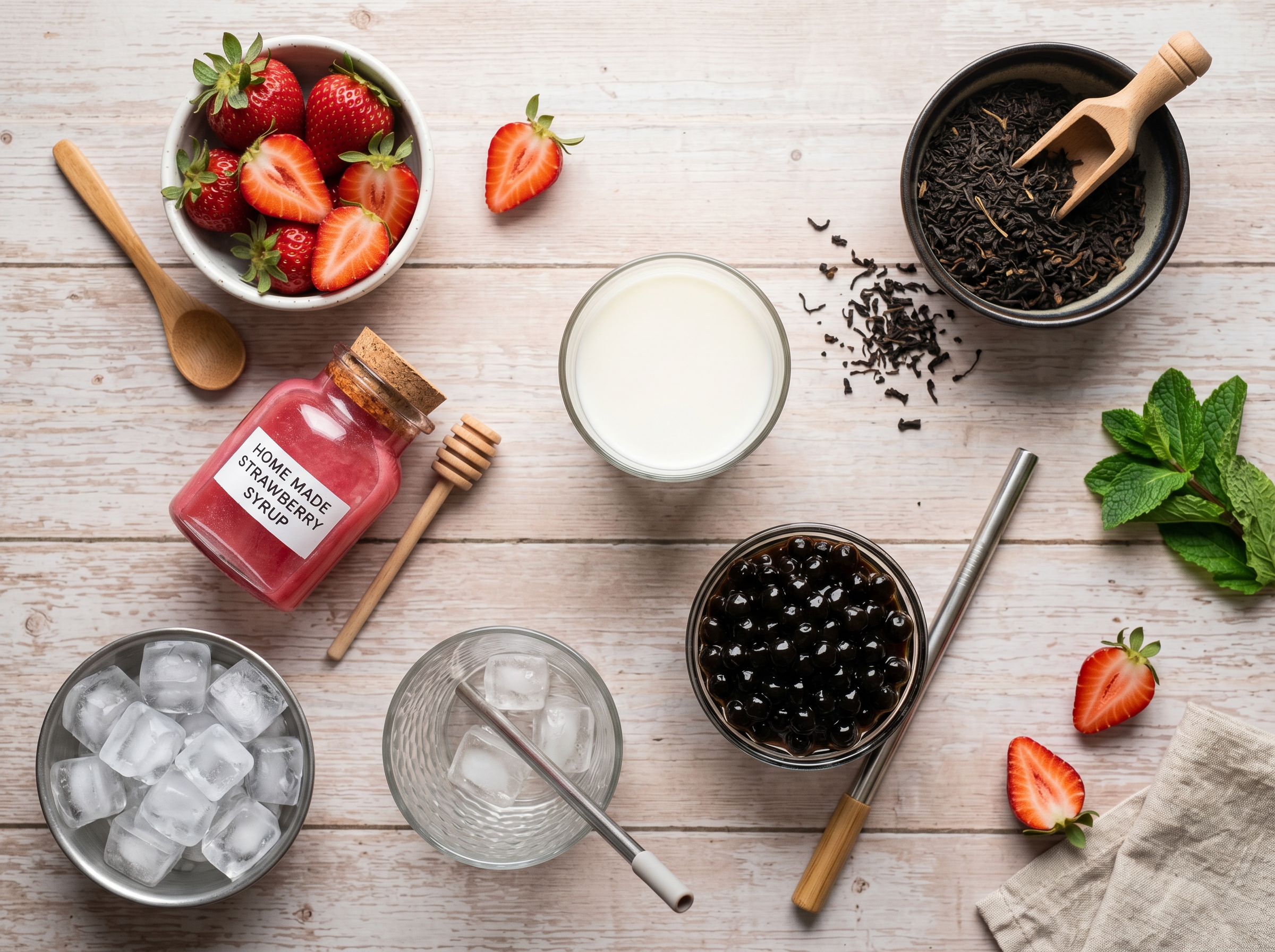
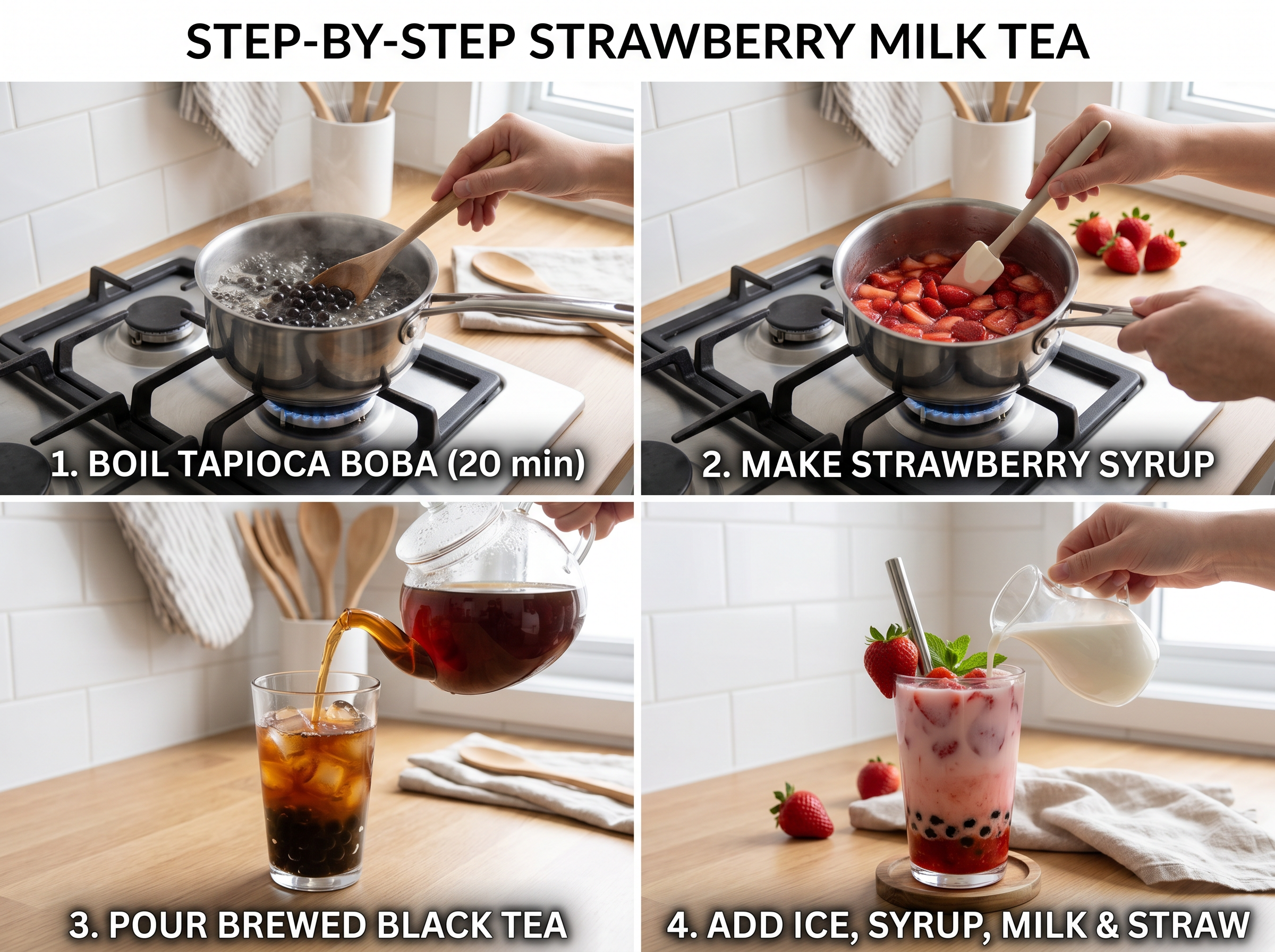
The Core Strawberry Milk Tea Recipe (Step-by-Step)
This is the base recipe — boba optional. Everything else in this guide builds on it.
Serves: 2 | Prep time: 10 min | Brew + chill time: 10 min | Total: ~20 min
Ingredients
- 300 ml (1¼ cups) strongly brewed black or jasmine tea, cooled
- 4 tbsp fresh strawberry syrup (from recipe above)
- 160 ml (⅔ cup) whole milk or oat milk
- 2 tbsp simple syrup (adjust to taste)
- Large ice cubes
- Optional: 100 g cooked tapioca boba pearls per serving
Instructions
- Brew and chill the tea. Make double-strength tea (2 bags per 300 ml water). Let it steep the recommended time, then remove bags. Cool to room temperature or speed-chill over an ice bath. Never pour hot tea directly over boba — it dissolves the pearls.
- Prepare boba if using. Cook tapioca pearls per package directions (usually 15–20 minutes boiling, then 15 minutes covered off heat). Drain, rinse, and soak in simple syrup while you prep the drink.
- Build the drink. Add ice to a 500 ml glass (about ¾ full). Pour in 2 tbsp strawberry syrup, 1 tbsp simple syrup, then the cooled tea. Stir gently.
- Add milk. Pour milk slowly over the back of a spoon for a layered effect — or stir for a uniform blush-pink color. Both look beautiful.
- Add boba. Spoon cooked boba pearls into the glass if using. Insert a wide straw immediately — boba sinks fast.
- Taste and adjust. More syrup for sweetness, more tea for bitterness, a squeeze of lemon if it tastes flat.
Pro tip: For a creamier texture without extra calories, replace 40 ml of milk with 40 ml of coconut cream. The fat emulsifies beautifully with the strawberry and gives the drink a slight tropical note that pairs surprisingly well with black tea.
Strawberry Milk Tea Without Boba
Strawberry milk tea without boba is just as satisfying — and arguably a better everyday drink because it is faster to make and significantly lower in calories. Here are three no-boba variations:
Classic No-Boba: Follow the core recipe exactly and skip the tapioca pearls. The drink is lighter in texture. If you miss the chewiness, substitute with basil seeds (also called sabja) — soak 1 tsp in 60 ml water for 10 minutes. They expand into tiny, slightly crunchy globules with almost zero calories.
Blended/Frozen Version: Combine 200 ml brewed tea, 3 tbsp strawberry syrup, 120 ml milk, and 1 cup of ice in a blender. Blend until smooth. This makes a slushy, milkshake-like drink that is perfect for summer parties. Pour into a wide glass and top with a fresh strawberry slice.
Strawberry Thai Milk Tea: Brew strong Thai tea (or black tea with a pinch of ground star anise), add 2 tbsp strawberry syrup, and top with evaporated milk instead of regular milk. The result is richer, slightly spiced, and gorgeous in orange-meets-pink layers.
Cooking the Perfect Boba Pearls
Boba pearls — or tapioca pearls — are what turn strawberry milk tea into full bubble tea. The difference between chewy, springy boba and a gummy, collapsed mess is almost entirely in the cooking method.
Two rules that most recipes get wrong:
- Never add boba to cold water. Always add pearls to a full rolling boil, otherwise they stick together before gelatinizing properly.
- Rest off heat. After boiling, cover the pot and let pearls rest 15 minutes. This finishes cooking via steam and gives the center time to hydrate without overcooking the outside.
Boba Cooking Method
| Step | Action | Time |
|---|---|---|
| 1 | Bring 1 liter water to full rolling boil | — |
| 2 | Add 100 g dried tapioca pearls | — |
| 3 | Stir immediately for 30 seconds to prevent clumping | — |
| 4 | Boil uncovered, stirring every 2–3 min | 12–15 min |
| 5 | Cover, remove from heat, let rest | 15 min |
| 6 | Drain, rinse with cold water briefly | — |
| 7 | Transfer to bowl with 2 tbsp simple syrup | — |
| 8 | Use within 2 hours | — |
Freshly cooked boba should be semi-translucent, springy when bitten, and have no hard center. If you bite into one and it is chalky in the middle, cook 5 more minutes and rest again.
Quick-cook boba: Many Asian grocery stores now sell “5-minute boba” or “instant boba” (look for brands like WuFuYuan). These use smaller pearls and different starch ratios for faster prep. They work fine for strawberry milk tea and are worth stocking if you make this regularly.
Strawberry Milk Tea Calories: Full Breakdown
Calorie counts vary wildly depending on milk type, syrup amount, and whether you add boba. Here is an honest breakdown based on standard serving sizes.
Calorie Comparison Table (per 500 ml serving)
| Version | Calories | Sugar (g) | Notes |
|---|---|---|---|
| With whole milk + boba | 320–380 | 52–64 | Standard café version |
| With oat milk + boba | 290–340 | 55–68 | Higher sugar from oat milk base |
| With almond milk + boba | 240–290 | 48–58 | Lower fat, lower calories |
| With whole milk, no boba | 180–220 | 32–42 | Much lighter option |
| With oat milk, no boba | 160–200 | 34–44 | Good vegan option |
| Reduced sugar, almond milk, no boba | 100–130 | 18–24 | Optimal for low-calorie version |
| Blended/frozen version | 250–310 | 40–55 | Depends on ice ratio |
Where do the calories come from?
- Boba pearls: 100 g cooked = ~130 calories, almost all carbohydrates. They add chewiness but are nutritionally minimal.
- Strawberry syrup (2 tbsp fresh): ~60–80 calories when sugar-sweetened; ~15 calories if you use a monk-fruit sweetener.
- Milk (160 ml whole): ~100 calories; oat milk ~80 calories; unsweetened almond milk ~15 calories.
- Simple syrup (2 tbsp): ~60 calories. Reduce or eliminate if your syrup is already sweet enough.
Low-calorie hack: Replace simple syrup with a liquid monk-fruit or erythritol sweetener, and use unsweetened almond milk. You will cut the calorie count by roughly 40% with very little flavor sacrifice. The strawberry still shines.
Vegan and Dairy-Free Strawberry Milk Tea
Strawberry milk tea is naturally vegan-adaptable — the only non-vegan element is the dairy milk. Every other component (tea, fruit, sugar, tapioca) is plant-based.
Best dairy-free milks for strawberry milk tea:
- Oat milk: Creamy, slightly sweet, pairs beautifully with black tea. Our top pick for flavor. Choose a barista edition for better emulsification. Note that oat milk adds about 10–15g extra sugar per serving compared to other alternatives.
- Coconut milk (full-fat): Rich and tropical. Best for blended versions or when you want a creamier, dessert-like texture. Can overpower delicate jasmine tea — pair with black tea instead.
- Cashew milk: Very neutral flavor, naturally creamy without gums or thickeners. Great option if you want the dairy-like texture without the oat sweetness.
- Soy milk: The most protein-rich option. Slightly beany flavor that most people cannot detect once the strawberry and tea are present. A classic boba shop substitution.
- Almond milk: Lowest calorie. Thinner body, slightly nutty. Works in iced versions where the ice dilutes things anyway.
Note on boba and vegan diets: Standard tapioca boba pearls are vegan — they contain only tapioca starch, water, and sometimes coloring. However, some café versions use gelatin-based pearls (especially colored ones) or add honey to the syrup soak. If in doubt, make your own boba at home or ask the shop explicitly.
Strawberry Milk Tea Powder: When and How to Use It
Strawberry milk tea powder is the shortcut ingredient that every boba shop keeps in stock. It is not inferior to fresh — it is just a different product with different appropriate use cases.
What it contains: Most commercial strawberry milk tea powders combine non-dairy creamer, sugar, strawberry flavoring (natural or artificial), and a tea extract (usually black tea dust). Some premium versions use real freeze-dried strawberry.
When powder makes sense:
- High-volume production (more than 20 drinks per day)
- No access to fresh strawberries (winter months)
- Batch meal prep (scoop and shake)
- Travel or camping situations
How to use strawberry milk tea powder correctly:
- Use 3–4 tablespoons (30–40g) per 350 ml serving — adjust by brand.
- Mix with a small amount of warm water first (2–3 tbsp) to dissolve completely before adding cold liquid.
- Add cold milk and/or water, then ice.
- Shake vigorously in a cocktail shaker or blender bottle to dissolve and aerate.
Do not just dump powder into cold liquid and stir — you will get clumps. The pre-dissolve step takes 30 seconds and makes a huge difference in texture.
Brand note: Taiwanese brands (Te Ching Ren, Tiger Sugar, Chatime-style) tend to use higher-quality tea extracts. Korean brands (Maxim, etc.) skew sweeter and creamier. American grocery store brands are generally the most affordable but have the least strawberry authenticity.
Café-Scale Strawberry Milk Tea Production
If you are running a boba shop or café and want to add strawberry milk tea to your menu, here is how professional operations approach it at scale.
Batch brewing tea concentrate:
Brew 10:1 concentrate — 100g loose-leaf Assam per 1 liter of 95°C water, steep 5 minutes, strain, cool, refrigerate. Dilute 1:9 for serving (1 part concentrate + 9 parts cold water or ice). This saves time per order and ensures consistency. Most high-volume shops use this concentrate method.
Strawberry syrup in bulk:
Either purchase a commercial strawberry syrup (Torani, Monin, Da Vinci are standard café brands) or, for premium positioning, make weekly batches of fresh-cooked syrup. Fresh syrup has a ~2-week fridge life, so plan production accordingly. For 100+ drinks per day, commercial syrup is the practical choice.
Workflow per drink at café speed:
- Add ice to shaker + cup simultaneously — 5 sec
- Measure 30 ml strawberry syrup — 5 sec
- Measure 90 ml tea concentrate — 5 sec
- Add 120 ml milk — 5 sec
- Shake 10 seconds — 10 sec
- Pour over cup ice, add boba — 10 sec
- Cap, straw, hand off — 10 sec
Total: ~50 seconds per drink
Equipment checklist for a café strawberry milk tea station:
- Tea brewer or concentrate kettle
- Commercial refrigerator for syrup, milk, concentrate
- Cocktail shaker or boba shaker (stainless steel, 700 ml capacity)
- Measured dispensing pumps for syrup (30 ml per pump)
- Boba warmer/rice cooker for holding cooked pearls at temperature
- Wide-bore straws (12 mm minimum for boba to pass through)
Industry note: Strawberry milk tea is typically positioned in the $5.50–$7.50 price range in US cafés, with food cost targets of 28–32%. At fresh syrup cost ($0.60/serving) + milk ($0.30) + tea ($0.15) + boba ($0.40) + cup/straw ($0.25), total COGS is approximately $1.70, hitting a solid 24% food cost at a $7 selling price.
Troubleshooting Common Strawberry Milk Tea Problems
We have made every mistake you can make with this drink. Here is what goes wrong and how to fix it.
Problem: Drink tastes watery.
Cause: Tea was not brewed strong enough or has too much ice melt. Fix: Always brew double-strength and add ice after assembly, not before. Use large ice cubes — they melt slower than crushed ice.
Problem: Strawberry flavor is flat or faint.
Cause: Berries were underripe or out-of-season frozen berries had no aroma. Fix: Add 1 tsp strawberry extract to your syrup, or increase the syrup amount by 1 tbsp per serving. A tiny pinch of salt (~⅛ tsp per batch of syrup) amplifies fruit flavor significantly.
Problem: Boba is hard or chalky in the center.
Cause: Undercooking. Fix: Cook an additional 5 minutes and rest covered for another 15 minutes.
Problem: Boba dissolved into mush.
Cause: Overcooked, or left in hot water too long. Fix: Rinse with cold water immediately after cooking to stop the cook. Use within 2 hours of cooking; do not reheat.
Problem: Drink has a weird tea bitterness that clashes with strawberry.
Cause: Oversteeping or using boiling water for green/oolong tea. Fix: Reduce steep time, lower the water temperature for delicate teas, and use less tea concentrate until you find the right balance.
Problem: Milk and tea separated into unappetizing streaks.
Cause: Temperature difference between tea and milk — hot meets cold. Fix: Always use fully chilled tea before mixing. Both tea and milk should be the same temperature when combined.
Problem: Color looks pale pink instead of vibrant.
Cause: Insufficient syrup or overripe strawberries that lost pigment during cooking. Fix: Add more syrup. For color, a few drops of beet juice (not beet-flavored — odorless beet extract) deepens the pink naturally without affecting taste.
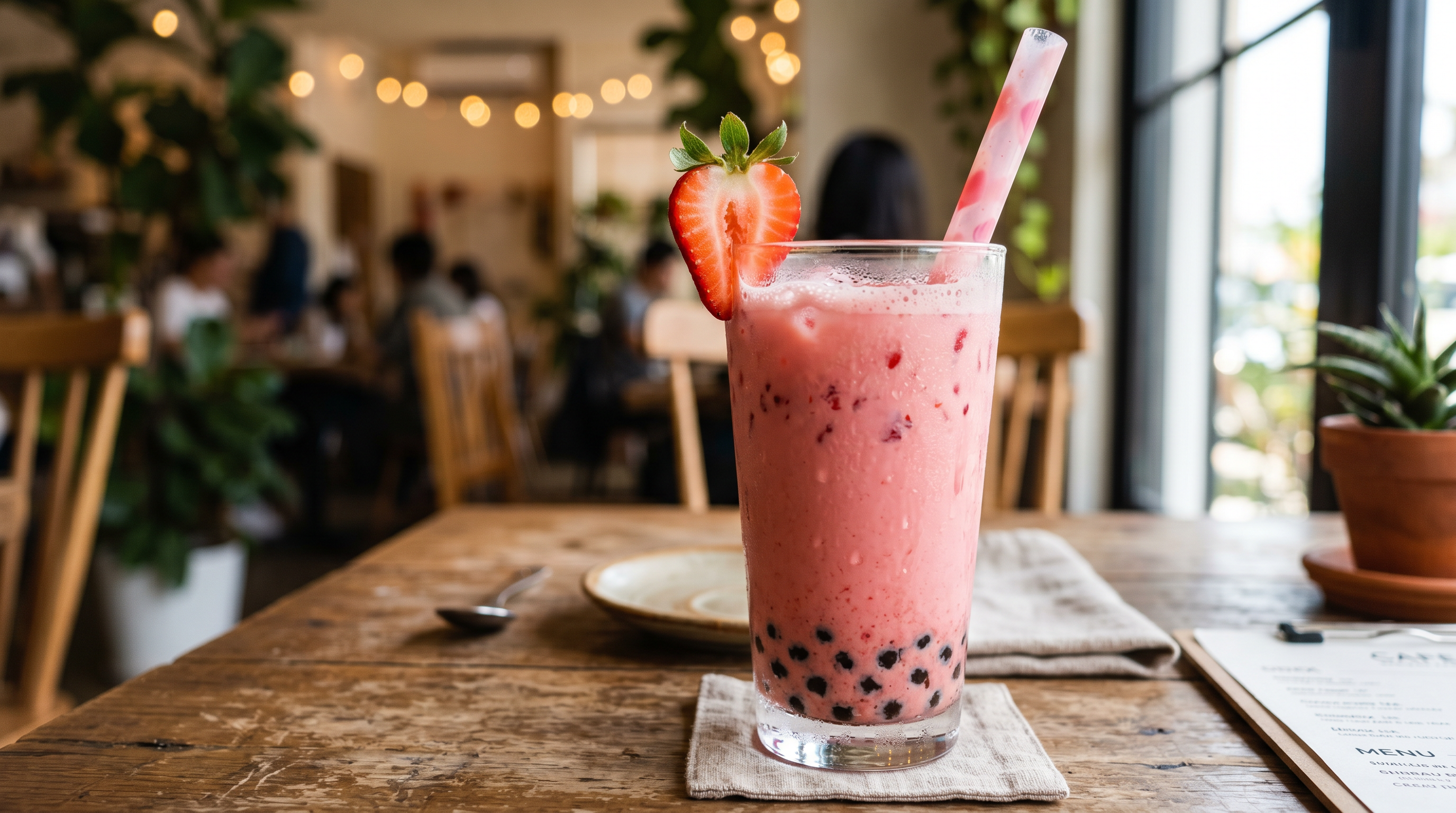
Seasonal Variations and Creative Riffs
Strawberry milk tea is a template, not a fixed formula. Here are proven variations worth trying.
Strawberry Matcha Milk Tea: Layer strawberry syrup at the bottom, then oat milk, then a whisked matcha (2g matcha + 30 ml hot water). The red-white-green layers are visually stunning and the earthiness of matcha balances the sweet berry perfectly. Becoming one of the most popular boba combinations of 2024.
Strawberry Brown Sugar Milk Tea: Substitute the simple syrup with brown sugar syrup (equal parts dark brown sugar and water, simmered 5 min). The molasses notes in brown sugar add depth and complexity. Drizzle extra brown sugar syrup down the inside of the glass before adding ice for the “tiger stripe” aesthetic.
Strawberry Hojicha Milk Tea: Hojicha is roasted green tea with a nutty, caramel-like flavor. Its smokiness creates an unexpected and sophisticated contrast with bright strawberry. Less sweet overall, more adult-palate-oriented.
Hot Strawberry Milk Tea: Yes, strawberry milk tea can be served hot. Brew a moderate-strength black tea, stir in 1.5 tbsp strawberry syrup, top with steamed or warm oat milk. It is soothing and unusual — closer to a fruit tisane than a boba drink, but genuinely delicious on cold days.
Strawberry Lychee Milk Tea: Add 1 tbsp lychee syrup alongside the strawberry syrup. The floral lychee amplifies the fruit notes rather than competing. Popular in Southeast Asian cafés.
Future Trends in Strawberry Milk Tea
Strawberry milk tea is evolving rapidly. We are tracking several trends reshaping how shops and home brewers approach this drink.
Fresh fruit blending. Instead of a cooked syrup, some progressive boba shops are blending 4–5 whole strawberries directly into the drink per order. The result is an opaque, deeper-textured drink with visible seeds — more smoothie-like, but with genuine tea character underneath. Requires a high-powered blender (Vitamix-class) for commercial viability.
Reduced-sugar formulations. As consumers become more health-conscious, cafés are offering 25%, 50%, and 75% sugar levels on their boba menus. For strawberry milk tea specifically, we have found that 50% sugar (about 1 tbsp syrup instead of 2) still delivers a satisfying drink if the strawberry syrup itself is made from ripe, sweet berries.
Alternative tea bases. Butterfly pea flower tea turns naturally purple, and when you add acidic strawberry syrup, it shifts to a vivid violet-pink through pH-sensitive pigmentation. The color-changing effect goes viral on social media regularly and adds essentially zero cost. Worth offering as a premium visual upgrade.
Plant-based dairy innovation. Newer oat milks and pea-protein milks have improved dramatically in texture and neutral flavor. As these become cheaper and more widely available, expect dairy-free strawberry milk tea to reach full parity with full-dairy versions in terms of creaminess and mouthfeel.
Strawberry milk tea in packaged beverages. The RTD (ready-to-drink) market has taken notice. Brands like Pokka, Calpico, and smaller craft producers now market canned and bottled strawberry milk tea. While the home-made version is far superior, the RTD category is growing at approximately 12% annually and normalizing the flavor combination for new audiences who then seek out café versions.
Frequently Asked Questions
What is the best tea for strawberry milk tea?
Black tea (Assam or Ceylon) is the most popular base because its malty tannins balance the sweetness of strawberry without being overpowered. Jasmine green tea is a lighter, more floral option. Oolong offers a middle ground with a natural stone-fruit quality that complements fresh strawberry beautifully. Avoid herbal teas without caffeine if you want a genuine tea flavor profile.
Can I use frozen strawberries instead of fresh?
Yes — frozen strawberries work very well for making syrup because they have already been broken down by freezing, which actually makes them release juice faster when cooked. Do not expect frozen strawberries to look as vivid as fresh, but the flavor will be close. Thaw them slightly before cooking for better texture control.
How many calories are in strawberry milk tea?
A standard 500 ml café-style strawberry milk tea with whole milk and boba pearls contains roughly 320–380 calories. A no-boba version with whole milk drops to about 180–220 calories. You can reduce it further to 100–130 calories by using unsweetened almond milk and a sugar-free sweetener.
How do I make strawberry milk tea without boba?
Simply follow the core recipe and skip the tapioca pearl step. The drink is lighter and quicker to make. For added texture, try basil seeds (sabja) soaked in water for 10 minutes — they expand and add a subtle crunch with almost no calories.
What milk is best for vegan strawberry milk tea?
Oat milk is the most popular vegan choice because its natural sweetness and creamy texture closely mimic whole dairy milk. Cashew milk is a close second — very neutral flavor and naturally thick. Coconut milk adds a tropical note that pairs well with black tea bases.
How long does homemade strawberry milk tea keep?
The assembled drink is best consumed within 1–2 hours. The strawberry syrup keeps refrigerated for up to 2 weeks in a sealed jar. Brewed tea concentrate keeps refrigerated for 5–7 days. Cooked boba pearls should be used within 2 hours of cooking — they harden and become unpleasant if refrigerated after cooking.
Why does my strawberry milk tea taste bitter?
Bitterness usually comes from oversteeping the tea or using water that is too hot for green or oolong varieties. Black tea can handle near-boiling water, but green tea should be brewed at 75°C (167°F) and steeped no longer than 2–3 minutes. Also check that you have enough syrup — insufficient sweetener makes the tea’s tannins taste more prominent.
Can I make strawberry milk tea hot?
Yes. Brew a moderate-strength black or oolong tea, stir in 1.5 tablespoons of strawberry syrup, and top with steamed oat milk or warm whole milk. Skip the ice and boba. The result is a warming, fruit-forward tea latte that is excellent in cooler months. Reduce the syrup slightly compared to the iced version — heat amplifies sweetness.
Quick Reference: Strawberry Milk Tea at a Glance
| Aspect | Recommendation |
|---|---|
| Best tea base | Assam black tea or jasmine green tea |
| Strawberry element | Homemade fresh syrup (10-min recipe above) |
| Best milk | Whole milk (dairy) or oat milk (vegan) |
| Boba type | Black tapioca (cook 15 min + 15 min rest) |
| Sweetness level | 2 tbsp syrup + 1 tbsp simple syrup per serving |
| Calories (with boba) | ~320–380 per 500 ml |
| Calories (no boba) | ~180–220 per 500 ml |
| Shelf life (syrup) | 2 weeks refrigerated |
| Shelf life (boba) | 2 hours after cooking |
| Scaling for café | Batch-brew 10:1 concentrate, commercial syrup for 100+ drinks/day |
Strawberry milk tea rewards small details: the right tea strength, ripe berries, properly cooked boba, and a good ratio of sweet to tart to creamy. Get those four things right and the drink is genuinely excellent. Start with the core recipe above, taste as you go, and use the troubleshooting section when something is off.
For a visual demo of the full boba technique, this YouTube tutorial on strawberry boba milk covers the blending approach in detail. For community tips and regional variations, the r/tea subreddit thread on strawberry milk tea has active discussion from home brewers across multiple countries.
Now go make a batch. Peak strawberry season is shorter than you think.
Related Articles
- Strawberry Boba Tea: The Complete Guide to Making, Customizing & Scaling
- How Many Calories in Boba Tea? Cup Size, Sugar, and Toppings
- Strawberry Bubble Tea: Complete Guide to Ingredients, Recipes & Commercial Production
- Popping Boba Recipe: Complete Guide to Making Bursting Pearls at Home and at Scale
- Popping Boba Production Line
- Konjac Pearl Making Machine
- How Are Skittles Made? The Full Factory Process