Popping Boba Recipe: Complete Guide to Making Bursting Pearls at Home and at Scale
Popping boba is made by mixing fruit juice with sodium alginate, then dropping it spoonful by spoonful into a calcium lactate bath — a chemical reaction instantly forms a thin gel shell that bursts with flavor when bitten.
Walk into any bubble tea shop today and popping boba is everywhere — those jewel-bright spheres that explode with fruit juice when you bite them. But the recipe is surprisingly accessible for a home cook. The same molecular gastronomy technique that wowed diners at three-Michelin-starred El Bulli in the early 2000s can produce a batch of perfect popping pearls in your kitchen in under 30 minutes. This guide covers everything: the chemistry behind the pop, step-by-step instructions for both the home and reverse spherification methods, flavor formulation ratios, troubleshooting fixes, and what scaling up to semi-commercial volumes actually looks like.
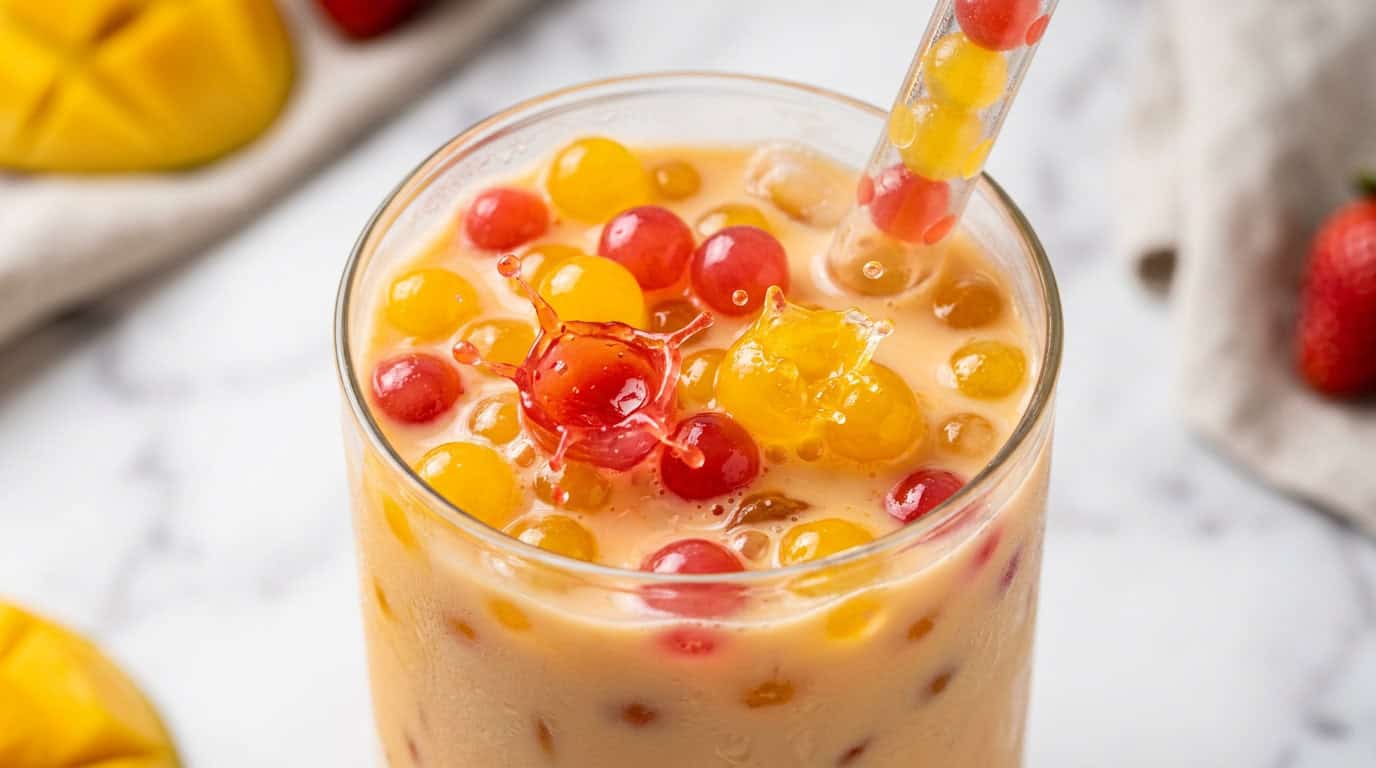
What Is Popping Boba?
Popping boba (also called bursting boba, popping pearls, or juice balls) is a type of bubble tea topping made through a technique called spherification. Unlike traditional chewy tapioca pearls — which are starchy and dense — popping boba has a thin, gel-like outer membrane that holds a liquid center of flavored juice or syrup. Bite into one and the membrane ruptures instantly, flooding your mouth with a burst of concentrated flavor.
The result is something genuinely different from anything else in a bubble tea: light, juicy, and fun in a way that dense tapioca can’t match.
How Popping Boba Differs from Tapioca and Crystal Boba
Before diving into the recipe, it helps to understand where popping boba sits in the boba family tree.
| Property | Popping Boba | Tapioca Pearls | Crystal Boba (Agar) |
|---|---|---|---|
| Base ingredient | Sodium alginate + fruit juice | Tapioca starch | Agar or konjac |
| Texture | Thin gel skin, liquid center | Dense and chewy throughout | Semi-firm jelly, no liquid center |
| Shelf life (cooked/made) | 3–7 days refrigerated | Best within 4 hours | 24–48 hours refrigerated |
| Sweetness source | Juice/syrup inside the sphere | Added during cooking | Flavored syrup soak |
| Burst sensation | Yes — strong “pop” | No | No |
| Production method | Cold spherification process | Boiling + shaping | Molding or cutting |
| Heat sensitivity | Breaks down above 85°C | Requires boiling | Mild heat tolerant |
Most bubble tea shops sell all three. Popping boba is the most visually dramatic — and the most technically interesting to make.
The Science Behind the “Pop” — Spherification Explained
Here’s where it gets genuinely fascinating. The technique is called spherification, and it works through a specific ionic reaction between two food-grade compounds:
- Sodium alginate is a polysaccharide extracted from brown seaweed. According to Wikipedia’s entry on sodium alginate, it is widely used as a food stabilizer and thickener (E401) — but its most remarkable property is that it gels instantly when it contacts calcium ions.
- Calcium lactate (or calcium chloride) provides those calcium ions. When a droplet of sodium alginate solution hits the calcium bath, calcium ions diffuse into the outer surface of the droplet and cross-link the alginate chains, forming a thin, flexible gel membrane in seconds.
The interior never gels — it stays liquid — because the calcium only penetrates a fraction of a millimeter before the membrane forms and slows further diffusion. That’s the pop: a liquid-filled sphere in a gel shell.
Two variations exist:
- Direct spherification: Sodium alginate goes into the juice; calcium goes into the bath. Simple, fast — but the gel membrane keeps thickening over time, so these must be served fresh.
- Reverse spherification: Calcium lactate goes into the juice; sodium alginate goes into the bath. The membrane forms from the outside in, seals completely, and the sphere stays stable in a storage bath for days. This is how commercial popping boba is manufactured.
Ingredients for a Popping Boba Recipe
The base popping boba recipe requires just three functional ingredients. Everything else is customization.
Core Ingredients: Sodium Alginate and Calcium Salts
Sodium alginate is the gelling agent. Use food-grade powder, not industrial grade. For direct spherification, the working concentration is typically 0.5–1.0 g of sodium alginate per 100 g of juice (a 0.5–1.0% solution). Going too high makes the membrane rubbery; too low and the spheres collapse before you can rinse them.
Calcium salts set the gel:
- Calcium lactate gluconate — milder flavor than chloride; preferred for most fruit recipes. Typical bath concentration: 0.5% (5 g per liter of water).
- Calcium chloride — slightly bitter, can leave a mild chemical aftertaste; use at 0.5–0.75% for the bath. Works fine if spheres are rinsed well in plain water immediately after forming.
- Calcium lactate — common for reverse spherification (goes inside the juice instead of the bath). Use at 1–2% of total juice weight.
The FDA’s GRAS (Generally Recognized As Safe) database lists sodium alginate and calcium lactate as approved food additives — confirming these are safe for consumption when used within standard culinary concentrations.
Choosing Your Fruit Juice or Flavoring
Not every juice works equally well. Key considerations:
- Acidic juices (lemon, lime, passion fruit) can interfere with alginate gelation because pH below ~3.5 reduces sodium alginate’s ability to hydrate properly. If working with high-acid juice, add a pinch of sodium citrate (0.5%) to raise pH slightly before dissolving the alginate.
- Calcium-rich juices (dairy-based, fortified juices) cause premature gelling if you’re doing direct spherification. These need reverse spherification instead.
- Fresh vs. bottled: Fresh fruit juices often contain enzymes (e.g., pineapple’s bromelain) that can degrade the gel. Briefly heating juice to 70°C for 2 minutes deactivates enzymes without significantly altering flavor.
Best juices for direct spherification: mango, strawberry, watermelon, lychee, passion fruit, blueberry, green apple.
Optional Additives and Colorants
- Sugar: 5–8% sucrose by weight improves mouthfeel and sweetness without affecting gelation
- Citric acid: 0.2% enhances brightness of fruit flavors
- Sodium citrate: 0.3–0.5% — pH buffer for acidic juices
- Natural colorants: Fruit-derived anthocyanins, spirulina (blue-green), turmeric (yellow). Avoid oil-based food colors — they separate.
- Flavor extract: 1–3 drops of food-grade flavor concentrate amplifies the juice taste, especially useful for commercially scaled batches where fresh juice is diluted
Equipment You Need to Make Popping Boba
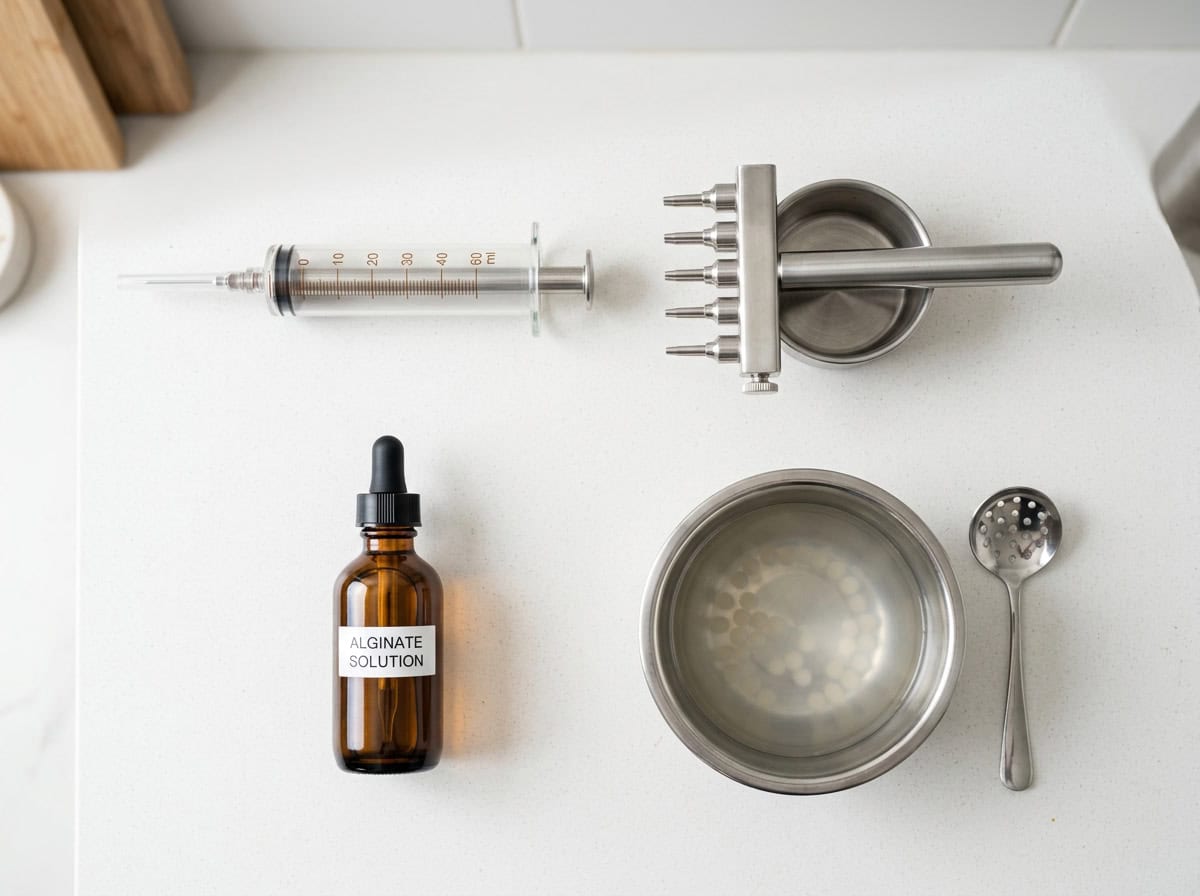
The equipment you choose determines your batch size and consistency.
Home Kitchen Setup (Syringe Method)
For 100–300 pearls per session:
- 1 large bowl (for the calcium bath) + 1 medium bowl (for the alginate mixture)
- A slotted spoon or strainer for rinsing
- A disposable syringe (without needle, 5–10 mL) or a squeeze bottle with a small round tip — this controls drop size and sphere diameter
- Digital kitchen scale accurate to 0.1 g (essential for alginate concentration)
- Immersion blender or regular blender — sodium alginate is notoriously clumpy and needs high-shear mixing to hydrate fully
Sphere size is controlled by drop height, tip diameter, and drop rate:
- 5 mm tip + 15 cm drop height → ~6–8 mm sphere (standard boba size)
- 3 mm tip + 10 cm drop height → ~4–5 mm sphere (mini boba)
Semi-Commercial Tools (Caviar Maker / Multi-Nozzle Droppers)
For 500–2,000 pearls per session:
- Caviar makers (also called sphere makers or boba droppers) are multi-nozzle silicone tools that release 8–16 drops simultaneously. They’re available from kitchen supply stores for $15–40 and dramatically increase throughput.
- Peristaltic pumps with custom nozzle heads — used in some catering setups to maintain constant drop rate and sphere uniformity
Commercial-Grade popping boba machines
| Equipment Type | Batch Capacity | Output Rate | Typical Use Case |
|---|---|---|---|
| Manual syringe | ~200 pearls/batch | ~50 pearls/min | Home kitchen, small café |
| Caviar maker (multi-nozzle) | ~2,000 pearls/batch | ~300 pearls/min | Catering, food stall |
| Semi-automatic boba dropper | 5–20 kg/hour | Continuous | Small-scale production |
| Commercial spherification machine | 50–200 kg/hour | Fully automated | Factory / beverage manufacturer |
At commercial scale, dedicated popping boba production machines handle the entire process: precise alginate mixing, temperature-controlled calcium baths, conveyor-based sphere forming, continuous rinse stations, and automated sizing. These eliminate the inconsistency that plagues manual production and enable the bright, uniform spheres you see in branded commercial products.
Step-by-Step Popping Boba Recipe
Direct Spherification Method (Best for Home Use)
Yields: ~150–200 pearls (enough for 6–8 drinks)
Time: 25 minutes active, 30 minutes rest
For the alginate base:
- 200 g fruit juice (mango or strawberry works best for beginners)
- 1 g food-grade sodium alginate (0.5%)
- 10 g sugar (optional)
- Pinch of sodium citrate if using acid-forward juice
For the calcium bath:
- 1 liter cold water
- 5 g calcium lactate gluconate
Instructions:
- Prepare the calcium bath first. Dissolve calcium lactate gluconate in 1 liter of cold water. Stir until fully clear. Set aside.
- Hydrate the sodium alginate. Blend sodium alginate powder with a small portion (about 50 g) of the juice using an immersion blender on high for 60–90 seconds until no clumps remain. Let the mixture rest for 15–20 minutes to fully hydrate — this resting step is the one most home cooks skip, and it’s why their spheres fall apart.
- Combine. Add the remaining juice and sugar to the alginate mixture. Blend briefly to homogenize. The mixture should be slightly viscous — similar to thin tomato sauce.
- Form the spheres. Fill your syringe or squeeze bottle with the juice-alginate mixture. Hold it 10–15 cm above the calcium bath and release single drops, keeping a steady pace. Each drop will sink slightly, then rise as the gel shell forms. Let them sit in the bath for exactly 90 seconds — under-soaked spheres burst too easily; over-soaked ones get rubbery shells.
- Rinse immediately. Using a slotted spoon, transfer spheres to a bowl of plain cold water and gently swish. This stops further gelling and removes the calcium aftertaste.
- Store in simple syrup. Transfer rinsed spheres to light sugar syrup (1:1 water:sugar) for serving. They’re best within 2–3 hours but can last refrigerated for up to 24 hours.
- Rinse immediately. Using a slotted spoon, transfer spheres to a bowl of plain cold water and gently swish. This stops further gelling and removes the calcium aftertaste.
- Form the spheres. Fill your syringe or squeeze bottle with the juice-alginate mixture. Hold it 10–15 cm above the calcium bath and release single drops, keeping a steady pace. Each drop will sink slightly, then rise as the gel shell forms. Let them sit in the bath for exactly 90 seconds — under-soaked spheres burst too easily; over-soaked ones get rubbery shells.
- Combine. Add the remaining juice and sugar to the alginate mixture. Blend briefly to homogenize. The mixture should be slightly viscous — similar to thin tomato sauce.
- Hydrate the sodium alginate. Blend sodium alginate powder with a small portion (about 50 g) of the juice using an immersion blender on high for 60–90 seconds until no clumps remain. Let the mixture rest for 15–20 minutes to fully hydrate — this resting step is the one most home cooks skip, and it’s why their spheres fall apart.
- Prepare the calcium bath first. Dissolve calcium lactate gluconate in 1 liter of cold water. Stir until fully clear. Set aside.
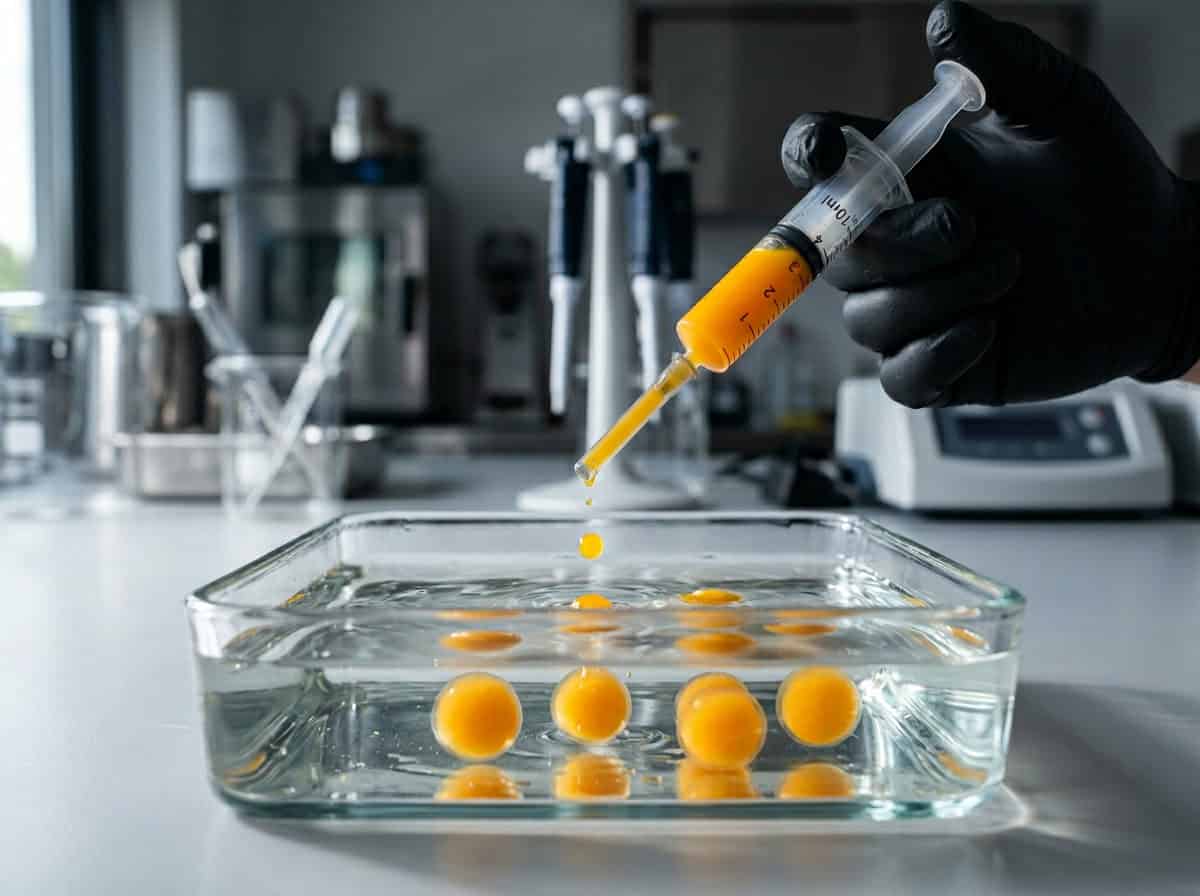
Reverse Spherification Method (Better Shelf Life)
Reverse spherification is the preferred method for any situation where you need popping boba to last more than a day — it’s what commercial manufacturers use.
Key difference: Calcium lactate goes inside the juice. Sodium alginate goes into the bath.
For the juice-calcium base:
- 200 g fruit juice
- 4 g calcium lactate (2%)
- Sugar and citric acid to taste
For the alginate bath:
- 1 liter water
- 5 g sodium alginate (0.5%)
Critical note: The alginate bath requires at least 1 hour of rest after blending (ideally overnight) to fully hydrate and release air bubbles. Bubbles in the bath create dimpled, misshapen spheres.
Instructions follow the same drop-and-lift sequence, but timing differs:
- Spheres should rest in the alginate bath for 2–3 minutes (longer than direct method)
- The gel shell forms from the outside inward — but because the calcium is inside, the gelation front actually stops when it meets the liquid calcium-juice center
- Spheres can be stored in plain cold water for 3–7 days in the refrigerator with no significant degradation
In practice: Reverse spherification produces a thicker, more durable membrane. The downside is the longer bath-prep time and slightly firmer bite. For home use, direct spherification is more convenient. For production environments, reverse is worth the setup.
Common Mistakes and How to Fix Them
| Problem | Cause | Fix |
|---|---|---|
| Spheres stick together | Dropping too many at once; bath too warm | Work in batches of 10–15; keep bath cold (10–12°C) |
| Flat or tailed spheres | Drop falling too fast or from too high | Lower syringe, use thicker tip, or chill the alginate mix slightly |
| Rubbery, thick membrane | Alginate concentration too high or soaking too long | Reduce to 0.5%, reduce bath time to 60 sec |
| Spheres dissolve | Soaking too short; alginate concentration too low | Increase to 0.75%, extend bath time by 30 sec |
| Bitter aftertaste | Calcium chloride residue from insufficient rinsing | Switch to calcium lactate gluconate; rinse in 2 fresh water baths |
| Alginate won’t dissolve | Clumping due to insufficient shear | Always blend on high; add powder to liquid, not vice versa |
Popular Popping Boba Flavor Variations
The base recipe is a template. Once you understand the sodium alginate-to-juice ratio, virtually any liquid can become popping boba — with some adjustments for pH and calcium content.
Fruit-Based Flavors (Mango, Strawberry, Passion Fruit)
Mango popping boba is the most beginner-friendly: mango juice is naturally viscous, pH ~3.8–4.2 (above the problematic threshold), and has no calcium interference.
Strawberry popping boba is brighter in color and more acidic (pH ~3.5). Add 0.3 g sodium citrate per 200 g juice to buffer the pH and prevent alginate from clumping.
Passion fruit popping boba is intensely flavorful but high-acid (pH ~3.0). Dilute 50/50 with water, add sodium citrate, and increase alginate to 0.75% to compensate.
Watermelon is light in flavor — increase to 15 g sugar per 200 g juice and consider adding 2 drops watermelon extract for intensity.
Tea and Coffee Boba Variations
Matcha popping boba: Mix 3 g matcha powder with 200 g sweetened water. Matcha has no pH or calcium issue, and the earthy flavor pairs exceptionally well with a slightly thicker (0.75%) alginate membrane. Serve in jasmine milk tea for a high-contrast visual.
Brown sugar coffee boba: Brew strong espresso (1:4 dilution with water), add brown sugar syrup, proceed with direct spherification. The slight bitterness of espresso creates a complex burst that works as a dessert component.
Yuzu citrus boba: Yuzu juice is extremely acidic (pH ~2.9) — dilute 1:3 with simple syrup and add 0.5 g sodium citrate. The aromatic quality of yuzu survives spherification beautifully.
Flavor Formulation Reference Table
| Flavor | Juice/Base | Sodium Citrate Needed | Alginate % | Calcium Bath | Notes |
|---|---|---|---|---|---|
| Mango | Fresh/bottled mango | None | 0.5% | 0.5% lactate gluconate | Standard; beginner-friendly |
| Strawberry | Blended fresh strawberry | 0.3 g per 200g | 0.6% | 0.5% lactate gluconate | Strain seeds before use |
| Passion fruit | 50/50 juice + water | 0.5 g per 200g | 0.75% | 0.5% lactate gluconate | Dilution required |
| Lychee | Bottled lychee syrup | None | 0.5% | 0.5% lactate gluconate | Reduce sugar by half |
| Matcha | Matcha + sweetened water | None | 0.75% | 0.5% lactate gluconate | Blend well to avoid lumps |
| Yuzu | 1:3 diluted yuzu + syrup | 0.5 g per 200g | 0.75% | 0.5% lactate gluconate | High-acid; dilution critical |
| Coffee/espresso | Diluted espresso + sugar | None | 0.5% | 0.5% lactate gluconate | Reverse method recommended |
| Watermelon | Fresh blended + strained | None | 0.5% | 0.5% lactate gluconate | Add extract for intensity |
How to Use Popping Boba — Serving Ideas and Applications
Classic Bubble Tea and Milk Tea Applications
The most common use is as a bubble tea topping. Popping boba works in both iced and room-temperature drinks, but never in hot drinks — heat above 75°C melts the gel membrane and the sphere collapses. For hot beverages, stir in just before drinking or serve separately.
Serving portions per drink:
- Casual: 30–40 g (about 20–25 pearls)
- Generous: 50–60 g (about 35–40 pearls)
Best pairings by flavor:
- Mango boba → jasmine green tea or coconut milk tea
- Strawberry boba → matcha latte or taro milk tea
- Passion fruit boba → lemon black tea or pineapple tea
- Coffee boba → brown sugar milk tea or plain milk tea
Dessert Applications
Beyond bubble tea, popping boba has become a staple in dessert kitchens:
- Frozen yogurt and ice cream topping — the cold temperature slows any residual gelling, so the spheres hold well for 20–30 minutes
- Cake decoration — used as a garnish on cheesecakes and mousse cakes; the burst of fruit cuts through richness
- Plated restaurant desserts — the molecular gastronomy origin means popping boba naturally fits high-end plating where a pop of color and surprise texture adds drama
- Cocktails and mocktails — alcohol-infused popping boba (using reverse spherification, as direct method struggles with alcohol’s pH effects) has become a cocktail bar trend; as researchers have noted in food science publications on flavor encapsulation techniques via Springer, controlled flavor release is increasingly used in premium beverage design
Commercial Foodservice Uses
At scale, commercial operations use popping boba as:
- Pre-packaged toppings distributed to franchise bubble tea chains (most come in 3.4 kg tubs)
- Ingredients in meal kit delivery services
- Components in specialty ice cream and dessert brands
The commercial product you see in stores is almost always made by the reverse spherification method with preservatives (sodium benzoate or potassium sorbate at 0.1%) added to the storage syrup to extend shelf life to 12–18 months unopened.
Storage, Shelf Life, and Quality Control
How Long Does Homemade Popping Boba Last?
Direct spherification batch: The membrane keeps thickening even after you remove the spheres from the bath. Within 24–48 hours in the refrigerator, the gel will become noticeably thicker and the pop will be muted. For best results, serve within 2–4 hours of making.
To slow the thickening: store in a plain water bath (not syrup), change the water every 12 hours, and keep at 4°C. This extends quality life to about 3 days.
Reverse spherification batch: Significantly more stable. Store in a light sugar syrup (1:3 sugar:water) at 4°C. Quality holds for 5–7 days, sometimes longer. The membrane is thicker to begin with, so slight additional thickening is acceptable.
Signs of spoilage: Off-smell (fermentation), cloudiness in the storage liquid, sphere collapse or clumping. Discard if any of these appear — the storage solution is essentially a sugar bath at room temperature, which can support microbial growth.
Commercial Storage Standards
Commercial popping boba (the kind you buy in 3.4 kg tubs) is pasteurized and packed in stabilized syrup. Shelf life is typically:
- Unopened, room temperature: 12–18 months
- Opened, refrigerated: 7–14 days
- Once added to a drink: consume within 24 hours
For any semi-commercial or catering operation producing popping boba in-house, following HACCP food safety protocols is essential. The calcium and alginate themselves pose no safety risk, but the sugar syrup storage environment requires pH control (target pH 3.5–4.0 with added citric acid) to inhibit bacterial growth.
Scaling Up — From Home Kitchen to Commercial Production
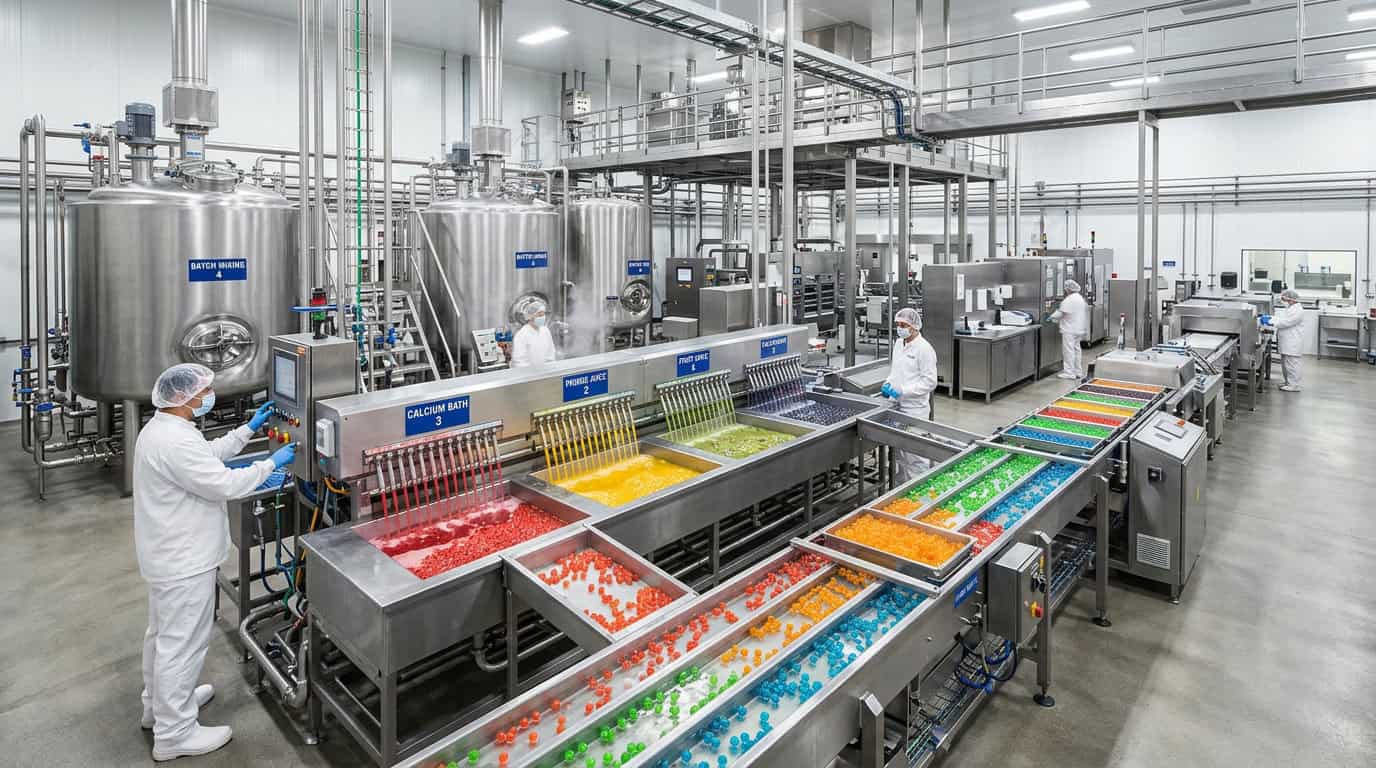
If you’ve made popping boba at home and want to scale — whether for a small café, catering business, or full production — the process changes in important ways.
Batch Size Challenges
The main issue is alginate hydration time. A home batch of 200 g takes 15–20 minutes to fully hydrate. A commercial batch of 20 kg will take far longer — and inadequate hydration is the leading cause of sphere defects (tails, flat spots, uneven membranes) at scale.
Commercial operations solve this with high-shear industrial mixers that can hydrate sodium alginate in 3–5 minutes even at scale. Temperature control of the calcium bath is equally critical at scale: heat from ambient temperature or from batch volume can soften the forming membrane and reduce sphere integrity.
Other scale-specific challenges:
- Consistency of drop size: Manual syringes produce spheres that vary ±1–2 mm. Commercial consumers demand uniformity. Precision nozzles and controlled pump pressure are required.
- Throughput: A skilled person with a manual syringe produces about 50 pearls per minute. A commercial machine produces 50–200 kg per hour.
- Food safety documentation: At commercial scale, ingredient sourcing, batch testing, and storage records become regulatory requirements in most markets.
How Commercial Popping Boba Machines Work
Dedicated spherification machines for popping boba production typically include:
- Mixing/hydration tank — high-shear mixing with programmable speed and time
- Calcium bath — stainless steel tank with temperature control (±0.5°C) and recirculation
- Multi-nozzle forming head — 50–500 nozzles operating simultaneously, with adjustable flow rate and nozzle diameter
- Conveyor rinse station — continuous plain water rinse removes calcium residue
- Sizing and grading — optical or mechanical sorting to remove off-spec spheres
- Automatic syrup filling — finished spheres drop into measured containers with sugar syrup
The right machine selection depends on your output needs, facility footprint, and budget. Equipment vendors in the food machinery space offer models ranging from bench-top units (20–50 kg/hour) to fully automated lines (500+ kg/hour). Understanding the variables — nozzle diameter, bath temperature, alginate concentration, drop rate — is as important as the machine itself; even the best equipment produces poor spheres with incorrect formulation.
Frequently Asked Questions
What is the material for popping boba?
Popping boba is made from fruit juice, sodium alginate (a seaweed-derived thickener), and a calcium salt (typically calcium lactate gluconate). The spheres contain no tapioca, gelatin, or dairy by default, making them suitable for vegans and most dietary restrictions.
Can I make popping boba without sodium alginate?
Not with the same bursting texture. Sodium alginate is the functional ingredient that forms the gel membrane. Some recipes use agar or gelatin to make solid “boba balls,” but these don’t produce the characteristic liquid-center pop. There is no direct substitute for sodium alginate in a true popping boba recipe.
Can I make popping boba with calcium chloride instead of calcium lactate?
Yes. Calcium chloride (CaCl₂) works and is often cheaper and easier to find. The drawback is a mild bitter or salty aftertaste if the spheres aren’t rinsed thoroughly. Calcium lactate gluconate is preferred for neutral flavor. Use the same bath concentration (0.5%) for either salt.
Why do my spheres turn out flat or teardrop-shaped?
This usually means the drop is falling too far, forming too quickly as it falls, or the alginate mixture is too cold and viscous. Try reducing the drop height to 8–10 cm, slightly warming the alginate mixture to room temperature, or using a slightly larger tip opening to produce rounder drops.
How do I store popping boba if not using immediately?
For home batches (direct spherification): store in plain cold water in the refrigerator and use within 24–48 hours. For reverse spherification batches: store in 1:3 sugar syrup at 4°C for up to 7 days. Never freeze popping boba — freezing destroys the gel membrane and the spheres won’t burst, they’ll just collapse.
Is popping boba vegan and gluten-free?
Yes on both counts. Sodium alginate comes from seaweed, calcium salts are mineral-derived, and fruit juice is plant-based. No animal products, no gluten. Always check the specific brands of ingredients for cross-contamination disclosures if you’re producing for someone with severe allergies.
Can I use popping boba in hot drinks?
Not in drinks above ~70°C. Heat melts the gel membrane and the sphere collapses, releasing all its liquid at once. For hot drinks, pour the hot liquid and let it cool to warm before adding boba, or serve the boba on the side.
Conclusion
The popping boba recipe comes down to two things: getting the sodium alginate fully hydrated, and controlling the bath time precisely. Nail those two variables and the rest — flavors, formats, serving applications — opens up completely. From a single mango popping boba recipe in your kitchen to multi-flavor production for a café, the same spherification chemistry scales across every level of ambition.
For anyone moving beyond the home kitchen, the formulation knowledge in this guide translates directly to semi-commercial setups — and the principles behind direct versus reverse spherification are the same ones commercial popping boba machines operate on. Start with mango or strawberry, build your feel for sphere consistency, and then experiment. The science is reliable once you understand it; the creativity is entirely yours.
External sources referenced in this article:
Related Articles
- What is Popping Boba? The Bursting Juice Pearls Taking Drinks by Storm
- How do I choose the right gummy manufacturing machine for my business?
- What are the operational costs associated with a jelly candy making machine?
- The Mesmerizing Journey: How Popping Boba Pearls Are Made in a Factory
- Popping Boba Production Line
- Konjac Pearl Making Machine
- How Are Skittles Made? The Full Factory Process