Boba popping pearls are juice-filled gel spheres made by spherification that burst when bitten, releasing real fruit juice in a single satisfying pop.
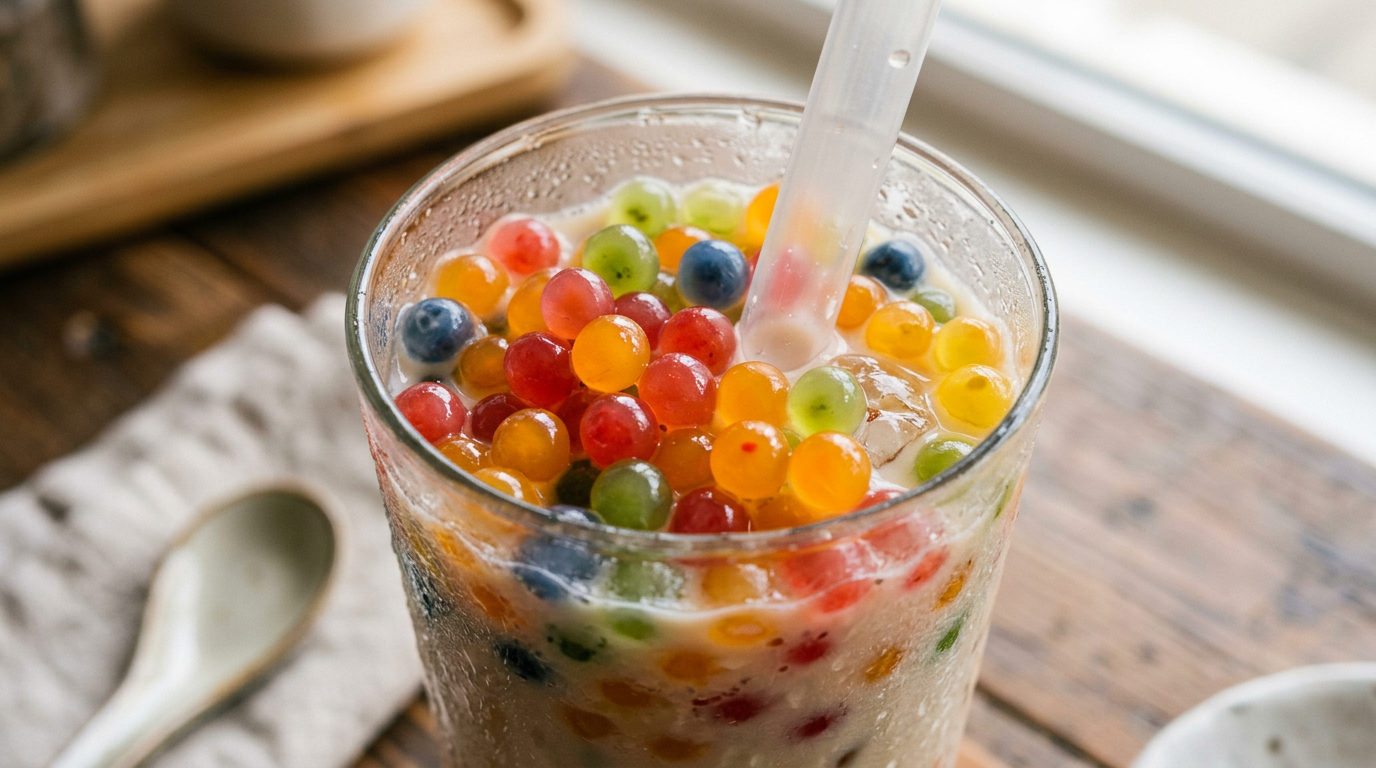
You bite down. There’s a brief, satisfying resistance — then a burst of cold mango or strawberry juice that hits your tongue all at once. That split-second pop is the entire reason boba popping pearls have taken over bubble tea menus from Taipei to Toronto. They’re not just a garnish. They’re an experience.
Whether you’re a bubble tea shop owner deciding between tapioca and popping toppings, a food product developer scaling up a new SKU, or a manufacturer evaluating spherification equipment, this guide covers everything: the food science, the production process, the flavor landscape, and the commercial considerations most guides skip entirely.
What Are Boba Popping Pearls?
Boba popping pearls are the juice-filled, burst-on-bite alternative to traditional tapioca boba. Unlike chewy tapioca balls (which are cooked starch through and through), popping pearls have a thin gel membrane surrounding a liquid interior. That membrane shatters under light pressure, which is the “pop.”
The term “boba popping pearls” is used interchangeably with popping boba, bursting boba, juice pearls, and flavored boba pearls. All refer to the same basic product. The Wikipedia entry for popping boba describes them as a type of boba with a “thin, gel-like skin with juice inside that bursts when squeezed” — an accurate summary, though it understates the engineering behind each sphere.
The Science Behind the Burst
The gel membrane is made through a process called spherification — a technique originally developed in molecular gastronomy and now industrialized at massive scale. In the most common method:
- A fruit-juice solution is blended with sodium alginate, a natural polysaccharide extracted from brown seaweed.
- That liquid is dropped (via a nozzle or vibrating plate) into a bath of calcium chloride solution.
- The calcium ions react with the alginate at the droplet’s surface, forming a thin, flexible gel shell within seconds.
- The result: a sphere with a liquid core and a gel exterior strong enough to survive packaging and shipping, but fragile enough to burst under bite pressure.
The wall thickness is controlled by drip time and alginate concentration. Most commercial boba popping pearls use a membrane between 0.3 mm and 0.8 mm thick. Thinner walls give a cleaner pop; thicker walls are more durable in transport and at high serving temperatures. Getting that balance right is the core engineering challenge.
Popping Pearls vs. Tapioca Boba: Key Differences
Most bubble tea topping decisions come down to texture and use case. Here’s where boba popping pearls and traditional tapioca diverge:
| Feature | Boba Popping Pearls | Tapioca Boba |
|---|---|---|
| Interior | Juice / flavored liquid | Solid cooked starch |
| Texture | Thin gel shell + burst | Chewy throughout |
| Preparation | Ready-to-use (no cooking) | Must be boiled, then cooled |
| Shelf life (unopened) | 12–18 months refrigerated | 2–3 years dry; 4–6 hours cooked |
| Calories (per 30g serving) | ~20–35 kcal | ~50–80 kcal |
| Heat sensitivity | Degrades above 40°C | Holds shape in hot drinks |
| Flavor intensity | Varies by juice fill | Mild; usually flavored by syrup soak |
| Best for | Cold drinks, desserts, yogurt | Hot/cold tea, milk tea, smoothies |
The calorie difference matters more than most operators realize. A standard serving of boba popping pearls delivers about half the calories of tapioca — a fact increasingly used on menus targeting health-aware customers.
How Boba Popping Pearls Are Made
Commercial production of boba popping pearls combines food-grade spherification, precision filling, and cold-chain packaging into a fully automated line.
This is the section most guides completely skip. Understanding the production process matters whether you’re evaluating a supplier’s quality claims, troubleshooting inconsistency in your own supply, or planning to manufacture in-house.
The Spherification Process at Scale
Industrial spherification looks very different from the dropper-bottle demo you might have seen on YouTube. Commercial boba popping pearl lines — like those used in factories across China, Taiwan, and Thailand — use vibrating nozzle arrays or rotating disk dispensers that can produce tens of thousands of spheres per minute.
The juice concentrate is prepared first: typically a blend of fruit concentrate (20–35% by weight), water, sugar, colorant (natural or artificial), and sodium alginate (0.4–0.8% concentration). The mixture is degassed under vacuum to remove air bubbles, which would cause irregular spheres.
The calcium bath is maintained at a specific pH (typically 5.5–7.0) and temperature (10–18°C). Too warm and the reaction accelerates unevenly; too cold and the alginate membrane doesn’t set before the sphere breaks apart.
After the forming bath, spheres move through a rinsing bath (clean water) to remove residual calcium and surface stickiness. Then they enter a preservation bath — typically a light sugar syrup or fruit juice solution at the target pH — where they’ll remain until packaging. This final bath determines the flavor profile the customer actually tastes, since the sphere absorbs some of the surrounding liquid over time.
For manufacturers looking to set up or upgrade their own spherification line, our confectionery production equipment includes automated boba production systems with adjustable nozzle configurations and bath temperature control.
Commercial Production Equipment
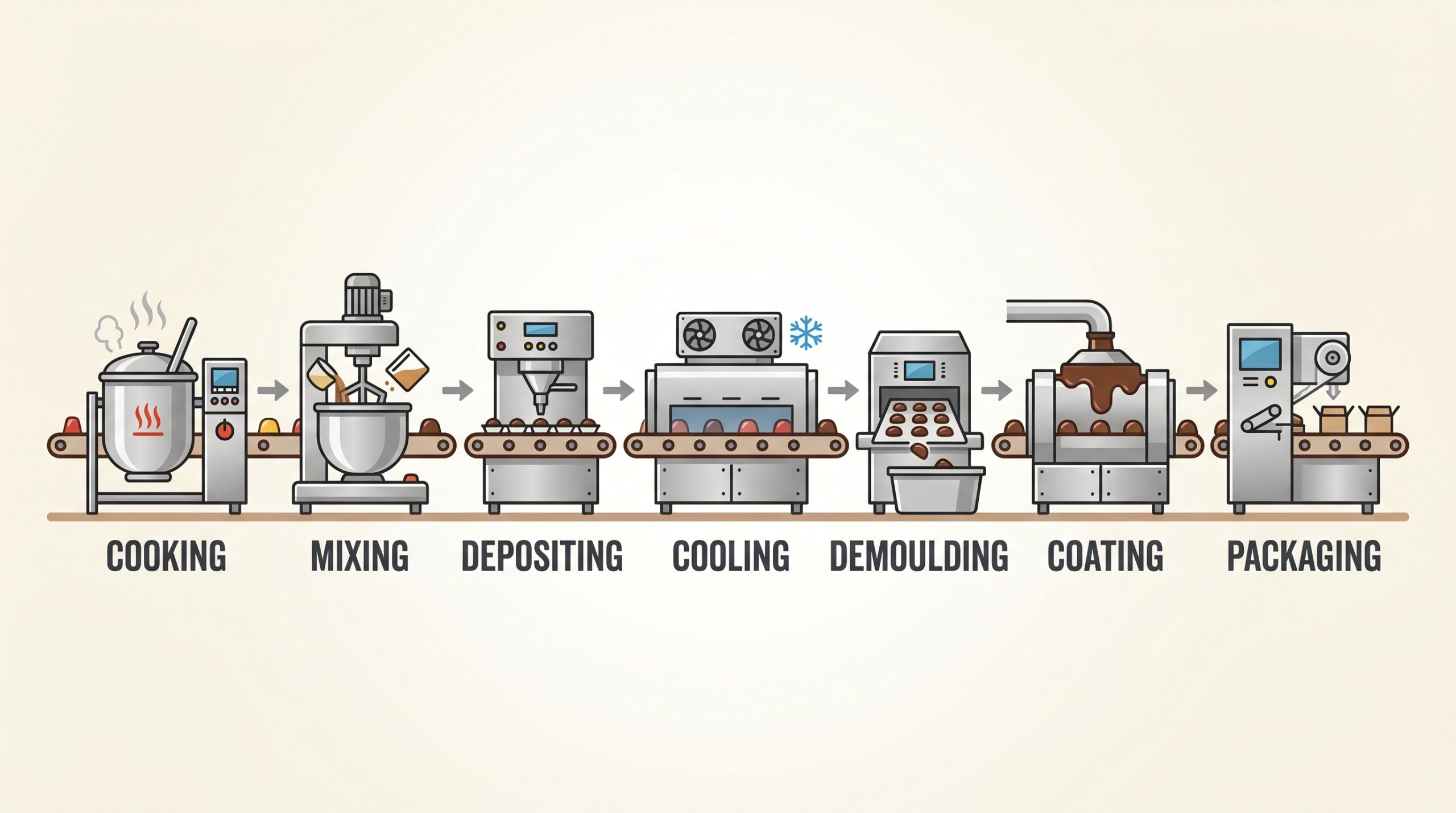
A full production line for boba popping pearls typically includes:
- Ingredient mixing tanks with high-shear mixers (alginate hydration is notoriously clumpy if done wrong)
- Spherification forming unit — multi-nozzle or vibrating-disk type, 50–500 kg/hour output depending on configuration
- Rinsing and preservation bath conveyors — stainless steel, food-grade
- Packaging station — typically filling into cups or pouches with the preservation liquid included
- Cold storage and logistics — the finished product must stay below 10°C through the chain
Smaller operations sometimes use reverse spherification instead: the calcium is inside the sphere (in a gel base), and the alginate is in the outer bath. This gives a thinner membrane and a softer pop, but is slower and harder to automate.
Quality Control in Manufacturing
Industrial QC for boba popping pearls focuses on three metrics:
Burst strength — measured by compression testing. A properly made popping pearl should burst at 50–150g of force. Below 50g and it bursts in the packaging; above 150g and customers don’t feel the pop in the drink.
Sphere diameter — typically standardized at 8–12 mm for commercial product. Diameter consistency below ±0.5 mm variation is considered food-grade standard.
Syneresis rate — the rate at which liquid leaks through the gel membrane over time. High-quality boba popping pearls show less than 3% weight loss over 30 days at 4°C.
Popular Flavors and Colors of Boba Popping Pearls
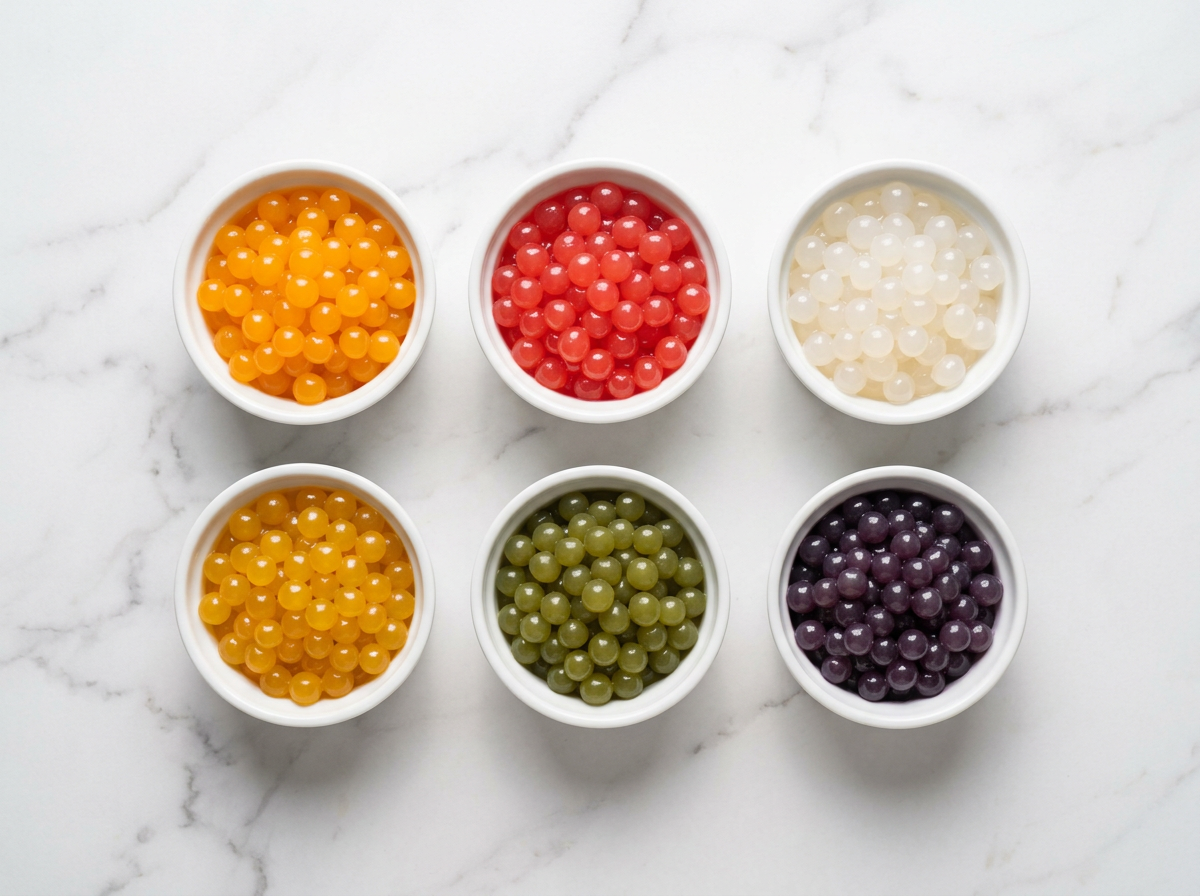
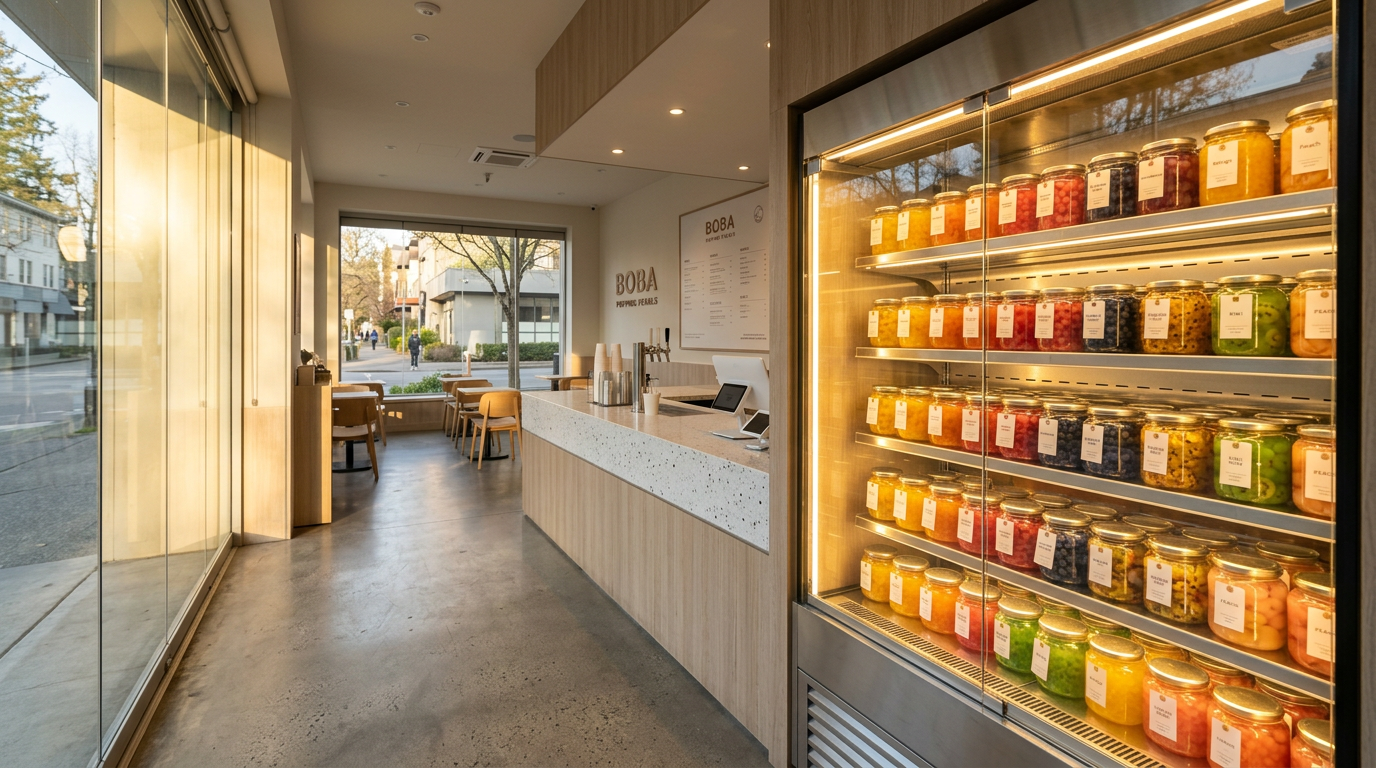
The most popular boba popping pearl flavors are mango, strawberry, lychee, passion fruit, and matcha — each matched to both taste profile and visual color for maximum menu appeal.
Flavor development for boba popping pearls is a balance between fruit authenticity, color vibrancy, and membrane stability. Highly acidic juices (like citrus) can destabilize the alginate membrane over time, so most commercial formulations use flavor concentrates rather than raw juice.
Classic Fruit Flavors
These five flavors account for the majority of global boba popping pearl sales:
- Mango — the bestseller in most markets. Bright orange-yellow color, clean tropical flavor. Pairs with mango milk tea, green tea, and coconut drinks.
- Strawberry — vivid red, familiar flavor. High customer recognition makes it a safe choice for new menus. Works in both tea-based and milk-based drinks.
- Lychee — translucent white or pale pink. More delicate sweetness than berry flavors. Particularly popular in East Asian-themed menus.
- Passion fruit — orange-gold color, acidic edge that cuts through sweetness in rich milk teas. The most complex flavor profile of the five.
- Matcha — green, earthy, slightly bitter. Skews toward premium or Japanese-inspired menus. Pairs better with non-milk drinks due to tannin interaction.
Specialty and Seasonal Varieties
Beyond the classics, the boba popping pearls market has expanded significantly in the past few years:
- Peach, cherry blossom, yuzu — seasonal drops that drive limited-time-offer traffic for bubble tea shops
- Coconut, taro, brown sugar — flavor profiles aligned with the milk tea mainstream
- Coffee, matcha white chocolate — premium positioning, typically at a 30–50% price premium over standard flavors
- Alcohol-infused — emerging category, typically using sake, lychee wine, or grape. Not universally available due to regulatory differences by market.
- Probiotic-enriched — newer formulations that incorporate live cultures into the preservation liquid. Shelf life is shorter (8–10 weeks vs. 12–18 months), but they command a health-premium price point.
Color and Visual Appeal
Color matters more for boba popping pearls than almost any other food topping because the pearls are visible through clear cups. The industry standard is to match color to flavor (orange for mango, red for strawberry) but niche products intentionally break this rule — black sesame popping pearls are jet black, butterfly pea flower versions shift from blue to purple on contact with acid.
The colorants used are typically either:
– Natural: beetroot (red/pink), turmeric (yellow), spirulina (green), anthocyanins (purple/blue)
– Synthetic (where permitted): FD&C Red 40, Blue 1, Yellow 5 — still common in markets with broader colorant regulations
For export products targeting the EU, all synthetic colorants must be declared on the label and may trigger the EU’s “may have an adverse effect on activity and attention in children” warning, which leads most exporters to switch to natural alternatives.
How to Use Boba Popping Pearls
Boba popping pearls work best as a cold topping — add them directly from the jar without cooking, and serve below 40°C to preserve membrane integrity.
This is the practical section. The usage rules for boba popping pearls are different from tapioca, and getting them wrong is a common reason customers complain about texture.
In Bubble Tea and Drinks
The standard approach:
- Open the jar or pouch and drain the preservation syrup partially (or fully, depending on your preferred sweetness level).
- Scoop directly into the cup — no cooking, no rehydration.
- Add your tea, milk, or base liquid cold or at room temperature.
- Seal and serve immediately.
The one hard rule: do not add hot liquid directly onto boba popping pearls. Above roughly 40°C, the alginate membrane begins to soften and the spheres flatten or disintegrate. If you’re serving a warm drink, add the pearls to the cup first, then pour the drink over ice before adding the warm component — so the pearls stay cool at the bottom.
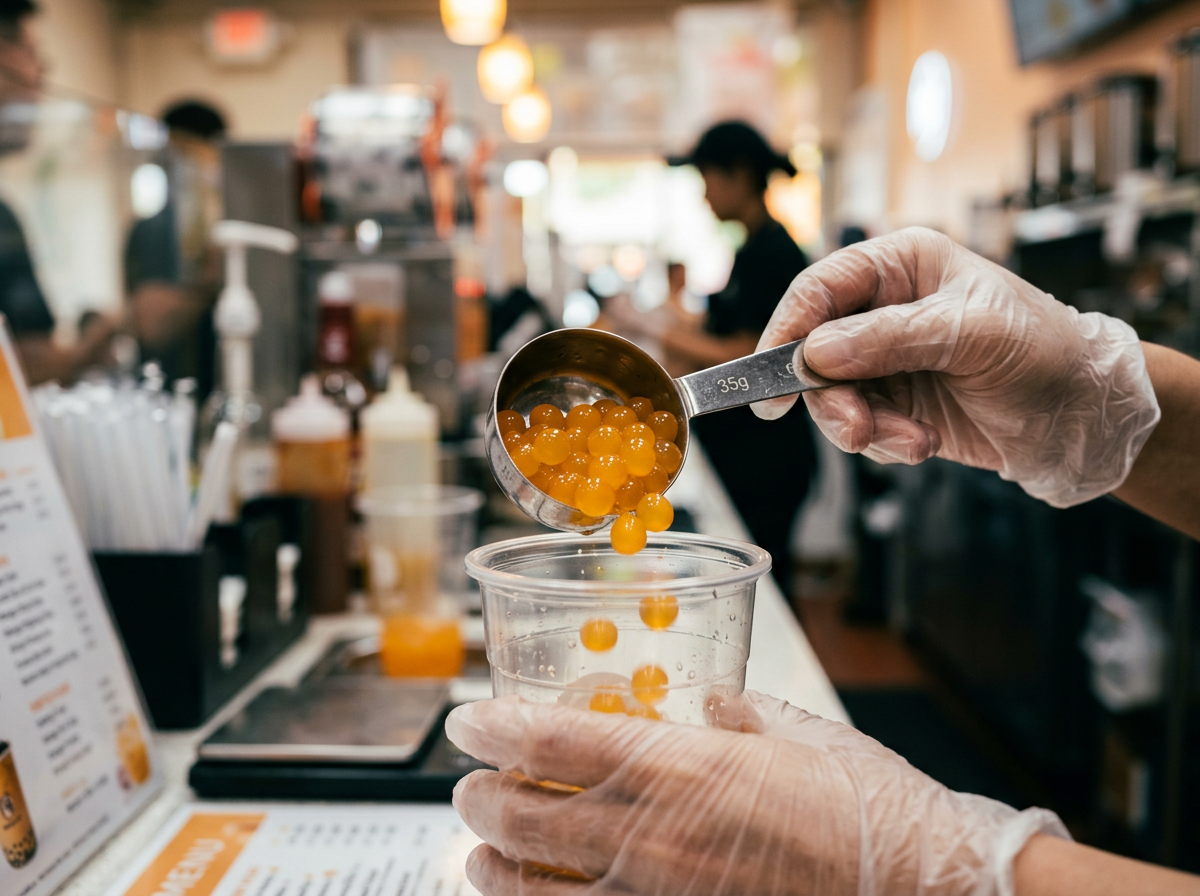
For businesses, the optimal scoop per 500 mL drink is 30–40g (roughly 30–40 pearls at standard 10 mm diameter). Some shops go heavier (50g+) as a differentiator, but this significantly affects the economics — at $4–8/kg for quality boba popping pearls, an extra 20g per cup adds $0.08–0.16 to cost.
In Desserts and Culinary Applications
Boba popping pearls have moved well beyond bubble tea. Current commercial applications include:
- Frozen yogurt and acai bowl toppings — the pearl survives freezing to about -5°C before the membrane loses flexibility; below that, the burst texture changes to a harder crunch
- Cake and macaron decoration — used as a visual element on top of pastries; must be refrigerated and consumed within 6–8 hours of placement due to moisture migration
- Cocktail garnishes — added to spirits, prosecco, and mocktails for visual effect and flavor burst
- Shaved ice — very popular in Taiwanese and Korean street food; the cold environment preserves texture perfectly
Chefs working with boba popping pearls for culinary applications often use the preservation syrup as an ingredient itself — it has concentrated fruit flavor and works well in sauces or vinaigrettes.
Storage and Shelf Life
| Storage condition | Shelf life |
|---|---|
| Unopened, refrigerated (2–8°C) | 12–18 months |
| Opened, refrigerated | 5–7 days (keep submerged in syrup) |
| Room temperature (≤25°C, unopened) | 3–6 months (quality degrades) |
| Frozen (below -18°C) | Not recommended — membrane texture change |
| Above 40°C | Membrane degradation begins within hours |
The biggest mistake operators make: leaving opened jars at room temperature for multiple days. The preservation syrup pH drops as the product oxidizes, and the membrane softens unevenly. Refrigerate after opening and keep the pearls submerged.
How to Choose the Right Boba Popping Pearls
The right boba popping pearls depend on your application, volume, and end customer — commercial bubble tea shops, food manufacturers, and home users have completely different requirements.
Most buying guides for boba popping pearls stop at “pick your favorite flavor.” That’s fine for a home kitchen. For commercial and manufacturing contexts, the decision is more structured.
For Commercial Bubble Tea Shops
Your key variables are: consistency, supplier reliability, and price-per-serving.
Consistency means every batch pops the same way. This requires suppliers with ISO 22000 or equivalent food safety certification, documented production QC specs (burst strength, diameter tolerance, syneresis rate), and the ability to share Certificate of Analysis (CoA) documents per batch.
Supplier reliability matters more than most operators realize until they run out. The supply chain for boba popping pearls is heavily concentrated in Taiwan, China (Guangdong, Fujian), and Thailand. Weather events, port delays, and food safety scares (there have been several in the past decade) have caused stock-outs that lasted weeks. Maintain 4–6 weeks of safety stock.
Price per serving: for standard flavors (mango, strawberry), quality wholesale boba popping pearls run $3–6/kg for orders over 100 kg. At 35g per cup, that’s $0.10–0.21 per serving. Premium or organic formulations run $8–14/kg. The economics change substantially above the 1-tonne-per-month threshold where direct importer relationships become viable.
For Food Manufacturers
If you’re incorporating boba popping pearls into a retail product (yogurt, ice cream, packaged desserts), your concerns are regulatory and functional:
- Regulatory: Confirm allergen status (sodium alginate is derived from seaweed — not a major allergen in most markets, but must be declared in some). Confirm colorant compliance for your target market. Confirm that the preservation system (pH, Brix, preservatives used) meets your local food safety regulations.
- Functional: The pearls need to survive your specific processing conditions. Will they go through a pasteurization step? A cold-fill line at 2°C? An aseptic packaging process? Not all boba popping pearls are designed for in-process conditions — most are designed for “add at point of service” use.
Manufacturers looking to produce their own boba popping pearls at scale can review our candy and confectionery production lines — we offer spherification equipment configurations for both R&D scale (5–20 kg/hour) and full production (50–300 kg/hour).
Quality Indicators and What to Avoid
| Indicator | Good sign | Red flag |
|---|---|---|
| Appearance | Uniform round spheres, consistent color | Flat, deformed, or cloudy spheres |
| Preservation liquid | Clear, low viscosity, bright color | Cloudy, thick, unusual odor |
| Burst test (manual) | Clean pop, clear juice release | Soft collapse, no burst, or bitter aftertaste |
| Documentation | CoA per batch, ingredient list, allergen statement | No documentation, vague ingredient list |
| Supplier certification | ISO 22000, HACCP, FDA registration | None listed |
| Minimum order | Clearly stated | Hidden MOQs discovered post-inquiry |
One warning worth repeating: avoid boba popping pearls that list “artificial flavoring” without specifying the compound in markets where you need full ingredient disclosure. Some lower-cost formulations use diacetyl-adjacent compounds for buttery or cream flavors that face scrutiny in the EU and parts of the US.
Future Trends in the Boba Industry (2026 & Beyond)
The global boba market is projected to reach $4.3 billion by 2028, driven by premiumization, health-forward formulations, and the expansion of boba popping pearls beyond the bubble tea context.
The market data is telling a clear story. Boba popping pearls specifically (as a segment within the broader boba/bubble tea market) are growing faster than tapioca-based products — their lower calorie profile, no-cooking convenience, and visual appeal align with current food trends better than traditional boba.
Health-Conscious Formulations
The next generation of boba popping pearls is moving toward:
- Lower sugar — reduced-Brix preservation syrups, with stevia or monk fruit replacing standard sucrose
- Functional ingredients — vitamin C fortification, probiotic cultures, collagen peptides
- Clean label — no artificial colors, no preservatives beyond pH control, non-GMO ingredients
- Organic certification — particularly relevant for the EU and North American premium foodservice segment
The probiotic-enriched boba popping pearls mentioned earlier are the most technically interesting development. Maintaining live culture viability inside a gel sphere through a cold supply chain is a genuine food science challenge — but several manufacturers in Taiwan are already shipping commercial versions with viable counts above 10^8 CFU/g. According to research published by food scientists studying encapsulation technology, the spherification process itself can be adapted to protect probiotic cultures from the acidic stomach environment, making this an active area of nutraceutical research.
Innovations in Production Technology
Production-side innovation is running in parallel with product innovation:
- Ultrasonic spherification — uses ultrasonic energy rather than calcium bath immersion to form the membrane faster and more uniformly, reducing processing time by 30–40%
- Multi-layer membranes — dual or triple alginate layers that allow different burst textures (soft outer, firmer core) within the same sphere
- Continuous-flow production — moving from batch processing to fully continuous lines that eliminate the wash-and-hold steps between batches, cutting production time and improving consistency
| Trend | Current Status | Timeline for Mainstream Adoption |
|---|---|---|
| Probiotic-enriched popping pearls | Commercial (niche) | Mainstream by 2027–2028 |
| Clean-label formulations | Mainstream in premium segment | Already mainstream in EU/US premium |
| Ultrasonic spherification | Pilot production | 2027–2028 |
| Functional (vitamin, collagen) pearls | Early commercial | 2026–2027 |
| Reduced-sugar (stevia-sweetened) | Growing | Already growing in Japan/Korea |
FAQ
What are boba popping pearls made of?
Boba popping pearls are made from fruit juice concentrate, water, sugar, natural or artificial colorant, and sodium alginate — a natural thickener derived from seaweed. The thin gel shell forms when the sodium alginate solution contacts calcium chloride in the forming bath. No artificial preservatives are needed if the pH is controlled correctly; the acidic fruit juice environment acts as a natural preservative.
Are boba popping pearls healthier than tapioca boba?
Per serving, yes — boba popping pearls typically contain 20–35 kcal per 30g serving compared to 50–80 kcal for cooked tapioca. They contain no starch and often less sugar (depending on the preservation syrup). The trade-off is that they don’t provide the same textural satiety that chewy tapioca does — some customers find popping pearls feel “lighter” in a way they don’t always want in a meal-replacement drink.
Can you heat boba popping pearls?
No — above roughly 40°C, the alginate membrane softens and the spheres lose their burst texture, often collapsing into a flat, unpleasant mass. Always serve boba popping pearls cold. If your drink is served warm, add the pearls separately at the bottom of the cup and pour the drink over ice first.
How long do boba popping pearls last after opening?
Opened boba popping pearls keep for 5–7 days refrigerated, provided they stay submerged in the preservation syrup. Once the syrup is drained, the exposed membrane dries out and the spheres harden within hours. Never leave opened product at room temperature for more than 2 hours.
What’s the difference between popping boba and bursting boba?
Nothing — these are two names for the same product. “Popping boba” and “bursting boba” are both widely used in the industry, along with “juice pearls,” “popping pearls,” and “boba popping pearls.” The variation is regional: “popping boba” dominates in North American and European markets; “bursting boba” is more common in certain Asian markets. The product is identical.
Can boba popping pearls be used in hot drinks?
Not recommended. The heat degrades the gel membrane. For hot drinks, use tapioca boba, which holds its texture in beverages up to 70°C. Boba popping pearls are specifically designed for cold applications. Some operators use them in warm (not hot) drinks by keeping the serving temperature below 35°C, but this is a narrow window and requires customer communication.
How are boba popping pearls manufactured at scale?
Commercial production uses multi-nozzle spherification equipment that forms thousands of spheres per minute. Juice concentrate mixed with sodium alginate is dispensed as drops into a calcium chloride bath, where the gel membrane forms in 30–90 seconds. The spheres then rinse, set in a preservation bath, and are packaged with the preservation liquid. Full production lines for boba popping pearls range from 50 kg/hour for small operations to 300+ kg/hour for major manufacturers.
Conclusion
Boba popping pearls occupy a unique space in the confectionery world: they’re technically sophisticated (spherification is genuinely complex food science), operationally simple to use (no cooking, ready-to-serve), and visually compelling in ways that drive repeat customer behavior.
For bubble tea shop operators, the decision between boba popping pearls and tapioca isn’t either/or — most successful shops stock both and let customers mix. The commercial calculus favors boba popping pearls for cold, health-forward menus; tapioca for warmer, richer drinks. For food manufacturers and equipment buyers, the boba popping pearl production process is well-understood and scalable — the main variable is membrane quality control at production speed.
If you’re evaluating equipment for boba popping pearl production, or looking to expand your confectionery line into this category, contact our engineering team to discuss the right spherification line configuration for your target output.