Blue raspberries do exist in nature — Rubus leucodermis (whitebark raspberry) is a real wild fruit with a dark blue-purple color — but the electric-blue candy flavor in your gummies, lollipops, and slushies was invented in the 1950s using artificial FD&C Blue No. 1 dye, not from any actual blue berry.
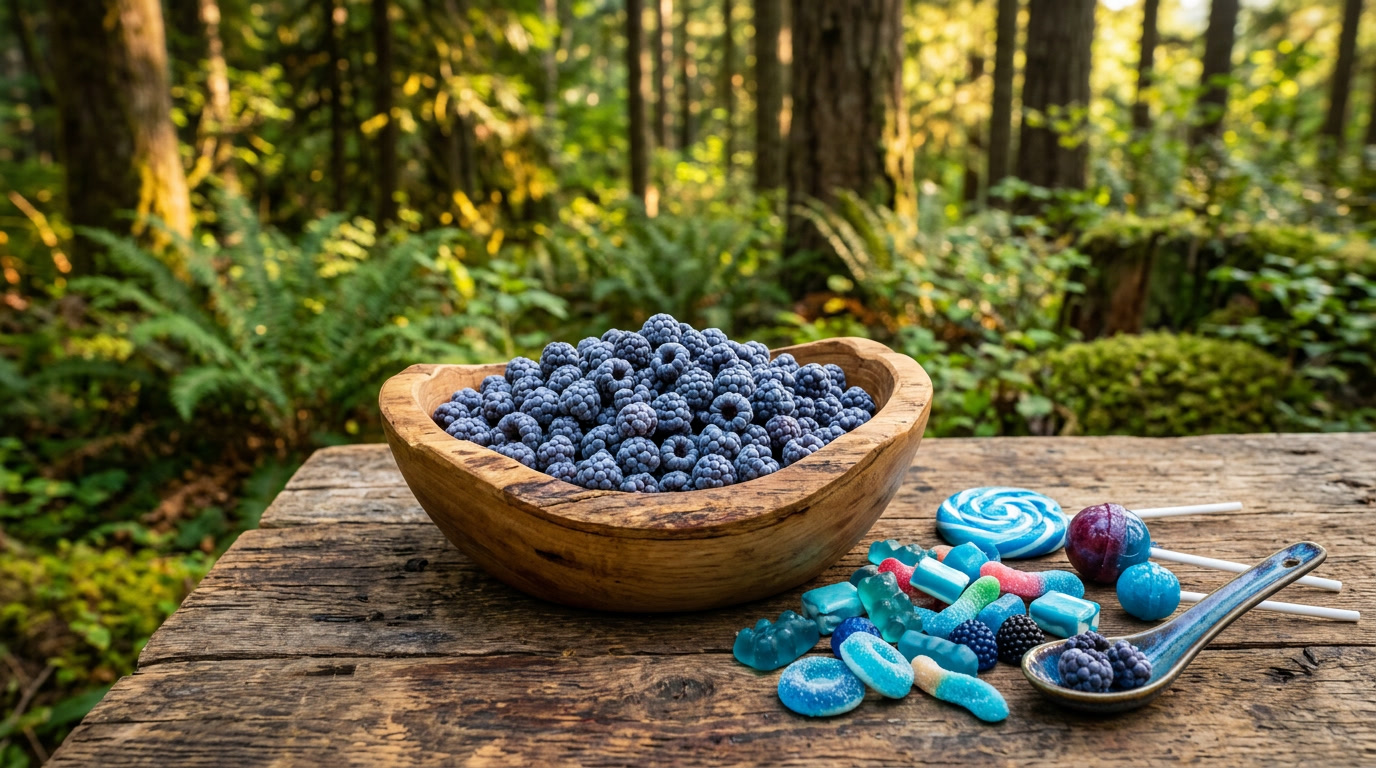
Every child who has ever held a blue ICEE or bitten into a blue gummy bear has paused and wondered: where does this color come from? Is there a real blue raspberry growing somewhere? Or did someone just make it up? The answer spans wild botany, FDA dye bans, candy manufacturing innovation, and a global confectionery market that has embraced the blue raspberry as one of its most iconic flavors. By the end of this article, you will know exactly what blue raspberries are, why the candy flavor looks nothing like the fruit, and how billions of pieces of blue raspberry candy are produced every year on industrial production lines around the world.
What Is a Blue Raspberry, Really?
A blue raspberry is one of two distinct things: Rubus leucodermis, a real wild North American berry that produces dark blue-purple fruit, or the artificial candy flavor invented in the late 1950s that pairs a synthetic raspberry flavor compound with vivid FD&C Blue No. 1 coloring. The two are connected by history — but not by appearance, taste, or color.
Rubus Leucodermis — The Real Blue Raspberry
Rubus leucodermis, commonly called whitebark raspberry, is a genuine species of raspberry native to the Pacific Northwest and western United States. The plant produces small, dark blue-to-purple drupes — clusters of tiny seed-filled lobes — that ripen in mid-to-late summer. The “whitebark” name comes from the canes, which develop a distinctive white waxy bloom as they mature.
The berries are edible and tart, similar in flavor intensity to wild red raspberries but with a deeper, slightly musky note. Native American communities across the Pacific Northwest harvested them for centuries. They are not, however, the vivid sky-blue of candy packaging — in real life, Rubus leucodermis fruit is a dusty dark blue-purple, closer to a blueberry in color than to the neon hue on a SLURPEE cup.
In practice, people who taste wild Rubus leucodermis for the first time are surprised: it’s pleasant, tart, and complex — nothing like candy blue raspberry. The flavor reads as “sophisticated wild berry” rather than the intensely sweet-sour punch consumers expect from the flavor name.
Blackcap Raspberry (Rubus Occidentalis) — The Flavor Ancestor
The other blue raspberry ancestor, Rubus occidentalis — the eastern blackcap raspberry — is equally important to this story. Blackcap raspberries look like black-purple spheres (similar to blackberries in color), grow across eastern North America, and have a uniquely tart, bright flavor that became the basis for the artificial “blue raspberry” candy flavor compound. The spec sheet for most commercial blue raspberry flavoring today references the blackcap’s flavor profile, not any true blue berry.
As noted by NDSU Agriculture’s horticulture extension, “Its flavor mimics the flavor of blackcap raspberry, a wild berry most of us have never seen or eaten.” This is the foundational fact most people miss: blue raspberry candy is blackcap raspberry flavor with blue coloring.
TABLE 1: Three Raspberries Compared
| Feature | Red Raspberry (Rubus idaeus) | Whitebark Raspberry (Rubus leucodermis) | Blackcap Raspberry (Rubus occidentalis) |
|---|---|---|---|
| Color when ripe | Bright red | Dark blue-purple | Near-black |
| Flavor profile | Sweet-tart, floral | Tart, earthy, complex | Sharply tart, bright |
| Native range | Europe, N. America | Pacific Northwest, Western US | Eastern N. America |
| Common use | Fresh eating, jam, commercial | Wild forage, regional markets | Wild forage, basis for candy flavor |
| USDA Zone | 3–9 | 5–8 | 4–8 |
| Similarity to candy “blue raspberry” | Low | Moderate (name only) | High (flavor basis) |
The Surprising History of Blue Raspberry Flavor
Blue raspberry candy was born from a problem: too many red flavors fighting for the same color. By the 1950s and early 1960s, ice pop makers were producing cherry, strawberry, watermelon, and raspberry — all coded red or dark red on store shelves. Consumers literally could not tell them apart by sight alone. Something had to change, and the solution that emerged was accidental, pragmatic, and commercially brilliant.
Why Raspberry Needed a New Color
The cascade began with food dye chemistry. For decades, raspberry-flavored ice pops used FD&C Red No. 2 (Amaranth dye) for coloring. Then in 1976, the FDA banned Red No. 2 following studies suggesting a possible carcinogenic risk in animal models. The ban created a formulation gap specifically for raspberry-flavored products, which had been paired with Red No. 2 for its particular dark red hue.
Ice pop manufacturers needed a new approach. Red No. 40, a different approved red dye, was already being used for cherry and strawberry. Adding a red-coded raspberry on top still left consumers unable to distinguish between multiple similar colors. Something dramatically different was needed.
The FD&C Blue No. 1 Revolution
The solution sitting on the laboratory shelf was FD&C Blue No. 1, also known as Brilliant Blue FCF. It was fully approved, heat-stable, vivid, and — crucially — completely unused for any mainstream candy flavor. No fruit had ever been “blue” in the commercial candy lineup.
Paired with a blackcap raspberry flavor compound — itself a tart, bright flavor profile distinct from cherry or strawberry — the blue-plus-raspberry combination immediately differentiated itself on the retail display rack. Kids could point to exactly which ice pop they wanted. Sales improved. The electric blue tongue became a badge of distinction.
As Wikipedia’s article on blue raspberry flavor records, “Blue raspberry is a manufactured flavoring and food coloring for candy, snack foods, syrups, and soft drinks.” The flavor had no pretense of being natural — it was purely functional, designed to solve a retail color problem that had been building for years.
From Ice Pops to Global Candy Phenomenon
The flavor spread rapidly across candy categories over the following decades:
- 1960s–1970s: Ice pops, slushies, and Kool-Aid drink mixes adopt the flavor
- 1980s: Gummy candy formulations incorporate blue raspberry; the Slurpee builds it into a standalone flavor identity
- 1990s: The sour candy explosion — blue raspberry sour belts, sour gummies, and sour patch variants push the flavor into an intensely tart expression that becomes its signature register
- 2000s–2010s: Energy drinks, vape flavors, cocktail syrups, and functional candy adopt blue raspberry as a recognizable signal for “bold, sharp, youth-oriented”
- 2020s–present: Natural-label reformulations use spirulina and butterfly pea flower for blue color; Rubus leucodermis extracts begin appearing in premium artisan products
The manufactured flavor that started as a pragmatic dye-availability solution now has its own flavor identity, nostalgia profile, and annual global candy sales measured in the billions of units.
The Science of Blue Raspberry Flavor
Blue raspberry flavor is a synthetic compound designed to mimic the tart profile of Rubus occidentalis, combined with FD&C Blue No. 1 coloring. The chemistry produces a sharp, intensely sweet-tart taste that is noticeably distinct from natural red raspberry — which is part of why it succeeded as a standalone category rather than being perceived simply as a substitute.
What’s Actually in Blue Raspberry Flavoring?
Commercial blue raspberry flavor concentrates typically combine:
- Ethyl butyrate — provides fruity, slightly pineapple-adjacent top notes that read as “fresh berry”
- Methyl anthranilate — the primary compound associated with artificial grape and berry flavors
- Various esters — create the tartness signature that defines the flavor’s acidic edge
- Citric acid — amplifies the sour-sweet contrast, particularly in sour gummy and sour belt formats
FD&C Blue No. 1 (Brilliant Blue FCF) provides the visual coloring. According to the FDA’s certified color additives guidance, FD&C Blue No. 1 is fully approved for use in food, drugs, and cosmetics, with established acceptable daily intake levels well above what any confectionery product would deliver.
Natural blue raspberry products — rare and premium — use actual Rubus leucodermis or blackcap extract, combined with spirulina extract or butterfly pea flower (Clitoria ternatea) for natural blue coloring. These products deliver a more complex, less aggressively sour flavor profile and cost significantly more to produce than conventional formulations.
Is Blue Raspberry Just Blackberry?
No — and the confusion is widespread. Rubus occidentalis (blackcap raspberry) looks like a blackberry but tastes very different. Blackberries (Rubus fruticosus) are sweeter and earthier, with lower acidity and a rounder flavor. Blackcap raspberries are sharply tart, bright, and more intense. The candy version amplifies the tart notes to an extreme — far more sour than either fruit would naturally be.
A useful practical test: taste a fresh blackberry, then a fresh blackcap raspberry, then a blue raspberry sour gummy. The relationship between them is real but thoroughly transformed by industrial amplification and added citric acid.
Does Blue Raspberry Come from Beavers? The Castoreum Myth
One of the most persistent food myths on the internet claims that artificial fruit flavors — including blue raspberry — are derived from castoreum, a secretion from the castor sacs of beavers. The FDA does approve castoreum as a natural flavoring additive. It does have a faintly vanilla-adjacent, fruity scent in small concentrations. Both facts are true.
What the myth gets wrong: mass-market blue raspberry candy does not use castoreum. Castoreum is expensive, difficult to source at volume, and produces a much more subtle flavor compound than the intense, sharp blue raspberry character required for gummy candy or lollipops. Modern blue raspberry candy uses fully synthetic flavor compounds — consistently, reliably, and at industrial scale across global supply chains.
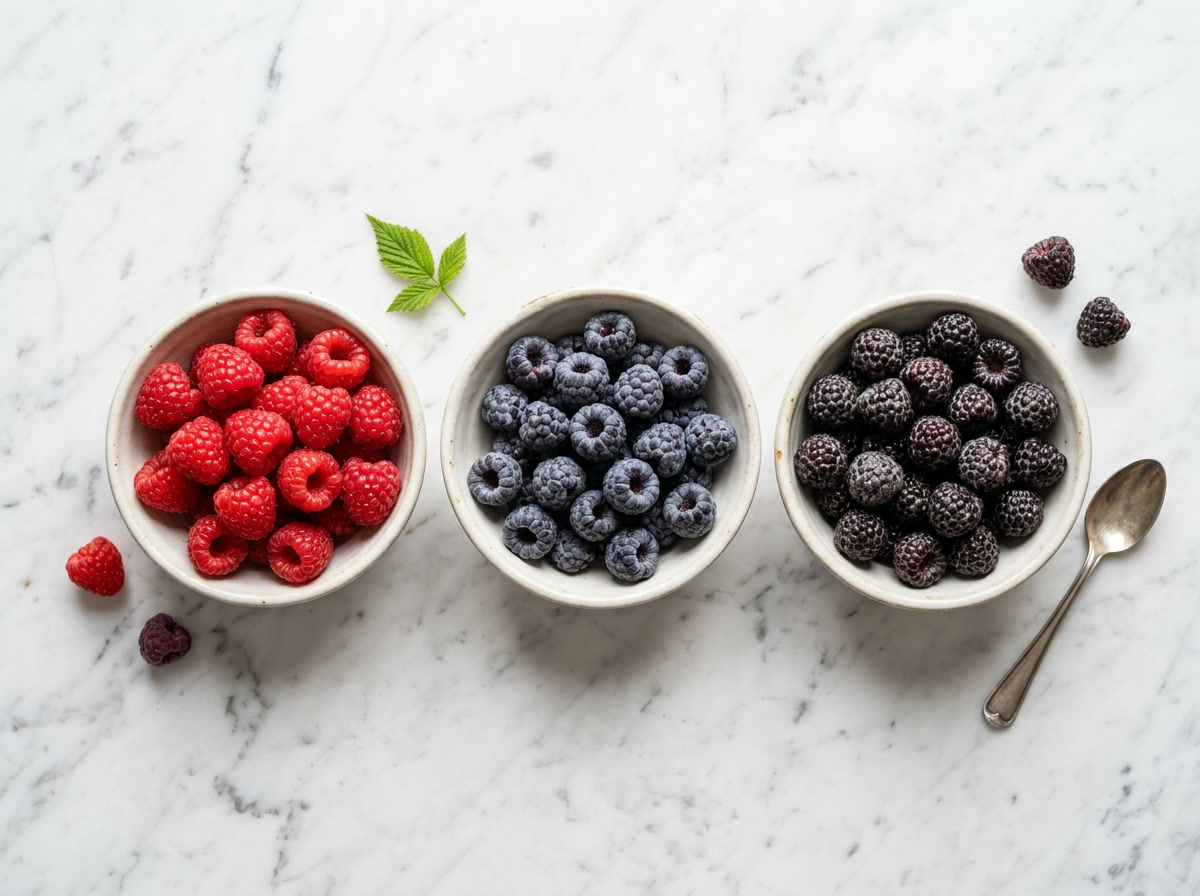
TABLE 2: Blue Raspberry vs. Natural Fruits — Flavor and Color Reality
| Property | Red Raspberry | Real Blue Raspberry (R. leucodermis) | Blackcap Raspberry | Candy Blue Raspberry |
|---|---|---|---|---|
| Fruit color | Bright red | Dark blue-purple | Near black | Does not exist in nature |
| Candy color | N/A | N/A | N/A | Electric/neon blue (FD&C Blue No. 1) |
| Sweetness level | Medium | Low-medium | Low | Very high |
| Tartness/Acidity | Medium | Medium-high | High | Extreme (+ citric acid) |
| Primary flavor compounds | Natural esters, raspberry ketone | Natural esters | Natural esters | Ethyl butyrate + synthetics |
| Commercially available at scale | Yes, globally | Very limited | Limited | Yes, globally |
| Approximate cost per kg | $3–8 (frozen bulk) | $20–50 (specialty) | $15–35 (specialty) | <$1 (artificial concentrate) |
Blue Raspberry in Candy Manufacturing — From Flavor to Finished Product
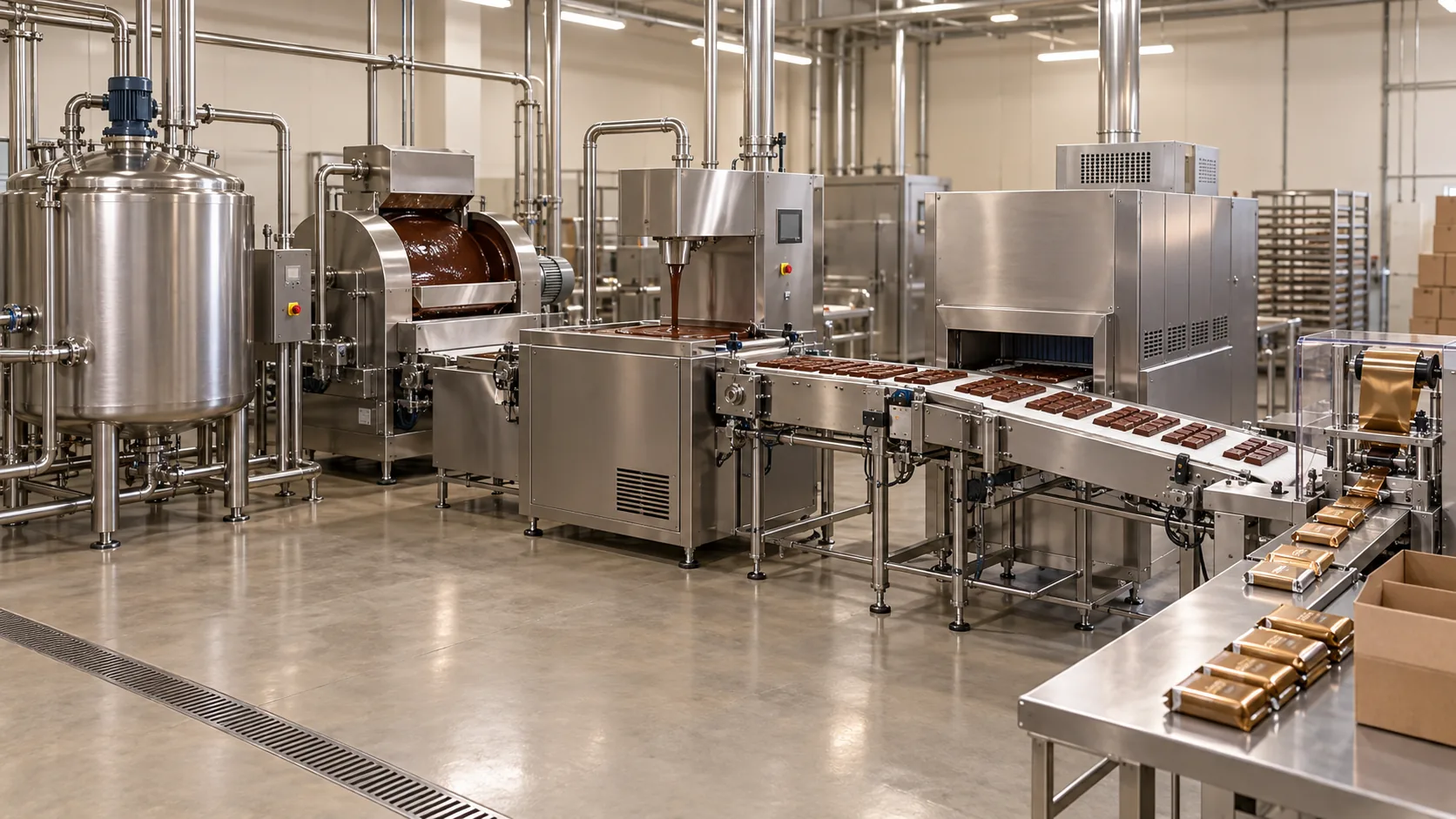
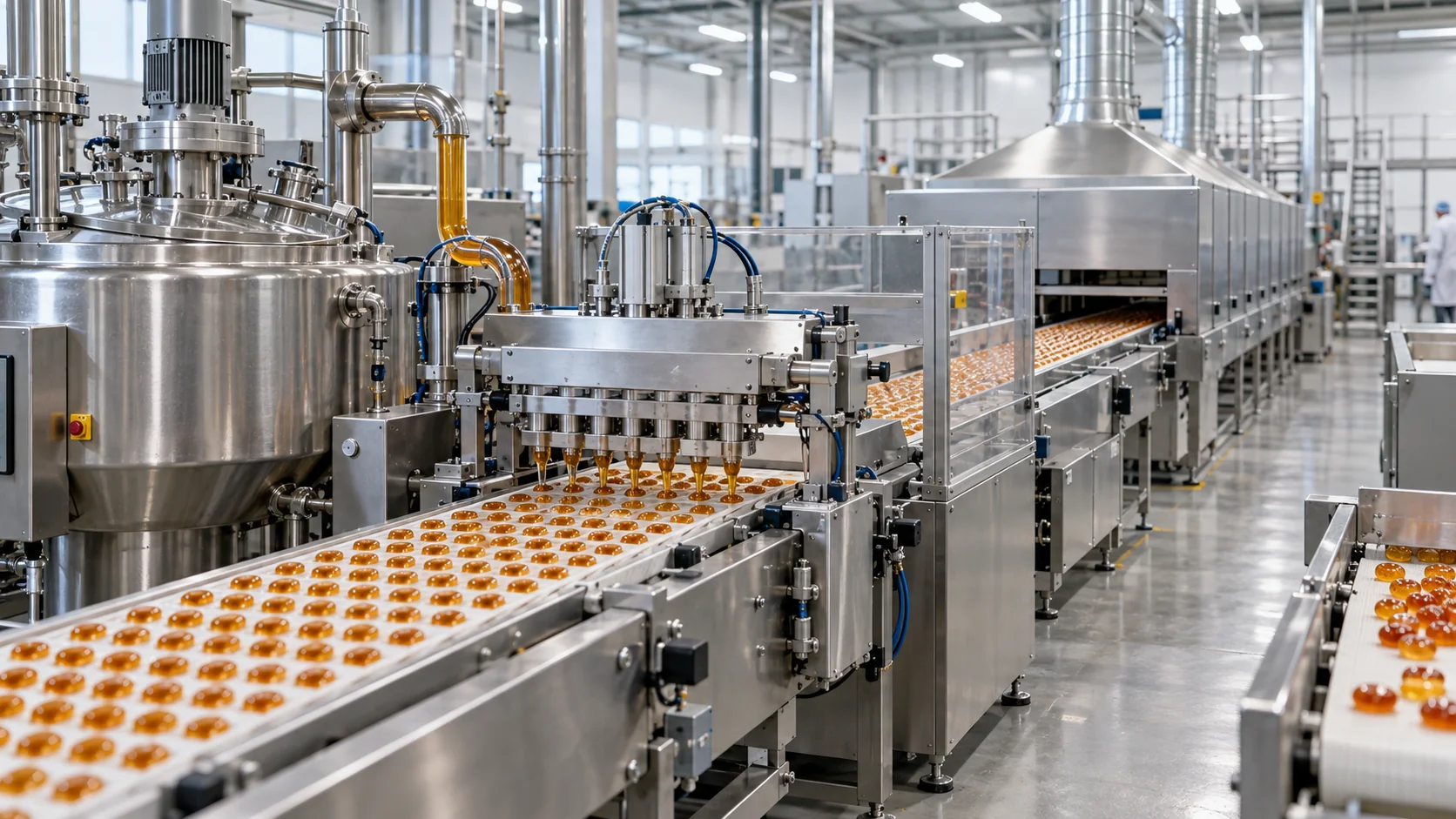
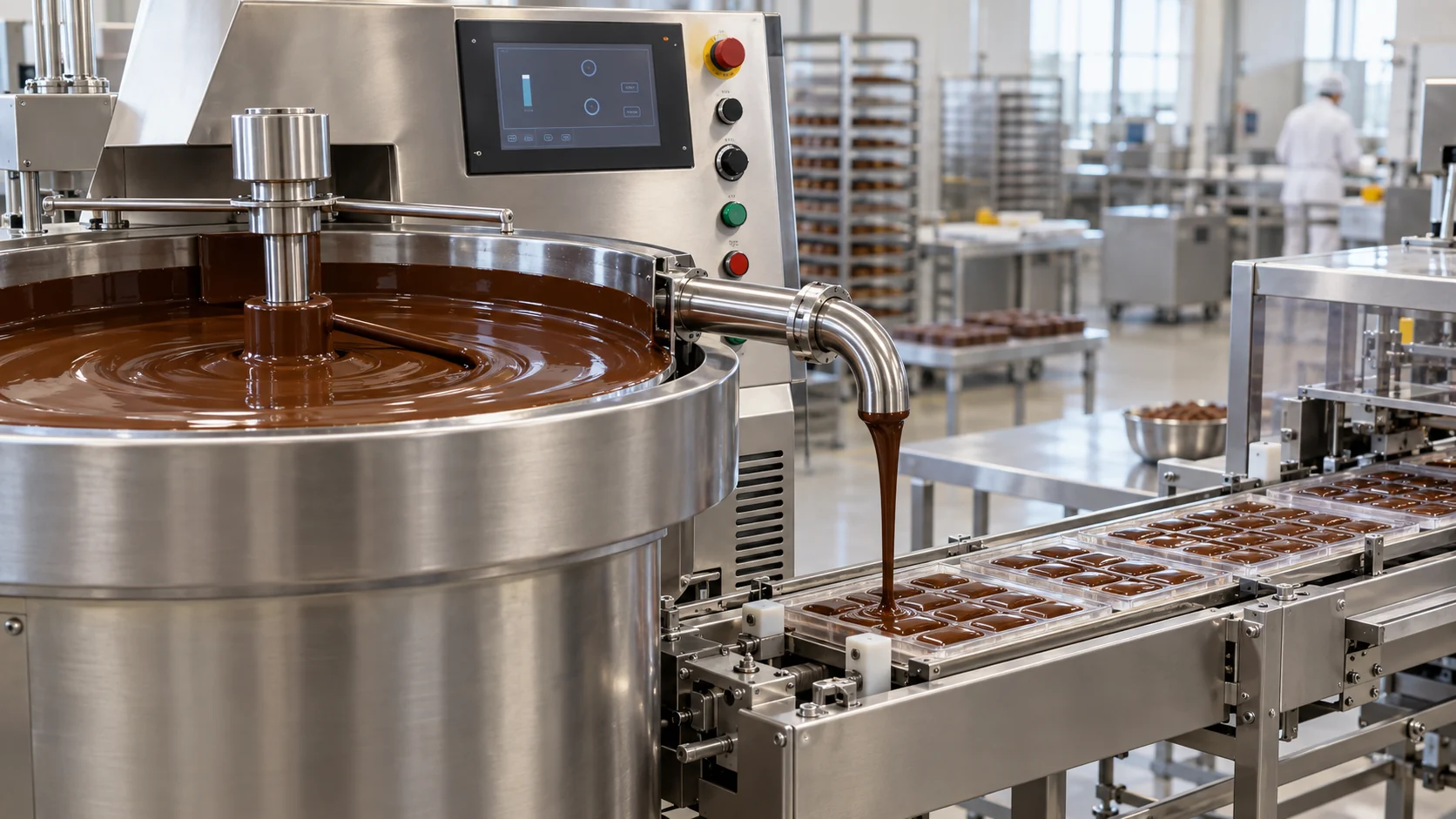
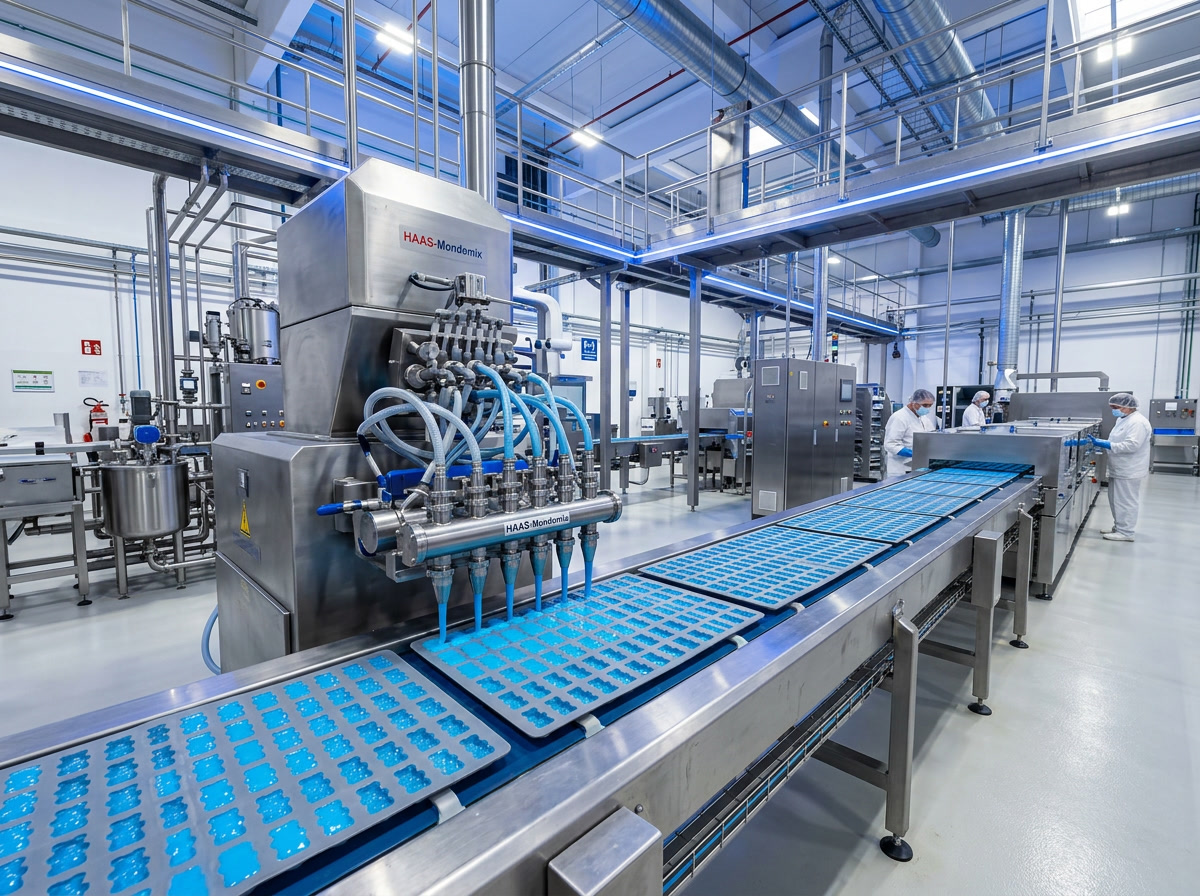
Blue raspberry is produced at industrial scale through precision confectionery manufacturing lines that combine flavor concentrates, coloring agents, and base candy formulations. Each candy format requires different processing parameters — gummies, lollipops, hard candy, and sour belts each follow distinct thermal and mechanical workflows.
How Blue Raspberry Gummy Candy Is Made
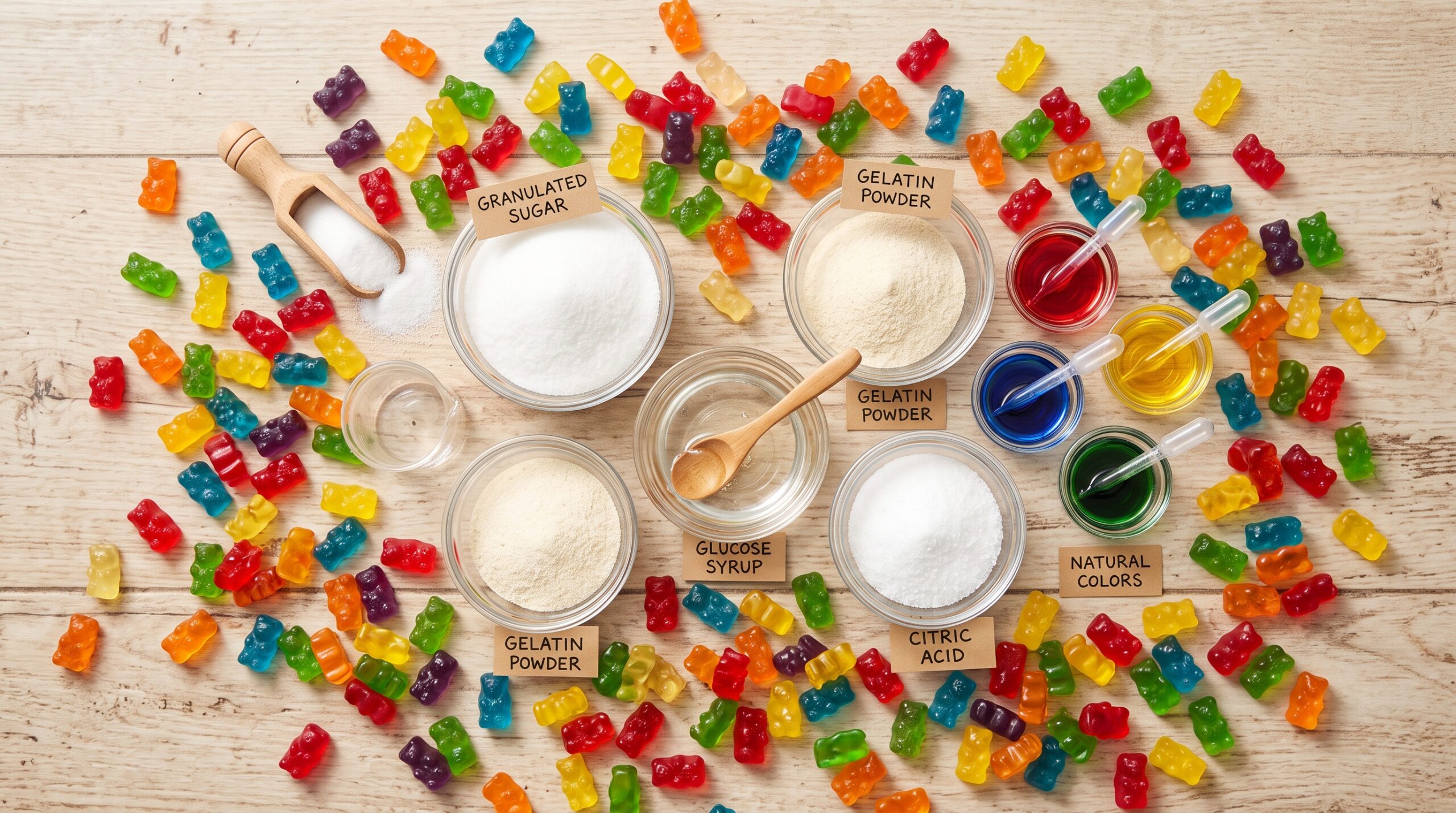
The gummy candy process starts with a sugar-glucose syrup base, heated to 107–115°C to achieve the correct Brix (dissolved sugar concentration). Gelatin — for conventional gummies — or pectin — for vegan and halal variants — is hydrated separately and blended into the hot syrup mass. FD&C Blue No. 1 coloring and blue raspberry flavor concentrate are added at this stage, with precise dosing: typically 0.01–0.05% w/w coloring and 0.3–0.8% w/w flavor concentrate.
The flavored mass is then deposited into starch molds (mogul system) or silicone molds at controlled temperatures. The deposited gummies cure in temperature-controlled rooms — 24–48 hours for gelatin-based, faster for pectin — then exit the mold and receive their final coating:
- Sugar coating — tumbled sugar crystal layer for classic gummies
- Citric acid + sugar coating — creates the sour punch associated with sour blue raspberry gummies
- Oil tumbling — provides a glossy, non-stick finish on high-end products
Modern industrial gummy production lines run at 80–300 kg per hour depending on gummy size and mold configuration, with fully automated depositing, cooling, and coating stations.
Blue Raspberry Lollipops and Hard Candy
Hard candy blue raspberry production is a distinct process. The sugar mass is cooked to 145–155°C (hard crack stage), which drives off nearly all moisture and creates the brittle, clear texture of hard candy. At these temperatures, coloring and flavor must be heat-stable — FD&C Blue No. 1 remains stable and vivid at hard candy processing temperatures, unlike most natural blue colorants.
The cooked mass is cooled on a water-cooled table, then formed via:
- Die-stamp machines for individually shaped hard candy pieces
- lollipop machines that insert sticks and form the candy head simultaneously
- Rope-and-cut machines for filled hard candy formats
Commercial lollipop lines run 200–400 pieces per minute on fully automated equipment. The blue raspberry color and flavor — both fully synthetic and heat-stable — perform consistently across these line speeds without fading or off-flavor development.
TABLE 3: Blue Raspberry Candy Types — Production Parameters
| Candy Type | Cooking Temp | Key Equipment | Typical Output | Special Notes |
|---|---|---|---|---|
| Gummy bears/worms | 107–115°C | Mogul depositing line | 80–300 kg/h | Gelatin or pectin; sour coating optional |
| Lollipop | 145–155°C | Lollipop die machine | 200–400 pcs/min | Stick insertion automated |
| Hard candy drops | 145–155°C | Rope-cut or die-stamp | 100–400 kg/h | High heat requires stable dye |
| Sour belt/strip | 107–115°C | Starch-cast belt line | 50–150 kg/h | Citric acid sanding on surface |
| Marshmallow | 60–80°C (post-aeration) | Whipping + depositing line | 100–300 kg/h | Color added post-aeration to protect pigment |
| Taffy/chew | 120–130°C | Batch taffy puller | 50–150 kg/h | Pulling aeration determines final texture |
As explained in the video What Actually Is Blue Raspberry?, the commercial production of this flavor involves large-scale industrial processes far removed from anything resembling natural fruit harvesting — underlining how completely blue raspberry has become its own manufactured flavor category independent of botany.
Can You Grow Real Blue Raspberries?
Yes — and the real thing is worth growing. Rubus leucodermis thrives in home gardens across cool-temperate climates, particularly in the Pacific Northwest, and delivers a genuine blue-purple raspberry that no candy can replicate in complexity or subtlety.
Where Wild Blue Raspberries Grow
Rubus leucodermis grows natively across:
- Pacific Northwest coastal belt — British Columbia south to northern California
- Interior mountain regions — Montana, Idaho, Oregon Cascades
- Elevation range — sea level to approximately 3,000 meters
- Preferred habitat — forest edges, disturbed ground, rocky slopes with good drainage
The plant tolerates dry summers well once established, making it more drought-resilient than red raspberry varieties. Wild populations fruit in July–August, with peak berry production in floricanes (second-year canes).
How to Grow Whitebark Raspberries at Home
Whitebark raspberry is not available at most garden centers, but specialty native plant nurseries — particularly in the Pacific Northwest — carry it. Bare-root canes ship best in early spring. Here is what successful cultivation looks like:
- Source canes from native plant sales, native nurseries, or specialty online growers. Verify the botanical name is Rubus leucodermis, not just “blue raspberry.”
- Select a site with full sun to light shade, well-drained soil, pH 5.5–6.5. Avoid heavy clay and low-lying frost pockets.
- Plant spacing — 60–90 cm between canes, rows 1.2–1.5 m apart. Install a trellis wire system; canes reach 2–3 m.
- Water consistently during fruit set (June–July). Drought stress at this stage reduces berry size and count. After harvest, drought tolerance improves significantly.
- Year 1 (primocanes) — canes establish roots and grow but do not fruit. Do not expect berries in the first season.
- Year 2 onwards (floricanes) — second-year canes produce fruit. After harvest, cut floricanes to the ground; new primocanes from year 2 become next year’s fruiting wood.
- Flavor expectation — tart, complex, distinctly raspberry but earthier than commercial red varieties. Excellent fresh, for jam, or for homemade blue raspberry syrup that is genuinely made from blue raspberries.
Blue Raspberry in the Global Candy Market — 2026 Trends
Blue raspberry remains one of the highest-performing candy flavors globally in 2026, driven by sour candy category growth, the gummy segment expansion, and the flavor’s strong association with bold, photogenic, youth-oriented branding.
Market Scale and Consumer Demand
The global gummy candy market was valued at approximately USD 6.5 billion in 2024 and is growing at a CAGR above 5% through 2030, per industry research reports. Blue raspberry consistently ranks in the top three flavors in sour gummy formats globally — alongside strawberry and watermelon — and holds the leading position in sour belt and sour strip categories across North America and Western Europe.
The sour candy sub-category, where blue raspberry is the dominant flavor, has seen particularly strong growth since 2020, driven by social media trends around sour challenges and the flavor’s intensely photogenic electric-blue color. Blue confections photograph exceptionally well on video and image platforms, providing organic marketing that candy brands have incorporated deliberately into their product development strategies.
Natural Blue Raspberry — The Clean Label Opportunity
A significant trend in 2025–2026 is the move toward natural-label blue raspberry products. Driven by consumer pressure in the EU, North America, and increasingly Southeast Asia, candy manufacturers are reformulating to replace FD&C Blue No. 1 with:
- Spirulina extract — the most widely adopted natural blue colorant, derived from blue-green algae. Stable in gummy formulations but heat-sensitive (unsuitable for hard candy processed above ~100°C).
- Butterfly pea flower extract (Clitoria ternatea) — produces vivid blue at neutral pH but shifts toward purple in acidic conditions, limiting its use in sour candy formulations where citric acid concentrations are high.
- Phycocyanin — concentrated spirulina pigment; more heat-stable than raw spirulina extract, increasingly used in lollipop and hard candy formulations seeking natural-label status.
Reformulation for natural-label blue is technically difficult. No natural pigment currently matches FD&C Blue No. 1 for heat stability, pH range, lightfastness, and cost simultaneously. Manufacturers producing blue raspberry lollipops at 150°C+ processing temperatures face the steepest technical hurdles and typically accept higher reformulation costs to access premium retail channels.
Do Blue Raspberries Have a Future as a Commercial Crop?
At the premium and functional end of the market, a small but growing number of confectionery and beverage companies are sourcing actual Rubus leucodermis or blackcap raspberry extract to create genuinely “natural blue raspberry” products. These carry higher price points, regional provenance claims (Pacific Northwest origin), and serve the premium gifting and artisan candy segments. The flavor profile differs markedly from conventional candy — less aggressively sour, more botanically complex — and consumers in the premium tier receive this positively as an authentic differentiator.
Whether Rubus leucodermis will scale to commercial cultivation remains an open question. The plant’s growth habits, relatively low yield compared to cultivated red raspberries, and limited current breeding work present real barriers. But interest is growing.
FAQ: Do Blue Raspberries Exist?
Are there wild blue raspberries?
Yes. Rubus leucodermis (whitebark raspberry) is a native North American species producing dark blue-purple berries. It grows across the Pacific Northwest and western mountain ranges, typically at forest edges and disturbed ground, and is edible but tart. It looks nothing like the vivid blue of candy packaging.
Is blue raspberry just blackberry?
No. The candy flavor is based on Rubus occidentalis (blackcap raspberry), which resembles a blackberry visually but has a distinctly sharper, more acidic flavor. True blackberries (Rubus fruticosus) are sweeter and earthier. The candy amplifies the tartness of blackcap raspberry far beyond any fruit’s natural profile.
Who invented blue raspberry and why?
Blue raspberry was developed by ice pop manufacturers in the late 1950s and early 1960s. The catalyst was the overabundance of red-coded flavors (cherry, strawberry, watermelon, raspberry) making products indistinguishable on store shelves, compounded by the FDA’s eventual ban on FD&C Red No. 2. Manufacturers adopted FD&C Blue No. 1 — an approved but unused blue dye — paired with blackcap raspberry flavor to create a visually unique product.
Does blue raspberry taste like real raspberry?
Not closely. Natural red raspberry has a balanced sweet-tart, floral flavor. Candy blue raspberry is sharper, more intensely sour, and lacks the floral notes of the natural fruit. The flavor was designed to be vivid and immediately recognizable, not botanically accurate to any particular berry.
Does blue raspberry come from beavers (castoreum)?
No. The rumor stems from castoreum — an FDA-approved natural flavoring derived from beavers — being mentioned alongside artificial fruit flavors. But mass-market blue raspberry candy uses fully synthetic flavor compounds, not castoreum, which is expensive, low-volume, and far too subtle in flavor for industrial candy production.
What is the blue dye in blue raspberry candy?
FD&C Blue No. 1, also called Brilliant Blue FCF. It is fully FDA-approved for use in food, drugs, and cosmetics, with established safety data at consumption levels found in confectionery products. The FDA’s certified color additives program requires ongoing safety review for all approved dyes.
Can I buy real blue raspberries?
In most grocery stores, no. Rubus leucodermis is not commercially cultivated at scale. Specialty farmers markets in the Pacific Northwest occasionally carry them in late summer. Specialty native plant nurseries sell canes for home cultivation — the most reliable way to taste the real thing.
Conclusion
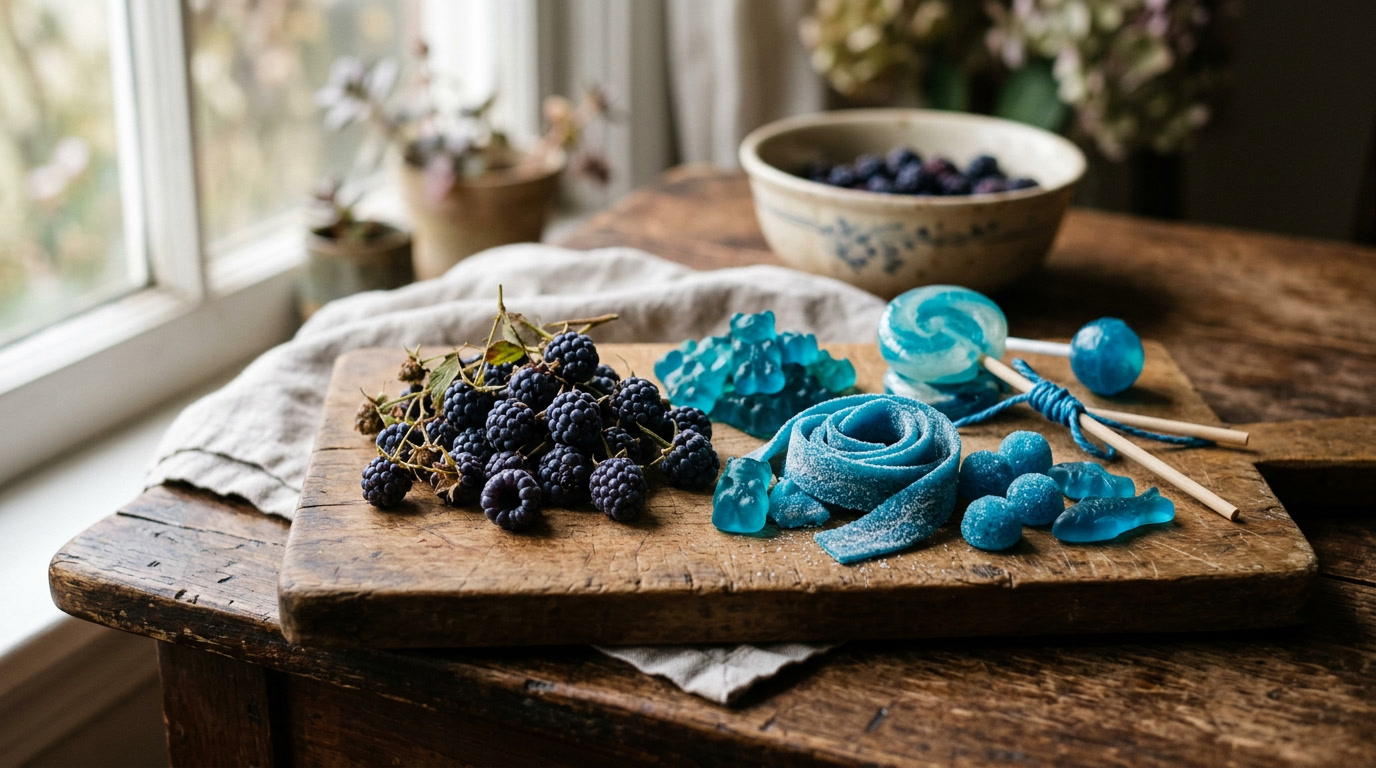
Do blue raspberries exist? The full answer is yes and no — and both halves are worth understanding. Rubus leucodermis (whitebark raspberry) is a genuine species of blue-purple raspberry fruit growing wild across North America’s western mountains. Tart, complex, and botanically legitimate, it has been harvested for centuries by communities who knew it simply as a good wild berry.
The candy blue raspberry flavor, by contrast, is something entirely different: a synthetic creation born from FDA dye regulations and retail color-differentiation problems, using FD&C Blue No. 1 and a blackcap raspberry flavor compound developed in a flavor laboratory. It has no meaningful connection to the whitebark raspberry’s actual taste or appearance — only to its name.
What makes this story remarkable is how completely the manufactured version has eclipsed the botanical reality. Most people encounter “blue raspberry” thousands of times — in gummies, lollipops, sour belts, and slushies produced on high-capacity confectionery manufacturing lines — before ever seeing or tasting the actual fruit. The candy flavor has become so culturally embedded that it now functions as its own flavor category, independent of any berry.
If you’re curious what the real thing tastes like, find a farmers market in the Pacific Northwest in August, or grow Rubus leucodermis yourself. The authentic blue raspberry is tart, complex, and genuinely delicious — nothing like the candy, and entirely worth knowing.
Related Articles
- Japanese Gummies: The Complete Guide to Japan’s World-Famous Chewy Candy
- Haribo Sugar Free Gummy Bears Review: The Sweet Truth Behind the Internet’s Most Infamous Candy
- How does a gummy manufacturing machine handle flavor and color additions?
- What Makes Sour Candy Sour? The Acids, Chemistry, and Production Secrets
- Gummy Candy Production Line
- Biscuit Production Line
- Are Skittles Gluten Free? Complete Guide 2026