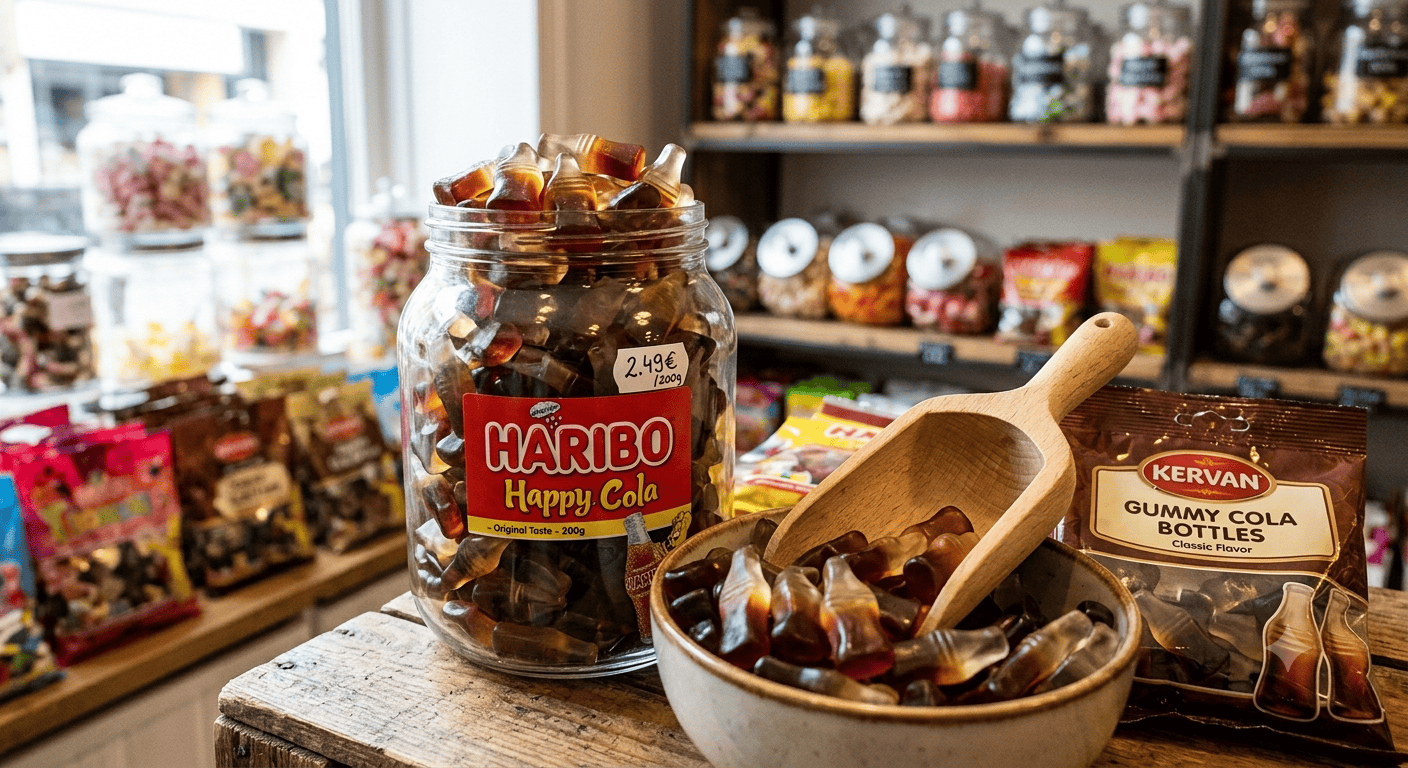
Coca Cola gummies are chewy, cola-flavored candies shaped like miniature soda bottles, made from gelatin, sugar, glucose syrup, and cola flavoring with a signature fizzy-sweet finish.
Picture cracking open an ice-cold Coca-Cola — that sharp caramel-citrus fizz hitting the back of your throat. Now imagine all of that sensation packed into a small, chewy, bottle-shaped gummy. That’s exactly what coca cola gummies deliver, and it’s why they’ve stayed one of the most consistently beloved confectionery products for decades. Whether you’re a candy retailer stocking shelves, a confectionery manufacturer evaluating production lines, or simply someone who grew up eating Haribo Happy Cola, this guide covers everything: ingredients, production science, market varieties, machinery requirements, and what separates a mediocre cola gummy from a genuinely excellent one.
What Are Coca Cola Gummies?
Coca cola gummies are gelatin- or pectin-based chewy candies that replicate the flavor profile of cola soda in a solid, bite-sized form.
The defining characteristic is the two-layer flavor architecture: a sweet cola body with a subtly acidic finish that mimics the carbonated sensation of drinking the real beverage. The iconic shape — a miniature bottle resembling a classic Coca-Cola glass bottle — is almost universal across brands, though slight design variations exist between manufacturers.
History and Origin
The cola gummy was pioneered by Haribo, the German confectionery giant, which introduced Happy Cola as part of its expanding gummy lineup in the 1980s. The product capitalized on two converging consumer trends: the global dominance of cola-flavored soft drinks and the explosive growth of the gummy candy category that Haribo itself had largely created with its Gold-Bears in 1922.
The shape was deliberate. By molding the candy to resemble a Coca-Cola bottle, manufacturers created an immediate visual association with the world’s most recognized beverage brand — even without any formal licensing. That visual shorthand proved enormously effective. According to data from the National Confectioners Association, gummy candy has remained one of the top three confectionery categories by retail value in the United States consistently since the early 2000s, with cola-flavored varieties routinely appearing in best-seller lists.
What Defines a True Cola Gummy
Not every chewy candy marketed as “cola flavored” qualifies as a coca cola gummy in the traditional sense. The authentic product has three defining properties:
- Bottle shape — miniature replica of a classic soda bottle, typically 3–4 cm in length
- Two-tone flavor arc — initial sweetness followed by a tangy, slightly acidic finish
- Gummy texture — chewy but not sticky, with enough firmness to hold the embossed shape
Some premium variants add a third dimension: a dusted or sanded exterior using a mixture of citric acid and sugar to intensify the fizzy sensation. These are often marketed as “sour cola gummies” and command higher retail price points.
Types and Varieties of Coca Cola Gummies
Coca cola gummies come in four main commercial variants: classic, sour, fizzy-dusted, and dual-layer, each targeting a different consumer preference.
The market has evolved well beyond the single Haribo Happy Cola archetype. Understanding the variant landscape matters both for retail buyers selecting SKUs and for manufacturers designing production lines.
Classic Cola Gummies
The original format: unfrosted, purely sweet-tangy, with a smooth gelatin surface. Brands like Haribo Happy Cola and Kervan Gummy Cola Bottles fall here. These appeal to the broadest demographic, including children, and tend to have the longest shelf lives because they lack the moisture-attracting citric acid coating.
| Characteristic | Classic | Sour | Fizzy-Dusted |
|---|---|---|---|
| Surface | Smooth | Smooth | Granular (citric + sugar) |
| Flavor intensity | Moderate | High | Very high |
| Shelf life | 12–18 months | 10–15 months | 8–12 months |
| Moisture sensitivity | Low | Low | High |
| Price premium | Base | +10–15% | +20–30% |
Sour Cola Gummies
These introduce malic or citric acid into the gummy base itself (not just the coating), creating a persistent tartness throughout the chew. The acidity level is calibrated to stay pleasurable — typically a pH of 3.2–3.8 in the finished product. Sour variants have surged in popularity particularly among teenage consumers. Trolli and Waterbridge both produce strong-selling sour cola gummy lines.
Fizzy-Dusted Cola Gummies
The “fizzy” sensation in these products comes from baking soda (sodium bicarbonate) combined with citric acid in the exterior sugar coating. When these two compounds meet saliva, they produce a mild carbon dioxide reaction — the same chemistry behind an Alka-Seltzer tablet, scaled down to a pleasant tingling in the mouth. Getting the ratio right is a formulation challenge: too much baking soda creates a soapy aftertaste, too little eliminates the fizz entirely. Most commercial recipes land at 0.8–1.2% sodium bicarbonate relative to the total coating weight.
Dual-Layer and Premium Variants
A growing segment uses co-extrusion or two-color depositing equipment to create gummies with a distinct inner layer — often a lighter, cream-soda-style core surrounded by a darker cola exterior. These deliver a visual cross-section that’s striking when cut, making them popular as bulk candy store offerings where the display case itself is part of the selling proposition.
Key Ingredients in Coca Cola Gummies
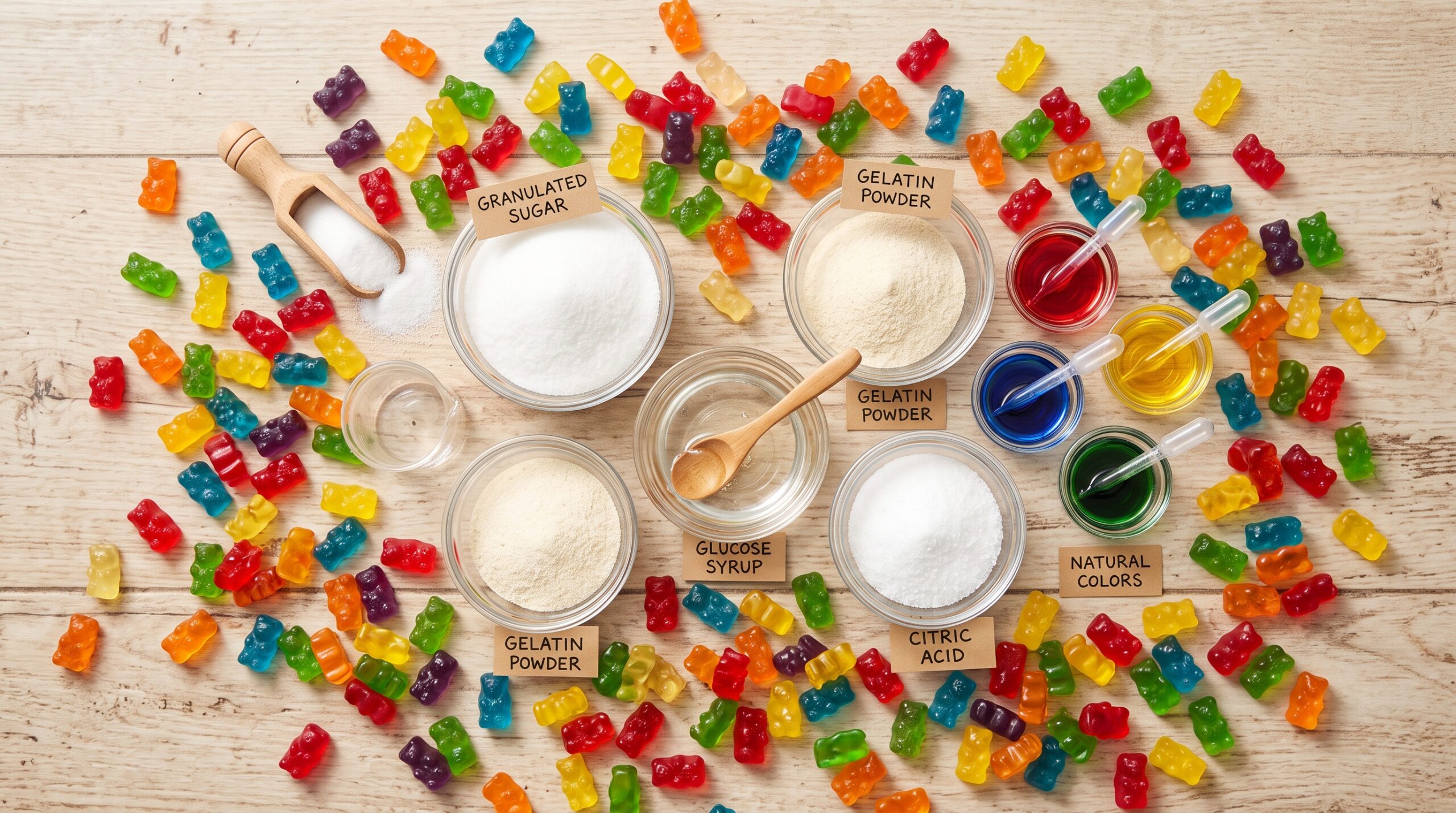
The core formula consists of gelatin (or pectin), glucose syrup, sucrose, water, citric acid, cola flavoring, and colorants — with gelatin concentration (typically 6–9%) controlling the final texture.
Every ingredient plays a specific structural or sensory role. Understanding this helps both consumers evaluating product labels and manufacturers troubleshooting formulation issues.
Gelatin vs. Pectin
Gelatin derived from porcine or bovine collagen is the dominant gelling agent in most commercial coca cola gummies. It provides the characteristic elastic chew that pectin-based products struggle to fully replicate. The bloom strength of the gelatin (typically 200–250 bloom for gummy applications) determines firmness.
However, the vegan confectionery market has driven real investment in pectin-based alternatives. Apple or citrus pectin can produce a comparable texture if combined with the right sugar-to-acid balance, but the processing window is narrower and the resulting gummy is slightly more brittle when cold. Manufacturers serving the halal or vegan consumer segment — a market worth billions globally — typically use pectin or carrageenan as substitutes.
Glucose Syrup and Sucrose
The sweetener system serves dual purposes: flavor and texture. Glucose syrup (typically corn-derived in North America, wheat-derived in Europe) prevents crystallization, maintains pliability over time, and contributes a clean, non-cloying sweetness. The sucrose-to-glucose ratio in most commercial cola gummies runs approximately 55:45 — enough sucrose for sweetness definition, enough glucose for shelf stability and flexible texture.
Cola Flavoring Compounds
This is where the magic and complexity live. True cola flavor is a proprietary blend typically containing some combination of:
- Citrus oils (lemon, lime, orange) for brightness
- Vanilla extract for depth and sweetness roundness
- Cinnamon and nutmeg in trace quantities for warmth
- Caramel for that characteristic dark sweetness
- Phosphoric acid notes to replicate cola’s distinctive tartness
Commercial flavoring houses sell ready-to-use “cola flavor” concentrates that confectionery manufacturers incorporate at roughly 0.3–0.8% of batch weight. The exact specification varies by brand target — some lean toward the classic Coca-Cola profile, others toward Pepsi’s sweeter vanilla-forward character.
Citric Acid and Colorants
Citric acid (0.5–2.0% depending on sour intensity target) provides tartness and acts as a natural preservative by lowering pH. Colorants are typically caramel color (E150a or E150d) for the warm amber-brown hue, sometimes supplemented with synthetic dyes for vibrancy. Brands targeting clean-label consumers use caramel coloring only; those targeting children’s markets in North America often add Red 40 or Yellow 5 for brightness.
| Ingredient | Typical % in Formula | Function |
|---|---|---|
| Glucose syrup | 40–45% | Sweetness, anti-crystallization, texture |
| Sucrose | 25–30% | Sweetness, structure |
| Gelatin (200 bloom) | 6–9% | Gelling, chew texture |
| Water | 15–18% | Processing, dissolved solids |
| Citric acid | 0.5–2.0% | Tartness, pH control |
| Cola flavoring | 0.3–0.8% | Core flavor identity |
| Caramel color | 0.2–0.5% | Appearance |
How Coca Cola Gummies Are Made
Commercial coca cola gummy production follows a six-step process: dissolve → flavor → deposit → cool → demold → finish, with temperature and humidity control being the most critical production variables.
Understanding the manufacturing process matters for anyone evaluating whether to produce coca cola gummies commercially, troubleshoot quality issues, or simply appreciate what’s inside the bag.
Step 1: Dissolve and Cook the Base
Gelatin is pre-hydrated (“bloomed”) in cold water for 20–30 minutes to allow even absorption. Separately, glucose syrup and sucrose are combined and cooked to a precise temperature (typically 110–115°C) to concentrate the solids and eliminate free water. The bloomed gelatin is then gently incorporated into the hot syrup mass, avoiding temperatures above 90°C to prevent gelatin denaturation.
Production note: pH at this stage matters. A mass with pH below 3.0 will cause the gelatin to hydrolyze prematurely, resulting in a weak set. Many manufacturers add citric acid only at the deposit stage to avoid this.
Step 2: Color and Flavor Addition
Once the gelatin-syrup mass reaches 70–80°C (stable but fluid enough to incorporate additives evenly), colorants and cola flavoring are blended in. This is done under controlled agitation to ensure even distribution without introducing air bubbles that would cause a cloudy finish.
Step 3: Depositing into Molds
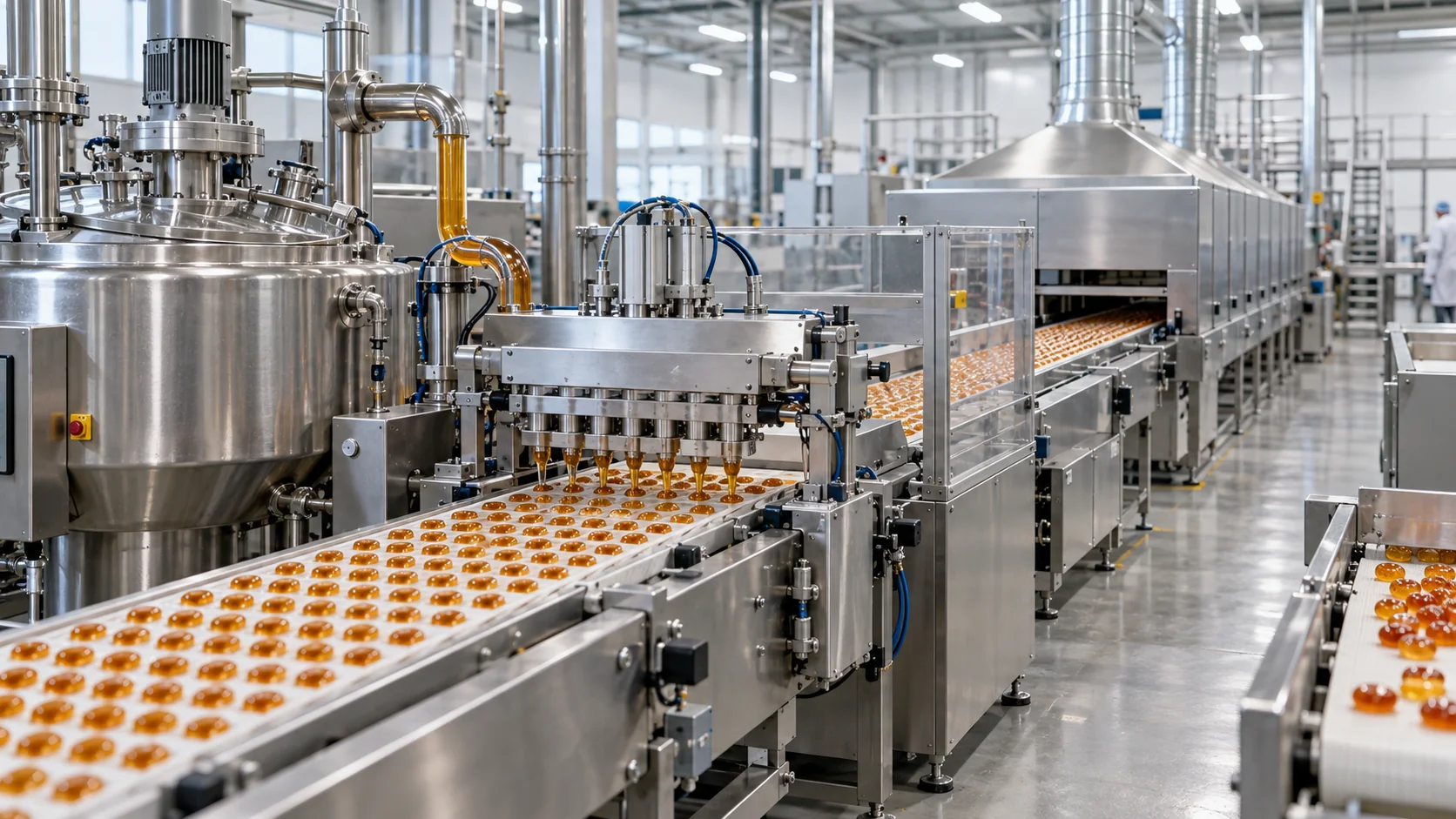
The flavored mass is pumped to a depositing machine that fills individual mold cavities in continuous sequences. Starch mogul systems (traditional) use cornstarch trays pressed with bottle-shaped impressions. More modern equipment uses silicone or polycarbonate molds with precise volume control per cavity — typically 3–6 grams per piece for standard cola gummies.
Depositing temperature is typically 60–75°C. Too hot and the gummy won’t hold its shape; too cool and the mass begins to gel prematurely, causing flow issues and irregular fills.
Step 4: Gelling and Drying
After depositing, molds enter a conditioning room held at 18–22°C and 40–50% relative humidity. This is where the gelatin network sets and excess moisture evaporates from the product. Drying time ranges from 18–48 hours depending on target moisture content, piece size, and whether the gummy is destined for a sour/dusted finish (which requires lower final moisture to prevent coating from dissolving).
Final moisture content targets: 14–18% for standard gummies, 12–15% for sour variants. Higher moisture = softer texture and shorter shelf life. Lower moisture = firmer texture but risk of a gummy that feels tough.
Step 5: Demolding and De-starching (for Mogul Systems)
Pieces are tumbled to release from starch molds, then passed through a de-starching system (brushes, air blowers) to remove residual cornstarch from the surface before finishing.
Step 6: Coating and Finishing
Standard gummies receive a light application of carnauba wax or beeswax in a coating drum — this creates the characteristic shine and prevents sticking during packaging. Fizzy or sour gummies go through an additional tumbling step where the citric acid/sugar/baking soda blend is applied. Coat weight is typically 2–4% of the gummy weight.
Commercial Production Equipment for Coca Cola Gummies
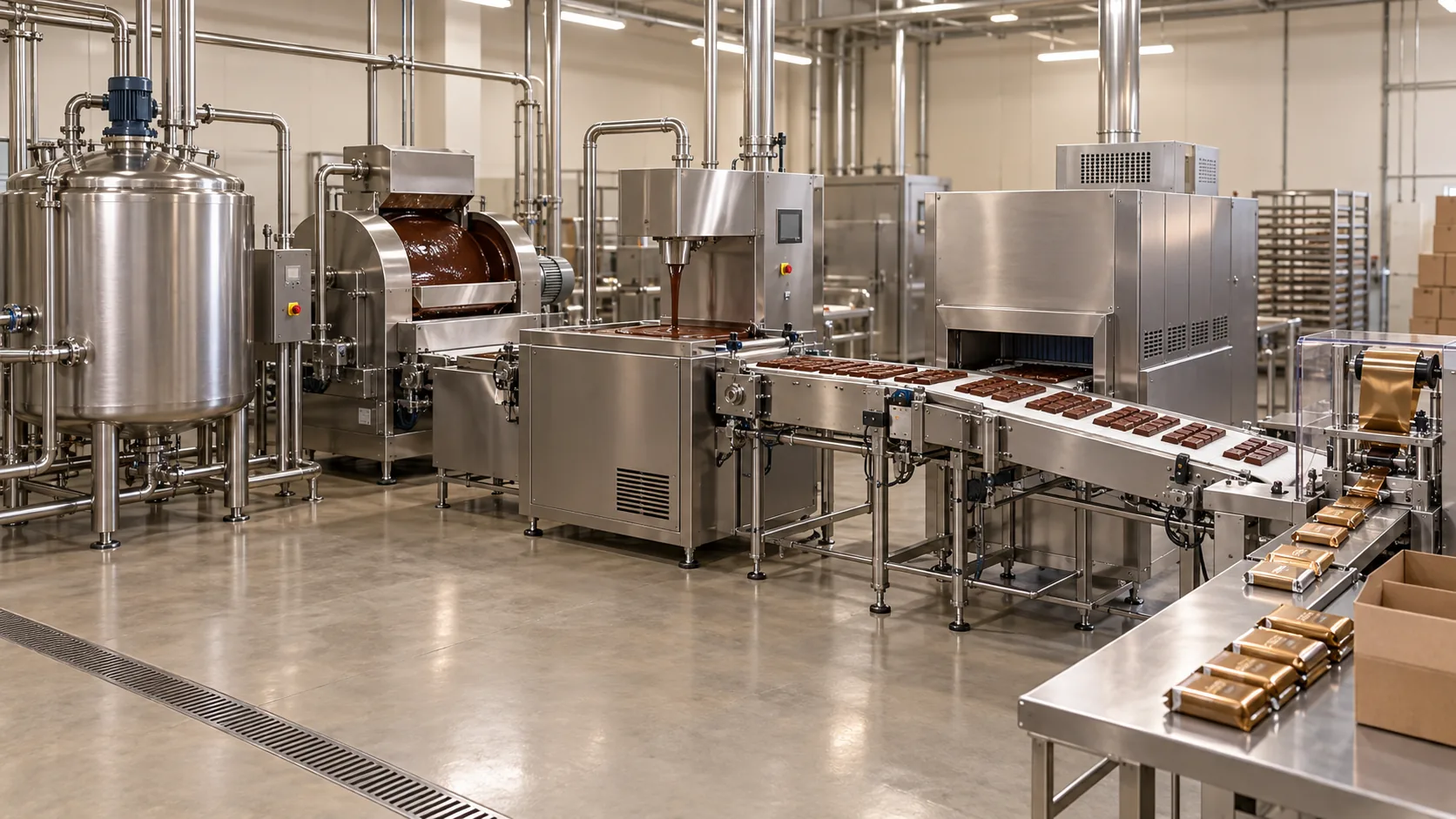
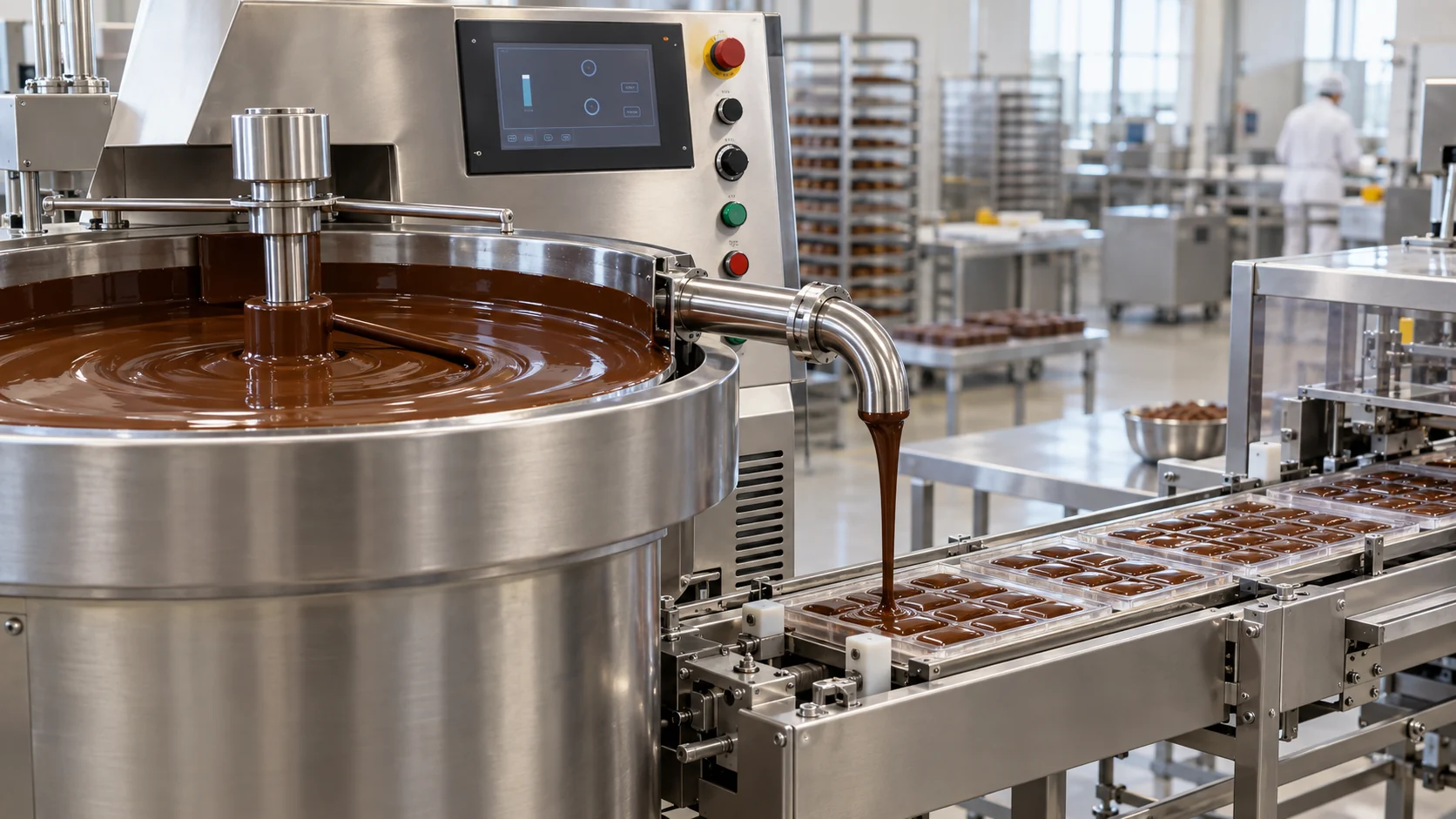
Producing coca cola gummies at commercial scale requires five core equipment categories: cooking vessels, depositors, conditioning systems, demolding units, and finishing/coating drums.
This section addresses the manufacturing infrastructure side — particularly relevant for confectionery businesses looking to add a cola gummy line or scale existing production.
Cooking and Blending Systems
Jacketed cooking kettles (100–2000 L capacity) with temperature-controlled steam injection are standard. Inline continuous cookers are preferred for high-volume operations running 500+ kg/hour, as they maintain consistent temperature profiles without the batch-to-batch variation of kettle cooking.
Gummy Depositing Machines
Two categories dominate the industry:
Starch mogul systems remain the workhorse for complex shapes like the Coca-Cola bottle silhouette. The starch tray provides excellent shape fidelity and acts as the conditioning medium. A typical mogul system operating at 2000 units/minute will require significant floor space (15–25 meters in line length) and a dedicated starch conditioning and recycling loop.
Servo-driven silicone mold depositors have gained significant market share for shorter runs and formats where starch handling is impractical. They offer faster changeovers (30–60 minutes versus 2–4 hours for mogul mold changes), lower minimum batch sizes, and a cleaner production environment. The trade-off is slightly lower throughput at equivalent machine cost.
Temperature and Humidity Conditioning
The conditioning room is non-negotiable. Temperature variation of ±2°C or humidity swings of ±5% RH will produce inconsistent texture batch to batch. Modern facilities use dedicated HVAC with dew-point control, often paired with real-time monitoring and automated adjustment systems.
According to food science research published through academic food technology resources, water activity (aW) control in the 0.55–0.65 range is the critical parameter for shelf-stable gummy products — not just moisture percentage alone. This nuance is often missed by first-time gummy manufacturers.
Coating and Finishing Drums
Standard confectionery coating pans work well for wax application. For sour/fizzy coatings, the sequence matters: apply sugar first, let it dry, then apply the acid/baking soda blend. Combining these in a single step risks premature reaction between the acid and bicarbonate in the drum.
| Equipment Category | Throughput Range | Key Selection Criteria |
|---|---|---|
| Continuous cooker | 200–2000 kg/hr | Temperature uniformity, cleaning speed |
| Starch mogul depositor | 1000–4000 units/min | Mold inventory, starch system capacity |
| Silicone mold depositor | 300–1500 units/min | Changeover time, deposit accuracy |
| Conditioning room | Batch size dependent | RH control, airflow uniformity |
| Coating drum | 100–800 kg/hr | Capacity, rotation speed control |
Global Market Trends for Cola Gummies (2025–2026)
The global gummy candy market, valued at over $7.5 billion in 2024, is growing at approximately 5.8% CAGR through 2030, with cola-flavored products remaining among the top-performing SKUs in the chewy candy subcategory.
Several macro trends are reshaping what manufacturers need to produce and where the growth is:
Vegan and Plant-Based Formulations
Consumer demand for vegan cola gummies has moved from niche to mainstream expectation in several European markets. Germany, the UK, and the Netherlands now see substantial portions of gummy category sales going to pectin-based products. Manufacturers who haven’t developed a gelatin-free formula for their cola gummy line are leaving revenue on the table in these markets.
The formulation challenge remains real: pectin gummies require a lower processing pH (around 3.2–3.5 during cooking), faster setting, and adjusted depositing temperatures. But the technology is mature — it’s a solved problem for manufacturers willing to invest in reformulation.
Functional and Better-For-You Variants

Cola gummies with added vitamins (particularly Vitamin C and B-complex), reduced sugar, or fiber additions are appearing in health food channels. These typically command a 40–80% price premium over standard cola gummies. The flavor impact of sugar reduction is significant — most reduced-sugar cola gummies use a combination of maltitol syrup and erythritol, which changes the texture profile and requires formula recalibration.
Premium and Craft Positioning
Artisan confectionery brands are creating small-batch coca cola gummies with natural flavors, real citrus oils, and clean-label color (caramel only, no synthetic dyes). These retail at $18–30 per pound versus $3–6 per pound for mass-market equivalents. The margins are attractive, but the production volumes are inherently small, favoring silicone mold depositing over mogul systems.
Asia-Pacific Growth
According to market intelligence, cola-flavored gummy candy has been growing rapidly in South and Southeast Asia as Western confectionery culture expands through e-commerce and modern trade channels. China, India, and Vietnam in particular show strong growth trajectories. This represents a significant opportunity for Asian confectionery manufacturers to develop regional cola gummy brands optimized for local taste profiles — slightly sweeter, often with less tartness than European formulations.
FAQ: Coca Cola Gummies
What happened to cola gummies?
Cola gummies never went away — they’ve evolved. Some legacy varieties from smaller brands were discontinued as larger players consolidated the market, but Haribo Happy Cola, Kervan, and multiple private-label cola gummies remain widely available. If you’re seeing fewer options at your local store, the likely cause is a shift in retailer assortment strategy rather than market decline. Online specialty candy retailers and bulk candy stores typically carry 5–10 distinct cola gummy SKUs.
Are cola gummies made with real cola?
No — cola gummies use artificial or natural cola flavoring compounds, not actual Coca-Cola or Pepsi. The flavor is a carefully constructed blend of citrus oils, vanilla, caramel, and phosphoric acid notes that mimics the cola profile. This is largely due to cost (a real cola reduction would be prohibitively expensive), shelf stability, and the challenge of concentrating carbonated beverage flavor in a solid gummy matrix.
What flavor is Haribo Happy Cola?
Haribo Happy Cola is a proprietary cola flavoring with a notably citrus-forward profile compared to generic cola gummies. The top note reads as lemon-lime with underlying caramel, closer to classic Coke’s flavor architecture than Pepsi’s vanilla-dominant profile. Haribo has not published the exact formula, but it’s recognizably distinct from competitor cola gummies — which is why it’s the benchmark most consumers compare others against.
Are coca cola gummies gluten-free?
Most commercial coca cola gummies are gluten-free, but always check the label. The core ingredients (gelatin, glucose syrup, sucrose, citric acid, flavoring) are naturally gluten-free. Cross-contamination risk depends on the specific production facility. Kervan explicitly labels their gummy cola bottles as gluten-free. Haribo’s Happy Cola does not carry a certified gluten-free designation in all markets due to shared production equipment.
Can coca cola gummies be made vegan?
Yes — vegan cola gummies are commercially produced using pectin or carrageenan instead of gelatin. Haribo’s traditional formula uses gelatin, making it non-vegan. However, multiple brands including Surf Sweets, YumEarth, and several European private-label manufacturers offer certified vegan cola gummies. The texture differs slightly — pectin gummies set firmer and are less elastic — but the flavor can be made essentially identical to gelatin-based versions.
How are coca cola gummies manufactured at scale?
At commercial scale, coca cola gummies are produced on starch mogul systems or servo-depositor lines that can produce thousands of individual pieces per minute. The process involves cooking a gelatin-sugar-syrup base to precise temperatures, adding cola flavoring and colorants, depositing into bottle-shaped molds, conditioning in temperature-humidity-controlled rooms for 18–48 hours, demolding, and finishing with wax or sour coatings. A full production line capable of 1,000 kg/hour requires significant capital investment and dedicated climate-controlled conditioning space.
What is the shelf life of coca cola gummies?
Standard (unfrosted) coca cola gummies typically have a shelf life of 12–18 months when stored at cool, dry conditions below 20°C. Sour or fizzy-dusted variants have shorter shelf lives — typically 8–12 months — because the hygroscopic citric acid coating absorbs ambient moisture over time, causing the coating to dissolve and the gummy surface to become sticky. Storage in high humidity environments accelerates quality degradation significantly.
Conclusion
Coca cola gummies occupy a rare position in the confectionery world: a product category that’s simultaneously nostalgic and genuinely innovative. From the classic Haribo Happy Cola that generations grew up with, to the modern fizzy-sour variants and vegan pectin-based formulas entering the market, the cola gummy has shown remarkable staying power precisely because it delivers a distinct, irreplaceable flavor experience in a format that’s easy to eat and satisfying to share.
For confectionery manufacturers, the coca cola gummy represents both opportunity and technical challenge. Getting the cola flavor balance right, managing texture across humidity ranges, and meeting the growing demand for vegan and clean-label variants all require real investment in formulation expertise and production equipment. The brands that do this well — Haribo chief among them — have built lasting consumer loyalty that generic competitors struggle to erode.
If you’re evaluating a cola gummy production line or looking to expand your confectionery range, the key parameters to nail down first are your target gelatin/pectin system, the depositing format (mogul vs. silicone mold), and your conditioning room specifications. Get those three right, and the cola flavoring will do the rest of the work.
Related Articles
- Peelable Gummy Candy: Types, Ingredients, and Production Guide
- Halloween Gummies: Types, Flavors, and How They’re Made
- Vegan Jelly Bears: Complete Guide to Ingredients, Production & Market Trends
- Strawberry Bubble Tea: Complete Guide to Ingredients, Recipes & Commercial Production
- Gummy Candy Production Line
- Starch-Free Gummy Depositing Machine
- Are Skittles Gluten Free? Complete Guide 2026