The Science of Air: How Aerated candy Is Made
Creating Light and Fluffy Textures
Adding air to thick sugar syrup is one of the most amazing processes in candy making. It’s a careful engineering process that completely changes how dense, chewy, and tasty the final product becomes.
Aerated candy isn’t just another type of sweet treat. It’s actually a complex system with multiple phases. At its heart, it’s tiny gas bubbles scattered throughout a liquid or solid base – what scientists call a foam or gas-in-solid mixture.
To understand and control this system, you need to know four key technical areas. These include the science behind how foams work, the industrial methods for adding air, what each ingredient does, and how to control the process precisely.
이 guide gives candy professionals everything they need to know. You’ll learn:
-
The basic physics and chemistry of creating and stabilizing foam in candy.
-
How different industrial aeration techniques compare – both mechanical and chemical methods.
-
What role each key ingredient plays in building structure and keeping it stable.
-
How to control important process steps to get the texture you want and fix common production problems.
The Science Behind Foam Creation
Making aerated candy is basically creating and setting a foam. A foam is a system where lots of gas gets spread out as small bubbles throughout a liquid – in this case, concentrated sugar syrup.
How stable and textured the final product becomes depends on key physical principles. Understanding these is essential for good recipes and process design.
Surface tension is the energy at the boundary between liquid syrup and gas. It acts like an energy wall that fights against creating new surfaces (the bubbles). To make foam, you need to add energy to overcome this tension. You also need surface-active agents (surfactants) to lower it.
The thickness of the continuous phase matters a lot. You need syrup that’s thick enough to physically trap air bubbles once they form. This slows down how fast they drain and merge together.
Laplace pressure describes the pressure difference between inside and outside a bubble. This pressure is higher in smaller bubbles than larger ones. This creates a pressure difference that pushes gas around.
This movement leads to something called Ostwald ripening. It’s the main way foams break down over time. Gas moves from smaller, higher-pressure bubbles into larger, lower-pressure ones. The smaller bubbles disappear while larger ones grow. Eventually this leads to rough texture and collapse. Managing Ostwald ripening is key to shelf life.
The life of foam in candy production has three main stages:
-
Formation (Bubbling/Whipping): This is when you first add energy – either mechanical (whipping) or chemical (gas release) – to create the gas/liquid boundary and spread gas into the syrup.
-
Stabilization: Right after formation, surface-active agents and stabilizers stick to the bubble surface, creating a protective film. At the same time, thickness modifiers in the bulk phase stop bubbles from moving and joining together.
-
Setting: The final stage involves the liquid syrup changing into a solid or semi-solid state. This permanently locks the bubble structure in place through sugar crystallization, protein or hydrocolloid gelling, or forming a glassy sugar state.
Ways to Add Air
How you introduce air into the candy determines the final texture, density, and appearance. Industrial techniques fall into two main categories: mechanical aeration and chemical aeration.
Mechanical Aeration
Mechanical aeration uses physical force to mix and break up gas (usually air or nitrogen) into thick syrup. You can do this in batch or continuous systems. Continuous methods dominate large-scale production because they’re more precise and efficient.
Batch systems, like planetary mixers, are common in artisanal or smaller operations. They whip air into syrup at normal atmospheric pressure. This works well for products like meringues and some nougats.
Continuous aerators, often called pressure beaters or mondomixers, represent the latest technology. In these systems, syrup and measured gas flow into a high-shear mixing head under high pressure.
The mixer’s design matters a lot. This includes whisk shape and rotor-stator setup, plus how fast it spins. These factors control the shear forces applied. Higher shear and speed usually create finer, more uniform bubble sizes.
Pressure is a key principle. These systems typically operate between 2 and 10 bar pressure. According to Henry’s Law, increased pressure makes more gas dissolve in the syrup. When the aerated syrup exits the mixing head and returns to normal pressure, the dissolved gas comes out of solution. This creates extremely fine, stable micro-bubbles throughout the mass. This creates the signature fine texture of products like high-quality marshmallows.
Chemical Aeration
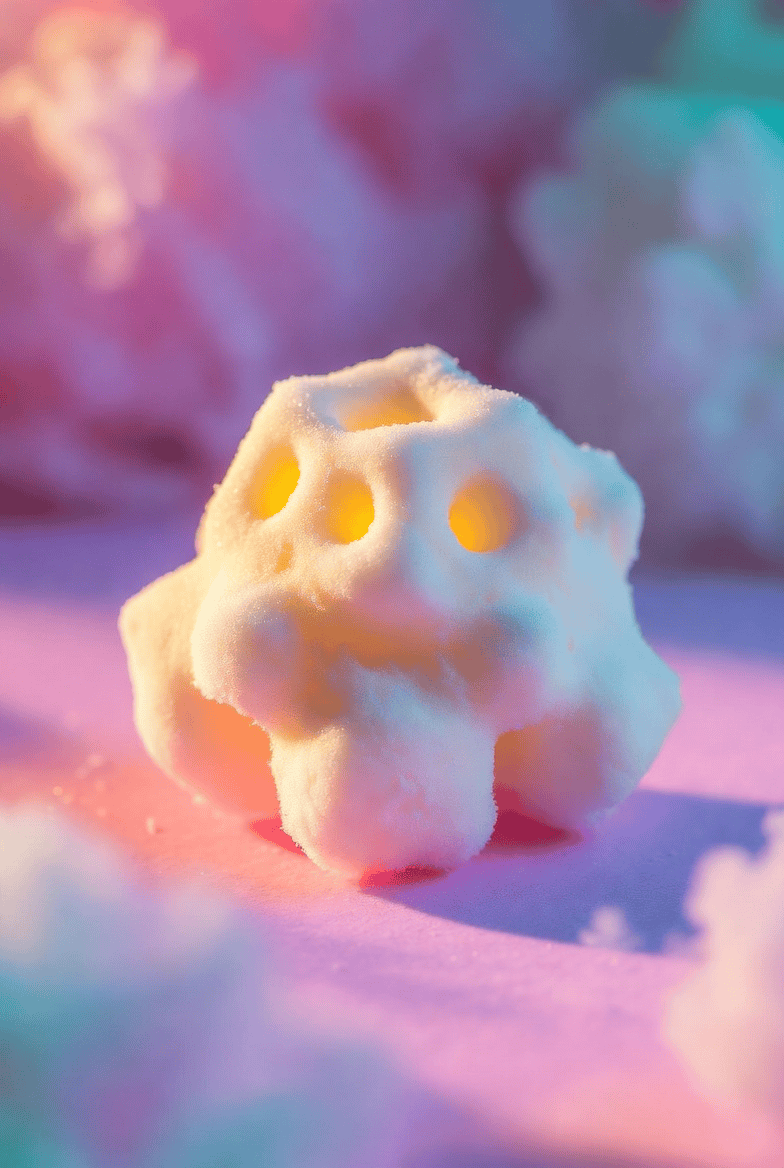
Chemical aeration creates gas right inside the candy mass through a controlled chemical reaction. This method creates the unique, brittle, and open-celled structure of candies like honeycomb and sponge candy.
The classic reaction involves acid-base neutralization. Sodium bicarbonate (baking soda) is the standard base. An acid, such as tartaric acid or cream of tartar, provides the reaction.
그것은 process needs precise temperature control. You typically add the ingredients to very hot (145-155°C), low-moisture, highly thick sugar cook. The high temperature quickly breaks down the sodium bicarbonate, releasing carbon dioxide gas.
The extremely high thickness of the syrup at this stage is crucial. It traps the rapidly forming CO₂ bubbles, stopping them from immediately escaping. As the gas expands, it stretches the sugar mass into a porous, foam-like structure. This sets into a brittle, glassy state when it cools.
cURL Too many subrequests.
|
특징
|
cURL Too many subrequests.
|
Chemical Aeration
|
|
원리
|
cURL Too many subrequests.
|
cURL Too many subrequests.
|
|
cURL Too many subrequests.
|
cURL Too many subrequests.
|
cURL Too many subrequests.
|
|
cURL Too many subrequests.
|
cURL Too many subrequests.
|
cURL Too many subrequests.
|
|
cURL Too many subrequests.
|
cURL Too many subrequests.
|
cURL Too many subrequests.
|
|
cURL Too many subrequests.
|
cURL Too many subrequests.
|
cURL Too many subrequests.
|
|
장점
|
cURL Too many subrequests.
|
cURL Too many subrequests.
|
|
단점
|
cURL Too many subrequests.
|
cURL Too many subrequests.
|
cURL Too many subrequests.
cURL Too many subrequests.
cURL Too many subrequests.
cURL Too many subrequests.
cURL Too many subrequests.
cURL Too many subrequests. cURL Too many subrequests.cURL Too many subrequests.
cURL Too many subrequests.
cURL Too many subrequests.
cURL Too many subrequests.
cURL Too many subrequests.
cURL Too many subrequests.
cURL Too many subrequests.
cURL Too many subrequests.
cURL Too many subrequests.
cURL Too many subrequests.
|
재료
|
cURL Too many subrequests.
|
cURL Too many subrequests.
|
cURL Too many subrequests.
|
|
젤라틴
|
cURL Too many subrequests.
|
cURL Too many subrequests.
|
Marshmallows, Gummy Foams
|
|
Egg Albumin (Egg White)
|
Excellent Foaming, Stabilizing
|
Rapidly denatures and adsorbs at the interface; provides structure upon heat coagulation.
|
Nougat, Meringues
|
|
Hydrolyzed Soy Protein
|
Foaming, Emulsifying
|
A plant-based alternative to gelatin/egg; forms a protective film around air bubbles.
|
Vegan Marshmallows, Chews
|
|
Gum Arabic
|
Stabilizer, Texture Modifier
|
Increases syrup viscosity, prevents sugar crystallization, and stabilizes the foam structure.
|
Chewy Nougats
|
|
Sodium Bicarbonate
|
Chemical Leavening Agent
|
Reacts with acid under heat to produce CO₂ gas, creating a porous structure.
|
Honeycomb, Sponge Candy
|
Process Control and Problem Solving
A perfect recipe can fail without precise process control. In aerated candy production, the recipe and the process are tightly linked. A change in one requires an adjustment in the other to maintain product quality and consistency.
Mastering Process Variables
Getting the target density, texture, and stability requires mastering several key process variables. Each parameter has a direct and predictable impact on the final product.
Temperature is arguably the most critical variable. It directly controls syrup thickness. Syrup that’s too hot may be too thin to trap air. Syrup that’s too cold may be too thick to aerate properly. In chemical aeration, temperature controls the reaction rate. In gelatin-based systems, it controls when the gel sets.
Mixing or whipping time and speed directly relate to the foam’s structure. Generally, higher whipping speeds create more shear, making smaller and more uniform bubbles for finer texture. Longer whipping times add more air, leading to lower final density. However, too much shearing can be harmful. It can break the stabilizing films around bubbles and cause the foam to collapse.
Pressure, specifically for continuous aerators, is a powerful tool. As discussed, higher back pressure increases gas solubility in the syrup. This allows creating exceptionally fine micro-bubbles when the pressure releases. This results in very smooth, creamy texture and better foam stability.
Fixing Common Problems
An experienced technologist learns to diagnose production issues by observing the product and understanding the underlying science. A systematic approach to problem-solving is essential for maintaining efficiency and quality.
A common issue is foam collapse or poor volume. Probable causes include insufficient or wrong type of stabilizer, syrup temperature that’s too high (reducing thickness), or over-shearing that destroyed the foam structure. Solutions involve adjusting stabilizer levels, checking syrup cooking and aeration temperatures with a calibrated thermometer, and optimizing mixer speed and time through trials.
Another frequent problem is coarse or uneven texture. This often results directly from Ostwald ripening, indicating failure in the stabilization system. It can also be caused by incorrect mixing parameters that created wide bubble size distribution initially, or by early sugar crystallization creating hard spots. To solve this, review the stabilization system (protein and hydrocolloid levels), adjust mixer settings for more uniform shear, and verify glucose syrup ratio to ensure crystallization is properly prevented.
In continuous production, density drift is a critical failure. The final density of the product may slowly increase or decrease during a production run, leading to out-of-spec product. This almost always comes from changes in one of three key inputs: back pressure, syrup temperature, or gas flow rate. The solution requires a process audit: calibrating pressure gauges, checking heat exchanger performance to ensure consistent syrup temperature, and verifying gas mass flow controller accuracy.
Table 3: Process Parameters and Their Impact on Aerated Candy Structure
|
파라미터
|
Impact on Structure & Texture
|
Control Strategy & Common Issues
|
|
Syrup Cooking Temperature
|
Determines final solids content and viscosity. Too low: weak structure. Too high: brittle, hard texture.
|
Use a calibrated digital thermometer. Issue: Inconsistent final texture.
|
|
Whipping Speed (RPM)
|
Higher speed generally creates smaller, more uniform bubbles, leading to a finer, smoother texture.
|
cURL Too many subrequests.
|
|
cURL Too many subrequests.
|
cURL Too many subrequests.
|
cURL Too many subrequests.
|
|
cURL Too many subrequests.
|
cURL Too many subrequests.
|
cURL Too many subrequests.
|
|
냉각 속도
|
cURL Too many subrequests.
|
cURL Too many subrequests.
|
cURL Too many subrequests.
cURL Too many subrequests. cURL Too many subrequests. cURL Too many subrequests.
cURL Too many subrequests.
cURL Too many subrequests.
cURL Too many subrequests.
cURL Too many subrequests. https://candyusa.com/
전문 제조 제과업체 협회 (PMCA) https://pmca.com/
미국 캔디 기술자 협회 (AACT) https://www.aactcandy.org/
cURL Too many subrequests. https://www.candyindustry.com/
cURL Too many subrequests. https://gomc.com/
cURL Too many subrequests. https://www.ift.org/
cURL Too many subrequests. https://www.sciencedirect.com/journal/food-chemistry
cURL Too many subrequests. https://ift.onlinelibrary.wiley.com/journal/15414337
cURL Too many subrequests. https://pubmed.ncbi.nlm.nih.gov/
cURL Too many subrequests. https://www.sciencedirect.com/journal/current-opinion-in-colloid-and-interface-science