How Chocolate is Made: A Complete Guide to Chocolate Manufacturing

Have you ever wondered how bitter cacao beans turn into the smooth, delicious chocolate bars we love? This amazing change is a perfect mix of science, art, and smart engineering. The worldwide chocolate business is worth more than 130 billion dollars, showing just how much people around the world love chocolate. But most people don’t know how chocolate is actually made in factories. This guide explains everything about chocolate manufacturing from start to finish. It’s written for business owners, entrepreneurs, and people who work in the chocolate industry. We’ll look at every step of making chocolate, from choosing the best beans to packaging the final product. You’ll learn expert tips and practical advice. This guide will help you understand the entire process of industrial chocolate manufacturing, including the main techniques, machines, quality control, and what’s coming next in the industry.
Basic Knowledge You Need
Before learning how to make chocolate, manufacturers need to understand the main ingredients. The quality of the final chocolate is decided long before the factory even starts working. It all begins with choosing the right bean and knowing the different types of chocolate products.
Why Cacao Beans Matter So Much
The “bean-to-bar” idea means controlling every single step, starting with the raw cacao beans. Choosing the right bean is the first and most important decision in chocolate manufacturing. Each type of bean gives chocolate a different basic taste.
- Criollo: This is called the “flavor” bean. Criollo beans are rare, expensive, and hard to grow. People love them because they have complex smells and flavors, including hints of nuts, caramel, and red fruits. They’re usually used in expensive, fancy chocolate.
- Forastero: This is the workhorse of chocolate making, used in over 80% of all chocolate production worldwide. It’s a strong, high-producing bean with a powerful, full taste that can sometimes be bitter. Most everyday 초콜릿은 from this bean.
- Trinitario: This bean is a natural mix of Criollo and Forastero, giving you the best of both types. It combines the strength and high production of Forastero with the refined taste of Criollo, making it a good choice for many chocolate makers.
Guide to Different Types of Chocolate
Each type of chocolate product is legally and technically defined by what’s in it. As a manufacturer, understanding these categories is essential for creating recipes and following labeling rules.
- Dark Chocolate: Made from chocolate liquor, cocoa butter, sugar, an emulsifier like lecithin, and vanilla. It has no milk in it. The percentage of cocoa solids (chocolate liquor plus added cocoa butter) is often used in marketing, typically ranging from 50% to over 90%.
- Milk Chocolate: Has all the same ingredients as dark chocolate, plus milk solids or milk powder. It has a creamier texture and sweeter taste because it has less cocoa and includes milk.
- White Chocolate: Technically not real “chocolate” because it doesn’t contain chocolate liquor or cocoa solids. It’s made from cocoa butter, sugar, milk solids, lecithin, and vanilla. Its quality depends heavily on how good the cocoa butter is.
- Ruby Chocolate: The newest type, introduced in 2017. It’s made from special “ruby” cacao beans and has a unique taste described as a mix of berry-fruitiness and smooth sweetness. Its pink color comes naturally from the bean during processing.
The Main Process
Industrial chocolate manufacturing is a series of precise, controlled steps. While small artisan makers can vary their methods, large-scale production needs to be consistent every time. This nine-step guide shows the standard process that turns raw beans into finished chocolate.
Step 1: Harvesting and Fermentation
The journey starts where cacao grows. Cacao pods are picked by hand when they’re ripe. Workers split open the pods with machetes and scoop out the beans, which are covered in white, fleshy pulp. These beans and pulp are then put in large wooden boxes or piled up and covered. Over several days, tiny organisms in the pulp start fermentation. This isn’t just about removing the pulp; it’s a critical step where the flavors that will become chocolate are first created.
Step 2: Drying and Bagging
After fermentation, the beans have about 60% water in them. They must be dried to prevent mold and get them ready for storage and shipping. The beans are spread out on large trays or patios under the sun and raked regularly so they dry evenly. In more industrial settings or humid places, mechanical dryers are used. The goal is to reduce the water content to about 7.5%. Once dried, the beans are put in jute sacks for shipping to chocolate manufacturing facilities around the world.
Step 3: Roasting
When the beans arrive at the factory, the first major change happens during roasting. Beans are roasted in large drum or ball roasters at carefully controlled temperatures, typically between 120°C and 160°C. Roasting does several important things: it kills any remaining bacteria, reduces moisture even more, and most importantly, develops the rich flavor and smell of chocolate. This is where the Maillard reaction happens – a chemical reaction between amino acids and sugars that creates hundreds of new flavor compounds.
Step 4: Winnowing and Nibs
The roasted beans are now brittle and easy to crack. They go through a winnowing machine, which first breaks the beans into smaller pieces. A system of screens and air currents then separates the light, papery outer shell (the husk) from the dense inner kernel (the cacao nib). The husk has limited use, sometimes sold as mulch or for tea, while the cacao nib is the pure, essential ingredient for all chocolate.
Step 5: Grinding into Liquor
The cacao nibs, which are roughly 50-55% cocoa butter, are fed into a grinder. Common machines include stone grinders, ball mills, or disc mills. The intense pressure and friction of grinding creates heat, which melts the cocoa butter inside the nibs. This turns the solid nibs into a thick, dark, non-alcoholic paste called chocolate liquor or cocoa mass. This pure liquor is the heart of chocolate.
Step 6: Blending and Refining
At this point, the chocolate liquor is mixed with other ingredients according to a specific recipe. For dark chocolate, sugar is added. For milk chocolate, sugar and milk powder are added. Extra cocoa butter is often included to make the chocolate feel better in your mouth and flow better. This rough mixture is then passed through a series of heavy-duty steel rollers, called a three-roll or five-roll refiner. This process grinds down the sugar and cocoa particles to an incredibly small size, typically 15-25 microns, which is smaller than what the human tongue can detect. This step is crucial for achieving a silky-smooth texture.
Step 7: The Art of Conching
Conching is one of the most important steps in chocolate manufacturing. The refined chocolate mixture is put in a conche, a machine with large mixers that continuously stir, knead, and add air to the chocolate at warm temperatures. This process can last from a few hours to over 72 hours. From an expert’s view, this is where the chocolate truly comes alive. At first, the smell is sharp and acidic. As conching continues, these harsh acids evaporate, and the scent becomes a rich, complex chocolate aroma. The texture changes from a slightly gritty paste into a smooth, flowing liquid. Conching completes flavor development, removes any remaining moisture, and coats every solid particle with cocoa butter, creating the final thickness and mouthfeel.
Step 8: The Science of Tempering
Tempering is a precise process of heating and cooling liquid chocolate to specific temperatures. This controls how the cocoa butter crystallizes. Cocoa butter can solidify into six different crystal forms, but only one, the Beta V crystal, gives the qualities we want in a finished chocolate bar. Proper tempering encourages the formation of a dense network of these stable Beta V crystals. This is what gives high-quality chocolate its shiny appearance, satisfying “snap” when broken, and a smooth, melt-in-your-mouth texture that doesn’t feel waxy.
Step 9: Molding and Cooling
The final step is to give the chocolate its shape. The perfectly tempered liquid chocolate is poured into molds of various shapes—bars, chips, bonbons, or other figures. The molds are then passed along a vibrating table to remove any trapped air bubbles, ensuring a smooth, uniform surface. Finally, the molds travel through a long cooling tunnel where the temperature is carefully controlled to let the chocolate solidify completely. This locks the stable Beta V crystal structure in place, preserving the temper and ensuring a long shelf life. The finished, solid chocolate is then removed from the molds and sent for packaging.
Essential Equipment
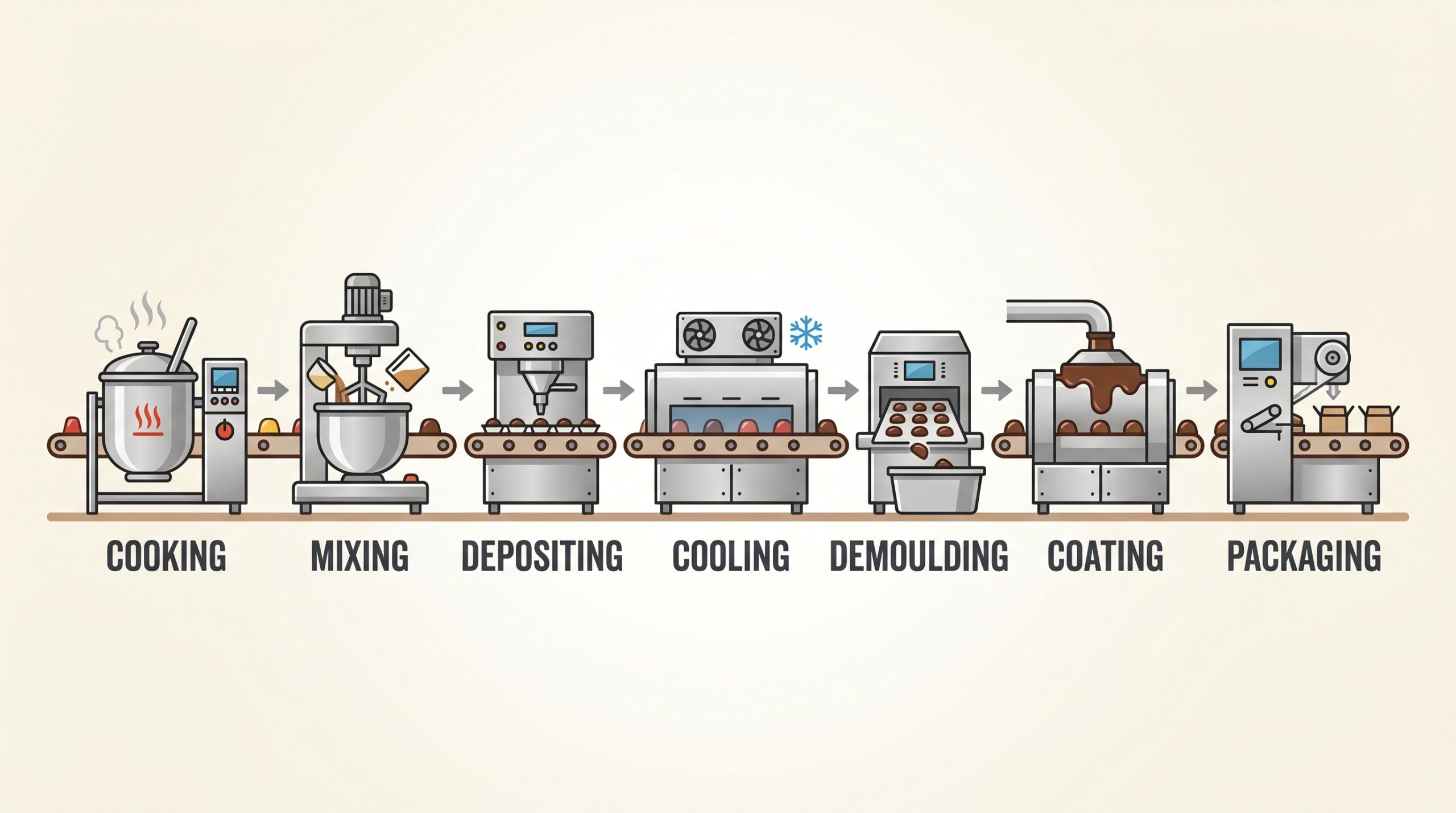
Scaling chocolate manufacturing from a kitchen to a factory requires a big investment in specialized machines. Each piece of equipment is designed to do a specific step with precision and consistency, which is what makes industrial production work. The right equipment isn’t just about making more chocolate; it’s about cURL Too many subrequests..
cURL Too many subrequests.
cURL Too many subrequests. production linecURL Too many subrequests.
| 단계 | Equipment | 주요 기능 |
| 이 글의 나머지 부분에서는 다크 초콜릿에 대해 이야기할 것입니다. 결국, 가장 잘 알려진 초콜릿 종류이기 때문입니다. | cURL Too many subrequests. | cURL Too many subrequests. |
| 풍선 | cURL Too many subrequests. | cURL Too many subrequests. |
| cURL Too many subrequests. | cURL Too many subrequests. | cURL Too many subrequests. |
| cURL Too many subrequests. | cURL Too many subrequests. | cURL Too many subrequests. |
| 콘칭 | cURL Too many subrequests. | cURL Too many subrequests. |
| 템퍼링 | cURL Too many subrequests. | cURL Too many subrequests. |
| 성형 | cURL Too many subrequests. | cURL Too many subrequests. |
| cURL Too many subrequests. | cURL Too many subrequests. | cURL Too many subrequests. cURL Too many subrequests. cURL Too many subrequests. |
cURL Too many subrequests.
cURL Too many subrequests.
cURL Too many subrequests.
cURL Too many subrequests.
cURL Too many subrequests.
cURL Too many subrequests.
- cURL Too many subrequests.
- cURL Too many subrequests. cURL Too many subrequests. cURL Too many subrequests.
- cURL Too many subrequests. cURL Too many subrequests. 기준.
- cURL Too many subrequests.
cURL Too many subrequests.
cURL Too many subrequests.
| cURL Too many subrequests. | cURL Too many subrequests. | Industrial (Large-Scale) |
| Bean Sourcing | Single-origin, direct trade, focus on unique terroir. | Blends of bulk beans (e.g., Forastero) for consistency and cost. |
| Machinery | Smaller, often multi-purpose machines (e.g., stone grinders). | Large, specialized, single-function automated lines. |
| Process Focus | Flavor development, highlighting unique bean characteristics. | Efficiency, speed, and absolute consistency of the final product. |
| Batch Size | 10kg – 100kg | 1,000kg – 50,000kg+ |
| 유연성 | High (easy to create limited editions). | Low (changing a recipe is a major undertaking). |
| Key Challenge | Scalability and cost management. | Maintaining quality at scale and supply chain logistics. |
Ensuring Excellence
In chocolate manufacturing, quality is not a final inspection; it is a way of thinking that’s built into every step of the process. A single failure at any stage can ruin the entire batch. A strong Quality Control (QC) program is the backbone of any successful manufacturing operation, ensuring product safety, consistency, and customer satisfaction.
From Raw Material to Final Product
Effective quality control begins before production starts, with careful inspection of all incoming raw materials—cacao beans, sugar, milk powder, and cocoa butter. It then continues as a series of checkpoints throughout the entire manufacturing line, from roasting to wrapping. This complete approach prevents defects rather than just finding them.
Table 3: Quality Control Checkpoints
The checkpoints below are essential for any professional chocolate manufacturer. They combine taste testing with objective, data-driven analysis to maintain the highest standards.
| 단계 | QC Check | Parameters Tested | Importance |
| Raw Cacao Beans | Sensory & Physical Test | Moisture content, bean count, mold/infestation, aroma. | Prevents poor quality raw material from entering production. |
| 이 글의 나머지 부분에서는 다크 초콜릿에 대해 이야기할 것입니다. 결국, 가장 잘 알려진 초콜릿 종류이기 때문입니다. | Color & Taste Test | Color measurement (spectrophotometer), sensory evaluation. | Ensures consistent flavor development and avoids burnt notes. |
| cURL Too many subrequests. | Particle Size Analysis | Measurement using a micrometer or laser diffraction. | cURL Too many subrequests. |
| 템퍼링 | cURL Too many subrequests. | cURL Too many subrequests. | cURL Too many subrequests. |
| cURL Too many subrequests. | cURL Too many subrequests. | cURL Too many subrequests. | cURL Too many subrequests. |
산업 응용 분야

cURL Too many subrequests. cURL Too many subrequests. cURL Too many subrequests.
cURL Too many subrequests.
- cURL Too many subrequests.
- cURL Too many subrequests.
- cURL Too many subrequests.
- cURL Too many subrequests. cURL Too many subrequests. cURL Too many subrequests.
- cURL Too many subrequests.
cURL Too many subrequests.
cURL Too many subrequests.
cURL Too many subrequests.
- cURL Too many subrequests.
- cURL Too many subrequests.
- cURL Too many subrequests.
- cURL Too many subrequests.
결론
cURL Too many subrequests. cURL Too many subrequests.cURL Too many subrequests.
자주 묻는 질문 (FAQ)
cURL Too many subrequests.
cURL Too many subrequests.
cURL Too many subrequests.
cURL Too many subrequests.
cURL Too many subrequests.
cURL Too many subrequests.
cURL Too many subrequests.
cURL Too many subrequests.
참고 링크:
- cURL Too many subrequests. https://www.fda.gov/
- cURL Too many subrequests. https://www.ecfr.gov/
- FSSC 22000 – 식품 안전 시스템 인증 https://www.fssc22000.com/
- ISO 22000 – 식품 안전 관리 시스템 https://www.iso.org/
- cURL Too many subrequests. https://onlinelibrary.wiley.com/
- cURL Too many subrequests. https://www.intechopen.com/
- cURL Too many subrequests. https://www.researchgate.net/
- Wikipedia – Chocolate https://en.wikipedia.org/wiki/Chocolate
- ScienceDirect – Food Science and Chocolate Processing https://www.sciencedirect.com/
- Registrar Corp – FDA Compliance for Food Manufacturers https://www.registrarcorp.com/