Japanese gummy candy is a chewy, gelatin-based confection first produced in Japan by Meiji in 1980, distinguished by its precise starch-mold technique, real fruit juice infusion, and distinctive soft-yet-elastic texture — made commercially at scale using depositing and cooling-tunnel machinery.
Walk into any Japanese convenience store and you’ll face a wall of gummy options unlike anything you’ll find in the West. Dozens of brands, shapes, flavor intensities, and textures — grape, muscat, peach, lychee, salt-soda, yogurt. The diversity isn’t random. It’s the result of four decades of manufacturing innovation driven by a single insight: Japanese consumers want a chewy candy that actually tastes like fruit. In this guide, we cover everything from the product landscape to the industrial process that makes japanese gummy candy the world’s most technically refined confection in its category.
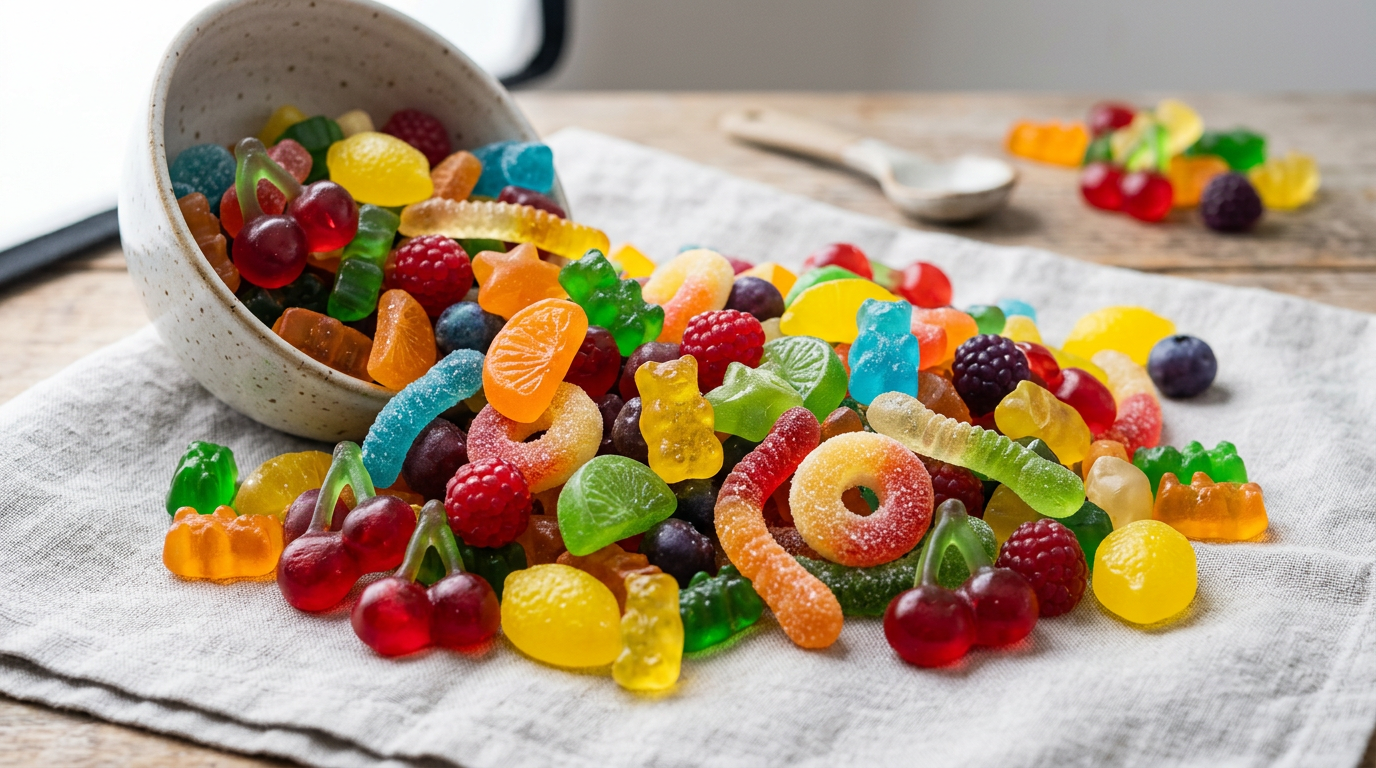
What Is Japanese Gummy Candy?
Japanese gummy candy is a soft confectionery made primarily from gelatin or pectin, sugar, glucose syrup, and real fruit juice — engineered for a balance of firmness and elasticity that sets it apart from European and American gummies.
Gummy candy as a concept originated in Germany, where Hans Riegel of Haribo created the first gelatin-based chewy candy in 1922. The format reached Japan, but early imports didn’t match local taste preferences. Japanese consumers found the texture too firm and the flavors too artificial. That gap drove Meiji to develop its own formula.
In 1980, Meiji released Cola Up, Japan’s first domestically produced gummy candy. It used a modified gelatin-pectin blend that delivered a softer chew with a cleaner fruit flavor finish. By 1988, Meiji’s Juicy Gummy had refined the starch-mold process further, using real fruit juice and pulp extract rather than synthetic flavoring. The product captured 14% of Japan’s gummy market within a decade — a share it still holds today.
What physically differentiates japanese gummy candy from Western equivalents:
- Texture gradient — softer outer layer, firmer core achieved by controlling gelatin-to-pectin ratios at the depositing stage
- Flavor intensity — real juice concentration (typically 5–30% juice content by weight) versus artificial flavoring
- Lower sweetness ceiling — Japanese formulas use 15–20% less added sugar, letting fruit acidity come forward
- Shape precision — starch-mold production allows extremely detailed molded shapes, down to orange segment ridges or strawberry seed patterns
The Core Ingredients
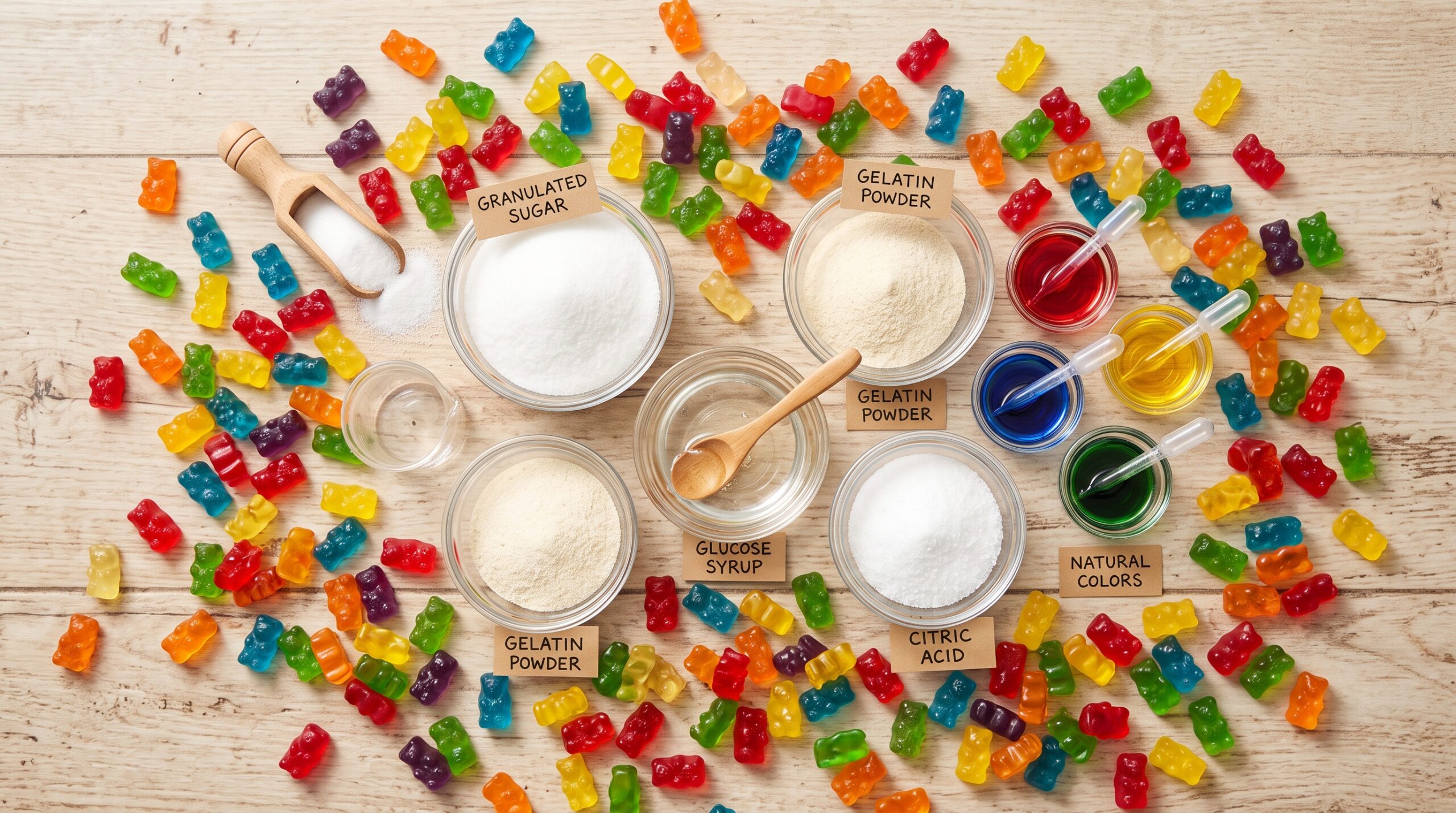
Japanese gummy candy production uses a fairly narrow ingredient list, but the ratios matter enormously:
| Ingredient | Function | Typical % by weight |
|---|---|---|
| Gelatin (pork or fish) | Base texture, elasticity | 4–8% |
| Pectin | Softness modifier, sets faster | 0.5–2% |
| Sugar | Sweetness, structure | 35–45% |
| Glucose syrup | Prevents crystallization | 20–30% |
| Fruit juice / concentrate | Flavor, color | 5–30% |
| Citric acid | Brightness, pH control | 0.5–1.5% |
| Wax coating (carnauba) | Non-stick surface finish | trace |
The gelatin-pectin ratio is the single variable that candy manufacturers tune most aggressively. Higher gelatin = firmer, bouncier. Higher pectin = softer, breaks cleanly. Japanese brands tend toward gelatin-dominant blends with pectin used as a softening agent, while European brands often invert that ratio.
Historical Context
Japan’s gummy market grew 6.8× between 1990 and 2023, reaching approximately ¥48 billion (roughly US$320 million) annually. That growth was not driven by sugar-candy expansion broadly — hard candy sales declined over the same period. The gain was specific to gummies, driven by product innovation, health positioning (collagen gummies, vitamin-C gummies), and packaging evolution (resealable pouches, individually-wrapped premium formats).
Main Types and Varieties of Japanese Gummy Candy
Japanese gummy candy falls into five main categories: fruit gummies, cola/soda gummies, sour gummies, functional gummies, and novelty DIY gummies — each produced with a distinct formula and texture profile.
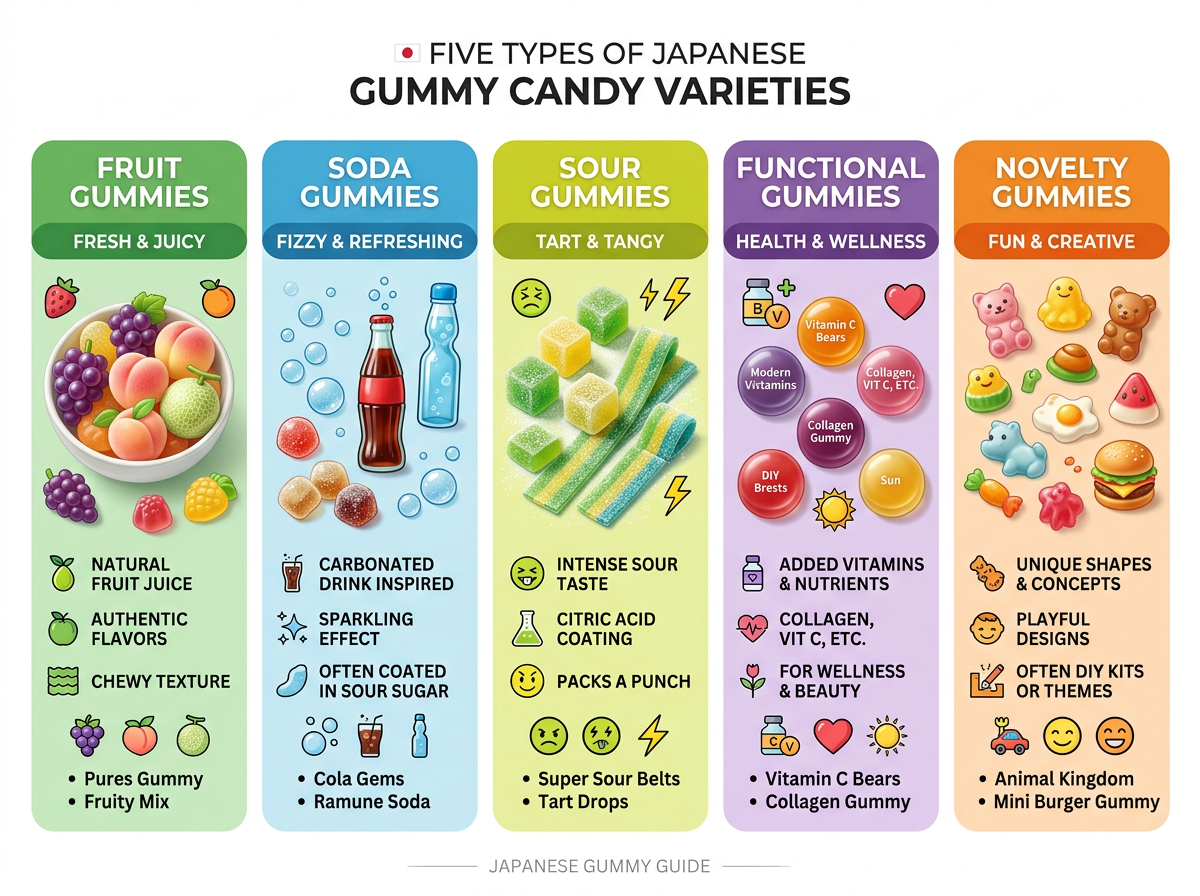
1. Fruit Gummies (フルーツグミ)
The core category and largest by volume. Brands include Meiji’s Juicy Gummy series, Kasugai Gummy (one of the most widely exported), and UHA Mikakuto’s Kororo — a unique small-sphere format designed to replicate the texture of fresh fruit skin breaking between your teeth.
Key sub-variants:
- Grape — Japan’s best-selling flavor; Kasugai grape is often cited as the benchmark
- Muscat — lighter, floral sweetness; harder to replicate with artificial flavoring, so brands use real muscat juice
- Peach / White Peach — seasonal releases drive significant sales spikes in summer
- Lychee — disproportionately popular in Japan relative to Western markets
2. Cola and Soda Gummies
Cola-flavored gummies form their own sub-category. Meiji’s original Cola Up product still sells. Modern versions often combine a cola-flavored body with a citric acid coating to mimic the carbonation sensation — a textural trick achieved by embedding sodium bicarbonate and citric acid in the outer layer separately, which react on contact with saliva.
3. Sour Gummies (すっぱいグミ)
UHA Mikakuto’s Shigekix is the dominant brand here, marketed at teenagers and young adults on the intensity of its sourness (citric acid coating concentration is significantly higher than European sour gummies). The brand runs a “spiciness” scale that treats sourness like a heat index — a successful marketing angle that drove 40% YoY growth for the SKU in 2022.
4. Functional Gummies (機能性グミ)
A rapidly growing segment. Products include:
- Collagen gummies — target women aged 25–45, positioned as beauty supplements
- Vitamin C gummies — FANCL and DHC compete here; often use ascorbic acid as both ingredient and sour note
- Melatonin / GABA gummies — newer entrants, regulatory scrutiny varies by market
Functional gummies command 2–3× the price premium of standard fruit gummies and have driven significant category growth since 2020.
5. DIY Novelty Gummies (知育菓子)
Kracie’s Popin’ Cookin’ series is the benchmark here. These kits include flavored powders that consumers mix with water to create shaped gummies at home — a micro-depositing process in a consumer-friendly format. The manufacturing challenge is creating precise, water-activated gel formation at room temperature without industrial depositing equipment. Kracie solved this using cold-set konjac-gelatin blends with very tight particle size control.
| Category | Key Brands | Avg. Retail Price (Japan) | Export Volume |
|---|---|---|---|
| Fruit Gummies | Meiji, Kasugai, UHA Mikakuto | ¥110–280 | High |
| Cola/Soda | Meiji Cola Up, Morinaga | ¥100–180 | Medium |
| Sour Gummies | UHA Shigekix, Nobel | ¥120–200 | Medium |
| Functional | FANCL, DHC, Morinaga | ¥300–1,200 | Low-Medium |
| DIY Novelty | Kracie Popin’ Cookin’ | ¥150–350 | High |
How Japanese Gummy Candy Is Made: The Manufacturing Process
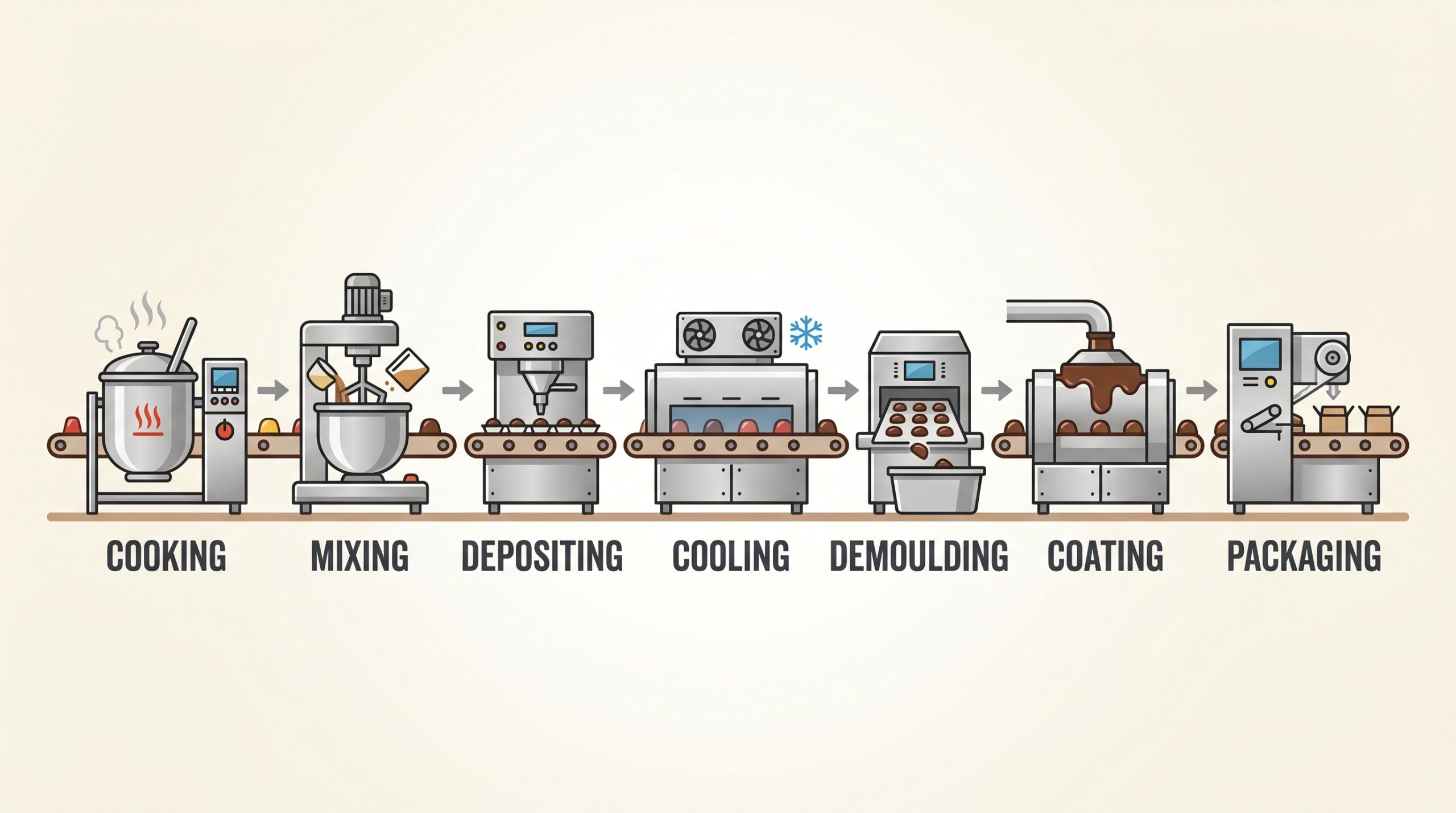
Japanese gummy candy is produced through a four-stage starch-mold (mogul) process: cook the base syrup, deposit into cornstarch molds, condition/cure, and coat — with the depositing and cooling stages being the most precision-critical.
This is where japanese gummy candy diverges most dramatically from consumer assumptions. There is no pouring, hand-shaping, or cutting in industrial production. The entire geometry of every gummy — whether it’s a round bear, a detailed grape cluster, or a strawberry — comes from the depositing step, where liquid candy is injected into impressions pressed into cornstarch trays.
Stage 1: Syrup Cooking
The gelatin, sugar, glucose syrup, water, and pectin are hydrated and cooked in jacketed batch kettles or continuous cookers at 105–115°C. Temperature control is critical: too high and the gelatin denatures, reducing elasticity; too low and the candy won’t set properly. Fruit juice concentrate is added after cooking to preserve volatile flavor compounds.
Modern lines use continuous cooking systems rather than batch kettles — they deliver consistent temperature profiles and reduce the cook time from 40 minutes per batch to a near-continuous 8–12 minute residence time.
Stage 2: Depositing Into Starch Molds (Mogul System)
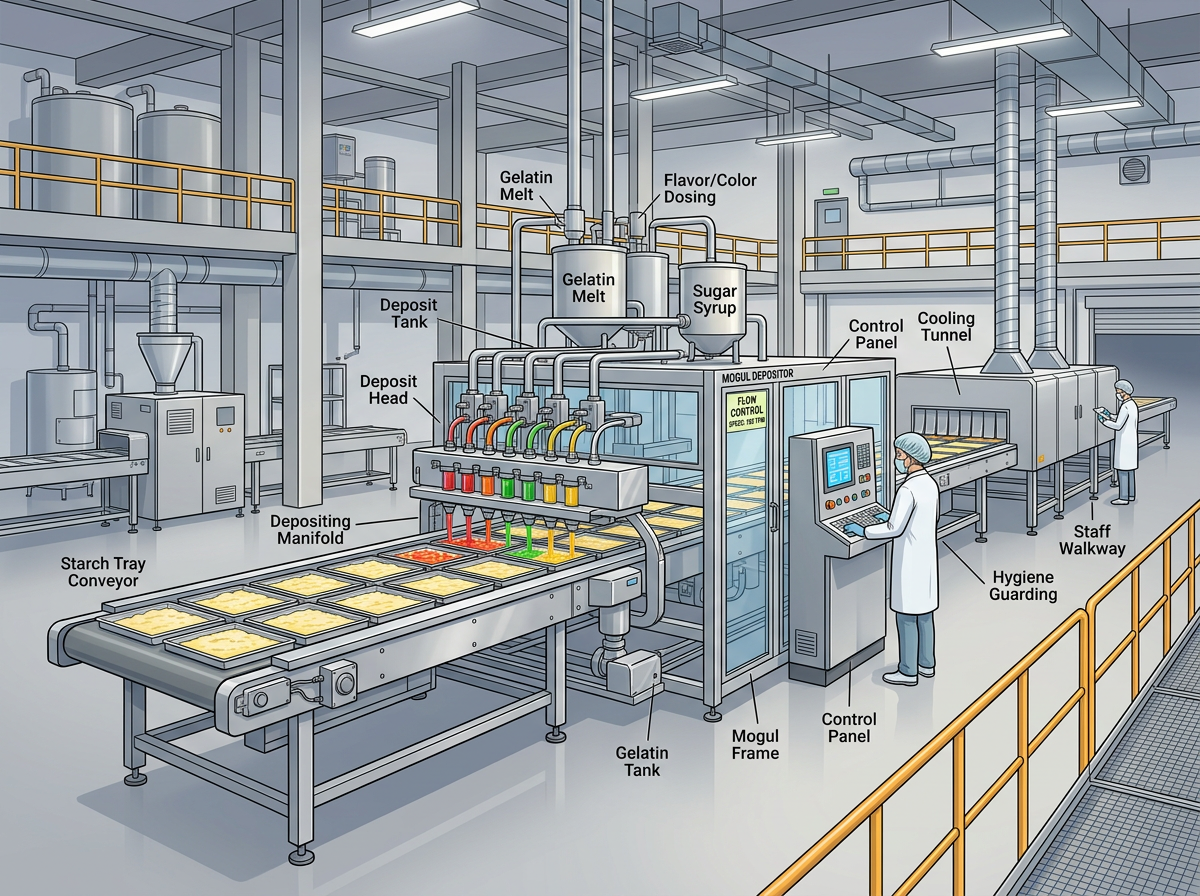
The mogul system is the heart of gummy production. A mogul line:
- Prints molds — a mold board presses shape impressions into a flat cornstarch tray. Impressions can be changed per production run.
- Deposits liquid candy — a precision pump system injects exact volumes of hot candy mass into each impression. Multi-color or layered gummies use dual-deposit heads that fire in sequence.
- Stacks and conditions — trays are stacked and moved to temperature- and humidity-controlled conditioning rooms for 12–48 hours. This is where the gummy sets and develops its final texture.
- De-molding and cleaning — a sieving system separates the set gummies from the cornstarch, and the starch is recirculated.
The depositing precision is measured in milligrams — a well-calibrated mogul can maintain ±0.5g weight consistency across millions of pieces per hour. Amazon’s japanese gummy candy selection shows this variety in action: the shape detail visible even in consumer retail products reflects direct mold quality.
Stage 3: Conditioning and Curing
This is the least visible but most impactful stage for product quality. The gummy must lose water content gradually to reach its final texture — typically dropping from 22–26% moisture at deposit to 14–18% at finish. Too fast and the exterior case-hardens; too slow and the product stays tacky.
Japanese manufacturers control this with precision air handling in conditioning rooms: typically 18–22°C at 60–70% relative humidity for 18–36 hours. Premium brands run longer conditioning cycles — UHA Mikakuto’s Kororo uses a 48-hour conditioning period that creates the distinctive multi-layer texture the brand is known for.
Stage 4: Coating and Finishing
After conditioning, gummies are tumbled in rotating drums with one or more coatings:
- Sugar sanding — fine sugar crystals applied with a binder; prevents sticking, adds crunch
- Wax coating — carnauba or beeswax applied in a polish drum for shine and anti-stick
- Sour coating — citric acid and sugar blended and tumbled onto the surface; the ratio controls sourness intensity
- Oil coating — light food-grade oil applied for a matte finish and surface moisture barrier
Most japanese gummy candy uses at minimum a wax coat. Premium products layer sugar sand under the wax for texture contrast.
Key Machinery for Japanese Gummy Candy Production
The core machinery required for japanese gummy candy production includes a mogul depositing line, continuous cooker, conditioning room HVAC system, and a coating drum — with the mogul line being the highest-capital item at US$300K–1.5M.
For manufacturers looking to enter or scale japanese gummy candy production, equipment decisions are the critical path. Here is a breakdown:
Mogul Lines
The mogul depositing line is the defining equipment for starch-mold gummies. Key selection criteria:
| Spec | Entry-Level Line | Mid-Range Line | High-Capacity Line |
|---|---|---|---|
| Output (kg/hr) | 150–300 | 500–800 | 1,200–2,000 |
| Mold change time | 60–90 min | 30–45 min | 15–20 min |
| Deposit accuracy | ±1.5g | ±0.8g | ±0.5g |
| Color heads | 1 | 2 | 2–4 |
| Investment (USD) | $300K–500K | $600K–900K | $1M–1.5M |
European suppliers (Baker Perkins, Chocotech) and Chinese suppliers (including JY Machine Tech) both compete in this space. The key difference at the premium end is depositing head accuracy and starch recirculation automation. Lower-end lines require manual starch management; premium lines recirculate, condition, and reuse starch automatically — reducing waste and labor cost significantly.
Continuous Cookers
Batch kettle cooking is viable for small runs, but industrial-scale japanese gummy candy production requires continuous cookers. These heat-exchange units maintain precise temperature profiles through residence-time control rather than batch timing — they’re more consistent and can be integrated directly with depositing lines.
Coating Drums
Coating drums come in two formats: pan coaters (rotating tilted pans, batch operation) and continuous coating drums. For high-volume production, continuous systems are preferred. The drum interior surface material matters: stainless steel with polished finish for wax coats; perforated poly-coated surfaces for sour coatings that need ventilation.
Packaging Integration
Japanese manufacturers typically integrate packaging directly off the mogul line: flow-wrapping for individually wrapped pieces, flat-pouch VFFS (vertical form-fill-seal) for pillow bags, and resealable zipper pouches for premium formats. Film selection matters — metallized PP provides better moisture barrier than clear PP, extending shelf life from 8 months to 12+ months.
How to Choose and Source Japanese Gummy Candy
When sourcing japanese gummy candy — either as a retailer, importer, or contract manufacturer — evaluate based on four criteria: texture stability (resistance to temperature cycling), flavor authenticity (real juice vs. flavoring), format flexibility, and supplier minimum order quantities.
Most guides stop at brand recommendations. Here’s where sourcing decisions actually break down:
For Importers and Retailers
Temperature cycling stability is your first filter. Japanese gummy candy formulated for Japan’s climate performs differently when shipped through warm-weather transit lanes or stored in non-climate-controlled warehouses. Products with higher gelatin ratios hold up better than high-pectin formulas. Always request a “shelf stability audit” from suppliers — ship a sample through your actual distribution chain before committing to a large order.
Packaging compliance is the second filter. Japanese candy packaging is designed for domestic labeling standards. For EU or US import, you need full ingredient relabeling (English, compliant allergen formatting), net weight in metric and imperial, and importer contact info. Some Japanese brands sell pre-labeled export SKUs; others require you to relabel — confirm before ordering.
MOQ vs. SKU depth tradeoff: Most Japanese candy distributors require minimum 3–5 carton orders per SKU. If you want 20 SKUs (reasonable for a specialty Asian food store), that’s 60–100 cartons before you get any volume discount. Negotiate consolidated shipments or find a distributor who aggregates.
For Contract Manufacturers
Discussions on Reddit’s r/japanlife community confirm that consumer demand for authentic japanese gummy candy centers on real juice content and texture — not brand name. If you’re producing OEM gummies in the Japanese style, the differentiation is in your formula and conditioning process, not in machinery brand alone.
Key levers:
- Juice concentration — 10% juice gives a mild background note; 20%+ gives a noticeable fruit character; 30% is where the product genuinely tastes like concentrated fruit
- Conditioning time — don’t cut this to improve throughput. An extra 6 hours of conditioning is the difference between a tacky product and a cleanly-textured one
- Mold depth ratio — deeper molds produce thicker gummies; shallower molds make flatter, firmer pieces. Most Japanese consumer products use a 1:0.7 width-to-depth ratio
Future Trends in Japanese Gummy Candy (2026+)
Japanese gummy candy is evolving toward functional health formats, reduced-sugar reformulations, and sustainable gelatin alternatives — with the B2B market seeing rising demand for plant-based (pectin-only) gummies and precision-deposited multi-layer products.
Functional and Nutraceutical Gummies
The line between candy and supplement is dissolving in Japan. FANCL, DHC, and Morinaga have all extended into gummy-format supplements. Outside Japan, the trend is broader: the global functional gummy market was valued at US$5.9 billion in 2023 and is projected to grow at 10.2% CAGR through 2030 according to industry research. Japanese manufacturers are well-positioned here because they already operate at the texture and flavor quality level supplements need — consumers won’t take a gummy that tastes bad, regardless of the health claim.
For production equipment, functional gummies introduce new challenges: active ingredient stability under heat (many vitamins degrade above 80°C), dose accuracy requirements (±5% per piece rather than ±10% is typical for supplement claims), and encapsulation for heat-sensitive ingredients.
Plant-Based and Vegan Gummies
Gelatin sourced from pork is the default in Japanese production — which creates market access friction in halal and vegan segments. The plant-based alternative is pectin-only or konjac-based formulas. Both behave differently in the mogul system: pectin sets faster and requires different depositing temperatures; konjac is more viscous and needs modified pump heads.
Japanese manufacturers like Meiji have begun releasing pectin-based variants of flagship lines. The texture profile is noticeably different — softer, less elastic — but consumer acceptance is improving as the category normalizes.
Reduced-Sugar and Low-GI Formulations
Japan’s Ministry of Health has not yet imposed sugar taxes on confectionery, but regulatory pressure is building. Manufacturers are proactively testing maltitol and isomalt substitutes for glucose syrup. Isomalt at 50% glucose substitution produces a gummy that is visibly firmer and slightly less transparent — acceptable for textured coated products, less acceptable for clear jewel-format gummies.
FAQ: Japanese Gummy Candy
What are the best Japanese gummies?
Kasugai Gummy and UHA Mikakuto Kororo are the benchmarks for imported japanese gummy candy in Western markets — Kasugai for fruit intensity, Kororo for textural innovation. Domestically in Japan, Meiji Juicy Gummy holds the largest market share at 14% of the category. The “best” depends on your priority: Kasugai for grape flavor, Kororo for the multi-layer mouthfeel, Shigekix for sourness intensity.
What is the Japanese jelly candy called?
Japanese jelly candy (ゼリー菓子) is distinct from gummy candy. Jellies use agar or kanten rather than gelatin, producing a firmer, cleaner break. Mitsukoshi Yokan and Kingyoku are traditional formats. Modern konnyaku jelly (konjac jelly) is another variant, popular for diet positioning. Gummy candy (グミ) uses gelatin or pectin and is specifically the chewy, elastic style.
What is gummy candy in Japanese?
Gummy candy is グミ (gumi) in Japanese — a phonetic borrowing of the English “gummy.” The category on Japanese packaging is typically labeled グミキャンディー (gumi kyandii) or simply グミ. Some premium products use the German origin and label in German-style, but this is decorative rather than linguistic.
What is the most famous candy in Japan?
Among all candy types, Meiji Milk Chocolate and Kit Kat (Nestlé Japan) are the most globally recognized Japanese candy brands. Within the gummy category specifically, Kasugai is the most internationally recognized japanese gummy candy brand, widely distributed in Asian grocery stores in North America, Europe, and Australia.
How is japanese gummy candy different from Haribo?
Haribo uses a higher gelatin concentration and longer conditioning at lower humidity, producing a firmer, denser chew. Japanese gummy candy is softer, uses more pectin as a modifier, and prioritizes fruit juice flavor over sweetness. Haribo’s Goldbears contain no fruit juice — flavoring is entirely synthetic. Most Japanese gummies contain 5–30% real juice. The texture difference is immediately apparent: Japanese gummies tear cleanly; Haribo gummies stretch and resist.
Can japanese gummy candy be produced outside Japan?
Yes. The starch-mold (mogul) process is used globally, and the formula for japanese-style gummy candy — gelatin-pectin blend, fruit juice base, precise conditioning — is reproducible on any well-calibrated mogul line. JY Machine Tech’s gummy depositing lines are specifically designed for the viscosity range and deposit accuracy required for Japanese-style gummies, making them viable for manufacturers in Southeast Asia, the Middle East, and elsewhere targeting this product style.
What makes japanese gummy candy shelf-stable?
Water activity (Aw) control is the key. Finished japanese gummy candy typically targets Aw of 0.55–0.65 — low enough to inhibit mold and bacterial growth without requiring preservatives. This is achieved through the conditioning process (reducing water content) and the wax/sugar coat (slowing moisture exchange post-conditioning). Products packaged in metallized film maintain this Aw for 9–12 months; clear film products may see Aw drift and texture change after 6–8 months in fluctuating humidity.
Conclusion
Japanese gummy candy is one of the most technically sophisticated confections in global production — not because it uses exotic ingredients, but because it demands precision at every stage: the gelatin-pectin ratio, the depositing accuracy, the conditioning time and humidity, the coating uniformity. That precision is exactly why japanese gummy candy commands a quality premium and why it has driven sustained category growth for four decades.
For retailers, the takeaway is formula quality first: look for real juice content, transparent ingredient lists, and temperature-stable conditioning. For manufacturers, the lever is the mogul line — specifically, deposit accuracy and starch conditioning automation, which are where the quality floor gets set. Whether you’re sourcing finished japanese gummy candy for retail or building production capacity to manufacture it, the decisions trace back to those same variables.
Want to know more about the specific equipment configurations for japanese gummy candy production? Contact JY Machine Tech for a production capacity consultation tailored to your output targets and product specifications.
Related Articles
- Best Gummy Production Line Solutions for Efficient Candy Manufacturing
- What is the basic function of a gummy manufacturing machine?
- How does a gummy manufacturing machine handle flavor and color additions?
- Peelable Gummy Candy: Types, Ingredients, and Production Guide
- Gummy Candy Production Line
- Starch-Free Gummy Depositing Machine
- Are Skittles Gluten Free? Complete Guide 2026