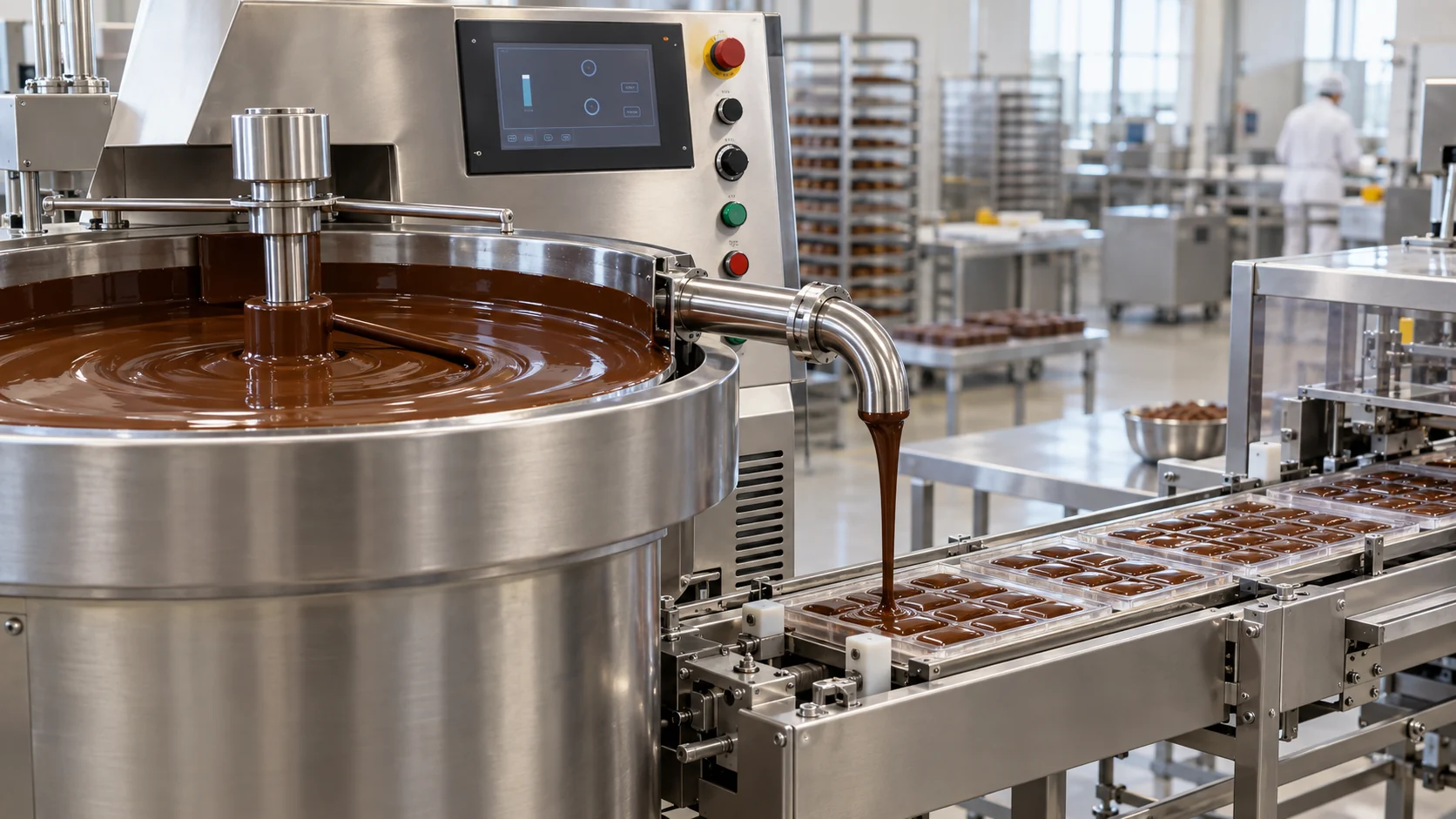
Beyond the Beep: A Technical Analysis of Metal Detection in Candy Production Lines
Introduction: Why Metal Detection Matters in Candy Manufacturing
In candy production lines, metal detection isn’t just a beep on the conveyor belt—it’s a core safeguard for food safety. Even the tiniest piece of stainless steel, broken blade, or loose screw can contaminate an entire batch of sweets, leading to recalls, financial loss, and damaged brand trust.
While hobbyists use detectors to find coins or jewelry, in the candy industry these machines act as the final line of defense between the factory and the consumer. Understanding how they work is crucial for quality managers, engineers, and food safety professionals.
This article goes beyond the basics. We’ll explore the physics behind metal detectors, the main detection technologies, and their specific role in modern candy production lines.
The Physics Behind Metal Detection in Food Lines
The Transmitter Coil: Creating a Magnetic Field
In candy production, products pass through a metal detector aperture. Inside, a transmitter coil generates an electromagnetic field.
Think of this as the “searchlight” sweeping through each chocolate bar, lollipop, or gummy pack.
Eddy Currents: The Contaminant’s Echo
When this field hits a metal contaminant—like a tiny blade fragment—eddy currents form within the particle.
These currents create their own secondary magnetic field, like ripples in water.
The Receiver Coil: Detecting the Disturbance
A receiver coil is finely tuned to pick up only these faint echoes, ignoring the main transmission field.
If metal is detected, the system instantly triggers a reject mechanism, removing the contaminated candy from the line.
This sequence—transmit, react, detect—happens in milliseconds, allowing candy factories to maintain high throughput without compromising safety.
Core Metal Detection Technologies
1. Very Low Frequency (VLF) Detection
Common in dry, low-moisture candies (e.g., hard candy, packaged chocolates).
Works by measuring phase shift cURL Too many subrequests.
cURL Too many subrequests.cURL Too many subrequests.
cURL Too many subrequests.cURL Too many subrequests.


cURL Too many subrequests.
cURL Too many subrequests. cURL Too many subrequests. cURL Too many subrequests..
cURL Too many subrequests.
cURL Too many subrequests.cURL Too many subrequests.
cURL Too many subrequests.cURL Too many subrequests.
cURL Too many subrequests.
| Merkmal | cURL Too many subrequests. | cURL Too many subrequests. |
|---|---|---|
| Am besten geeignet für | cURL Too many subrequests. | cURL Too many subrequests. |
| cURL Too many subrequests. | cURL Too many subrequests. | cURL Too many subrequests. |
| cURL Too many subrequests. | cURL Too many subrequests. | cURL Too many subrequests. |
| Kosten | cURL Too many subrequests. | cURL Too many subrequests. |
cURL Too many subrequests.
cURL Too many subrequests.
cURL Too many subrequests.cURL Too many subrequests.
LösungcURL Too many subrequests.
cURL Too many subrequests.
cURL Too many subrequests.cURL Too many subrequests.
LösungcURL Too many subrequests.
cURL Too many subrequests.
cURL Too many subrequests.cURL Too many subrequests.
LösungcURL Too many subrequests. cURL Too many subrequests. cURL Too many subrequests. cURL Too many subrequests.
cURL Too many subrequests.
cURL Too many subrequests. cURL Too many subrequests. a “coin vs. nail” (like hobby detectors) and more about distinguishing real metal contaminants vs. product interference.
High salt content in caramel or licorice can mimic a metallic signal.
Modern detectors apply algorithms to separate true contaminants from harmless conductivity effects.
Advanced Trends in Candy Production Line Metal Detection
Multi-Frequency Technology
Allows inspection at several frequencies simultaneously.
Ideal for mixed candy packs with different densities and moisture levels.
Integration with X-ray Systems
Many candy plants combine metal detection + X-ray inspection.
X-ray covers contaminants like glass, stones, dense plastic that metal detectors can’t find.
AI & Data Analytics
New systems use AI pattern recognition to reduce false positives.
Data logging helps factories comply with HACCP and FDA regulations.
Conclusion: Building Safer Candy Production with Detection Technology
Metal detectors in candy production are more than just machines that “beep.” They are precision instruments applying physics, electronics, and software intelligence to protect consumers.
By understanding VLF vs. PI, managing product effect, and integrating with X-ray and AI systems, candy manufacturers can ensure:
Stronger safety compliance
Fewer false rejects
👉 For candy producers, metal detection isn’t an afterthought—it’s the heartbeat of modern food safety.
- IEEE – Institute of Electrical and Electronics Engineers https://www.ieee.org/
- ASTM International – Security & Detection Standards https://www.astm.org/
- cURL Too many subrequests. https://www.iso.org/
- cURL Too many subrequests. https://www.nist.gov/
- FDA – U.S. Food and Drug Administration (Food Safety) https://www.fda.gov/
- SAE International – Electromagnetic Standards https://www.sae.org/
- Transportation Security Administration (TSA) https://www.tsa.gov/
- IEC – International Electrotechnical Commission https://www.iec.ch/
- cURL Too many subrequests. https://www.ansi.org/
- Smithsonian Institution (Archaeology & History) https://www.si.edu/
Verwandte Artikel
- Feuchtigkeitsdetektion: Wissenschafts- & Technologieleitfaden für Ingenieure 2025
- Wie Cookies Maker Technologie funktioniert: Ingenieurwesen hinter perfekten Keksen
- Kontaminationsdetektion: Kernprinzipien & Technologien für 2025
- Technologie-Leitfaden für Abfüllmaschinen 2025: Präzisionssysteme entschlüsselt
- Gummy Candy Production Line
- Lebensmittelverpackungsmaschine
- Skittles Herstellungsprozess: Einblick in die Fabrik