Halloween Gummies: Types, Flavors, and How They’re Made
Halloween gummies are fruit-flavored, gelatin-based candies molded into spooky shapes — ghosts, skulls, pumpkins, eyeballs, and bats — sold as seasonal treats and trick-or-treat handouts every October.
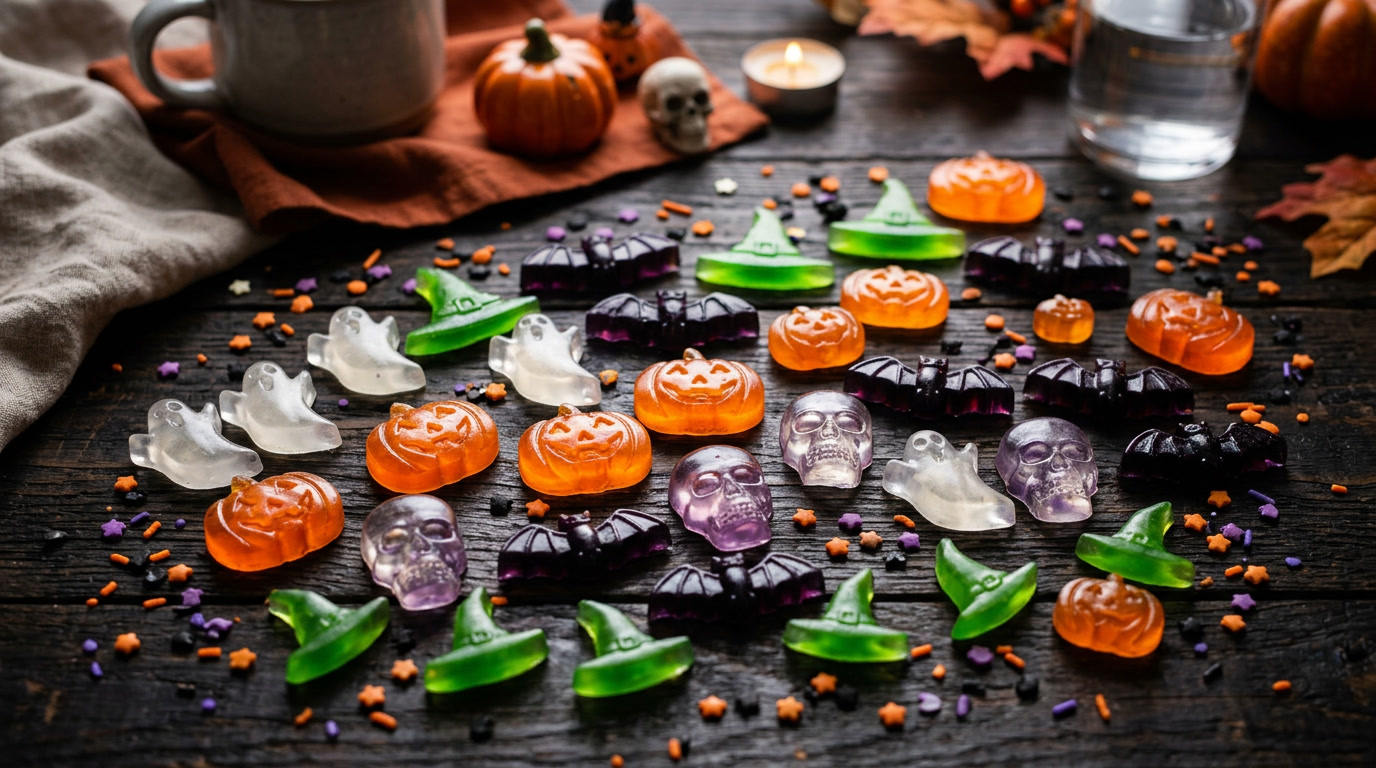
Every October, candy aisles transform. Regular bears and worms give way to neon eyeballs, translucent ghosts, and blood-orange skulls. **Halloween gummies** have grown from a niche novelty into a $3+ billion seasonal candy category. Yet most buying guides stop at brand names. This article goes deeper — covering how these candies are formulated, how shapes are engineered, which brands do what best, and how you can even make your own at home.
Whether you’re stocking a trick-or-treat bowl, planning a Halloween party, or simply curious what separates a good halloween gummy from a forgettable one, you’ll leave here with a clear picture.
What Are Halloween Gummies?
**Halloween gummies are gelatin-based confections flavored with fruit acids and natural or artificial colorings, produced in molds designed specifically for the October holiday season.**
Unlike the standard gummy bear or gummy worm that stays on shelves year-round, halloween gummies rotate in only for the 6–8 weeks around the holiday. Manufacturers retool mold sets, adjust color palettes toward dark purples, oranges, and blacks, and often push sour or cinnamon flavor profiles that skew toward an older audience.
Core Ingredients in Halloween Gummies
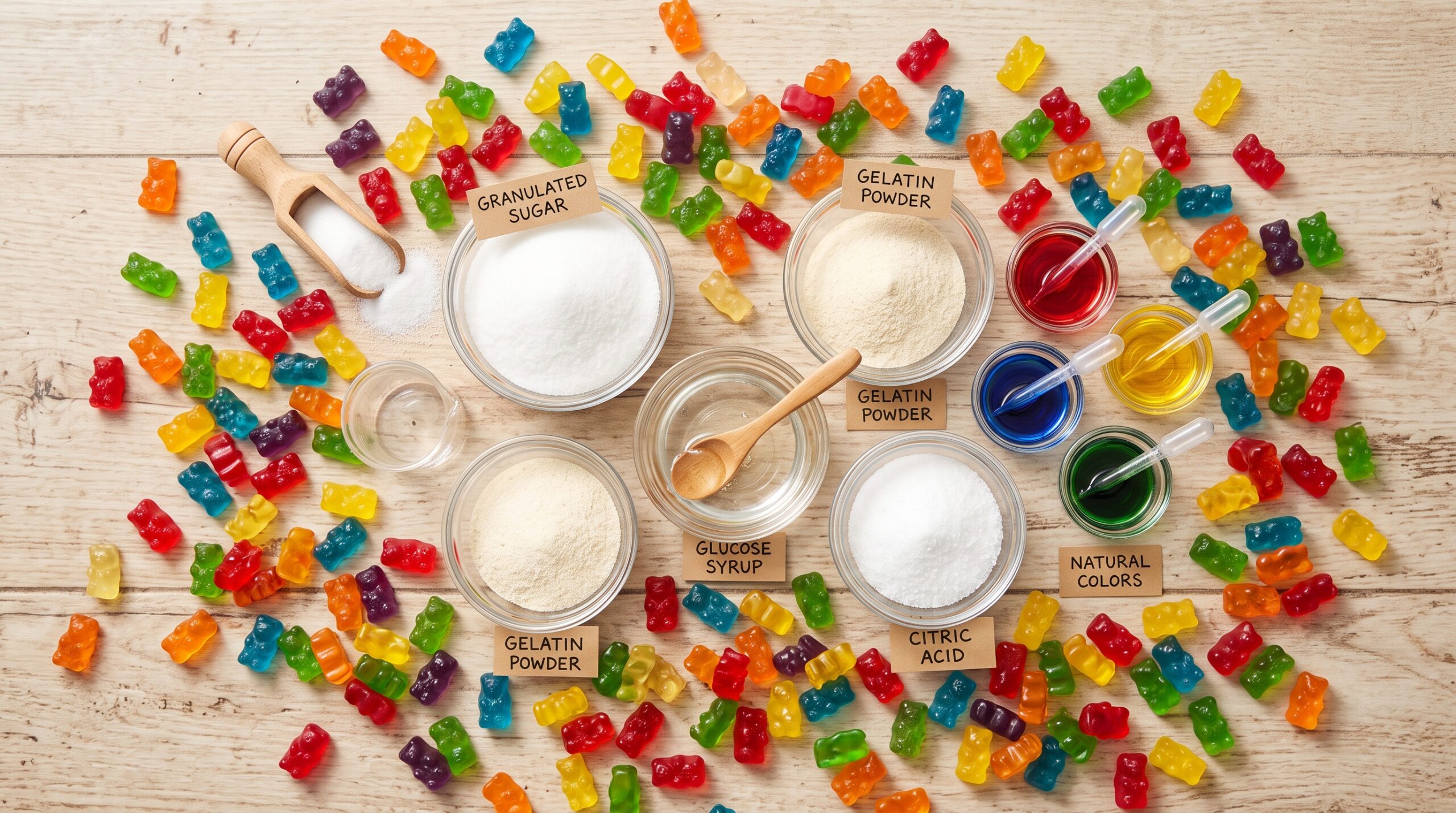
The base formula for nearly every halloween gummy on the market shares four categories of ingredients:
- Gelatin (or pectin for vegan versions) — provides the chew. Bloom strength (measured in grams) determines firmness. Most commercial gummies use 175–250 Bloom pork gelatin. Pectin, derived from fruit peels, produces a softer, less elastic bite. According to Wikipedia’s overview of gelatin chemistry, the protein’s triple-helix structure is what creates that distinctive snap-and-melt texture.
- Sweeteners — sucrose (table sugar) and glucose syrup form the syrup base. The glucose-to-sucrose ratio controls crystallization and shelf life. Too much sucrose and the candy blooms (white sugar coating forms); too much glucose and it stays sticky.
- Acidulants — citric acid and malic acid deliver the tart punch. Sour halloween gummies typically carry 2–3% citric acid by weight, which is notably more aggressive than standard gummies at around 0.8%.
- Colorings — FD&C synthetic dyes (Red 40, Yellow 5, Blue 1) or natural alternatives (black carrot, spirulina, turmeric) give halloween gummies their vivid, spooky palette. The FDA’s guidance on color additives clarifies that all approved synthetic dyes must be batch-certified before use in food products — a standard every major gummy brand complies with.
How Halloween Gummies Differ from Regular Gummies
Regular gummies prioritize flavor consistency and shelf stability for year-round distribution. Halloween gummies sacrifice some shelf life (they’re meant to sell out in 6–8 weeks) in exchange for:
- More complex mold geometries — a skull with hollow eye sockets is significantly harder to demolding cleanly than a simple bear shape. Manufacturers use silicone mold inserts at industrial scale to achieve this.
- Darker, more saturated colorings — black and deep purple require higher dye loads, which can affect flavor perception.
- Seasonal flavor profiles — watermelon, green apple, and black cherry replace the standard strawberry/orange/lemon trinity seen in year-round products.
| Feature | Year-Round Gummies | Halloween Gummies |
|---|---|---|
| Shape complexity | Low (bears, worms, rings) | High (skulls, eyeballs, bats) |
| Color palette | Bright primaries | Dark purples, oranges, blacks |
| Typical acidity | ~0.8% citric acid | 2–3% citric acid (sour variants) |
| Shelf window | 12–18 months | 6–8 weeks seasonal |
| Price per oz | $0.30–$0.60 | $0.50–$1.20 |
Types of Halloween Gummies
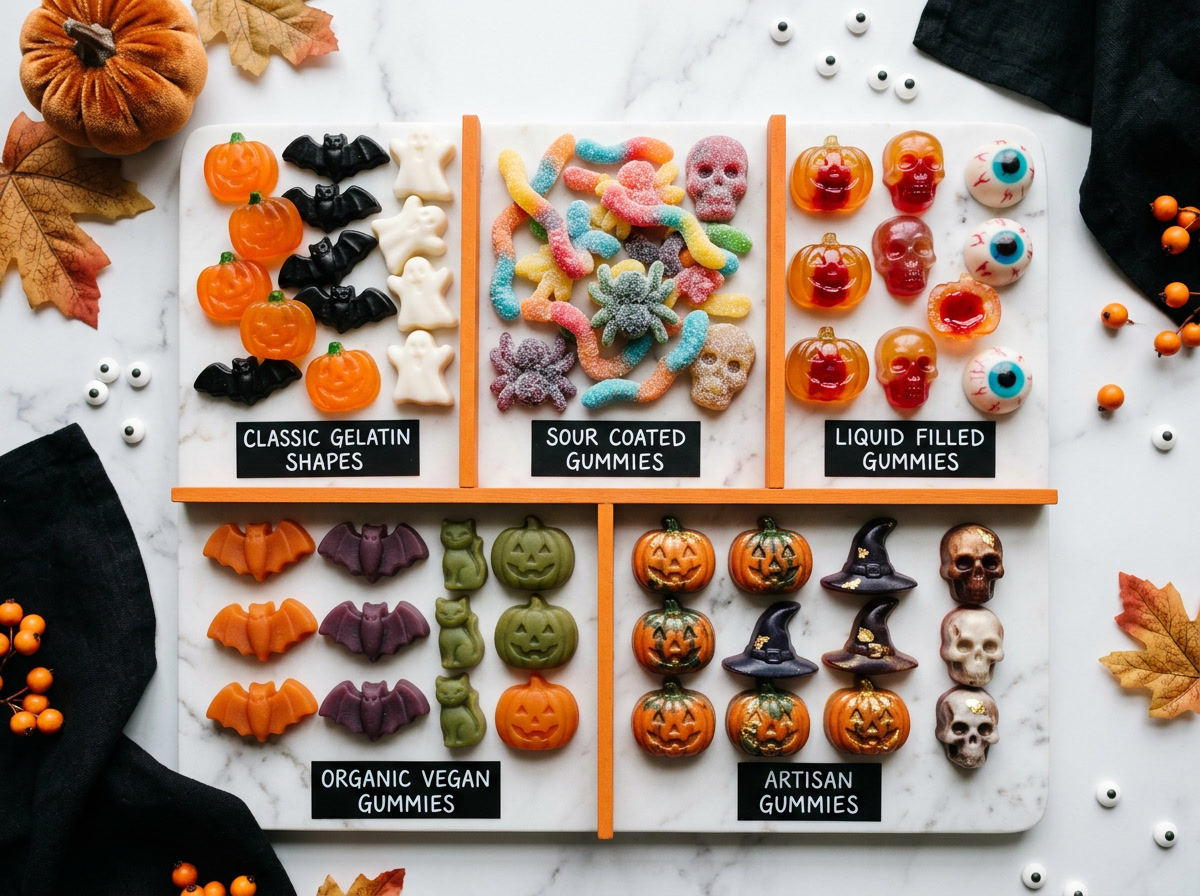
**The halloween gummy market splits into five distinct product formats: classic gelatin shapes, sour-coated, liquid-filled, organic/natural, and premium artisan varieties.**
Understanding these types helps whether you’re buying for a trick-or-treat bowl, a Halloween party spread, or deciding which category to produce if you’re in the confectionery industry.
Classic Molded Halloween Gummies
The most common format. Gelatin syrup is deposited into starch molds (or silicone molds in smaller-batch production) and allowed to set for 24–48 hours before demolding, oiling, and packaging.
**Popular shapes include:**
- Ghosts (often strawberry or peach flavored)
- Skulls (typically cherry or black cherry)
- Pumpkins (orange citrus or mango)
- Eyeballs (often strawberry with a gelatin “pupil” in the center)
- Bats (grape or blueberry)
- Worms and brains (green apple or watermelon)
Brands like **Haribo**, **Black Forest**, and **Trolli** dominate this segment. Haribo’s seasonal Halloween lineup — sold in the US since the late 1990s — remains the benchmark for mold detail and texture consistency.
Sour Halloween Gummies
A sour sugar coating (citric acid mixed with fine sugar) is tumbled over the finished gummies. The result: a sharp acidic hit on contact that softens as the candy dissolves.
Sour halloween gummies have captured significant market share among teens and adults who find classic gummies too mild. Trolli’s Sour Brite Crawlers Halloween edition and Warheads’ seasonal offerings lead this segment.
**The sensory science:** Sourness from citric acid interacts with TRPA1 receptors in the mouth, which creates the “sour face” reflex. The contrast between that sharp opening and the sweet gelatin body is what makes sour gummies compelling rather than just unpleasant.
Liquid-Filled Halloween Gummies
A more recent innovation. The gummy shell encases a liquid or semi-liquid center — typically a fruit juice concentrate or a sweetened syrup. Manufacturing these requires co-extrusion equipment (a tube-within-a-tube die head) rather than traditional starch molding.
The filling ratio matters: too much liquid and the shell breaks during packaging; too little and the liquid center isn’t perceptible to the consumer. Commercial liquid-filled halloween gummies typically run at 15–20% fill by weight.
Fini Candies’ eyeball-themed liquid-filled gummies and several private-label items from Halloween party packs fall into this category.
Organic and Natural Halloween Gummies
Consumer demand for cleaner ingredient lists has pushed multiple brands into natural halloween gummies. These substitute:
- Pork gelatin → pectin (making them vegetarian/vegan)
- Synthetic dyes → fruit and vegetable concentrates
- High-fructose corn syrup → cane sugar or brown rice syrup
Annie’s Organic, YumEarth, and SmartSweets all produce Halloween-season runs. The trade-off is texture: pectin gummies have a shorter chew and dissolve faster, which some consumers prefer and others find less satisfying.
Premium and Artisan Halloween Gummies
At the top end sits small-batch artisan production — brands like Sugarfina create halloween gummies using natural fruit flavors, real juice concentrates, and hand-decorated packaging. These are positioned as gifts rather than trick-or-treat candy. Price points reflect this: $8–$15 for a 3–4 oz bag versus $1.50 for a mass-market 6 oz bag.
| Category | Price/oz | Key Brands | Target Buyer |
|---|---|---|---|
| Classic molded | $0.30–$0.55 | Haribo, Black Forest, Trolli | Trick-or-treat bulk buyers |
| Sour coated | $0.40–$0.65 | Trolli Sour Brite, Warheads | Teens, party hosts |
| Liquid-filled | $0.55–$0.85 | Fini, private label | Novelty seekers |
| Organic/natural | $0.70–$1.10 | Annie’s, YumEarth | Health-conscious parents |
| Premium artisan | $1.50–$3.00 | Sugarfina, specialty shops | Gift givers |
How Halloween Gummies Are Made
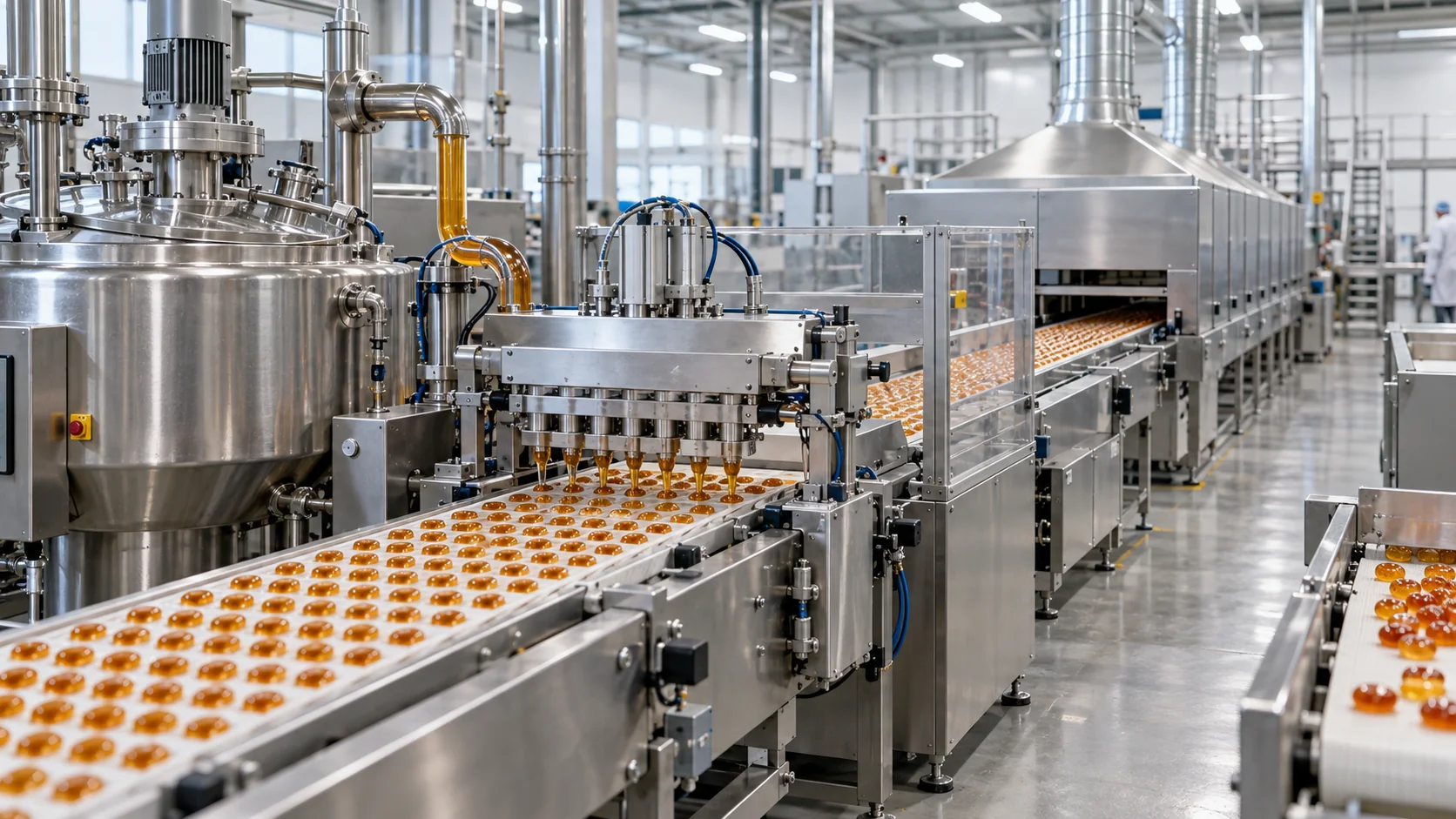
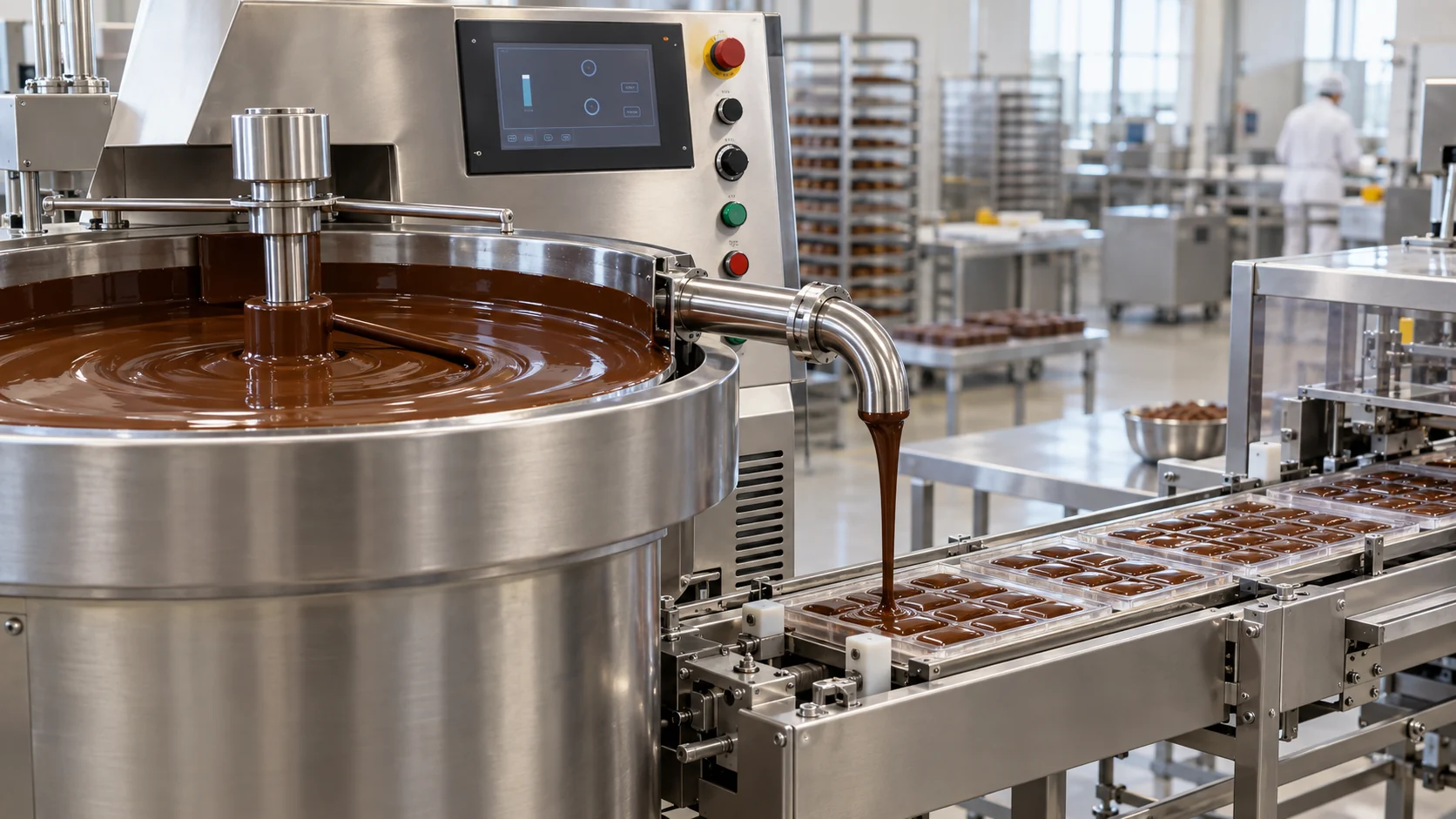
**Halloween gummies are produced on continuous depositing lines: hot gelatin syrup is formulated, colored, flavored, then deposited into starch or silicone molds, cooled, demolded, and tumbled with oil or sour sugar before packaging.**
The manufacturing process scales from small artisan batches (100 kg/day) to industrial confectionery lines running 1,000–3,000 kg/hour. Understanding the process reveals why shape accuracy, texture, and flavor consistency vary so widely between brands.
Step 1: Gelatin Hydration and Cooking
Dry gelatin granules are soaked in cold water (the “bloom” stage) for 30–60 minutes, then dissolved with heat (around 60–70°C). Simultaneously, a sugar-glucose syrup is cooked to 106–110°C in a separate vessel. The two streams are combined in a mixer along with acidulants, flavorings, and colorings.
This master batch is then split into individual color streams if the product requires multi-colored gummies (e.g., a ghost that’s white on top and orange at the base). Temperature control throughout is critical: too hot and the gelatin degrades; too cool and the syrup won’t flow properly through the depositing nozzles.
Step 2: Depositing Into Molds
For starch molding (the dominant industrial method), impressions are stamped into corn starch trays using a “mogul” machine fitted with the specific shape tools — in this case, skulls, ghosts, pumpkins, or whichever halloween shapes are in production. The syrup is then deposited precisely into each cavity.
For silicone molds (common in artisan and mid-scale production), pre-formed molds are placed on conveyor trays and the syrup is deposited by nozzle arrays.
This is where shape complexity becomes a production constraint. A simple bear shape has minimal undercuts and releases cleanly. A detailed skull with hollow eye sockets or a pumpkin with carved facial lines requires molds with precise parting lines or flexible silicone that can be peeled away without tearing the gummy. **Industrial halloween gummy production typically requires 15–25% longer demolding dwell times compared to standard shapes** due to this increased geometry complexity.
Step 3: Setting and Demolding
Starch-molded trays move through a climate-controlled drying room (18–22°C, 30–40% relative humidity) for 24–48 hours. Moisture migrates out of the gummy and into the starch, firming the product to final texture. The starch is then separated by shaking, recovered, and recycled.
Silicone molds are demolded manually or by automated rollers that flex the mold to pop the finished gummies free.
Step 4: Finishing and Coating
Demolded gummies enter a rotating drum where they receive one of two finishes:
- Oil polish — a light food-grade oil (often carnauba or sunflower) coats each piece to prevent sticking and give the characteristic sheen.
- Sour sugar tumbling — citric acid and fine sugar are added to the drum instead. The acid coats the exterior while the sugar provides bulk.
Step 5: Packaging
Most halloween gummies are packaged in either individually wrapped 1–2 oz trick-or-treat portions or in bulk bags of 8–36 oz for home bowls and party use. Nitrogen flushing of sealed bags extends shelf life by displacing oxygen. Modified atmosphere packaging (MAP) allows for 12–18 month ambient shelf life even for sour-coated products.
The machinery behind this — from depositing systems to cooling tunnels to starch moguls — is the same class of equipment used by confectionery manufacturers worldwide. For operations looking to set up or upgrade gummy candy production lines, the depositing system and mold set selection are the two highest-ROI decisions in the capital plan.
Top Halloween Gummy Brands Compared
**Haribo leads on texture and mold fidelity; Trolli leads on sourness intensity; Albanese leads on flavor variety and bulk value; artisan brands like Sugarfina win on gifting experience.**
Here’s how the major players actually stack up beyond marketing copy:
Haribo
Germany-based Haribo, the inventor of the gummy bear (1922), releases US-market Halloween packs featuring ghosts, skulls, and pumpkin shapes. Their gelatin formulation produces a notably firmer chew than most US competitors — a result of higher gelatin bloom strength and lower moisture content. Mold detail is excellent. Flavors are conservative (strawberry, raspberry, orange) but reliably consistent batch to batch.
**Best for:** Households that want a classic, reliable halloween gummy with strong brand recognition.
Trolli
Trolli’s halloween lineup leans sour and novelty-forward. Their Sour Brite Crawlers Halloween edition and eyeball-themed products consistently rank highest with teen buyers. The sour coating is more aggressive than most competitors — genuinely lip-puckering at 3%+ citric acid load.
**Best for:** Halloween parties and teen/adult candy bowls.
Albanese Candy
Indiana-based Albanese positions on flavor variety and bulk value. Their halloween assortments include 12+ distinct flavor variants (mango, passion fruit, black cherry alongside standard fruits) and are available in multi-pound bulk bags that undercut competitors on price per ounce. Texture is slightly softer than Haribo but preferred by younger children.
According to the [National Confectioners Association](https://www.candyusa.com/), seasonal Halloween candy represents over 8% of annual US candy sales — a stat that underscores why regional brands like Albanese invest heavily in expanding their Halloween SKU count each year.
**Best for:** Bulk trick-or-treat bags, classroom parties, cost-conscious buyers.
Trader Joe’s
Trader Joe’s releases a limited Halloween gummy assortment every September, typically at $3.99–$4.99 for a 10–12 oz bag. The formulation uses cleaner ingredient lists than most mass-market brands (no artificial dyes in recent years). Availability is strictly limited to store inventory — once sold out, they’re gone until next year, which creates genuine scarcity demand.
**Best for:** Buyers who prioritize cleaner ingredients and don’t mind hunting for stock.
SmartSweets and YumEarth (Better-For-You Segment)
Both brands produce Halloween runs with dramatically reduced sugar content. SmartSweets uses stevia and chicory root fiber; YumEarth uses organic sweeteners and natural dyes. Neither matches the texture of gelatin-and-sucrose originals, but for households managing sugar intake or buying for children with dye sensitivities, these are the only serious options.
| Brand | Texture | Sourness | Flavor Variety | Price ($/oz) | Best For |
|---|---|---|---|---|---|
| Haribo | Firm | Low | Standard (4–5) | $0.45 | Classic quality |
| Trolli | Medium | High | Standard + novelty | $0.50 | Teens, party |
| Albanese | Soft-medium | Low-medium | Wide (12+) | $0.32 | Bulk/value |
| Trader Joe’s | Medium | Low | Limited | $0.40 | Cleaner ingredients |
| SmartSweets | Soft | Medium | Limited | $0.95 | Low-sugar households |
| Sugarfina | Firm | Low | Curated | $2.10 | Gifting |
How to Make Homemade Halloween Gummies
**To make homemade halloween gummies, combine unflavored gelatin with fruit juice and sweetener, pour into spooky silicone molds, refrigerate for 2 hours, and unmold — total active time under 30 minutes.**
Making halloween gummies at home has three real advantages over buying: you control every ingredient, you can achieve shapes and flavor combinations that aren’t commercially available, and it’s significantly cheaper per piece at scale (relevant for large Halloween parties).
Basic Recipe
**Yield:** approximately 60–80 standard halloween gummies (depending on mold size)
**Ingredients:**
- 120ml cold fruit juice (cherry, orange, grape, or apple work well)
- 3 tablespoons (21g) unflavored gelatin powder (like Knox)
- 2 tablespoons honey or agave (adjust to taste)
- 1 teaspoon citric acid (for sour finish — optional)
- 1–2 drops food coloring (black, orange, or purple for halloween palette)
**Process:**
- Pour cold juice into a small saucepan. Sprinkle gelatin evenly over the surface. Let bloom 5 minutes.
- Warm over low heat, stirring, until gelatin fully dissolves (~60°C). Do not boil.
- Remove from heat. Stir in sweetener, citric acid (if using), and coloring.
- Transfer to a squeeze bottle or small pitcher with a spout for controlled pouring.
- Fill silicone molds (available in skull, ghost, pumpkin, bat shapes online and at craft stores).
- Refrigerate uncovered for 2 hours. Gummies should be firm and slightly tacky.
- Unmold by flexing the silicone. Dust with sour sugar if desired.
**Storage:** 7–10 days refrigerated in an airtight container. Not recommended for ambient storage beyond 2–3 days at room temperature due to high moisture content.
Choosing the Right Molds
Silicone molds with halloween shapes are widely available online. A few practical notes:
- Molds with fine interior detail (carved pumpkin faces, skull teeth) require slower pouring and sometimes a toothpick to push syrup into narrow cavities before it sets.
- Shallower molds (< 12mm depth) produce gummies that unmold more cleanly but are thinner and more fragile.
- For large batches, multi-cavity molds (48–96 cavities per sheet) are more efficient than single-shape novelty molds.
Vegan Homemade Halloween Gummies
Replace gelatin with **agar-agar** or **pectin**:
- Agar-agar: Use 1.5 teaspoons per 240ml liquid. Note that agar sets firm and brittle rather than chewy — the finished product is more like a firm jelly. Still pleasant, but texturally different from commercial gummies.
- Pectin: Use 2 tablespoons liquid pectin per 240ml. Produces a softer, shorter bite closer to commercial vegan gummies. Requires the addition of calcium water (sold with most liquid pectin products) for proper set.
According to [USDA FoodData Central](https://fdc.nal.usda.gov/fdc-app.html#/?query=gummy+candy), a standard 40g serving of commercial gummy candy contains approximately 130 calories and 28g of sugar. Homemade versions made with juice and honey rather than glucose syrup typically run 15–20% lower on sugar per gram — a meaningful difference if you’re serving children.
Are Halloween Gummies Healthy?
**Halloween gummies are high in added sugar (typically 20–28g per serving), low in fiber and protein, and contain synthetic colorings in most mass-market products — they should be treated as occasional treats rather than everyday snacks.**
This isn’t a reason to avoid them entirely — seasonal sweets are part of cultural traditions — but understanding the nutritional profile helps set realistic expectations.
Sugar Content and Portion Reality
A standard trick-or-treat fun-size pack of halloween gummies (approximately 25–30g) contains 17–22g of sugar. The [American Heart Association’s guidelines](https://www.heart.org/en/healthy-living/healthy-eating/eat-smart/sugar/added-sugars) recommend no more than 25g of added sugar per day for children — meaning a few halloween gummies can use up most of a child’s daily sugar allowance. For adults the limit is 36g, which provides more room.
The “fun-size” format creates a portion illusion. Eating three or four fun-size packs — common on Halloween night — delivers 50–80g of sugar, roughly equivalent to a large soda.
Food Colorings and Allergens
Most mass-market halloween gummies use FD&C synthetic dyes. While all approved dyes in the US are FDA-certified as safe at normal consumption levels, some studies have explored links between artificial food dyes and hyperactivity in children sensitive to these compounds. The research remains contested — a [2012 systematic review published by researchers at the Harvard School of Public Health](https://www.ncbi.nlm.nih.gov/pmc/articles/PMC3441937/) found effects were most pronounced in children already diagnosed with ADHD.
For households with dye-sensitive children, the natural-dye alternatives (Annie’s, YumEarth, Trader Joe’s recent formulations) provide a practical workaround.
**Common allergens to check on halloween gummy labels:**
- Gelatin (pork-derived) — not an allergen but a dietary restriction for vegetarians, vegans, and certain religious dietary laws
- Wheat starch (used in some budget formulations as a gelling aid)
- Tree nuts (cross-contamination risk in multi-product confectionery facilities)
- Soy (soy lecithin used in some liquid-filled varieties)
Better-For-You Modifications
If you want halloween gummies with a better nutritional profile:
- Choose pectin-based over gelatin-based — adds minimal fiber and suits broader dietary restrictions.
- Choose sour over sweet — higher acid content means less sugar needed for flavor balance.
- Portion by piece count, not bag — counting pieces instead of weighing grams is more practical for children.
- Make homemade with real juice — you get some vitamin C and polyphenols from the fruit, unlike the flavored water used in commercial formulas.
FAQ
**How much are Trader Joe’s Halloween gummies?** Trader Joe’s Halloween gummies typically retail at $3.99–$4.99 for a 10–12 oz bag. They are a limited seasonal item available only in-store (no online shipping), usually from early September through Halloween. Stock varies by location and sells out quickly.
**What are the most popular Halloween gummies?** Haribo’s Halloween packs, Trolli Sour Brite Halloween Crawlers, and Albanese’s Halloween assortments consistently rank as top sellers. Haribo wins on brand recognition, Trolli on sour intensity, and Albanese on bulk value. Trader Joe’s Halloween gummies generate strong cult demand but limited availability constrains their reach.
**Can you make halloween gummies ahead of time?** Yes. Homemade halloween gummies keep 7–10 days refrigerated in an airtight container. For parties, make them 1–3 days in advance. Beyond 3 days at room temperature they can develop surface condensation and stickiness. Commercial halloween gummies have 12–18 month shelf lives due to lower moisture content and packaging.
**What makes halloween gummies sour?** The sour coating on sour halloween gummies is a mixture of citric acid and fine sugar tumbled onto the finished candy. Citric acid (and sometimes malic acid) activates TRPA1 taste receptors in the mouth, creating the sour perception. Higher acid concentration = more sour. Trolli and Warheads use the highest citric acid loads among major brands.
**Are halloween gummies vegan?** Most are not — the majority use pork-derived gelatin. Vegan halloween gummies use pectin or agar-agar instead. Brands confirmed vegan: YumEarth, SmartSweets, Annie’s Organic, Surf Sweets, and Squish Candies. Always check the label as formulations change.
**What is the most unhealthy Halloween candy?** Among common Halloween treats, gummy candy and milk chocolate with nougat or caramel deliver the highest combined sugar and fat loads. Gummies are purely sugar-acid-gelatin systems — little redeeming nutritional value. Reese’s Peanut Butter Cups add fat and protein but also more total calories. Pure sugar candies like Pixy Stix or SweeTarts are highest in sugar density by weight.
**How are halloween gummies shaped like skulls and ghosts?** The shapes come from mold tooling — either starch impressions in an industrial mogul machine or silicone molds in smaller-scale production. Hot gummy syrup is deposited into the cavities and allowed to set before demolding. Complex shapes with undercuts (hollow eye sockets, carved mouths) require flexible silicone molds that can be peeled away, rather than rigid starch molds that would trap the candy. Industrial confectionery equipment manufacturers design these depositing systems specifically to handle the seasonal mold changeovers that halloween production requires.
Conclusion
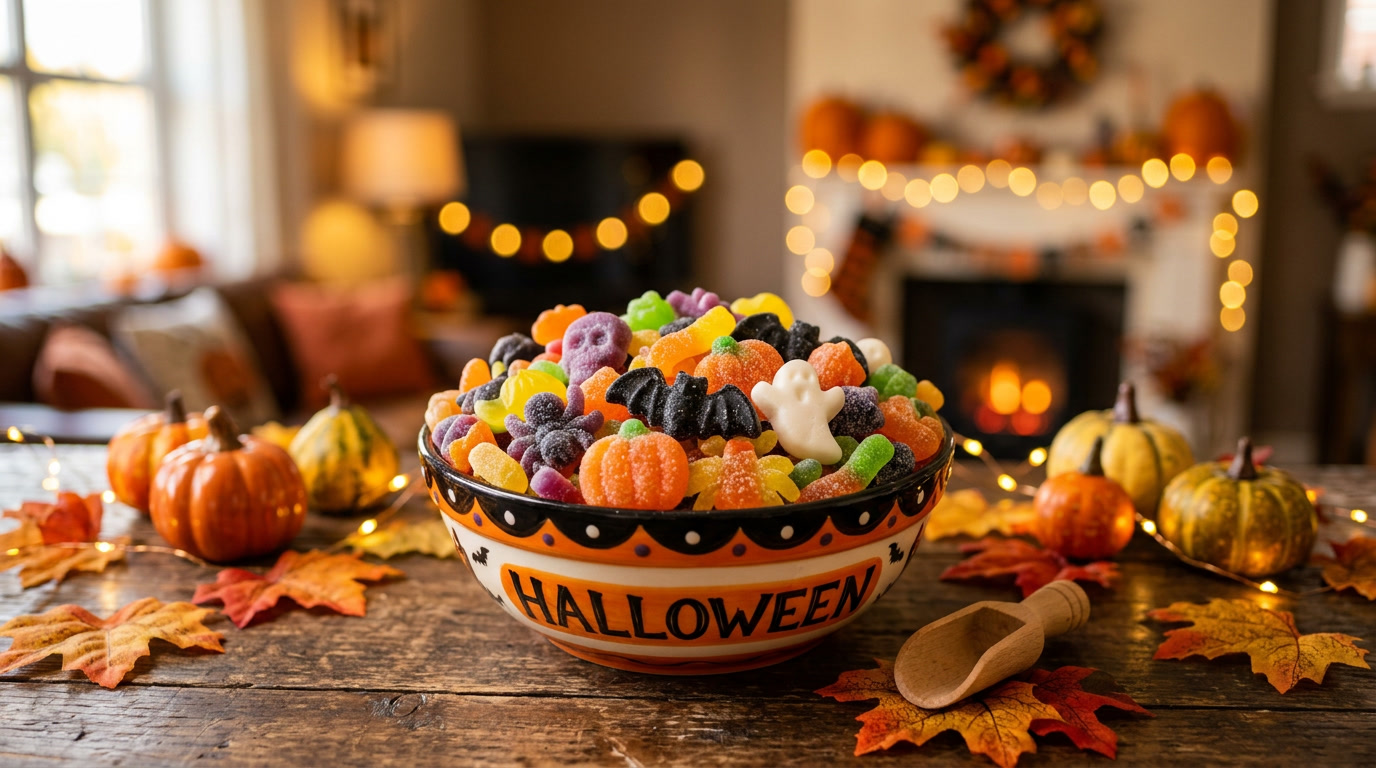
**Halloween gummies** have evolved into one of the most diverse subcategories in seasonal candy. From Haribo’s firm, mold-detailed classics to SmartSweets’ low-sugar alternatives, and from Trolli’s aggressively sour coatings to Sugarfina’s artisan gifting boxes — there’s a variant suited to nearly every buyer preference and occasion.
What unites all of them is the underlying confectionery chemistry: gelatin or pectin sets the texture, sugar and glucose syrup build the body, citric acid drives the flavor, and precision molding tools create the spooky shapes that define the holiday aesthetic. Understanding that process — whether you’re choosing a brand at the grocery store, making a batch at home, or evaluating equipment for a confectionery production line — makes every halloween gummy decision clearer.
If you’re ready to stock up for October, start with Albanese for bulk value, Haribo for quality classics, and Trolli for sour variety. For health-conscious households, YumEarth or Trader Joe’s (when available) are the cleanest options. And if you want full control over ingredients and shapes, a home batch takes under 30 minutes of active work and costs less than half the retail price per piece.
Related Articles
- Soft Candy: Types, Textures, and How They’re Made (2026 Guide)
- Gummy Bear Flavors: The Complete Brand-by-Brand Guide (Plus How They Are Made)
- Coca Cola Gummies: The Complete Guide to Flavors, Ingredients & Production
- Science Behind Cola Gummies: How They’re Made & Engineered
- Gummy Candy Production Line
- Starch-Free Gummy Depositing Machine
- Are Skittles Gluten Free? Complete Guide 2026