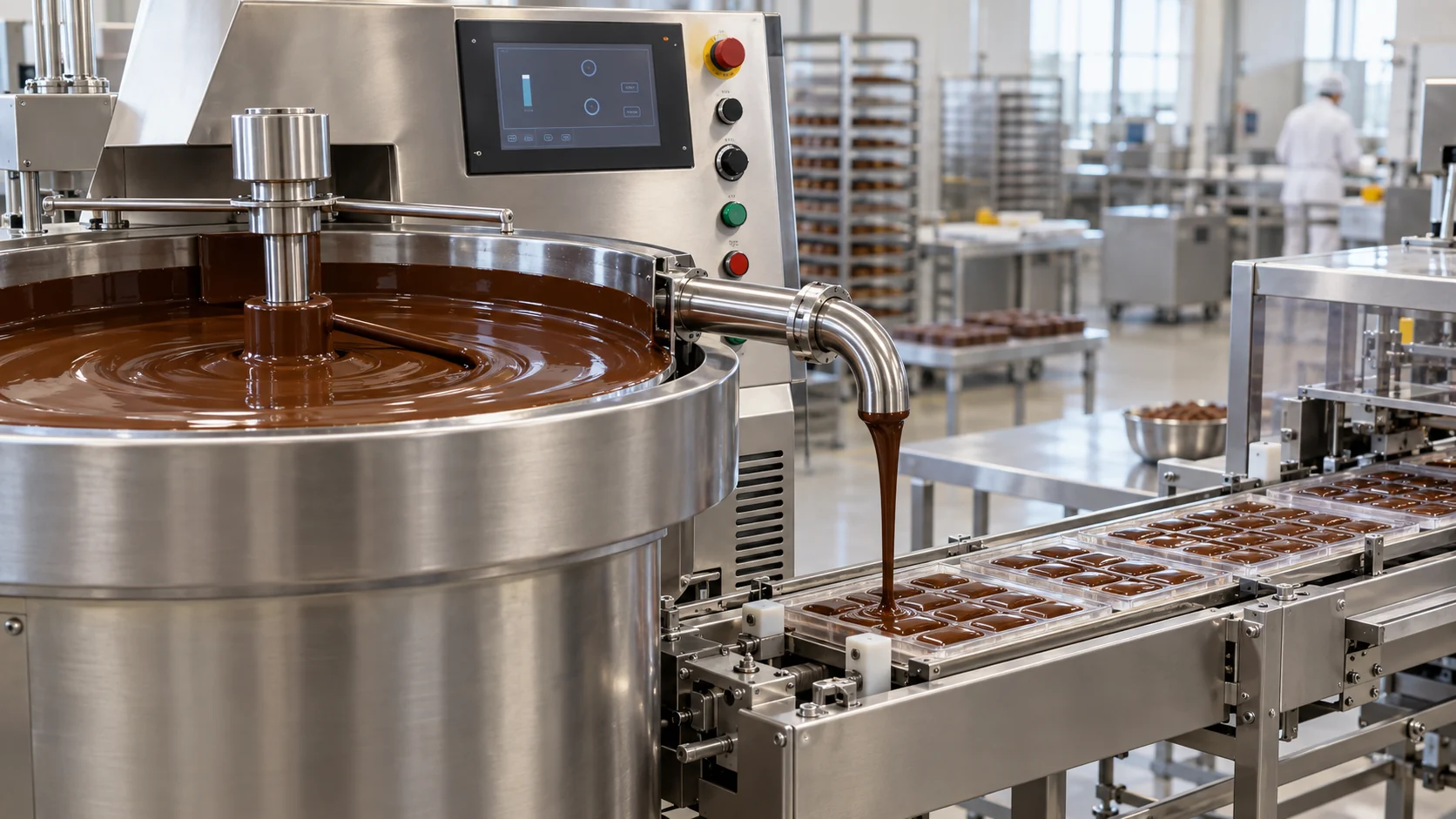
Japanese gummies are precision-crafted chewy candies made by brands like Kasugai, Meiji, and UHA Mikakuto, prized worldwide for intense natural fruit flavors, smooth elastic texture, and sophisticated manufacturing processes.
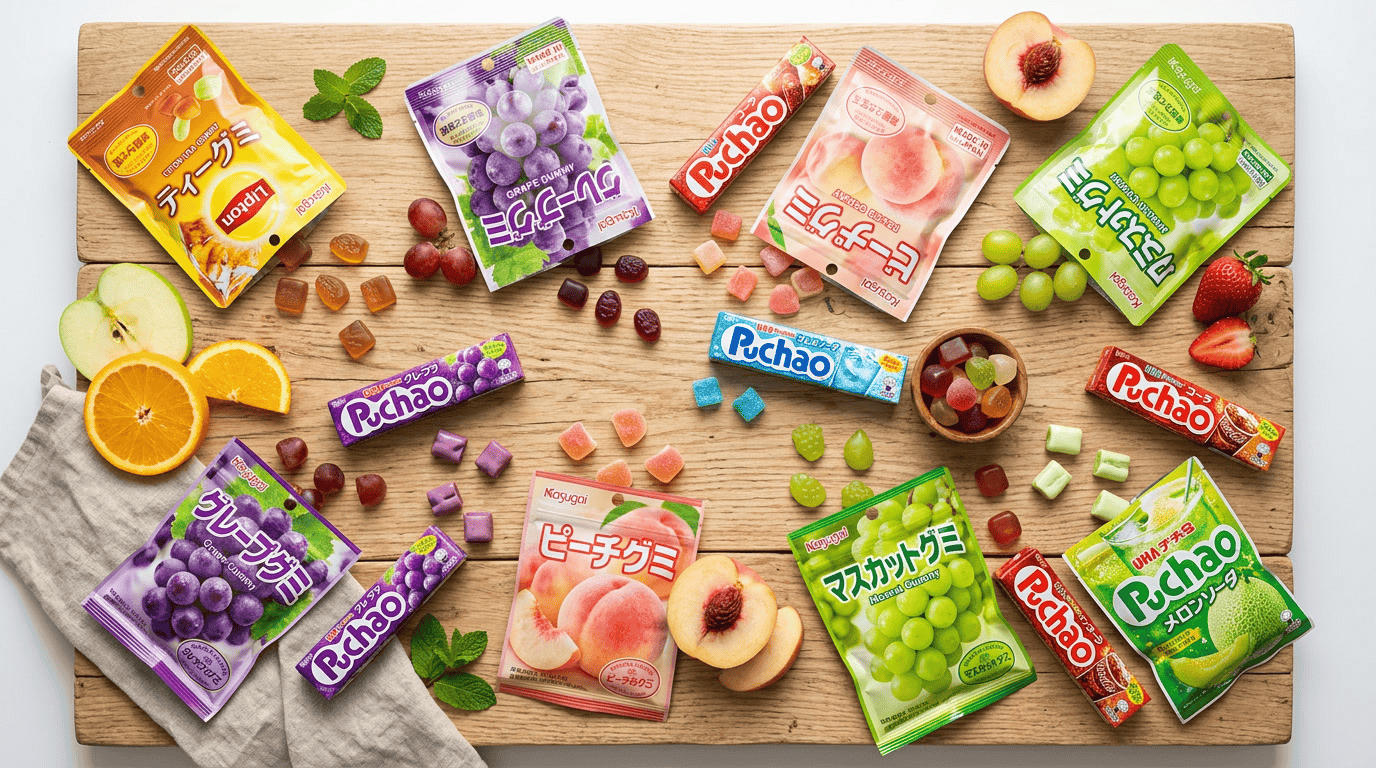
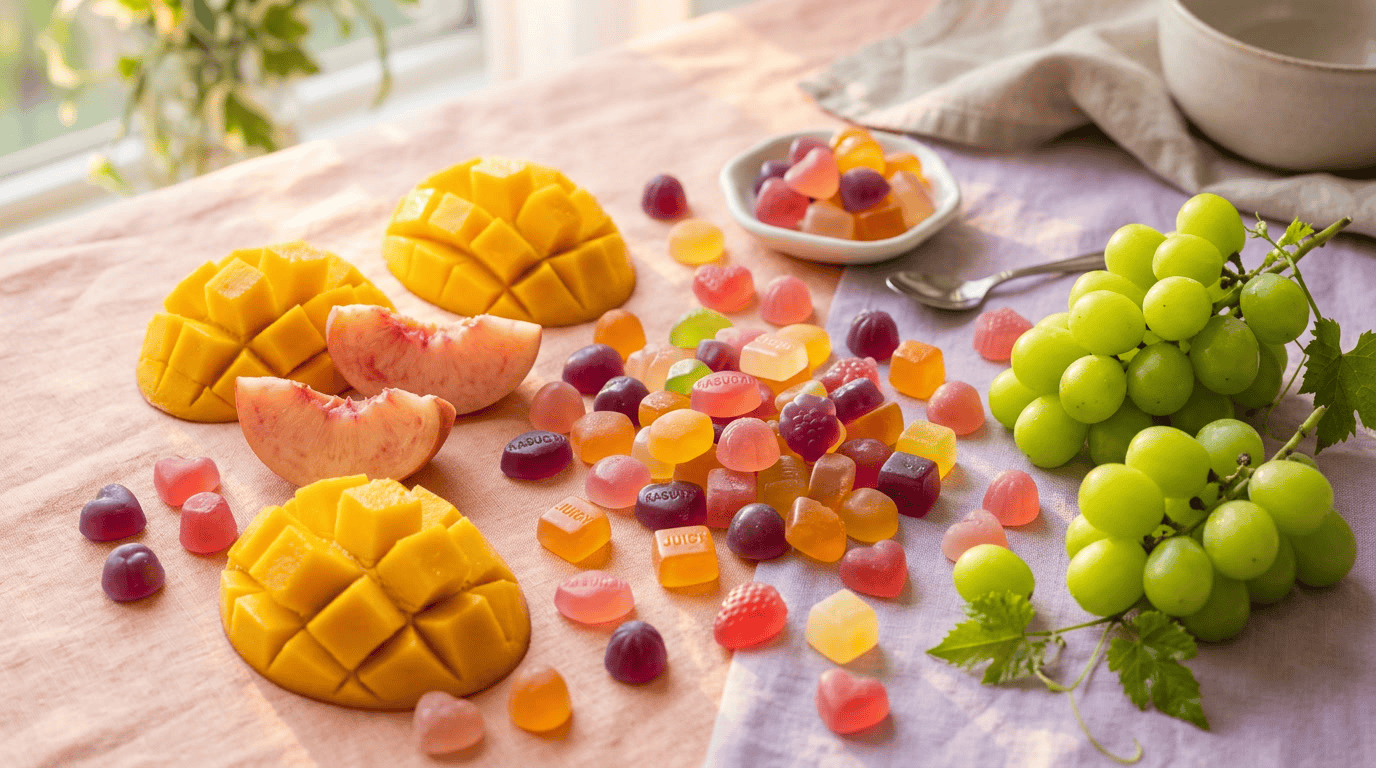
Walk into any convenience store in Tokyo or Osaka and you’ll face a wall of gummy candy that stops you cold. Not because of the packaging — though that’s stunning — but because of what’s inside: gummies that actually taste like the fruit on the label. Grape gummies that smell like real Kyoho grapes. Peach gummies so fragrant you’d swear the fruit was crushed five minutes ago. Mango gummies with a smooth, yielding bite that Western brands have never quite matched.
Japanese gummies have earned a worldwide following for good reason. This guide covers everything from the history and top brands to the manufacturing science behind that famous texture — and what the booming export market means for buyers and businesses alike.
What Are Japanese Gummies?
Japanese gummies are chewy, gelatin-based confections produced in Japan, distinguished by their unusually intense fruit flavor concentration, precise texture engineering, and use of natural juice in formulation. Unlike mass-market Western gummies, Japanese manufacturers typically use real fruit juice or puree — not just artificial flavoring — as a primary ingredient.
The category encompasses dozens of product lines and hundreds of SKUs, from the classic fruit shapes of Kasugai to the fizzy, multi-textured Puchao from UHA Mikakuto. What unites them is an obsessive attention to mouthfeel: the gelatin-to-pectin ratio, the sugar crystallization profile, and the moisture content are dialed in far more tightly than in comparable Western products.
A Brief History of Japanese Gummy Candy
The story of japanese gummies starts with an unlikely import. According to Wikipedia’s history of gummy candy, German confectioner Hans Riegel invented the first gummy bear in 1922 under the Haribo brand. Haribo’s gummies arrived in Japan in the late 1970s, but Japanese candy makers didn’t simply copy them. They adapted the formula to local palates — reducing the sugar intensity, adding more fruit character, and softening the bite.
Kasugai launched its iconic fruit gummy line in 1981. Within a decade, Japanese consumers were buying gummies at a rate that surprised even the manufacturers. By the 1990s, domestic brands had overtaken imported European gummies in market share. The 2000s saw the category explode internationally as Japanese snacks became globally desirable through anime culture, travel, and online retail.
What Sets Japanese Gummies Apart from Western Gummies
The difference is real, measurable, and rooted in formulation. Three key factors drive it:
1. Fruit juice content. Premium japanese gummies use 5–30% real fruit juice. Western commodity gummies often use fruit “flavoring” (artificial compounds) with zero juice. The Maillard reactions during heat treatment of real juice create aroma compounds you simply cannot replicate synthetically.
2. Gelatin grade. Japanese manufacturers source pharmaceutical-grade gelatin with a Bloom strength of 200–250, producing a smooth, elastic bite. Lower-Bloom gelatin (common in budget Western gummies) gives a grainy, crumbly texture. Many Japanese brands now blend gelatin with pectin to produce a softer “melt” at body temperature.
3. Moisture engineering. Japanese gummies are typically formulated to a water activity (Aw) of 0.60–0.65, higher than the 0.50–0.55 typical of Western shelf-stable gummies. This keeps the texture supple without requiring refrigeration, but demands tighter humidity control during production.
| Feature | Japanese Gummies | Western Gummies (typical) |
|---|---|---|
| Fruit juice content | 5–30% real juice | 0–5% (mostly flavoring) |
| Gelatin Bloom strength | 200–250 | 150–200 |
| Water activity (Aw) | 0.60–0.65 | 0.50–0.55 |
| Texture profile | Smooth, elastic, slight resistance | Firm, sometimes grainy |
| Primary flavor sources | Real juice + aroma compounds | Artificial flavors |
| Typical SKU count (major brand) | 30–80 | 5–20 |
Top Japanese Gummy Brands and Products
Japanese gummies span a wide range of formats, price points, and flavor concepts. Here are the brands that defined the category — and what makes each one worth knowing.
Kasugai — The Gold Standard
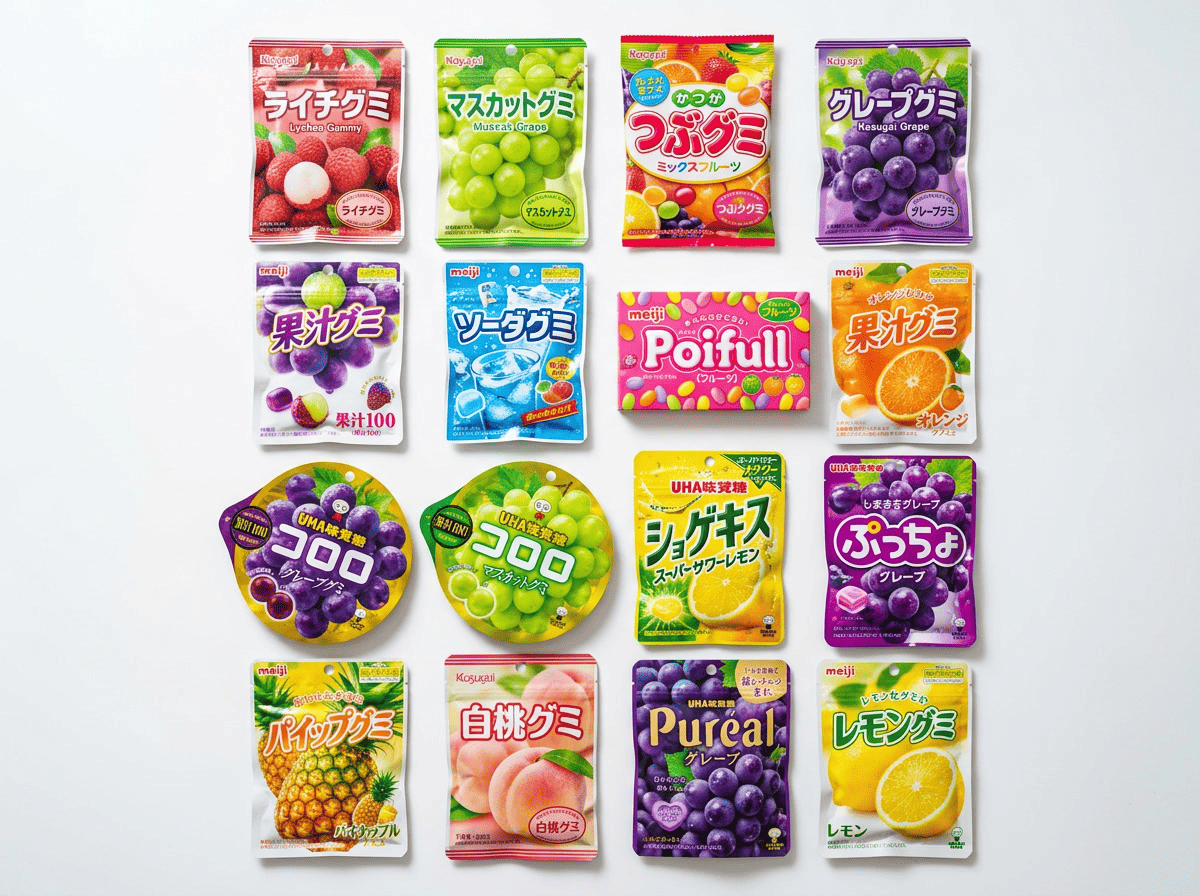
Kasugai Seika has made japanese gummies since 1981. Their muscat, lychee, peach, and mango varieties are benchmarks for fruit authenticity. The muscat gummy uses juice from Nagano Prefecture Kyoho grapes and has a fragrance that genuinely evokes fresh-picked fruit.
What sets Kasugai apart technically: they use a dual-layer forming process that encases a slightly softer center within a slightly firmer outer shell, creating the characteristic “resistance then give” bite their fans describe. The bags are individually sealed for freshness — a detail that signals their seriousness about shelf life.
UHA Mikakuto and Puchao
Puchao is the innovation leader. Each piece contains embedded gummy bits inside a chewy candy shell — essentially two textures in one. The carbonated cola and ramune varieties add a third: effervescence that builds as you chew. This multi-sensory complexity is deliberate and difficult to manufacture; the gummy insert must be formulated to survive the co-extrusion process without losing its bite.
UHA also produces the Mi Gummy and Kororo lines. Kororo deserves special mention: each piece resembles a peeled grape, with a juice-filled center that bursts when bitten. The skin is a thin, meltable pectin layer. This construction requires forming machinery with tolerances under 0.1 mm.
Meiji, Nobel, and Bourbon
Meiji produces the Fruits Gummy line, notable for its collagen content — each bag contains 1,000 mg of low-molecular-weight collagen peptides. This “beauty gummy” positioning resonated deeply with Japanese consumers in the 2010s and has since been widely copied by international brands.
Nobel and Bourbon occupy the value tier but maintain higher juice content than equivalent Western products. Nobel’s Hi-Chew (a chewy taffy-gummy hybrid) became one of Japan’s most successful candy exports, now manufactured in the United States for the North American market.
| Brand | Top Product | Key Differentiator | Fruit Juice Content |
|---|---|---|---|
| Kasugai | Muscat / Peach / Lychee | Dual-layer texture, real juice | 10–20% |
| UHA Mikakuto | Puchao / Kororo | Multi-texture, juice-burst center | 5–15% |
| Meiji | Fruits Gummy | Added collagen 1,000 mg/bag | 10–15% |
| Nobel | Hi-Chew | Taffy-gummy hybrid, wide flavors | 5–10% |
| Bourbon | Gummy lines | Value positioning, broad retail | 3–8% |
| Haribo Japan | Goldbears JP | Localised fruit intensity | 0–5% |
Industry Applications — The Japanese Gummy Export Market
The global Japanese candy export market, including japanese gummies, reached approximately USD 2.8 billion in export value in 2024, driven by growing demand in North America, Southeast Asia, and the Middle East.
Global Export Growth
The United States is the largest single export destination. Japanese snack boxes, subscription boxes, and Asian grocery chains have driven awareness. According to the Japan External Trade Organization (JETRO), Japanese processed food exports have grown at a compound annual rate of 7.2% since 2016.
Southeast Asia — particularly Thailand, Vietnam, and the Philippines — represents the fastest-growing market. Price sensitivity is higher, but the cultural appetite for Japanese branded products is strong, and convenience store chains like 7-Eleven Japan have established a powerful retail footprint across the region.
Manufacturing Scale and Technology
Japan’s candy industry is not artisanal at scale. Major producers like Kasugai and UHA run continuous depositing lines that produce upward of 3,000 kg of gummy per shift. The equipment — mogul depositing machines, cooling tunnels, tumbling drums for sugar/oil coating — is specialized and manufactured primarily in Germany, Japan, and increasingly China.
The precision required for products like Kororo demands depositing equipment with dual-nozzle heads that inject the liquid center simultaneously as the outer shell is formed. Tolerances are exceptionally tight. This is why products like Kororo have no direct Western equivalent — they require capital investment and manufacturing expertise that most snack companies have not prioritized.
Key Export Markets and Business Considerations
Importing japanese gummies for resale requires navigating country-specific labeling requirements. The U.S. FDA requires English ingredient and allergen labeling, which most Japanese brands now include on dedicated export SKUs. EU importers must comply with Novel Food regulations, particularly for products containing collagen from non-EU sources.
Minimum order quantities from Japanese manufacturers vary significantly. Large brands like Kasugai typically work through import distributors at container-load minimums (~10 metric tons), while smaller specialty brands may accept pallet orders via Japanese trading companies.
How Japanese Gummies Are Made — The Manufacturing Process
Understanding the production process explains why japanese gummies taste and feel the way they do — and why replicating them is harder than it looks.
Key Ingredients and Their Roles
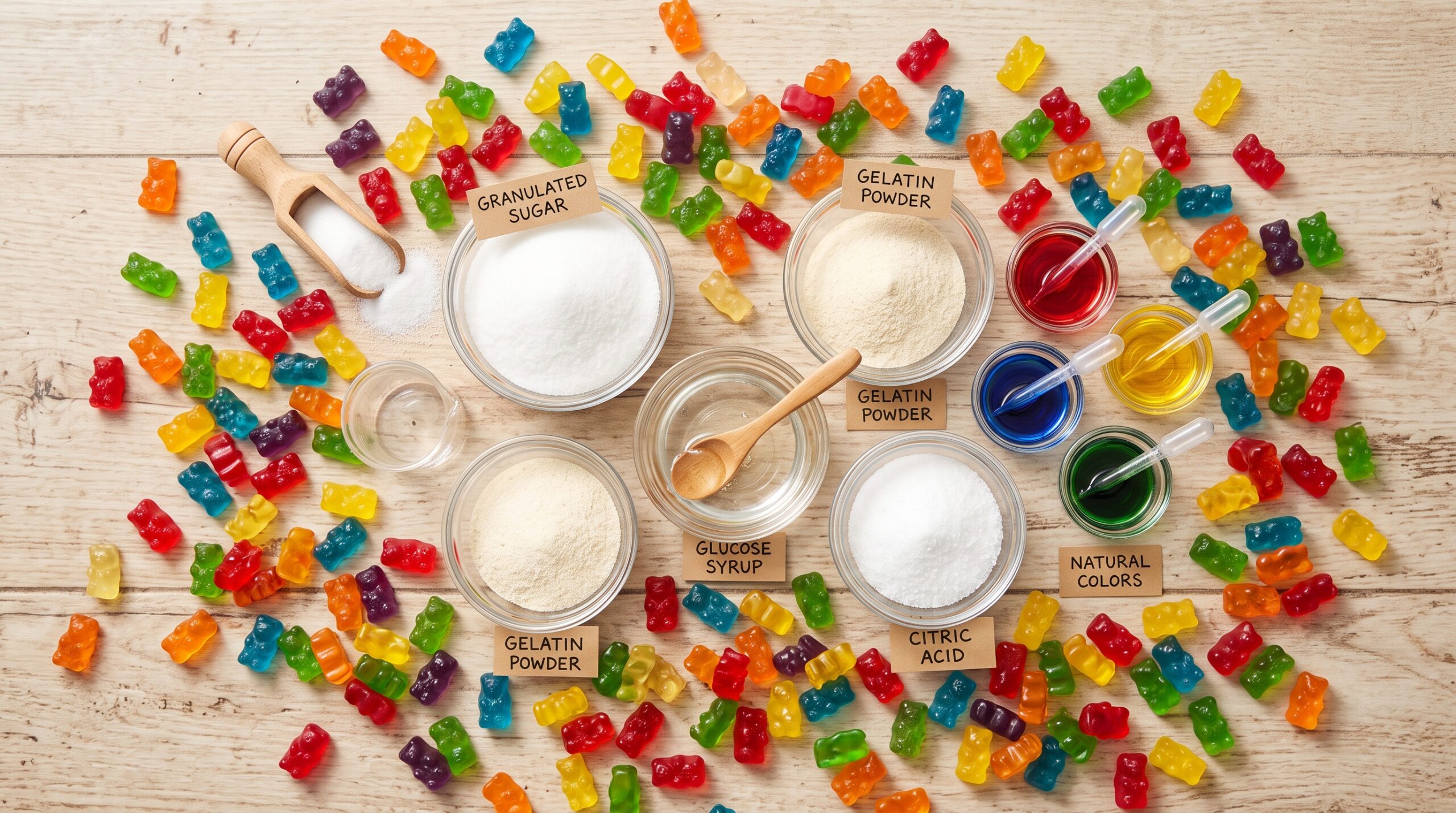
A standard Japanese gummy formulation contains:
- Corn syrup / glucose syrup (40–50%): Provides body, controls crystallization, preserves moisture.
- Sugar (20–30%): Sweetness and crystallization control.
- Real fruit juice / concentrate (5–30%): Flavor, color, and natural acid.
- Gelatin (5–10%): Provides chew. Pharmaceutical-grade, Bloom 200–250.
- Citric acid (0.5–2%): pH adjustment, tartness balance.
- Natural flavor compounds: Amplify the fruit note from the juice.
- Vegetable oil or beeswax coating: Applied in tumbler post-demolding; reduces sticking and adds gloss.
Some lines add functional ingredients: collagen peptides (Meiji), vitamin C, or natural plant extracts. These must be heat-stable enough to survive the 85–95°C cooking stage.
The Production Equipment Used
Industrial gummy production follows a six-stage process:
- Gelatin hydration: Gelatin powder is bloomed in cold water for 30 minutes, then dissolved at 60°C. This step determines final texture — over-hydration weakens the gel; under-hydration causes lumps.
- Cooking: The base syrup (corn syrup, sugar, water) is cooked to 105–115°C in a continuous cooker. Juice and acid are added post-cook to prevent flavor degradation.
- Gelatin integration: The dissolved gelatin is blended into the cooked base at 80–85°C. Temperature control is critical; gelatin denatures above 90°C.
- Depositing: The liquid mass is pumped to a mogul depositing line, where it fills starch molds at high speed (up to 140 deposits/minute). For dual-layer or juice-burst products, co-depositing heads are used.
- Cooling and demolding: Mold trays pass through a cooling tunnel (12–18°C, 24–48 hours) to allow the gel matrix to set fully. Demolding uses inverted brushing.
- Finishing: Pieces are tumbled with sugar, citric acid blends, or oil/wax coatings. This final step determines surface appearance and stick prevention.

Quality Control Standards
Japanese gummy producers operate to FSSC 22000 or ISO 22000 food safety standards, typically with additional internal specifications beyond the regulatory minimum. Critical control points (CCPs) include cook temperature, depositing temperature, final water activity, and metal detection pre-packaging.
In practice, Japanese manufacturers run water activity checks every 2 hours of production, versus the daily checks common in some Western facilities. This explains the consistent shelf-life performance of japanese gummies even at long transit times.
How to Choose and Buy Japanese Gummies
Whether you’re a consumer, a gift buyer, or sourcing for commercial resale, navigating the japanese gummies market has some nuances worth knowing.
For Consumers — Where to Buy
The easiest paths to authentic japanese gummies:
- Asian grocery stores (H Mart, 99 Ranch, Mitsuwa) carry mainstream lines like Kasugai and Puchao fresh, with fast turnover ensuring good freshness.
- Amazon stocks most major lines — browse Japanese gummy candy on Amazon, though verify seller and check reviews for freshness complaints on aged stock.
- Japanese snack subscription boxes (Bokksu, TokyoTreat, Yami) include japanese gummies monthly, often with smaller or exclusive sizes not in retail.
- Japanese convenience stores if you’re visiting Japan — 7-Eleven, FamilyMart, and Lawson each carry 15–25 gummy SKUs, including seasonal and regional exclusives.
Common Mistakes When Buying Japanese Gummies
Mistake 1 — Buying based on packaging size alone. Japanese gummy packs are often smaller (50–70g) than Western equivalents (100–200g). This is intentional — freshness over quantity — but the per-gram price is higher.
Mistake 2 — Ignoring best-by dates. Japanese gummies have a typical shelf life of 9–12 months from manufacture. Imported packs can arrive with 3–5 months remaining. That’s still safe, but flavor brightness degrades after the midpoint of shelf life.
Mistake 3 — Refrigerating them. Refrigeration causes condensation that dissolves the sugar coating, changes the gelatin texture, and accelerates staling. Store japanese gummies at room temperature (15–25°C), away from direct light.
Pro tip: If you’re buying Kasugai muscat or lychee varieties, smell the unopened bag. Fresh product has a detectable fruit aroma even through the sealed packaging. If you can’t smell anything, the product is old.
Future Trends in Japanese Gummies (2026+)
The japanese gummies category is not static. Three major trends are reshaping product development heading into the late 2020s.
Functional Gummies and the Health Innovation Wave
Japan’s aging population and health-conscious younger consumers are driving demand for “benefit gummies” that deliver more than flavor. The collagen gummy segment has spawned vitamin C, probiotic, hyaluronic acid, and magnesium variants. UHA Mikakuto launched a gummy with L-theanine targeting stress relief — sold in 500 mg doses per serving.
The global functional gummy market is projected to grow from USD 4.1 billion in 2024 to USD 9.3 billion by 2030, according to market research compiled by Statista. Japanese brands are well-positioned to capture a disproportionate share of the premium tier.
Export-Driven Product Development
Historically, Japanese gummy makers reformulated only slightly for export markets. That’s changing. UHA now produces Puchao in larger 3.5 oz retail bags specifically for U.S. mass market (Walmart, Target), with modified sugar levels to suit American taste preferences. Kasugai has introduced a “sharing bag” format for the U.S. market — a category that barely exists in Japan, where individual portion packs dominate.
Sustainability and Clean Label
The third trend is ingredient transparency. Japanese consumers increasingly scrutinize ingredient lists. This has pushed manufacturers toward:
- Marine collagen as an alternative to bovine gelatin (broader halal/kosher compatibility)
- Pectin-based vegan gummies (already significant in Korea; growing in Japan)
- Natural color systems (spirulina blue, beet red, turmeric yellow) replacing FD&C dyes
- Reduced sugar formulations using stevia/erythritol blends
The challenge: natural colors and vegan gelatin alternatives behave differently in depositing equipment. Manufacturers running standard gelatin lines cannot simply switch without equipment modification or new depositing parameters.
| Market Segment | 2024 Value (USD) | 2028 Forecast (USD) | CAGR |
|---|---|---|---|
| Japanese gummies — domestic | $820M | $940M | +3.5% |
| Japanese gummies — export | $2.8B | $4.6B | +13.2% |
| Functional gummies (Japan origin) | $310M | $720M | +23.5% |
| Vegan/pectin gummies (Japan) | $45M | $190M | +43.1% |
(Market estimates based on industry analyst reports; figures represent manufacturer sell-in value.)
FAQ: Japanese Gummies
Why are japanese gummies so good?
Japanese gummies use real fruit juice (5–30%), pharmaceutical-grade gelatin, and tightly controlled moisture levels — three factors that produce more authentic flavor and better texture than most Western gummies. The manufacturing standards are also significantly higher, with water activity checks every 2 hours.
Are japanese gummies healthy?
They are candy — primarily sugar and gelatin — and should be enjoyed in moderation. Many Japanese gummy lines include functional additions: Meiji Fruits Gummy provides 1,000 mg of collagen peptides per bag, and some UHA lines include vitamin C or amino acids. Calorie counts are typically 70–100 kcal per 40g serving, similar to Western gummies.
Does Japan sell gummies in regular stores?
Yes. Japanese gummies are sold in every convenience store (7-Eleven, FamilyMart, Lawson), supermarket, and drug store across Japan. The average convenience store stocks 15–25 gummy SKUs at any given time, with seasonal rotations every 8–12 weeks.
What are the most popular japanese gummy flavors?
Muscat (white grape), peach, lychee, mango, and grape are the perennial bestsellers for fruit gummies. In the carbonated/novelty segment, cola, melon soda, and ramune lead. Matcha and yuzu are growing internationally as unique Japanese flavors that Western gummy brands don’t replicate.
Can I import japanese gummies for resale?
Yes, with conditions. U.S. imports require English ingredient and allergen labeling — most Japanese brands produce export SKUs with compliant labels. FDA registration for the foreign supplier facility is required under FSMA. Minimum order quantities vary: large brands work through import distributors at container-load minimums (~10 metric tons), while smaller brands may accept pallet orders via trading companies.
How are japanese gummies made differently from Western gummies?
The core difference is equipment precision and ingredient quality. Japanese producers use pharmaceutical-grade gelatin, real fruit juice, and depositing equipment with tighter tolerances. Products like UHA Mikakuto’s Kororo require co-depositing machinery capable of forming two different gel matrices simultaneously at sub-millimeter precision.
What makes Kasugai the most famous japanese gummy brand?
Kasugai has been making japanese gummies since 1981 and built a 40+ year track record. Their muscat and lychee varieties became iconic because they used premium Japanese fruit varieties as juice sources. The brand also benefits from strong export distribution, with Kasugai gummies among the first Japanese gummies widely available outside Japan.
Conclusion
Japanese gummies occupy a category of their own: candy that’s been taken seriously. From the pharmaceutical-grade gelatin and real fruit juice in Kasugai’s flagship lines to the sub-millimeter co-depositing precision behind UHA Mikakuto’s Kororo, the quality gap versus Western gummies is real, consistent, and rooted in manufacturing discipline that’s taken decades to develop.
For consumers, the path forward is simple: try the classics first (Kasugai muscat or peach), then explore the format innovations (Puchao, Kororo). For businesses — whether importing for retail, developing private-label gummies, or evaluating the gummy candy manufacturing equipment needed for high-quality production — the Japanese market demonstrates what’s possible when you invest in the right ingredients, the right machinery, and the right quality systems. The global appetite for japanese gummies is growing at double-digit rates, and the brands, flavors, and manufacturing capabilities discussed here will only become more relevant in the years ahead.
Related Articles
- Perfect Gummy Candy Ice Cream: Keep Gummies Soft & Chewy (2025)
- Do Blue Raspberries Exist? The Truth Behind the World’s Most Famous Candy Flavor
- What Is Kohakutou Candy? The Complete Guide to Japanese Crystal Candy
- Karl Gummies: The Complete Guide to Feastables’ Iconic Sour Candy
- Gummy Candy Production Line
- Starch-Free Gummy Depositing Machine
- Are Skittles Gluten Free? Complete Guide 2026