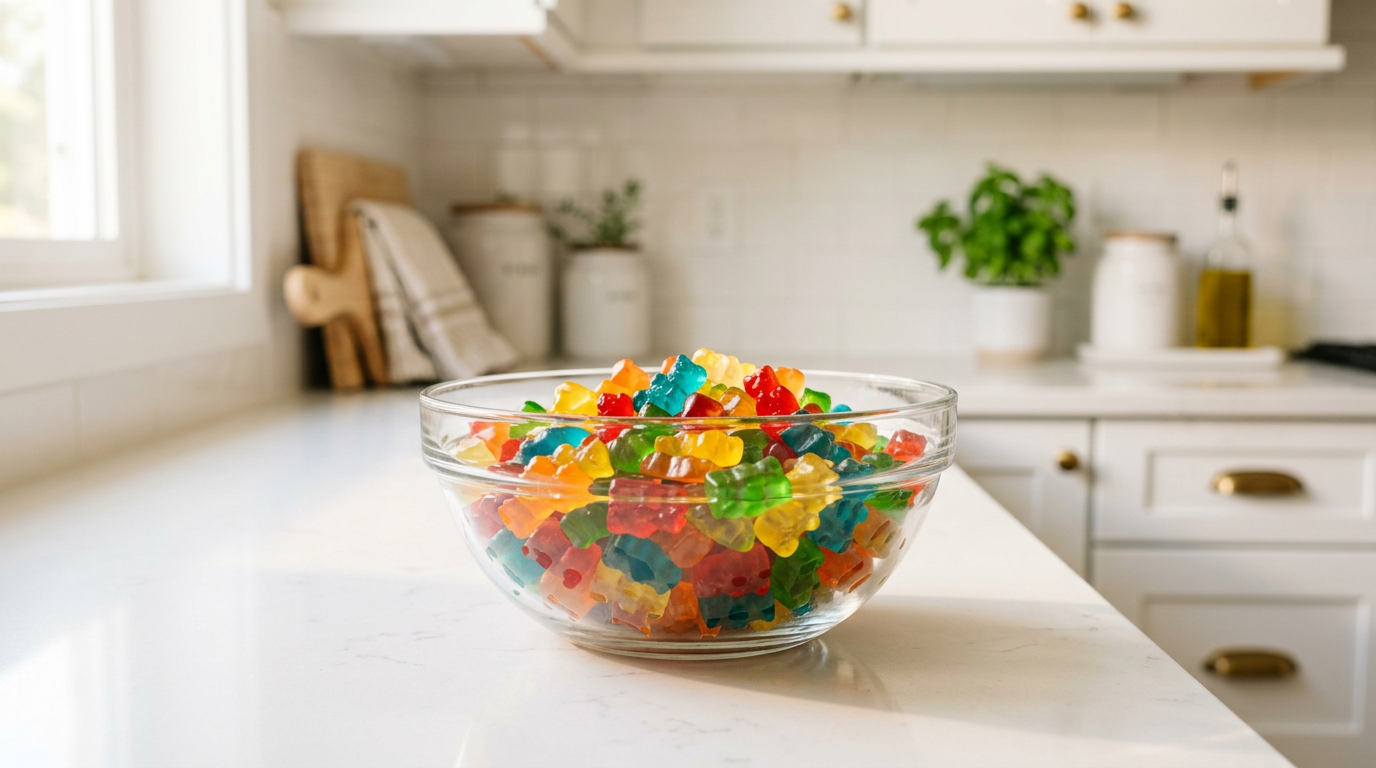
French Candy: The Complete Guide to Types, Traditions & Commercial Production
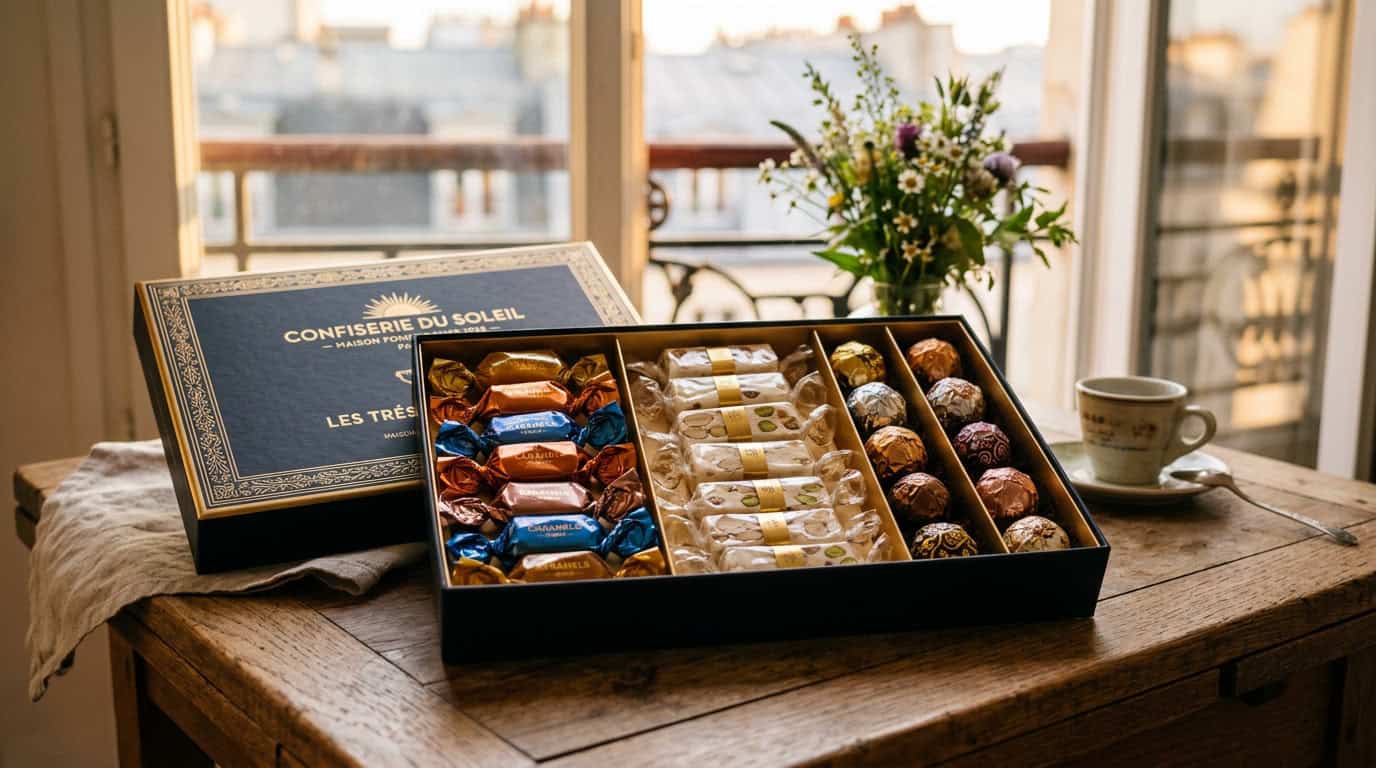
French candy includes bonbons, caramels, nougats, pralines, and lollipops — a centuries-old confectionery tradition now produced commercially at scale worldwide.
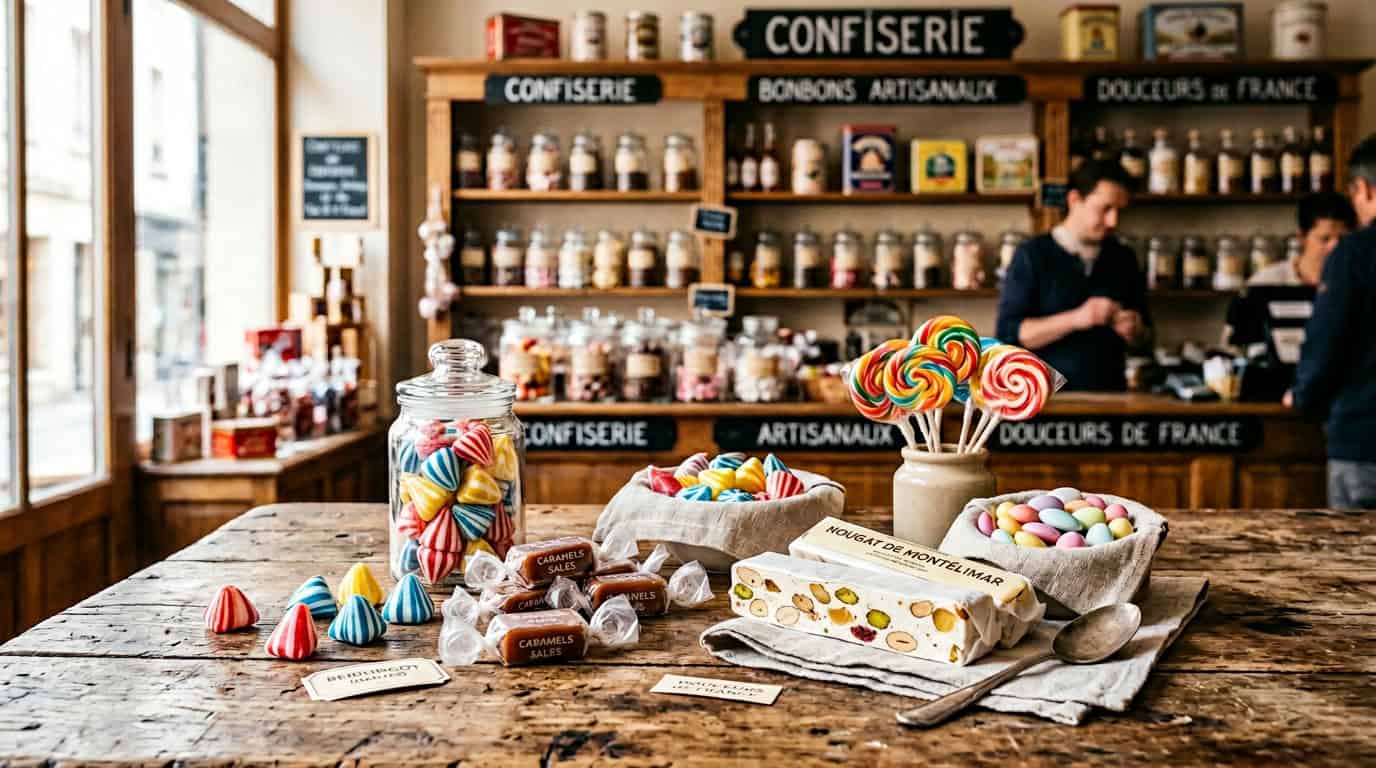
Walk into any traditional confiserie in France, and you’ll find rows of glass jars filled with hand-crafted sweets that look almost too beautiful to eat. French candy is not just sugar — it’s a cultural institution that dates back to the royal courts of the 16th century. Today, that same tradition drives a global confectionery market worth billions, with industrial producers recreating artisan techniques at massive scale.
Whether you’re a candy enthusiast trying to understand what makes French sweets special, or a manufacturer evaluating candy production equipment, this guide covers everything you need to know — from iconic candy types and their origins to the industrial machinery that makes large-scale production possible.
What Is French Candy?
French candy, known broadly as confiserie française, refers to the wide range of sugar-based confections that originated in or are closely associated with France’s rich culinary tradition. These sweets are defined not just by flavor, but by precise technique, high-quality ingredients, and centuries of craftsmanship.
France’s contribution to global confectionery is enormous. The country is credited with developing or perfecting some of the world’s most beloved candy forms, including pralines (invented in the 1600s for the Count of Plessis-Praslin), hard sugar candies, and crystallized fruit confections. According to Statista’s global confectionery market data, the global candy market surpassed $200 billion in 2024 — a market that French traditions helped shape.
The Origins of French Confectionery
French candy’s roots lie in the royal courts of the 16th and 17th centuries, when sugar was still a luxury ingredient. Court confectioners (confiseurs) were prized artisans, and their creations — from crystallized violets to gilded sugar sculptures — were status symbols for the aristocracy.
The Enlightenment era democratized candy production. As sugar imports from the Caribbean lowered costs, confiseries spread across France, and regional specialties emerged: calissons from Provence, berlingots from Carpentras, nougat from Montélimar, caramels from Brittany. Each region perfected its signature sweet over generations.
What Makes French Candy Distinctive
Three things set french candy apart from confectionery traditions elsewhere:
- Ingredient quality: French confectioners traditionally insist on natural flavors — real fruit extracts, high-cocoa chocolate, pure butter, and regional honey. Synthetic flavor shortcuts are considered a mark of inferior quality.
- Technical precision: Many French candy recipes require exact temperature control during cooking — a difference of 2°C can determine whether a caramel is chewy or hard.
- Regional identity: Genuine French sweets are often tied to specific geography. Montélimar nougat uses lavender honey from Provence; Brittany salted caramels rely on fleur de sel from Guérande salt marshes.
| Characteristic | French Candy | Mass-Market Candy |
|---|---|---|
| Flavoring source | Natural extracts, regional ingredients | Largely artificial |
| Sugar cooking precision | Exact temperature stages (hard-ball, soft-crack, etc.) | Automated standardized process |
| Regional identity | Strong (calissons, berlingots, nougat de Montélimar) | Generally absent |
| Production scale | Artisan to mid-industrial | Full industrial |
| Price point | Premium | Budget to mid-range |
Most Famous Types of French Candy
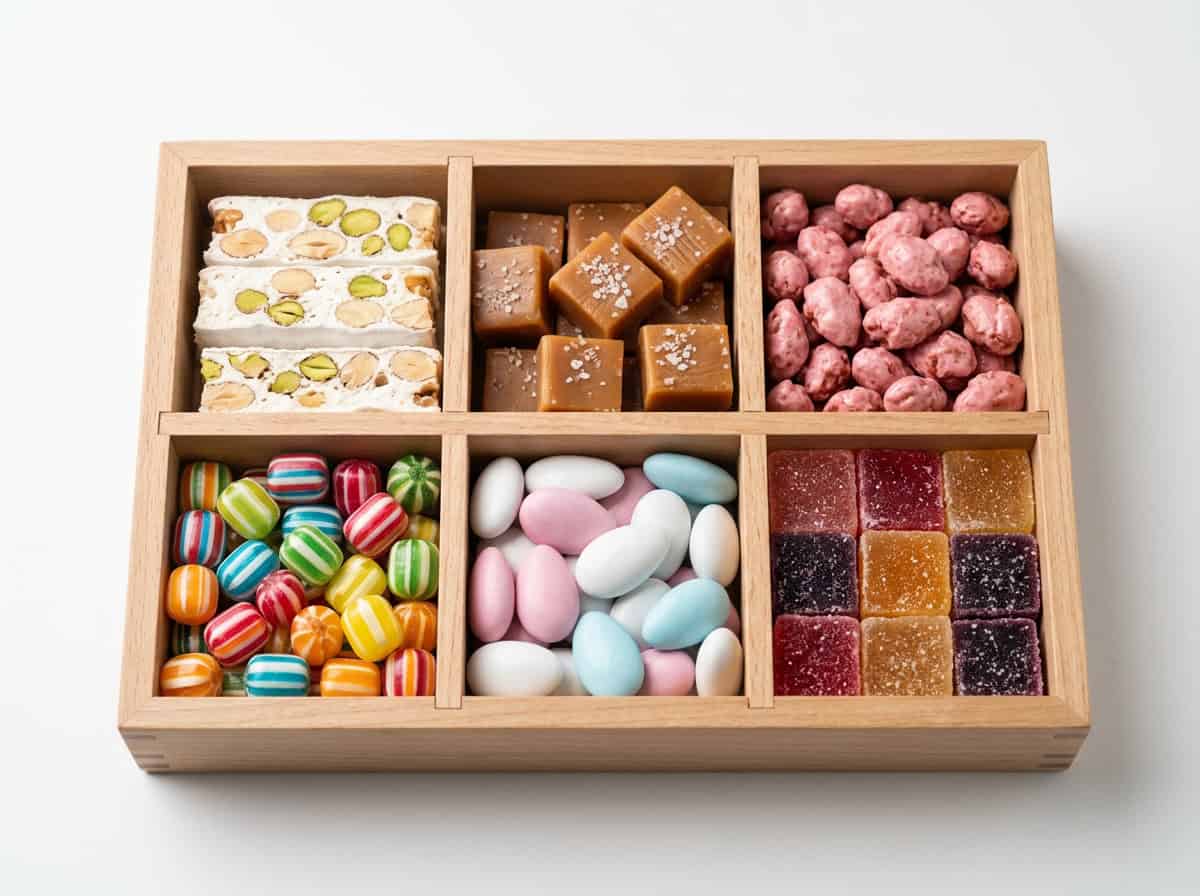
France has produced dozens of iconic french candy types. Here are the most recognized — and most commercially produced — categories.
Hard Candy and Bonbons (Bonbons Durs)
Hard french candy — bonbons durs — encompasses everything from simple fruit-flavored drops to highly decorative sugar sculptures. The famous berlingot de Carpentras is a striped hard candy made from boiled fruit-flavored syrup, folded and cut into characteristic tetrahedral shapes.
Pierrot Gourmand, one of France’s most recognized candy brands, built its identity on high-quality lollipops — a form of hard candy on a stick that remains popular worldwide. Their products are now manufactured on industrial lollipop production lines capable of producing thousands of pieces per hour.
Hard candy manufacturing requires:
1. Sugar and glucose syrup cooked to 155–165°C (hard-crack stage)
2. Addition of natural flavors and colorants at precise cool-down points
3. Forming via die-cut, roll-and-cut, or deposited methods
4. Cooling tunnels to set the final shape
French Caramels and Toffees
Brittany’s caramels au beurre salé (salted butter caramels) sparked a global salted caramel trend that now dominates premium candy markets. These soft, chewy caramels are cooked to exactly 118–121°C (soft-ball stage), then cooled and cut by hand — or, in commercial production, by high-speed cutting machines.
The difference between a caramel and a toffee comes down to cooking temperature and fat content. French caramels typically use a higher proportion of fresh cream and butter than British toffees, producing a softer, richer texture that holds at room temperature without a wrapper.
Industrial caramel production lines must maintain precise temperature profiles throughout the entire cooking and cooling process to replicate artisan results at scale.
Nougat (Nougat de Montélimar)
Montélimar nougat is among the most protected French candy traditions. To legally bear the Nougat de Montélimar name, the product must contain at least 28% almonds and 2% pistachios, and the honey used must come from Provence. This AOC-style protection mirrors France’s wine and cheese geography rules.
Nougat production requires a specialized cooking process — egg whites are whipped to stiff peaks and slowly incorporated into boiled sugar syrup (cooked to 145–155°C), then mixed with nuts and seeds. Commercially, nougat production lines handle this mixing and forming at scale, producing slabs that are later cut to size.
Pralines and Sugared Almonds (Dragées)
Pralines were invented circa 1630 by the chef of the Duke of Plessis-Praslin. The original consisted of whole almonds coated in caramelized sugar — now called pralin in France, not to be confused with Belgian or American pralines.
Dragées (sugared almonds) hold a special cultural place in France — they’re traditionally distributed at baptisms, communions, and weddings. Commercially, dragées are produced on rotating drum pan-coating lines, where almonds are tumbled as layers of sugar syrup are gradually applied and dried.
| Candy Type | Key Ingredient | Cooking Temp | Production Method |
|---|---|---|---|
| Hard candy (bonbons durs) | Sugar + glucose syrup | 155–165°C | Die-cut, deposited, or rolled |
| Caramel (beurre salé) | Sugar + cream + butter | 118–121°C | Slab cast + cut |
| Nougat (Montélimar) | Sugar + honey + egg whites + nuts | 145–155°C | Batch whip + slab cut |
| Pralines | Almonds + caramelized sugar | 160–170°C | Batch tumble-coat |
| Dragées (sugared almonds) | Almonds + sugar layers | Ambient (layering) | Pan coating drum |
| Lollipops | Sugar + glucose + flavors | 155–165°C | Stick-insertion machine |
French Candy in Commercial Production: From Artisan to Industrial Scale
The artisan confiseur and the industrial candy manufacturer share the same chemistry — they just work at very different scales.
Artisan vs. Industrial Methods
In a traditional French confectionery workshop, a master confiseur works with copper kettles, marble slabs, wooden spatulas, and decades of tactile experience. They judge sugar stages by the sound of bubbling, the way a pulled strand behaves, the color of the caramel.
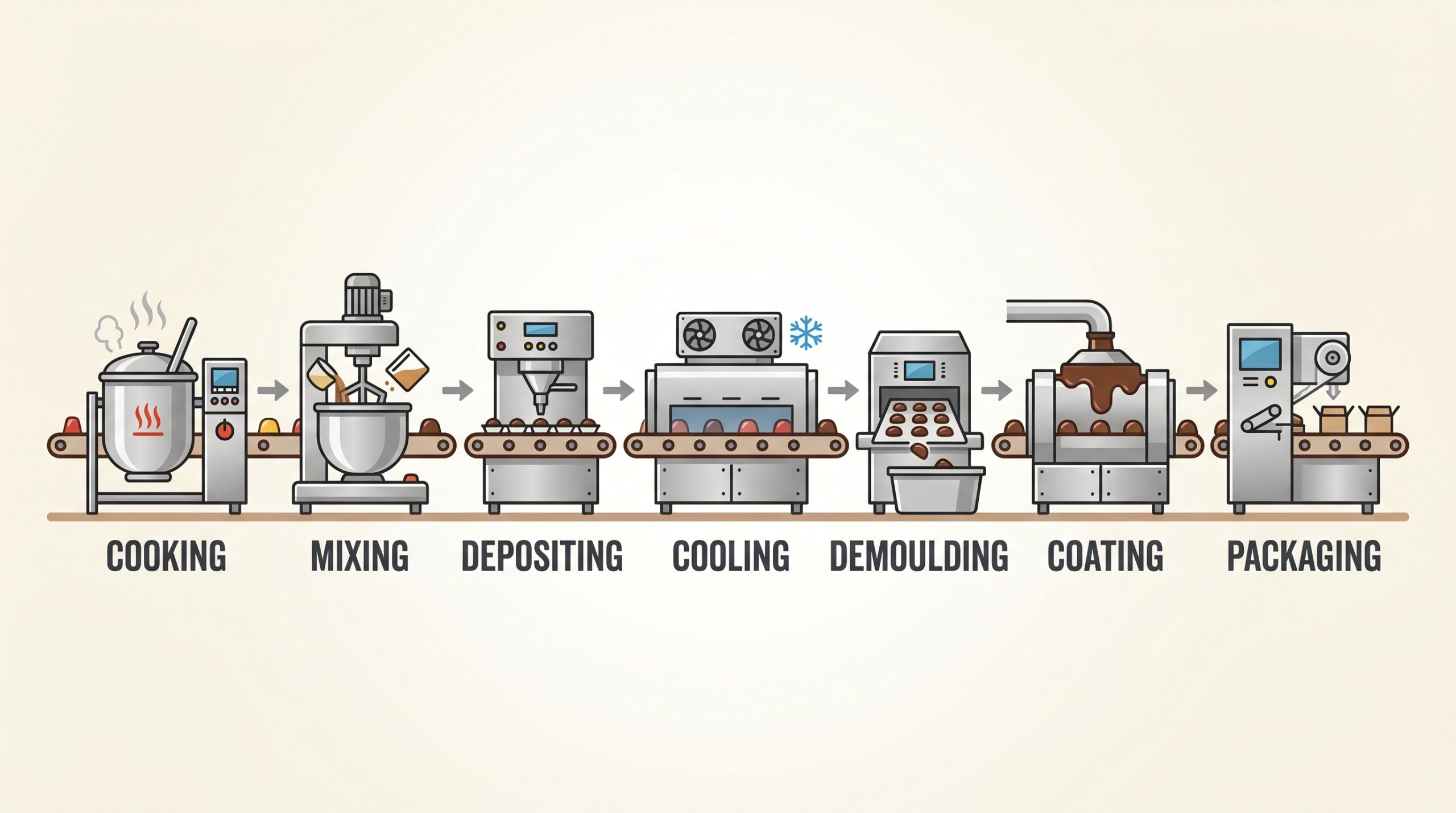
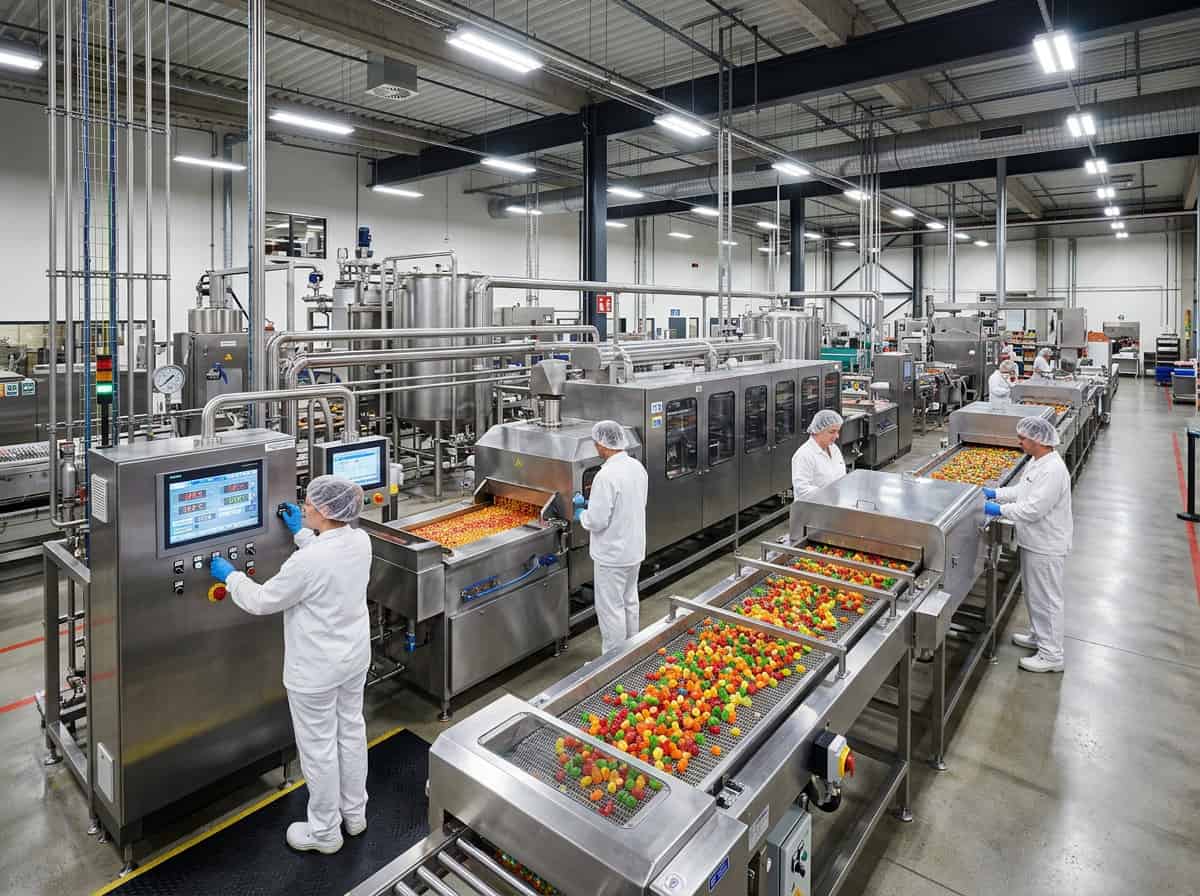
Industrial production replaces those sensory judgments with precision sensors, automated temperature controls, and continuous-flow processing systems. A modern candy production line can process hundreds of kilograms of sugar per hour, maintaining the same exact temperature profiles that a skilled artisan would monitor by touch.
The quality gap between artisan and industrial has narrowed dramatically over the past decade. Advanced PLC (Programmable Logic Controller) systems allow industrial lines to replicate artisan temperature curves almost exactly. The real difference is now primarily in ingredient sourcing and batch size — not in the technical quality of the finished product.
Core Equipment for Commercial French Candy Production
Producing french candy types commercially requires equipment matched to each specific product’s cooking and forming requirements:
For hard candy and lollipops:
– Continuous candy cookers (dissolves sugar and glucose at controlled temperatures)
– Flavor and color dosing systems
– Rope sizer and batch rollers
– Die-cut or deposit forming machines
– Cooling conveyors and tunnels
– Individual wrapping machines (twist-wrap or flow-wrap)
For caramel and toffee production:
– Vacuum caramel cookers (prevents burning of dairy fats)
– Continuous or batch cooking kettles
– Cooling and sizing rollers
– Guillotine cutters or wire-cut machines
– Individual wrapper or slab packaging lines
For nougat:
– High-shear mixing vessels with steam-jacketed walls
– Continuous whipping stations
– Slab forming presses
– Multi-blade cutting machines
For dragées and pan-coated products:
– Rotating coating drums (batch or continuous)
– Sugar syrup spray systems
– Hot and cold air drying systems
– Polishing drums for final gloss coating
Choosing the Right Equipment for French-Style Candy
For entrepreneurs and manufacturers planning to produce french candy commercially, equipment selection depends on three variables: product type, production volume, and desired automation level.
Key decision points:
- Single product vs. multi-product lines: Dedicated lollipop machines are more efficient for high-volume single-SKU production. Flexible batch systems allow manufacturers to switch between caramels, nougat, and hard candy with minimal changeover.
- Continuous vs. batch production: Continuous lines offer higher throughput (100–500 kg/hr) but require significant upfront investment. Batch systems suit start-ups and premium artisan-scale producers who prioritize flexibility over volume.
- Automation level: Full automation reduces labor costs and human error in temperature-critical stages, but requires trained maintenance staff. Semi-automatic lines are a practical middle ground for producers targeting 50–200 kg/hr output.
- Hygienic design standards: Candy production equipment must comply with food safety standards (e.g., EU Regulation 1935/2004, FDA 21 CFR). Look for stainless steel food-contact surfaces, CIP (Clean-in-Place) compatibility, and accessible design for daily sanitation.
JY Machine (Junyu) manufactures complete candy production lines for hard candy, lollipops, toffee, and soft candy — systems specifically designed to produce the types of confections that define the french candy category. Their lines are engineered for precise temperature control, matching the exacting standards that French-style candy production demands.
French Candy Industry: Market Trends and Future Outlook (2026+)
The global french candy market is evolving rapidly, driven by premiumization, clean-label demand, and expanding international markets.
Growing Global Demand for Premium Confectionery
Premium candy is one of the fastest-growing segments in global food retail. According to industry market analysis on confectionery trends, French-branded confectionery carries a strong premium halo in markets from the United States to Japan, commanding price points 40–60% above mass-market equivalents.
China, Southeast Asia, and the Middle East are emerging as high-growth markets for imported and locally-produced French-style candy. Asian consumers in particular associate French confectionery with luxury, gifting culture, and quality assurance — driving strong demand for premium-packaged bonbons and pralines.
This creates an opportunity for candy manufacturers worldwide: produce French-style candy types locally (using the right equipment and recipes) and capture the premium positioning without the import logistics premium.
Clean-Label and Natural Ingredient Trends
Consumers across all major markets are pushing for shorter ingredient lists, natural colorants, and real fruit flavors — demands that align naturally with traditional French candy-making principles.
Industrial producers are responding by:
– Replacing synthetic colorants with plant-based alternatives (spirulina for blue, beetroot for red, turmeric for yellow)
– Sourcing organic cane sugar and natural glucose syrups
– Eliminating artificial preservatives through water activity management
This shift is actually an advantage for producers who invest in quality cooking equipment — precise temperature control reduces the need for stabilizer additives, naturally improving the ingredient profile.
Automation and Smart Manufacturing
The next generation of french candy production equipment integrates IoT sensors, real-time quality monitoring, and automated recipe management. Smart candy lines can:
- Automatically adjust cooking temperatures based on ambient humidity readings (humidity affects sugar crystal formation)
- Track batch data for full traceability compliance
- Detect and reject malformed pieces at the forming stage using machine vision
| Trend | Impact on Production | Equipment Implication |
|---|---|---|
| Premiumization | Higher tolerance for complex recipes | Multi-stage cooking systems |
| Clean-label | Natural colorants, shorter ingredient lists | Precise temperature control; no chemical shortcuts |
| Asia-Pacific growth | Larger batch sizes; export packaging | High-capacity continuous lines |
| Smart manufacturing | IoT integration, automated QC | PLC-controlled lines with data logging |
| Gift/premium packaging | Smaller format, decorative shapes | Flexible forming + depositing |
Frequently Asked Questions About French Candy
What candy comes from France?
France’s most famous candies include Montélimar nougat, Brittany salted caramels, berlingots from Carpentras, calissons from Aix-en-Provence, dragées (sugared almonds), and Pierrot Gourmand lollipops. Many modern gummy candy brands (including Haribo, which produces in France) also have strong French production roots. In practice, the most internationally recognized is the salted caramel — a flavor that spread globally from Brittany in the 1990s.
What sweets are famous in France?
The most culturally significant French sweets are nougat de Montélimar, calissons d’Aix, berlingots, caramels au beurre salé, dragées, pâtes de fruits (fruit jellies), and réglisse (licorice). Each has protected regional origins and centuries of tradition. For commercial manufacturers, the most scalable to produce are hard candy (bonbons), lollipops, caramels, and nougat — all of which have well-established industrial production lines.
What is the most popular French candy brand?
Pierrot Gourmand (lollipops), Haribo France (gummies), Carambar (soft caramels), and Lutti (gummies and hard candy) are among France’s best-selling candy brands. For premium/artisan, Arnaud Soubeyran (Montélimar nougat), La Cure Gourmande (hard candy), and Henri Le Roux (salted caramel) lead the market.
Is French candy different from American candy?
Yes — in ingredient approach, sweetness level, and production tradition. French candy typically uses natural flavors, lower artificial sweetener content, and more butter/cream in soft varieties. American candy tends toward higher sweetness intensity, more artificial flavors, and longer shelf life through preservatives. Neither is inherently “better” — they reflect different consumer preferences and production philosophies.
How is hard French candy made industrially?
Industrial hard french candy production begins with dissolving sugar and glucose syrup in water, then cooking the mixture to 155–165°C in a continuous candy cooker. At the correct temperature, the cooked mass is transferred to a cooling table (or continuous cooling belt), where flavors and colorants are added. The cooled mass is then pulled or rolled to the correct size, formed by die-cutting or batch rolling, cooled in a tunnel, and individually wrapped. A full continuous lollipop line can produce 150–300 kg of finished candy per hour.
What equipment is needed to produce French-style caramels commercially?
Caramel production requires a cooking vessel capable of reaching 118–121°C without scorching dairy fats (vacuum cookers are preferred for cream-heavy recipes), a continuous or batch mixing system, a cooling and sizing roller, and a cutting machine (guillotine or wire-cut). For soft-wrap caramels, a twist-wrap or fold-wrap packaging machine is also needed. JY Machine manufactures complete toffee and caramel production lines suited to this process.
Can French candy production techniques be used in industrial scale?
Yes — modern candy manufacturing equipment replicates artisan temperature profiles with high precision. PLC-controlled cooking systems can follow exact temperature curves, humidity-compensated cooking times, and automated ingredient dosing, producing results that rival artisan quality at 50–500 kg/hr throughput. The key is matching equipment specifications to the specific candy type’s technical requirements.
What is the difference between praline and dragée?
A praline (French origin) is an almond coated in caramelized sugar — the whole mass of nuts and caramel is ground to a paste or left in pieces. A dragée is a whole almond with multiple thin layers of hard sugar coating applied in a rotating drum — producing a smooth, shiny outer shell. Both are produced using pan-coating equipment, but the final temperature profiles and coating ratios differ significantly.
Conclusion
French candy represents one of the world’s most sophisticated confectionery traditions — a heritage built on precise technique, quality ingredients, and deep regional pride. From the salted caramels of Brittany to the nougat of Montélimar, these sweets have influenced candy culture globally.
For food manufacturers, the commercial opportunity is clear: global demand for premium french candy styles is growing, clean-label ingredient requirements are now standard expectations, and industrial equipment has evolved to match artisan quality at scale. The gap between a Breton confiseur ‘s copper kettle and a modern PLC-controlled candy cooker is smaller than it’s ever been.
Whether you’re sourcing candy production equipment for a new lollipop line, evaluating caramel production systems, or scaling up your nougat output, matching the right machinery to your product’s specific technical requirements is the single most critical factor in producing consistent, high-quality french candy at commercial scale. JY Machine’s candy production lines — covering hard candy, lollipops, toffee, and soft candy — are engineered with exactly those requirements in mind.
Related Articles
- Peelable Gummy Candy: Types, Ingredients, and Production Guide
- Spanish Candy: Types, Traditions, and the Machinery Behind Every Bite
- Gumdrops Candy: The Complete Guide to History, Production & Commercial Manufacturing
- The Ultimate Guide to Cactus Candy: Commercial Production, Ingredients, and Industry Trends
- Gummy Candy Production Line
- Food Packaging Machine
- Skittles Manufacturing Process: Inside the Factory