Candy Production Line: A Professional Manufacturer’s Guide
Inleiding
Ever wondered how millions of perfectly formed, deliciously consistent candies are produced every single day? It’s not magic; it’s a feat of engineering, precision, and strategy encapsulated in one powerful system: the candy production line. This is the engine that drives the global confectionery industry, turning simple raw materials into the treats enjoyed by billions. But for entrepreneurs and established manufacturers alike, navigating the complexities of this technology can be a daunting task.
This guide is designed to explain the entire process in simple terms. We will journey from the basic principles of a candy production line to the detailed workings of key machinery. You will learn how to select the right equipment for your specific needs, understand the different types of lines available, and look into the future of confectionery manufacturing. This guide provides the expert insights and practical frameworks necessary to navigate the world of candy production, whether you are starting a new venture or scaling an existing one.
What is a Candy Production Line?
A System-Based View
A common mistake is to view a candy production line as just a sequence of individual machines. A professional manufacturer sees it differently: it is a fully integrated, working system. Each component, from the initial raw material mixer to the final packaging unit, is designed to work together with the others. The failure or poor performance of one part can impact the entire operation.
The primary goals of this integrated system are clear and essential. First is consistency; every candy must have the same weight, shape, texture, and flavor. Second is quality control, ensuring every piece meets safety standards and brand specifications. Third is speed, maximizing output to meet market demand and achieve cost savings through volume. Finally, the system must offer scalability, allowing a business to grow its production capacity as it expands.
Key Modern Characteristics
Modern candy production line are defined by several core characteristics that set them apart from older, more basic manufacturing methods. Understanding these is key to appreciating their value.
- Automation: The most significant evolution is the shift towards comprehensive automation. This greatly reduces the need for manual labor, which in turn minimizes the potential for human error, improves cleanliness, and ensures a repeatable, consistent process 24/7.
- Modularity: Lines are no longer rigid, single-purpose installations. Modern designs emphasize modularity, giving producers the flexibility to add, remove, or change components. This allows for the production of different candy types or shapes on the same base line, maximizing the return on investment.
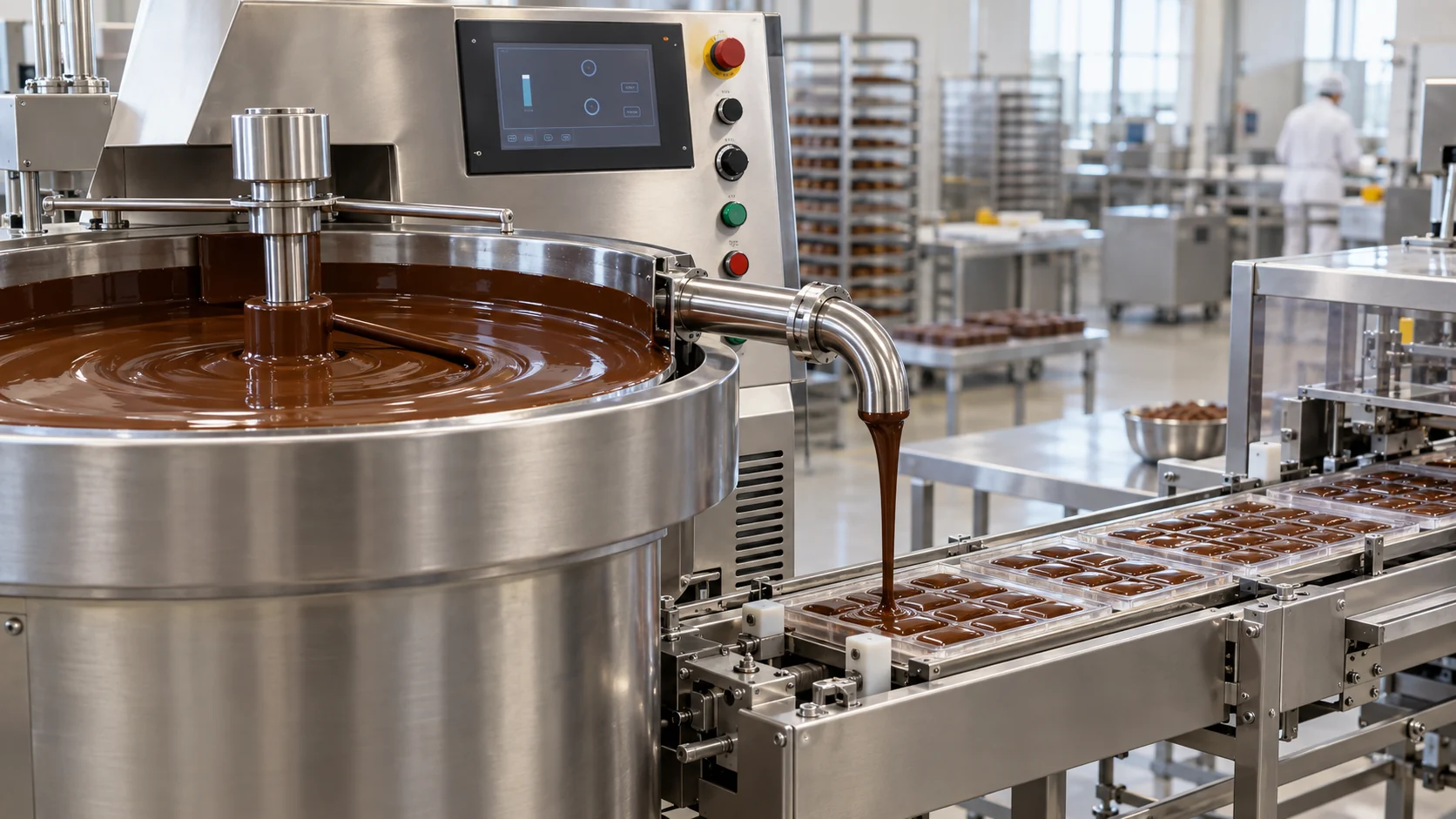
- Control: A centralized PLC (Programmable Logic Controller) system acts as the brain of the operation. From a single human-machine interface (HMI), operators can precisely manage every critical parameter, including cooking temperatures, mixing speeds, depositing times, and cooling curves. This level of control is fundamental to achieving high-quality results.
- Hygiene and Safety: Following global food safety standards is essential. This is reflected in the physical construction of the line. You will see extensive use of food-grade stainless steel (typically SS304 or SS316L), designs that eliminate hard-to-clean crevices, and compliance with Good Manufacturing Practices (GMP).
The Core Production Process
A Step-by-Step Journey
To truly understand a candy production line, one must follow the journey of the ingredients from their raw state to a finished, packaged product. While specifics vary by candy type, the core process follows a logical and sequential path.
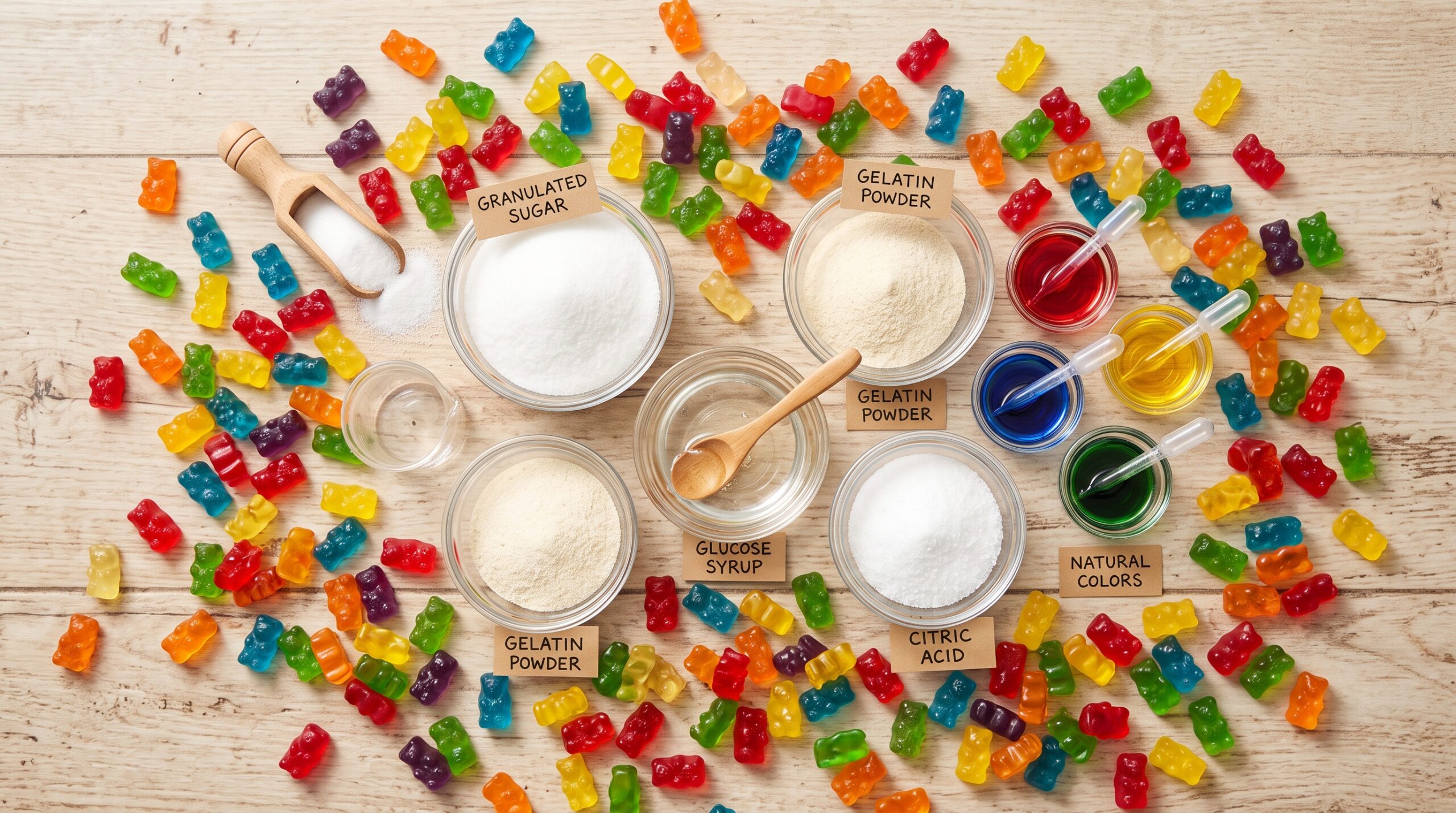
- Ingredient Preparation and Mixing: The process begins with precision. Raw materials like sugar, corn syrup, water, and gelatin or pectin are automatically or semi-automatically weighed according to a pre-programmed recipe. These ingredients are then fed into large, heated pre-mixers or cookers. Here, they are blended into a uniform mixture, often with initial heating to begin the dissolving process.
- Cooking: This is arguably the most critical stage, as it determines the final texture and shelf life of the candy. The mixture is pumped into a high-capacity cooker. The type of cooker depends on the candy; a microfilm cooker provides rapid, high-temperature cooking for hard candies, while a vacuum cooker can achieve the same result at lower temperatures to prevent sugar discoloration. The goal is to cook the mass to a precise final moisture content, which can be as low as 1-2% for hard candy or much higher for gummies.
- Adding Flavors and Colors: Once the base candy mass is cooked, it is discharged into a mixing or holding tank. At this point, delicate ingredients that cannot withstand high cooking temperatures are added. This includes flavors, colors, and acids (like citric or malic acid for a sour taste). For functional candies, this is when active ingredients like vitamins, minerals, or CBD are introduced. Precision dosing pumps ensure that every batch receives the exact same amount of these additives for perfect consistency.
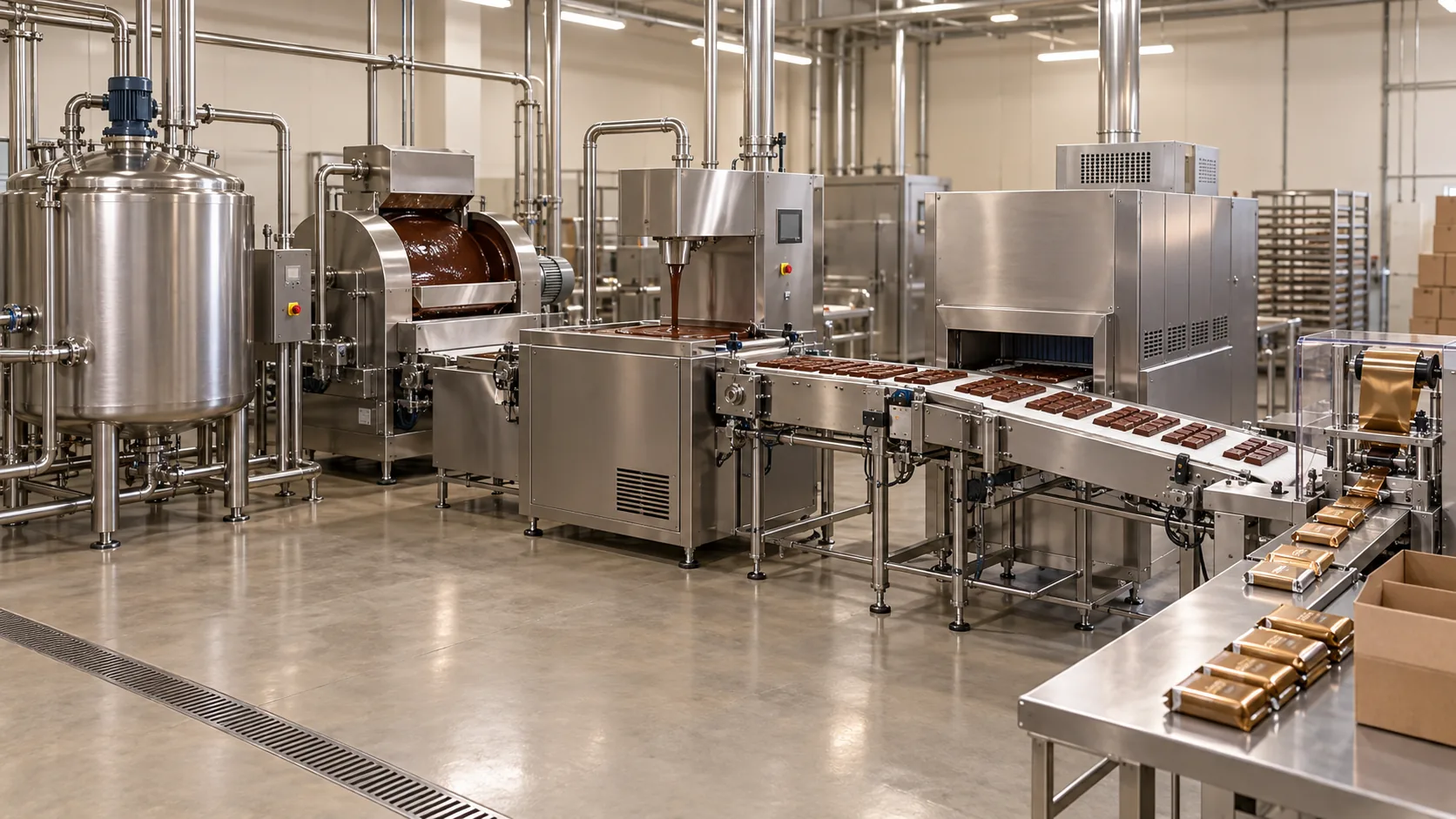
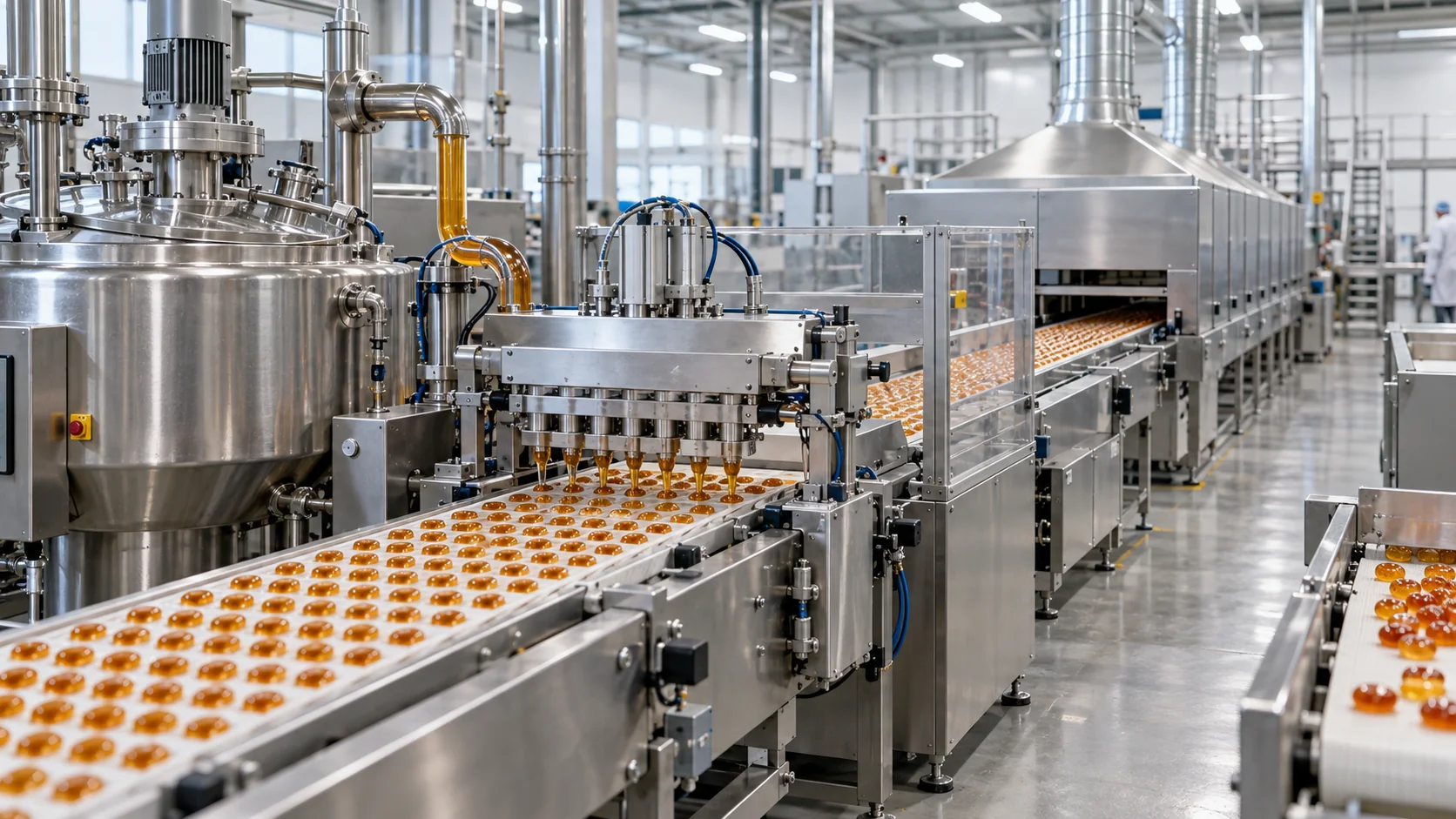
- Forming and Shaping: With the candy mass fully prepared, it’s time to give it a shape. The method used here defines the candy production line. For gummies and many hard candies, the mass is sent to a depositor, which injects a precise volume into molds (made of silicone, metal, or pressed in starch). For lollipops or stamped hard candies, the mass is pushed out into a “rope,” sized, and then stamped into shape by a forming die. For products like licorice, an extruder forces the mass through a die to create the final shape directly.
- Cooling: Immediately after forming, the hot and soft candies must be cooled to become solid and stable. They are transported through a long, enclosed cooling tunnel. These tunnels are climate-controlled, often with multiple zones that gradually reduce the temperature and humidity. Proper cooling is essential to prevent defects like cracking in hard candies or stickiness in gummies. The time spent in the tunnel can range from a few minutes to over half an hour, depending on the candy size and type.
- Finishing and Packaging: After exiting the cooling tunnel, the candies are removed from molds. They may then undergo a finishing process. Gummies are often tumbled in a large drum with a light coating of oil to prevent sticking, while sour candies might be coated with a sugar/acid mixture. From here, the finished candies are moved to automated verpakkingsmachines that weigh, bag, wrap, or box them at high speeds, ready for shipment.
Exploring Main Line Types

cURL Too many subrequests.
cURL Too many subrequests.
cURL Too many subrequests.
cURL Too many subrequests.
| cURL Too many subrequests. | cURL Too many subrequests. | cURL Too many subrequests. | cURL Too many subrequests. |
| cURL Too many subrequests. | cURL Too many subrequests. | cURL Too many subrequests. | cURL Too many subrequests. |
| cURL Too many subrequests. | cURL Too many subrequests. | cURL Too many subrequests. | cURL Too many subrequests. |
| cURL Too many subrequests. | cURL Too many subrequests. | cURL Too many subrequests. | cURL Too many subrequests. |
| cURL Too many subrequests. | cURL Too many subrequests. | cURL Too many subrequests. | cURL Too many subrequests. |
cURL Too many subrequests.
cURL Too many subrequests.
cURL Too many subrequests.
cURL Too many subrequests.
- cURL Too many subrequests. cURL Too many subrequests.
- cURL Too many subrequests. cURL Too many subrequests.
- cURL Too many subrequests. cURL Too many subrequests.
- cURL Too many subrequests. cURL Too many subrequests.
- cURL Too many subrequests. cURL Too many subrequests.

cURL Too many subrequests.
cURL Too many subrequests.
| cURL Too many subrequests. | cURL Too many subrequests. | What to Look for in a Manufacturer/Supplier |
| Production Capacity | What is my target output for Year 1? Year 3? | Do they offer scalable solutions? Can the line be upgraded later? |
| Candy Type & Quality | What specific candy will I make? What is my quality standard? | Do they have proven experience with my candy type? Can they provide samples? |
| Automation Level | What is my local labor cost? What level of consistency do I need? | Do they offer semi-automatic and fully automatic options? Is the control system user-friendly (e.g., Siemens, Allen-Bradley)? |
| Space & Utilities | What is the available space in my facility? | Do they provide detailed layout drawings and utility requirements upfront? |
| After-Sales Support | Who will install the line? What about training and spare parts? | In our experience, strong after-sales support is essential. Look for suppliers who offer installation supervision, on-site operator training, and a clear warranty policy with readily available spare parts. |
Key Machinery Deep Dive
The Cooker
The cooker is where the fundamental chemistry of candy making occurs. Its function is to dissolve ingredients and boil the resulting syrup to a precise solids concentration, which dictates the final product’s texture. For hard candies, this can be 98% solids or higher. Cookers range from simple open-kettle atmospheric cookers for small batches to advanced, continuous systems. Continuous cookers, such as microfilm cookers, pass a thin film of syrup over a heated surface for extremely rapid and efficient cooking. This prevents sugar breakdown and discoloration, which is vital for high-quality products.
Manufacturer’s Insight: For high-clarity hard candies or lozenges, a continuous vacuum cooker is superior. By cooking under a vacuum, the boiling point of the syrup is lowered. This allows you to reach the final solids concentration at a lower temperature, preventing any sugar burn (caramelization) and producing a crystal-clear candy. The vacuum also effectively removes trapped air bubbles, further enhancing clarity and density.
De depositor

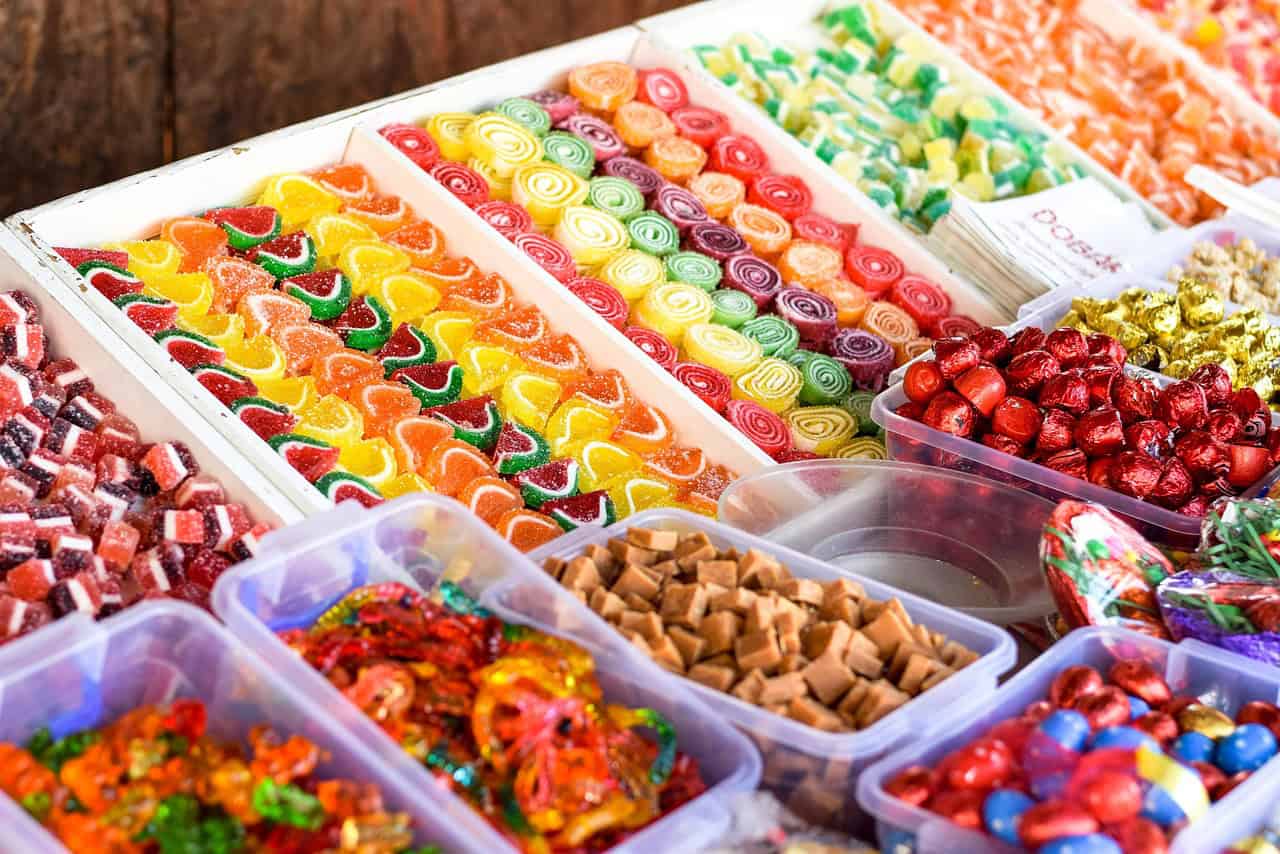
The depositor is the heart of any modern gummy or hard candy line, responsible for precision and uniformity. After cooking, the candy mass is held in a heated, jacketed hopper on the depositor. From there, a series of pistons or pumps inject a precise, pre-set volume of the mass into molds passing underneath. The entire process is synchronized—the movement of the molds and the action of the depositing pistons are perfectly timed to ensure every mold cavity is filled cleanly and accurately. The design of the nozzles and the accuracy of the depositing mechanism are critical for producing candies of a consistent weight and shape.
Manufacturer’s Insight: Look for servo-driven depositors over older, pneumatic-driven models. While pneumatic systems are cheaper, servo motors offer unparalleled control and repeatability. They can ensure weight accuracy within a fraction of a gram, which significantly reduces product waste. Over the lifetime of the machine, the material savings from a servo depositor’s accuracy can easily pay for its higher initial cost, making it a critical factor for profitability.
The Cooling Tunnel
The function of the cooling tunnel is to bring the hot, freshly deposited candies down to room temperature in a controlled manner, allowing them to solidify and become stable for demolding and packaging. This is not simply a refrigerated box. A well-designed tunnel is a sophisticated piece of climate-control equipment. It uses high-velocity air, often dehumidified, to efficiently remove heat from the candies and molds. The air is circulated in a counter-flow pattern—coolest at the exit and warmer at the entrance—to prevent thermal shock to the candies, which can cause cracking or surface defects.
Manufacturer’s Insight: A common mistake made by new producers is underestimating their cooling requirements. A short or inefficient cooling tunnel is a frequent bottleneck for the entire candy production line. For superior results, especially with deposited hard candies, invest in a tunnel with multiple climate zones. An initial zone with slightly higher humidity can prevent case hardening, while subsequent zones with very dry, cold air ensure a thorough and stable final cure. This level of control results in better texture, clarity, and shelf stability.
The Cut-and-Wrap Machine
For candies like toffees, caramels, or some types of hard candies that are not deposited, the cut-and-wrap machine provides the final touch. This integrated unit takes a conditioned “rope” of candy from a batch roller and rope sizer, cuts it into individual pieces of a precise length, and immediately wraps each piece. Wrapping styles vary and include twist-wrap (common for toffees) or fold-wrap (like a bouillon cube). These machines are marvels of mechanical engineering, operating at high speeds to cut and wrap hundreds of pieces per minute.
Manufacturer’s Insight: When choosing a cut-and-wrap machine, its compatibility with your specific wrapping material is a critical, often overlooked, factor. Different films (e.g., polypropylene, cellophane, waxed paper) behave differently at high speeds. Some are more prone to static electricity, which causes them to cling to the machine, while others may tear or stretch. Always insist on testing the machine with the exact wrapping film you intend to use. A successful test run at your target production speed is the only true confirmation of compatibility.
Broadening the Scope
Beyond Traditional Confectionery
While we often associate them with traditional sweets, the applications for modern candy production lines are surprisingly diverse and expanding into high-value adjacent industries. The precision, cleanliness, and scalability of these systems make them ideal for a range of products beyond simple confectionery.
- Large-Scale Confectionery: This remains the primary application. Global brands rely on massive, highly automated lines running 24/7 to produce the billions of candies, chocolates, and gums sold worldwide.
- Boutique & Artisanal Production: On the other end of the spectrum, smaller, more flexible, and semi-automatic lines have empowered a new generation of craft candy makers. These systems allow for professional-grade production at a scale suitable for local or regional markets.
- Pharmaceutical Industry: The technology is perfectly suited for producing medicated lozenges and throat drops. A depositing line can guarantee that each lozenge contains a precise, verifiable dose of an active pharmaceutical ingredient (API), an essential requirement for medical products.
- cURL Too many subrequests. cURL Too many subrequests.
cURL Too many subrequests.
cURL Too many subrequests.
cURL Too many subrequests.
| cURL Too many subrequests. | cURL Too many subrequests. | cURL Too many subrequests. |
| cURL Too many subrequests. | cURL Too many subrequests. | cURL Too many subrequests. |
| Sustainability | cURL Too many subrequests. | cURL Too many subrequests. |
| cURL Too many subrequests. | cURL Too many subrequests. | cURL Too many subrequests. |
| cURL Too many subrequests. | cURL Too many subrequests. | cURL Too many subrequests. |
cURL Too many subrequests.
cURL Too many subrequests.
cURL Too many subrequests.
cURL Too many subrequests.
cURL Too many subrequests.
Veelgestelde Vragen
cURL Too many subrequests.
cURL Too many subrequests.
cURL Too many subrequests.
cURL Too many subrequests. cURL Too many subrequests. cURL Too many subrequests.
cURL Too many subrequests.
cURL Too many subrequests.
cURL Too many subrequests.
cURL Too many subrequests.
Referentielinks:
cURL Too many subrequests. https://candyusa.com/
cURL Too many subrequests. https://pmca.com/
cURL Too many subrequests. https://www.aactcandy.org/
cURL Too many subrequests. https://gomc.com/
cURL Too many subrequests. https://www.candyindustry.com/
cURL Too many subrequests. https://www.rockwellautomation.com/
cURL Too many subrequests. https://www.isa.org/
cURL Too many subrequests. https://www.sciencedirect.com/topics/food-science/food-process-control
PMMI – The Association for Packaging and Processing Technologies https://www.pmmi.org/
International Confectionery Association (ICA) https://www.international-confectionery.org/