Plain boba tea is generally gluten free — tapioca pearls are made from cassava root starch, not wheat. However, certain toppings, flavored syrups, and cross-contamination risks at busy boba shops can make specific drinks unsafe for people with celiac disease or severe gluten sensitivity.
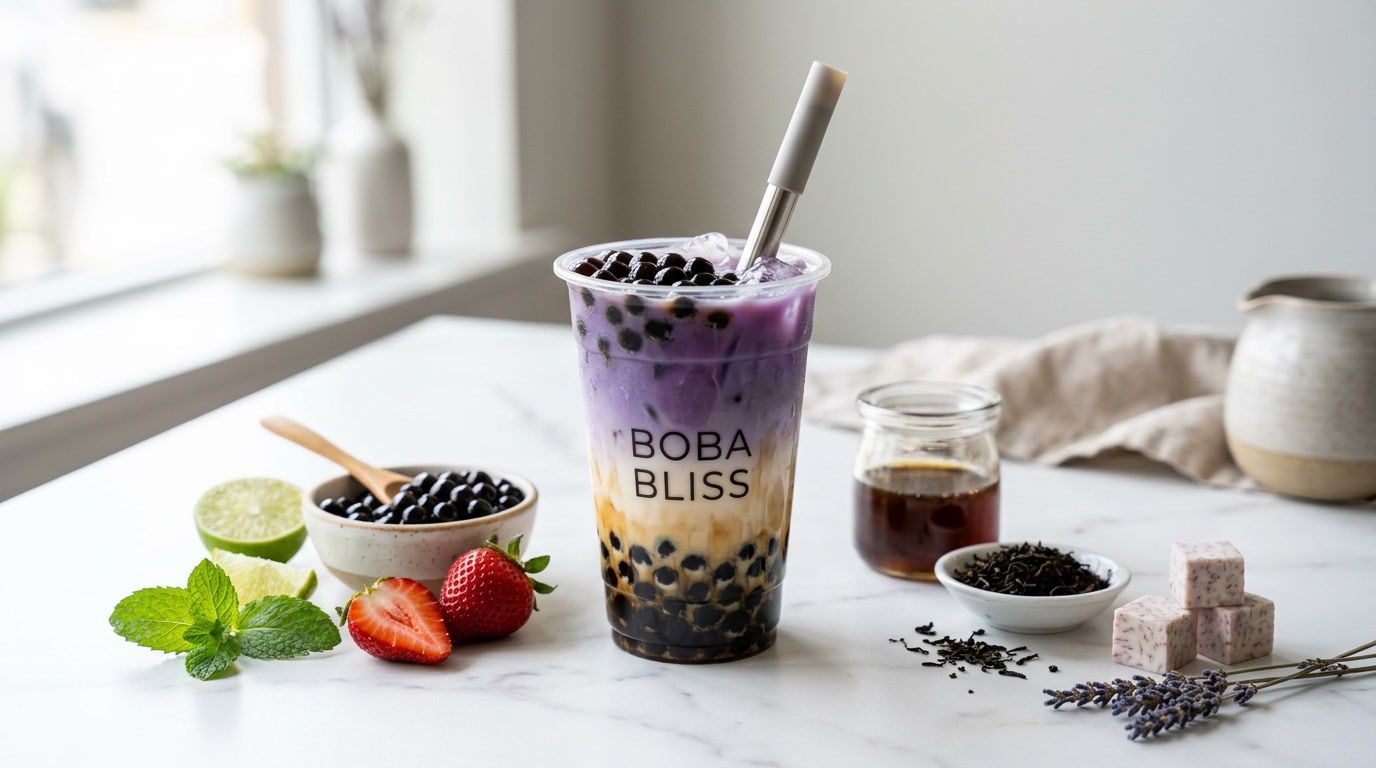
You just got diagnosed with celiac disease — or maybe you’ve been living gluten-free for years and a friend just invited you to a boba café. Your immediate question: is boba gluten free? The short answer is “usually yes,” but as anyone with celiac disease knows, “usually” is a dangerous word when your health is on the line.
This guide breaks down every ingredient in a typical boba drink, flags the hidden gluten traps in toppings and syrups, explains cross-contamination risks in real boba shops, and gives you a practical decision framework for safely enjoying boba — whether you’re ordering at a chain, a local shop, or making it yourself at home.
What Is Boba Tea? Understanding the Basics
Boba tea (also called bubble tea or pearl milk tea) is a Taiwanese drink combining tea, milk or creamer, sweetener, and chewy tapioca pearls — typically sipped through a wide straw.
Originating in Taichung, Taiwan in the 1980s, boba has exploded into a global industry. Today the global bubble tea market is valued at over $3.9 billion and growing, according to market research from Statista. What makes the gluten question tricky is that “boba” isn’t a single standardized product — it’s a customizable drink with dozens of base tea options, milk varieties, sweeteners, and toppings, each with its own ingredient profile.
Core Ingredients of Boba Tea
A standard boba drink contains four basic components:
- Tea base — black tea, green tea, oolong, or jasmine
- Milk or creamer — fresh milk, oat milk, almond milk, or non-dairy coffee creamer
- Sweetener — simple syrup, fructose syrup, or brown sugar
- Tapioca pearls — the signature chewy balls made from cassava (tapioca) starch
Each of these base ingredients is naturally gluten free. The complications arise when you move beyond the basics.
Types of Boba Drinks
The boba category now spans a wide range of drinks that vary significantly in their gluten risk:
- Classic milk tea — most basic form, lowest risk
- Fruit tea — tea blended with fruit purees or juice; moderate risk from syrups
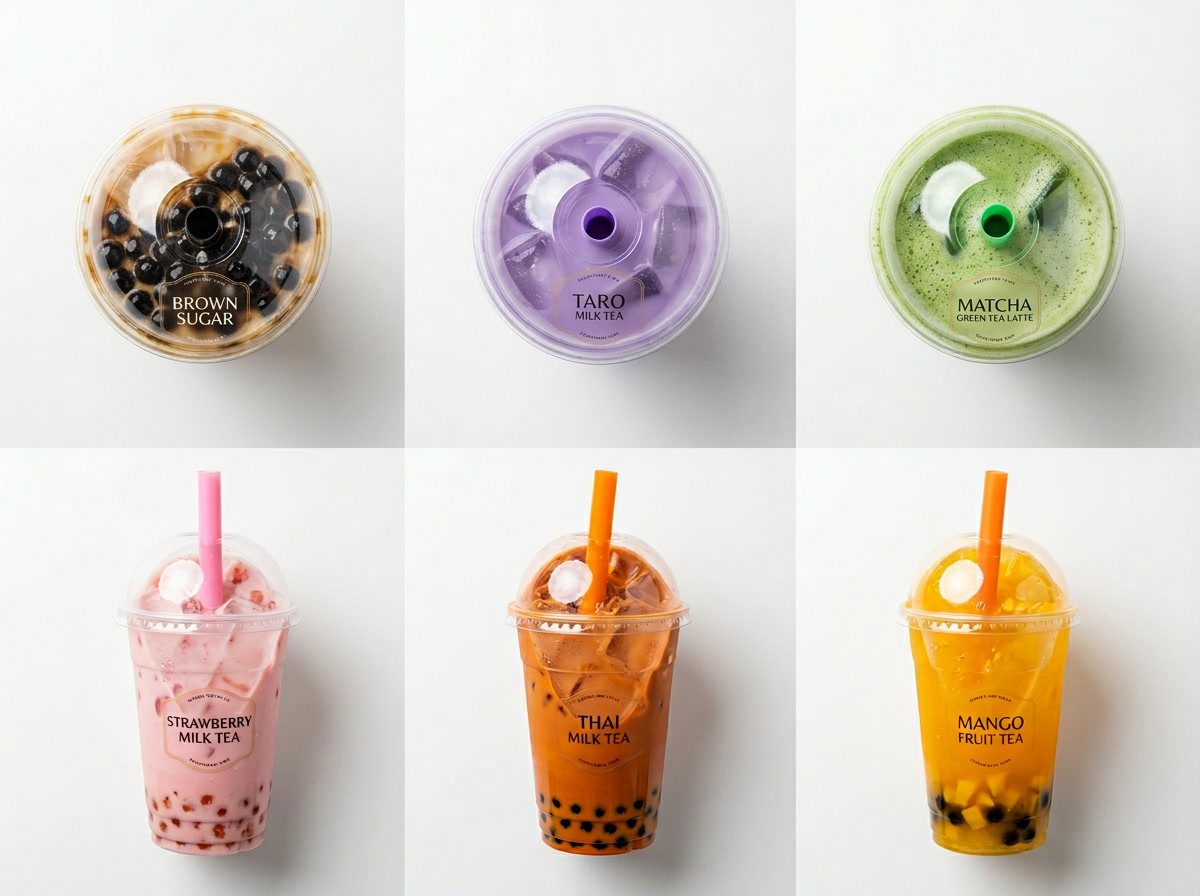
- Taro milk tea — purple-hued drink using taro root powder; requires label-checking
- Brown sugar boba — caramelized brown sugar syrup over milk; usually safe
- Matcha latte boba — matcha powder dissolved in milk; generally safe
- Cheese foam boba — cream cheese topping whipped over tea; usually safe
- Tiger milk tea — brown sugar tiger stripes in milk tea; usually safe
Is Boba Gluten Free? Breaking Down the Core Ingredients
The core answer: yes, traditional boba tea is gluten free because its primary ingredients — tapioca starch, tea, and fresh milk — contain no wheat, barley, or rye.
Understanding why requires looking at each ingredient under the microscope, because the gluten-free label isn’t stamped across every version.
Tapioca Pearls: The Most Important Ingredient
Tapioca pearls are the defining ingredient of boba, and the question “is boba gluten free” often really means “is tapioca gluten free?” The answer is yes — cassava starch (tapioca) is naturally gluten free and safe for people with celiac disease.
Cassava is a root vegetable grown across South America, Africa, and Asia. The starch extracted from its root contains no gluten proteins whatsoever. Traditional tapioca pearls are made from cassava starch, water, and sometimes brown sugar or caramel coloring — all gluten free.
However, here’s where it gets critical: some manufacturers coat finished tapioca pearls in a dusting of wheat starch to prevent sticking during storage and packaging. This is not always disclosed on the label. The National Celiac Association confirms that while plain boba tea should be gluten free, consumers should check whether tapioca pearls have been treated with wheat starch coatings.
In practice, major tapioca pearl brands sold to commercial boba shops (like Wu Fu Yuan, WuFuYuan, or Q-Boba) typically do not use wheat starch coatings, but it’s worth asking your shop about their supplier.
The Tea Base: Naturally Gluten Free
All pure teas — black, green, oolong, white, jasmine, pu-erh — are naturally gluten free. Tea leaves contain no gluten, and the brewing process doesn’t introduce any. Loose-leaf teas and most tea bags are safe.
Where tea can become problematic:
– Flavored tea bags may contain barley malt flavoring (check labels)
– Instant tea powders may have added ingredients — check each product
– Chai blends from some manufacturers may include non-GF additives
For commercial boba shops using standard loose-leaf or traditional tea bags, the tea base is virtually always safe.
Milk and Creamers
Fresh whole milk, skim milk, and most plant-based milks (almond, coconut, soy, oat) are gluten free. The exception worth noting: oat milk. While oats themselves don’t contain gluten, most commercial oat products are processed on shared equipment with wheat. Unless the oat milk is certified gluten free (like Oatly’s GF-labeled varieties), people with celiac disease should request a different milk option.
Traditional non-dairy coffee creamers used at boba shops (like the powder coffee creamer many shops use) are generally gluten free but may vary by brand.
Sweeteners
Simple sugar syrups, fructose syrup, and honey are gluten free. Brown sugar syrup — which is central to tiger milk tea and brown sugar boba — is made from dissolved brown sugar and water, also gluten free.
TABLE 1: Boba Core Ingredients Gluten-Free Status
| Ingredient | Naturally GF? | Hidden Risk | Celiac-Safe? |
|---|---|---|---|
| Tapioca pearls (plain) | ✅ Yes | Wheat starch coating possible | ⚠️ Ask about supplier |
| Black / green / oolong tea | ✅ Yes | Flavored tea bags may contain barley | ✅ Usually safe |
| Fresh cow’s milk | ✅ Yes | None | ✅ Safe |
| Almond / coconut milk | ✅ Yes | Cross-contamination in facility | ✅ Usually safe |
| Oat milk | ⚠️ Depends | Shared equipment with wheat | ⚠️ Must be certified GF |
| Fructose / sugar syrup | ✅ Yes | None | ✅ Safe |
| Brown sugar syrup | ✅ Yes | None | ✅ Safe |
| Non-dairy creamer powder | ⚠️ Varies | Depends on brand | ⚠️ Check brand |
Boba Toppings: Where the Gluten Hides
Most boba toppings are gluten free, but flavored puddings, certain jelly coatings, and some syrup bases can contain gluten — and this is where celiac-risk shoppers need to focus.
Most people asking “is boba gluten free” are thinking about the drink itself, not the extras. This is where things get complicated. The topping bar at a boba shop can be a minefield.
Popping Boba: Is It Gluten Free?
Popping boba (also called bursting boba or fruit pearls) are small spheres filled with fruit juice that burst in your mouth. They’re made using a process called spherification — calcium-rich liquid coated with sodium alginate, a seaweed-derived compound.
Popping boba is generally gluten free. The ingredients — fruit juice, water, sugar, sodium alginate, calcium chloride, coloring — contain no gluten. However, some flavors use artificial flavorings or additives that may vary by manufacturer.
The Reddit celiac community has discussed this extensively, noting that tapioca balls coated in non-GF starch do exist in the market and “GF boba exists, but boba is not automatically” safe — a nuance many non-celiac consumers miss.
Jelly Toppings
Grass jelly, lychee jelly, coconut jelly, and aloe vera jelly are common boba toppings. Most are gluten free:
- Coconut jelly — made from coconut water and agar or konjac, naturally GF
- Grass jelly — made from a dried plant called Platostoma palustre, naturally GF
- Lychee jelly — typically agar-based, naturally GF
- Pudding (egg or taro) — made from eggs, milk, starch (may be cornstarch or tapioca starch, usually GF; confirm with shop)
- Red bean topping — plain red beans are GF; sweetened packaged red bean paste may contain additives
Flavored Syrups and Powders
This is the most significant hidden gluten risk in boba drinks:
- Taro powder — taro root is naturally GF, but many commercial taro powder blends contain powdered creamer, artificial flavor, and in some cases, maltodextrin sourced from wheat. In the US, wheat-derived maltodextrin must be labeled, but at an international brand or non-labeled product, this isn’t guaranteed. Always ask about the taro powder brand.
- Matcha powder — pure ceremonial or culinary matcha is GF; some flavored matcha blends are not.
- Brown sugar syrup — made from sugar and water, safe.
- Flavored syrups (strawberry, mango, passion fruit, etc.) — usually safe, but check if any contain barley malt flavoring (uncommon but possible).
TABLE 2: Boba Toppings Gluten-Free Guide
| Topping | GF Status | Risk Level | Notes |
|---|---|---|---|
| Tapioca pearls (classic) | ✅ Usually GF | Low | Ask about wheat-starch coating |
| Popping boba | ✅ Usually GF | Low | Check manufacturer for unusual flavors |
| Coconut jelly | ✅ GF | Very low | Safe |
| Grass jelly | ✅ GF | Very low | Safe |
| Lychee jelly | ✅ GF | Very low | Safe |
| Egg pudding | ⚠️ Usually GF | Low-medium | Depends on starch used |
| Taro powder | ⚠️ Varies | Medium | Many blends contain non-GF ingredients |
| Matcha powder | ⚠️ Varies | Low-medium | Pure matcha is GF; blends vary |
| Wheat starch pearls | ❌ NOT GF | High | Some commercial pearls use wheat starch |
| Barley malt syrup | ❌ NOT GF | High | Rare but possible in flavored syrups |
Cross-Contamination Risks at Boba Shops
Cross-contamination is the biggest gluten risk for celiac customers at boba shops — even when all the ingredients are technically gluten free.
This is where the gap between “gluten free ingredients” and “celiac safe preparation” becomes critical. According to the Celiac Disease Foundation’s guidelines on food safety, even tiny amounts of gluten — as little as 20 parts per million — can trigger an immune response in people with celiac disease.
Shared Equipment Issues
In a busy boba shop, the same shaker tins, blender jars, measuring cups, and drink dispensers may be used for dozens of drinks in rapid succession. If the shop also serves drinks with wheat-containing ingredients (certain boba snacks, mochi, or waffle cones sold alongside drinks), the risk of cross-contamination goes up significantly.
Specific high-risk scenarios:
– Shared tapioca cooker — if one batch of wheat-starch-coated pearls was cooked in the same pot, residual gluten remains
– Shared blender — if blended drinks with potentially gluten-containing powders are made in the same blender
– Shared scoop or ladle — for toppings bar where multiple items are scooped
– Staff gloves not changed — between handling different ingredients
– Shared fridge space — cross-contact from open containers
What to Ask Your Boba Shop
Before ordering, use these specific questions to assess safety:
- “What brand of tapioca pearls do you use, and are they gluten free?” — A staff member who knows the brand name and can confirm GF status is a green flag.
- “Are any of your powders (taro, matcha, flavored) certified gluten free?” — Many shops can’t answer this on the spot; that’s a yellow flag.
- “Do you use any wheat starch in your kitchen or for any of your ingredients?” — A clear “no” from someone knowledgeable is a green flag.
- “Can you make my drink with a clean shaker and fresh ingredients?” — Most shops will accommodate this request.
- “Do you serve any food items containing gluten in the same prep area?” — If they sell mochi, sandwiches, or baked goods, cross-contamination risk is elevated.
Pro tip from experience: We’ve found that smaller, specialty boba shops with a limited menu and made-to-order preparation are often more reliable than high-volume chains where drinks are assembled assembly-line style. The lower throughput means cleaner equipment turnover.
Specific Boba Varieties: Gluten-Free Status
Most popular boba varieties are gluten free, but taro milk tea and certain flavored powders require extra verification.
Here’s a rundown of the most popular boba drinks and their gluten status:
Taro Boba: Gluten Free or Not?
Taro root itself is 100% gluten free — it’s a starchy root vegetable with no wheat proteins. However, commercial taro powder used in boba shops is not always gluten free. Many taro powder products are formulated blends that include powdered creamer, artificial flavor, and colorings. Some brands use maltodextrin derived from wheat (though in the US, this must be labeled).
If you’re celiac, always ask which brand of taro powder the shop uses and request to see the label if possible.
Brown Sugar Boba: Usually Safe
Brown sugar tiger milk tea is made from brown sugar dissolved in water (to make the tiger-stripe syrup), fresh milk, and tapioca pearls. The brown sugar caramel is naturally gluten free. This is one of the safer specialty boba options for gluten-sensitive customers.
Matcha Boba: Check the Source
Pure matcha (stone-ground green tea leaves) contains no gluten. However, some commercial matcha blends — especially the lower-cost “matcha powder” used in food service — may contain fillers or anti-caking agents. Ask whether the shop uses pure ceremonial-grade or culinary-grade matcha, or a flavored matcha blend.
Classic Milk Tea: Lowest Risk
The original Hong Kong-style milk tea (black tea with evaporated milk and sugar) has the simplest ingredient list and the lowest gluten risk. If you’re extremely sensitive, this is often the safest order.
How to Choose Safe Gluten-Free Boba
To safely enjoy gluten-free boba, choose shops that can verify their tapioca pearl brand, prepare drinks with dedicated equipment, and avoid taro powder unless labeled certified gluten free.
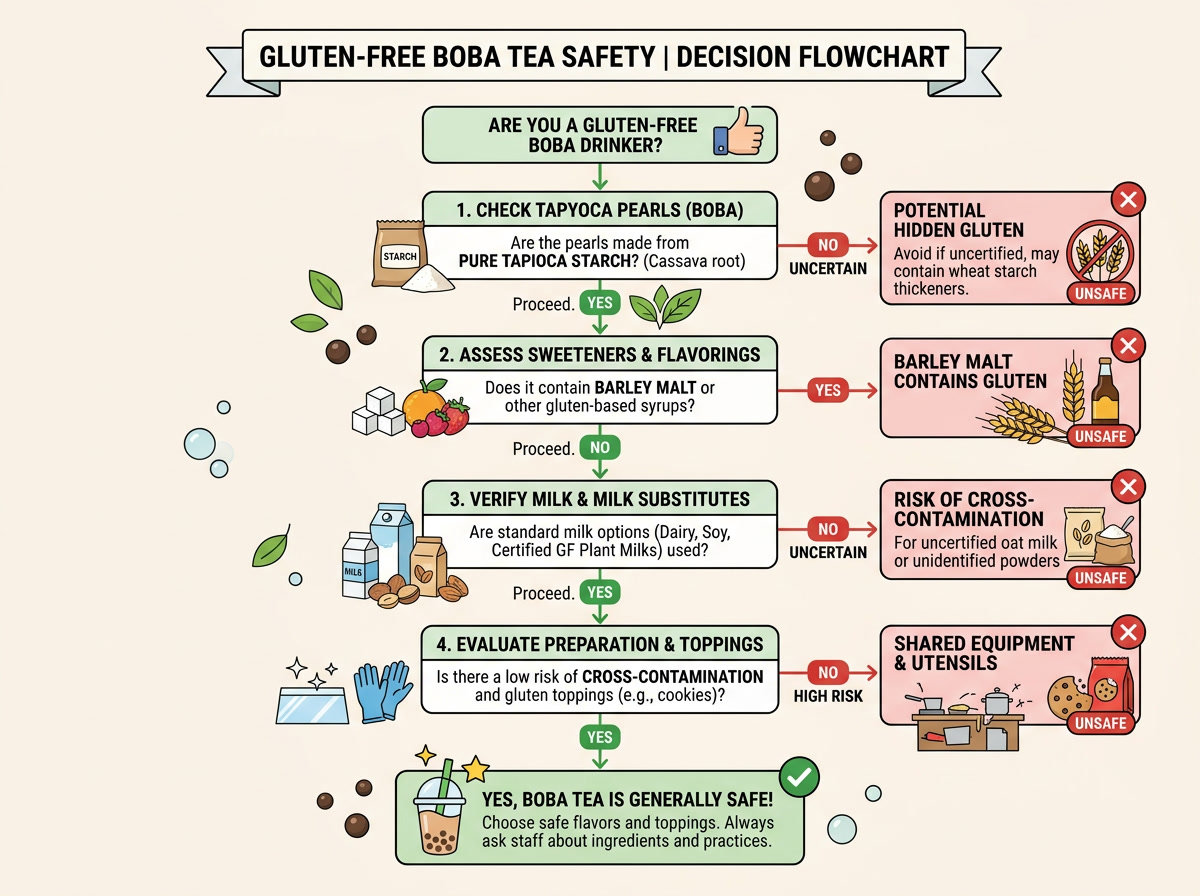
The decision isn’t binary — it’s a risk assessment based on your sensitivity level. Here’s how to approach it:
Decision Framework: Your Sensitivity Level
| Sensitivity Level | Risk Tolerance | Recommended Approach |
|---|---|---|
| Non-celiac gluten sensitivity | Moderate | Most boba shops are fine; avoid obvious gluten ingredients |
| Celiac disease (mild reaction) | Low | Call ahead, ask about pearls + powders, request clean shaker |
| Celiac disease (severe reaction) | Very low | Only certified GF shops or homemade |
| Celiac + multiple food allergies | Minimal | Homemade only |
What to Order if You’re Not Sure
When in doubt, these are the safest choices at a standard boba shop:
– Classic black milk tea with standard tapioca pearls (ask about pearl brand)
– Fruit tea with fruit jelly toppings (skip popping boba if unsure of source)
– Brown sugar milk tea with no added powders
Avoid until verified:
– Taro drinks (unless powder brand confirmed GF)
– Matcha drinks (unless pure matcha confirmed)
– Any drink with multiple flavored powders
Certified Gluten-Free Boba Brands
Some packaged boba brands have obtained third-party gluten-free certification, making them safer for celiac consumers:
- WuFuYuan / Wu Fu Yuan instant tapioca pearls — widely available; most varieties are GF by ingredient, though not always certified
- Bossen brand toppings — some products certified; check individual SKUs
- Q-BOBA — check current product line as formulations change
Always verify current certification status on the product packaging, as formulations and certifications change.
Making Gluten-Free Boba at Home
Making boba at home is the safest option for people with celiac disease — you control every ingredient from certified GF sources.
Home boba preparation has grown significantly in popularity, partly accelerated by the pandemic café closures and partly driven by the demand for dietary-accommodating options. Here’s how to do it safely.
Essential Gluten-Free Ingredients
- Tapioca starch (certified GF) — Bob’s Red Mill Tapioca Flour is certified GF and works perfectly for pearls
- Brown sugar or white sugar — for pearl dough and syrup
- Black tea or green tea — loose leaf from a dedicated GF facility, or any standard pure-leaf tea bag
- Fresh milk or certified GF plant milk — avoid oat milk unless certified GF
- Water — for pearl dough and syrup
Step-by-Step Gluten-Free Boba Recipe
- Make the pearl dough: Mix 1 cup tapioca starch with 2–3 tbsp brown sugar and ½ cup boiling water. Stir quickly until a dough forms.
- Roll pearls: Shape into small balls (~½ inch diameter); roll on a surface dusted with more tapioca starch (not flour).
- Cook pearls: Boil in water for 15–20 minutes until translucent. Let rest 15 minutes off heat.
- Make brown sugar syrup: Dissolve ¼ cup brown sugar in ¼ cup water over low heat.
- Brew tea: Steep 2 tbsp loose-leaf black tea in 8 oz boiling water for 4–5 minutes. Cool.
- Assemble: Add pearls to glass, pour syrup, add ice, pour tea, top with milk. Stir and enjoy.
Total time: ~45 minutes. The pearls can be made in larger batches and stored in simple syrup in the refrigerator for up to 3 days.
Future Trends in Gluten-Free Boba (2025+)
Demand for certified gluten-free boba products is growing rapidly, driven by rising celiac diagnoses and mainstream dietary awareness.
Rising Demand for GF Certification
The number of Americans following a gluten-free diet has grown steadily over the past decade. According to the FDA’s gluten-free labeling regulations, any food labeled “gluten free” in the US must contain fewer than 20 ppm of gluten — creating a legal standard that boba brands are increasingly working to meet.
Several trends are shaping the boba industry’s approach to gluten-free accommodation:
- Menu labeling — major chains like Gong Cha, Tiger Sugar, and Sharetea are publishing detailed allergen menus online as consumer demand for transparency grows
- Certified GF tapioca pearl suppliers — some suppliers now offer third-party GF certified pearls specifically marketed to health-conscious shops
- Plant-based and allergy-friendly expansion — boba shops are increasingly marketing to the health-conscious consumer, making GF accommodation part of brand positioning
Innovation in Boba Ingredients
The boba industry is seeing innovation in ingredients that could improve the gluten-free experience:
- Resistant starch pearls — newer tapioca formulations with added resistant starch for gut health benefits, all naturally GF
- Alternative starch pearls — some manufacturers are experimenting with sweet potato, arrowroot, or konjac-based pearls
- Konjac jelly — low-calorie jelly topping made from konjac (glucomannan), naturally and reliably GF
The spec sheets from food machinery manufacturers rarely mention this, but the industrial process for tapioca pearl manufacturing has become cleaner and more controlled in recent years — reducing the risk of wheat starch cross-contamination at the production level.
FAQ: Is Boba Gluten Free?
Is popping boba gluten free?
Popping boba is generally gluten free. It’s made using spherification — fruit juice or flavoring encased in a gel membrane made from sodium alginate (seaweed-derived). No wheat, barley, or rye is used in the standard process. The exception would be unusual flavors using barley malt or wheat-based flavoring, which is uncommon but not impossible. Check with the shop about their popping boba supplier.
Is brown sugar boba gluten free?
Yes, brown sugar boba is one of the safest boba options for gluten-free drinkers. The brown sugar tiger syrup is made from brown sugar dissolved in water — no gluten-containing ingredients. Combined with fresh milk and traditional tapioca pearls, this drink’s ingredient list is short and clean.
Is boba gluten free and dairy free?
Boba can be both gluten free and dairy free with simple substitutions. Request oat milk (certified GF if needed), almond milk, or coconut milk instead of dairy. Skip any toppings with dairy (egg pudding, cheese foam). Classic fruit teas are naturally dairy free and are a good base choice.
Can celiac patients eat tapioca safely?
Yes — tapioca (cassava) starch is naturally gluten free and safe for people with celiac disease. The grain protein gluten only exists in wheat, barley, and rye. Cassava is a completely unrelated root vegetable. However, verify that the specific tapioca product hasn’t been processed in a facility with wheat contamination risk.
Is taro boba gluten free?
Taro root itself is gluten free, but commercial taro powder used in boba shops often contains non-GF additives. Many taro powder blends include powdered creamer, artificial flavoring, and colorings that may not be certified gluten free. Always ask the shop which brand of taro powder they use and whether it’s gluten free before ordering.
Which country eats the least gluten?
Countries with rice-based food cultures — such as Japan, Thailand, Vietnam, and much of Southeast Asia — traditionally consume the least gluten. Gluten intake is strongly correlated with wheat consumption. Diets centered on rice, cassava, corn, and sweet potato have minimal naturally occurring gluten, though globalization and the introduction of wheat-based foods is changing this.
Is boba jelly gluten free?
Yes, most boba jelly toppings are gluten free. Grass jelly, lychee jelly, coconut jelly, and aloe vera jelly are all made from plant-based gelling agents (agar, konjac, etc.) and are naturally free of gluten. Always confirm with your shop that no wheat-based thickeners were added to the jelly base.
How do I find gluten-free boba near me?
Search for boba shops that post allergen menus online, or call ahead to ask about their tapioca pearl brand and preparation practices. Apps like Find Me Gluten Free can surface user-reviewed boba shops with gluten-free options. Alternatively, making boba at home using certified GF tapioca starch is the most reliable option for people with celiac disease.
Conclusion
So, is boba gluten free? In most cases, yes — plain boba tea made from tapioca pearls, tea, milk, and sugar is inherently gluten free. The core ingredients don’t contain wheat, barley, or rye.
The real risk lies in three places: (1) tapioca pearls that have been coated with wheat starch by certain suppliers, (2) flavored powders like taro and matcha blends that may contain non-GF additives, and (3) cross-contamination at high-volume shops using shared equipment. For non-celiac gluten sensitivity, a standard boba shop is usually fine. For people with celiac disease, the safest path is to call ahead, ask specific questions about ingredients and preparation, or make boba at home using certified GF tapioca starch.
The boba industry is trending toward greater ingredient transparency and dietary accommodation. Until certified GF labeling becomes standard across the category, your best tool is informed questioning. Use the tables and checklists in this guide to make every boba order a confident one.
Internal links: related: gluten-free food and machinery considerations