How to Make Gummy Sweets: The Complete Guide from Home Kitchen to Commercial Production
To make gummy sweets: combine sugar, gelatin, and flavored liquid; heat until dissolved, pour into molds, and refrigerate for 30 minutes to set.
Walk into any candy store and the gummy section is always the busiest. That chewy, bouncy texture — somewhere between a fruit snack and a soft candy — is the result of a surprisingly precise piece of food science. Whether you want to make a small batch at home for a birthday party or you’re exploring what it takes to run a gummy confectionery production line, the fundamentals are the same: the right gelling agent, the right ratio, and controlled heat.
This guide covers everything. Home recipes with exact measurements, the science behind why gelatin behaves the way it does, vegan substitutions that actually work, common mistakes that cause gummies to weep or stay sticky, and — crucially — what changes when you scale from a silicone mold in your kitchen to a commercial gummy candy machine producing thousands of units per hour.
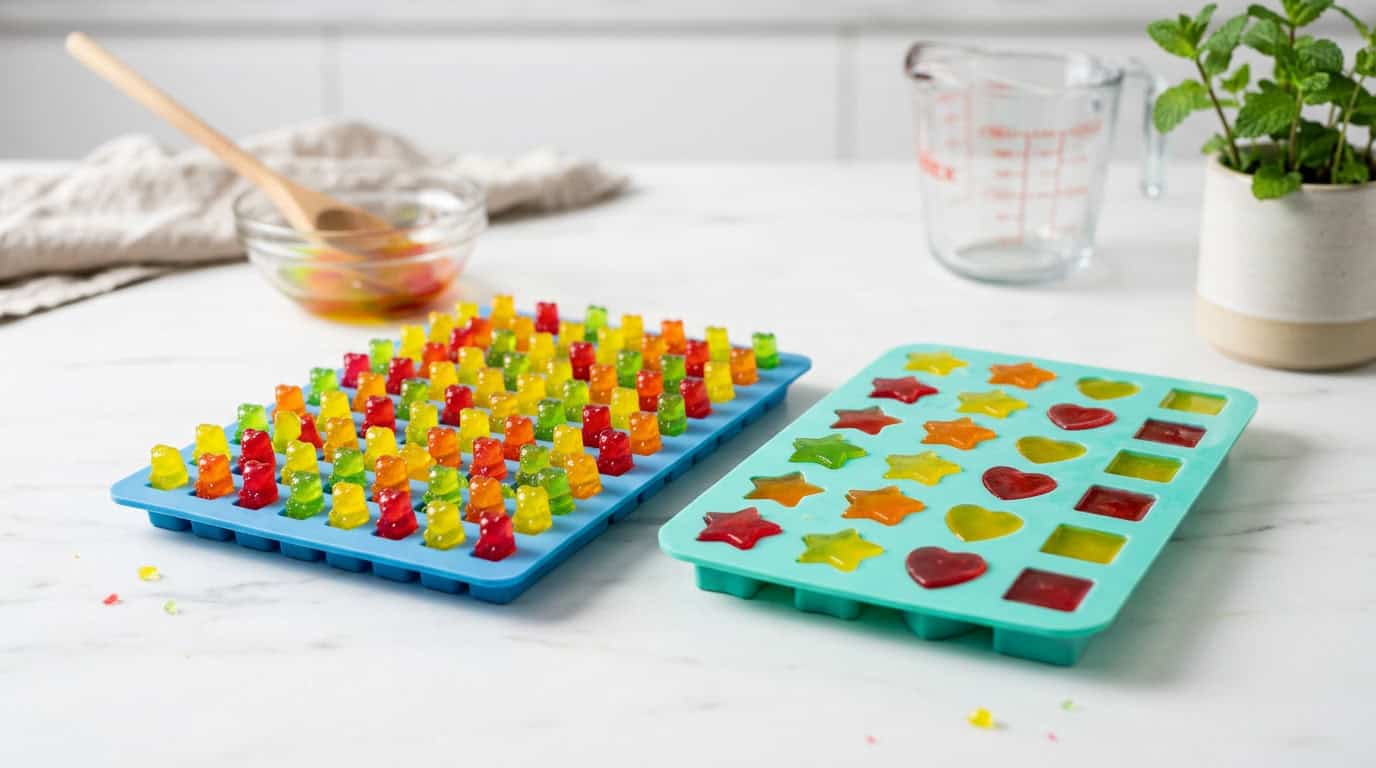
What Are Gummy Sweets? The Science Behind the Chew
Gummy sweets are a confection made by setting a hot sugar-and-gelling-agent syrup in shaped molds.
They are distinct from hard candies (which are glass-like, crystallized sugar structures) and from marshmallows (foam-based). What makes gummies unique is the hydrocolloid network — a mesh of protein or polysaccharide chains that traps water and sugar in a semi-solid matrix. When you bite in, that network deforms elastically before breaking, giving you the signature chew.
The earliest commercial gummy candy was the Haribo Gold Bear, introduced in 1922 by Hans Riegel in Bonn, Germany. According to the Haribo company history, the original recipe used gelatin derived from pork bones — the same basic technology used today, though formulations have diversified dramatically.
The Gelling Agents Behind the Chew
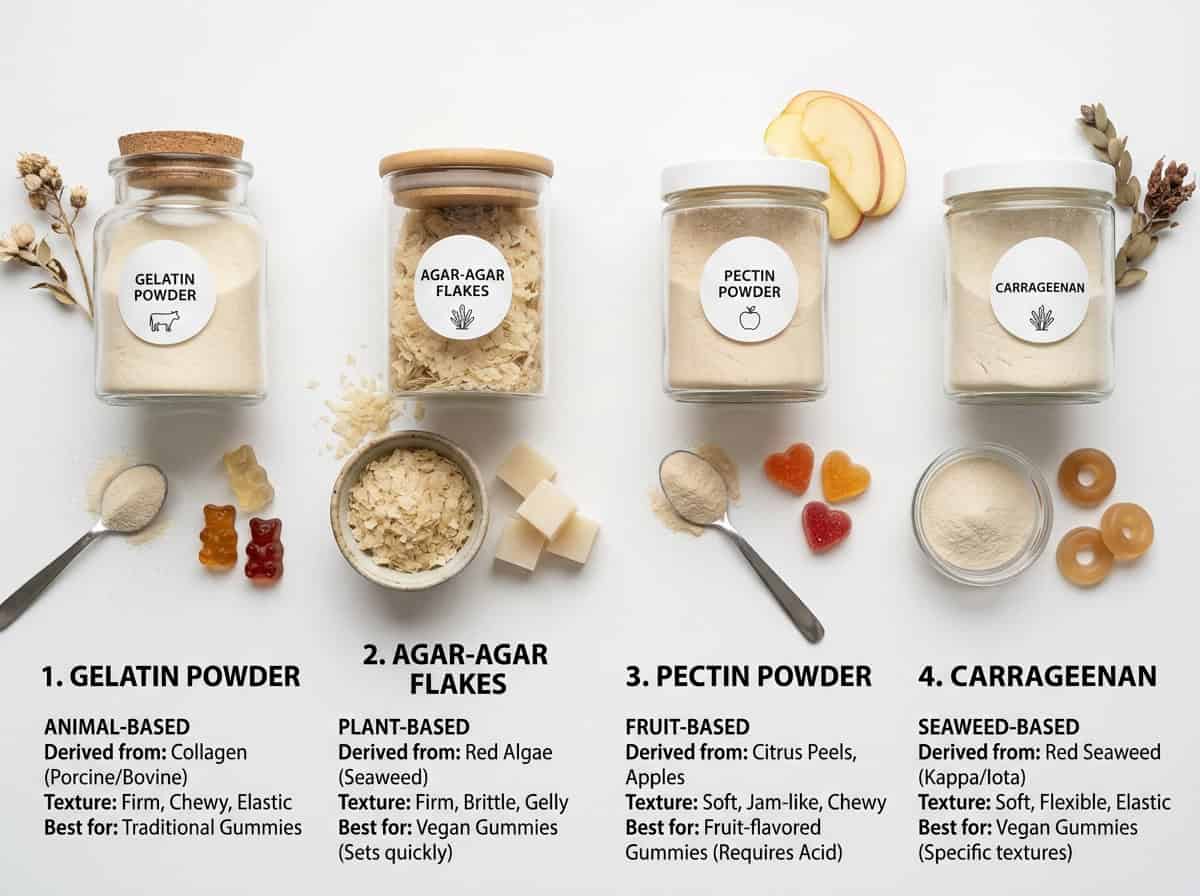
Four main gelling agents are used in gummy production. They are not interchangeable — each delivers a different texture, melt point, and production window.
| Gelling Agent | Source | Texture | Melt Point | Vegan | Notes |
|---|---|---|---|---|---|
| Gelatin (Type A/B) | Pork or beef bones/skin | Elastic, chewy, clear | ~35°C | ❌ No | Industry standard; holds shape well |
| Pectin (HM / LM) | Apple or citrus peel | Softer, more fragile | ~65°C | ✅ Yes | Requires sugar + acid to gel; used in fruit snacks |
| Agar-agar | Red algae | Firm, slightly brittle | ~85°C | ✅ Yes | Sets harder; less elastic; popular in Asian gummies |
| Carrageenan | Red seaweed | Smooth, gel-like | ~60°C | ✅ Yes | Often blended with locust bean gum for elasticity |
TABLE 1: Gelling agent comparison for how to make gummy sweets
Gelatin is dominant in Western gummy production because it produces the most elastic, chewy texture and remains stable at room temperature without weeping. Its melt-in-mouth quality at body temperature is a deliberate sensory feature.
Sugar, Acid, and Flavor: The Flavor Trinity
Beyond the gelling agent, three variables define taste:
- Sweetener — sucrose (table sugar) is standard, but corn syrup or glucose syrup is always added at 20–40% of total sugars to prevent crystallization and control viscosity.
- Acid — citric acid is the most common; malic acid is sharper and longer-lasting; tartaric acid is rare. Acid does double duty: it triggers the sour taste and activates pectin gelling in vegan formulas.
- Flavoring — food-grade flavor concentrates or natural fruit juice. Concentrates are more stable in heat; juice adds authenticity but introduces variables (enzyme content, pH, water content) that can destabilize gelatin.
Core Ingredients for Making Gummy Sweets
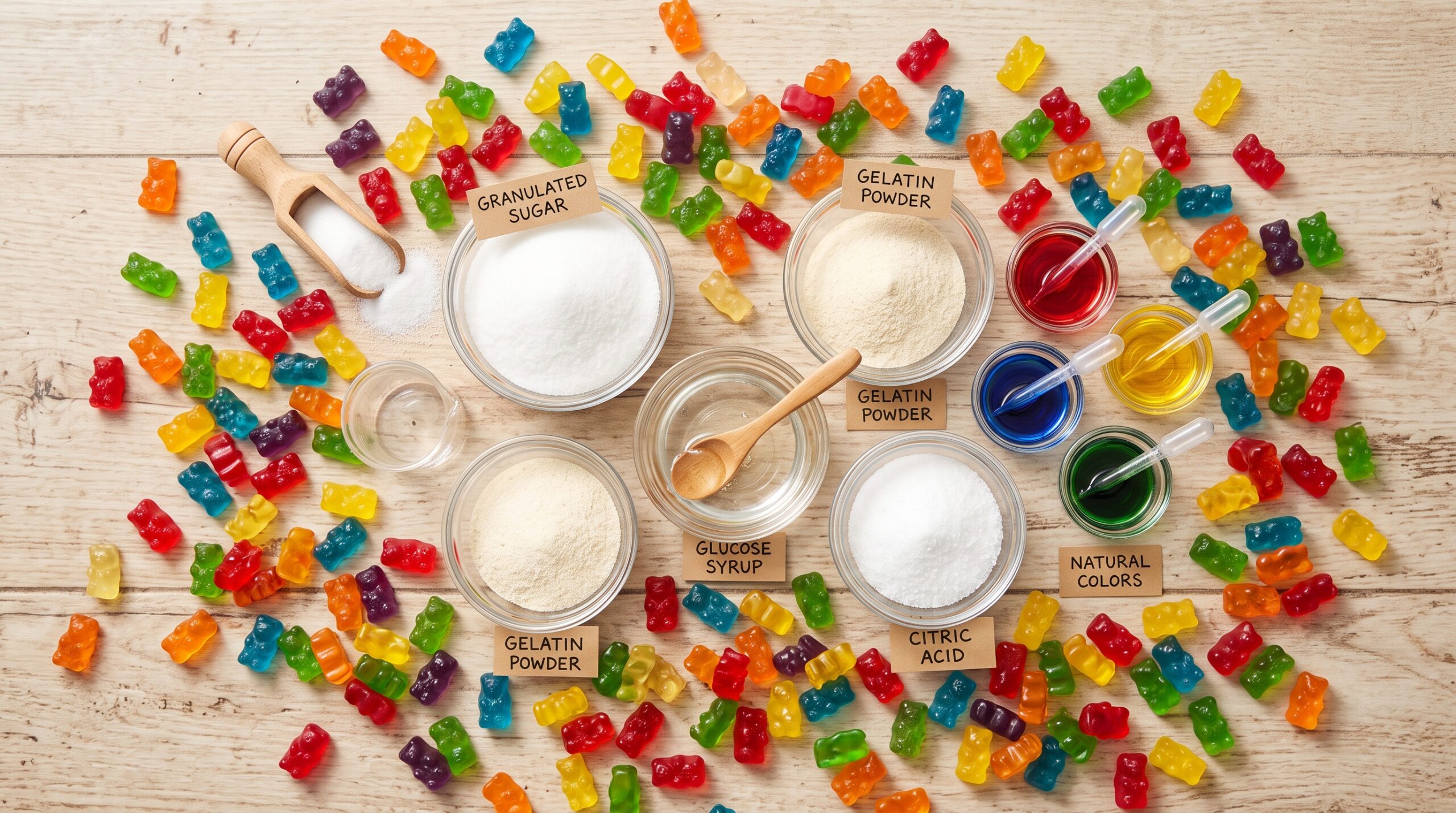
You need a gelling agent, a sweetener, a liquid base, an acid, and a flavor source — that’s the full ingredient set.
Understanding what each ingredient does at a molecular level will prevent the most common failures before they happen.
Gelatin: Bloom Strength Matters
Gelatin comes in two useful forms: powdered (the supermarket standard) and sheet (professional patisserie). Both work; bloom strength (the gel firmness rating) is more important than form.
- Bloom 100–150: soft gummies, chewier, more fragile
- Bloom 200–250: firm gummies, holds shape well, typical of commercial bears
- Bloom 260+: very firm, used in pharmaceutical gummies
Most supermarket gelatin (Knox, Great Lakes) is Bloom 225–250 — ideal for gummy sweets. Professionals use pharmaceutical-grade Type A (porcine) at Bloom 240 for consistent results.
The ratio that works: 1 tablespoon (≈9g) of gelatin per 120ml (½ cup) of liquid produces a firm, bear-like gummy. For chewier results, drop to 7g per 120ml.
Sweeteners: Why You Need Both Sugar and Corn Syrup
Sugar alone crystallizes as the gummy dries, producing a grainy texture on the surface. Corn syrup (or glucose syrup) is hygroscopic — it attracts and retains moisture — and its branched molecular structure physically interrupts crystallization.
A reliable starting ratio: 60% sucrose + 40% corn syrup by weight of total dissolved sugars.
Reduce total sugar content below 50% of the syrup and you get a sticky product that never fully sets. This is one of the most common home-batch failures.
Acids, Colors, and Coatings
Citric acid: add at 0.5–1.5% of total batch weight. Above 2%, the acid starts to hydrolyze the gelatin chains over time, causing the gummy to become soft and weep liquid — this is why sour gummies have a shorter shelf life than plain ones.
Natural colors: anthocyanins (red/purple from berries), curcumin (yellow), spirulina (blue/green). These are pH-sensitive — citric acid will shift some colors dramatically. Synthetic FD&C colors are stable but increasingly being replaced in premium products.
Coatings: the waxy/non-sticky finish on commercial gummies is either:
– Beeswax + carnauba wax blend applied warm
– Sugar sanding (fine crystal sugar dusted post-demold)
– Citric acid + sugar mixture for sour-coated varieties
How to Make Gummy Sweets at Home (Step-by-Step)
The home process takes under 45 minutes active time plus 30–60 minutes setting time in the refrigerator.
Equipment You Need
- Silicone gummy molds (bear, worm, or flat slab shapes)
- Small saucepan
- Silicone spatula
- Kitchen scale (more reliable than volume measures for gelatin)
- Squeeze bottle or dropper bottle (optional, but very helpful for filling molds cleanly)
- Thermometer (the syrup temperature window matters)
Avoid metal molds — the gummy sweets stick and are difficult to demold without tearing.
Basic Homemade Gummy Sweets Recipe (Makes ~60 bear-sized gummies)
Ingredients:
– 120ml (½ cup) fruit juice or flavored liquid
– 2½ tablespoons (22g) unflavored gelatin powder
– 3 tablespoons (36g) granulated sugar
– 1 tablespoon (20g) light corn syrup
– ½ teaspoon citric acid (adjust to taste)
– 2–3 drops food coloring (optional)
– ¼ teaspoon flavoring extract (optional, for concentrated flavor)
Instructions:
- Bloom the gelatin. Pour the cold juice into your saucepan. Sprinkle gelatin evenly over the surface. Wait 5 minutes without stirring — this is “blooming” and it prevents lumps.
- Heat gently. Place over low-medium heat. Stir continuously until the gelatin is fully dissolved and the liquid is clear, about 3–5 minutes. Do NOT boil — temperatures above 82°C (180°F) begin to degrade gelatin, reducing its bloom strength and producing a weaker, cloudier gummy.
- Add sweeteners and acid. Remove from heat. Stir in sugar, corn syrup, citric acid, and coloring/flavoring. Mix until fully dissolved.
- Skim and transfer. Let the mixture sit for 2 minutes, then skim any foam with a spoon. Pour into a squeeze bottle or use a small ladle.
- Fill molds. Work quickly — the mixture sets fast, especially in a cold kitchen. Fill each cavity to the top.
- Set in refrigerator. 30 minutes for small molds (bear-sized), 60 minutes for larger shapes. Do not freeze — ice crystals rupture the gelatin network and produce a grainy texture on thawing.
- Demold. Turn the mold upside-down and push from behind. If they stick, leave them uncovered in the refrigerator for another 2 hours — the surface drying helps.
- Dry for texture (optional but recommended). Leave demolded gummies on a rack at room temperature for 24–48 hours. Moisture evaporation firms the texture significantly and reduces surface stickiness. This step is what makes homemade gummies feel like store-bought.
Pro tip: The “weeping” issue (liquid pooling around gummies) is almost always caused by too much acid or too little gelatin. If your gummies cry, reduce citric acid by half or increase gelatin by 2g next batch.
Common Mistakes and How to Avoid Them
| Mistake | Cause | Fix |
|---|---|---|
| Gummies won’t set | Too little gelatin; boiled mixture | Use scale (not spoon); heat gently, never boil |
| Gummies are too soft | Bloom too low; not enough dry time | Use Bloom 225+ gelatin; air-dry 24h |
| Surface is sticky | High humidity; not enough dry time | Dust with cornstarch; store in airtight container with silica gel |
| Gummies are weeping / wet | Too much citric acid | Reduce acid; add after removing from heat |
| Cloudy texture | Over-boiled; foam not skimmed | Heat to max 80°C; skim foam; filter through cheesecloth |
| Uneven mold fill | Syrup too cool / viscous | Fill at 65–70°C; work fast or keep warm over low heat |
TABLE 2: Common gummy-making mistakes and solutions
Commercial Gummy Sweet Production: What Changes at Scale
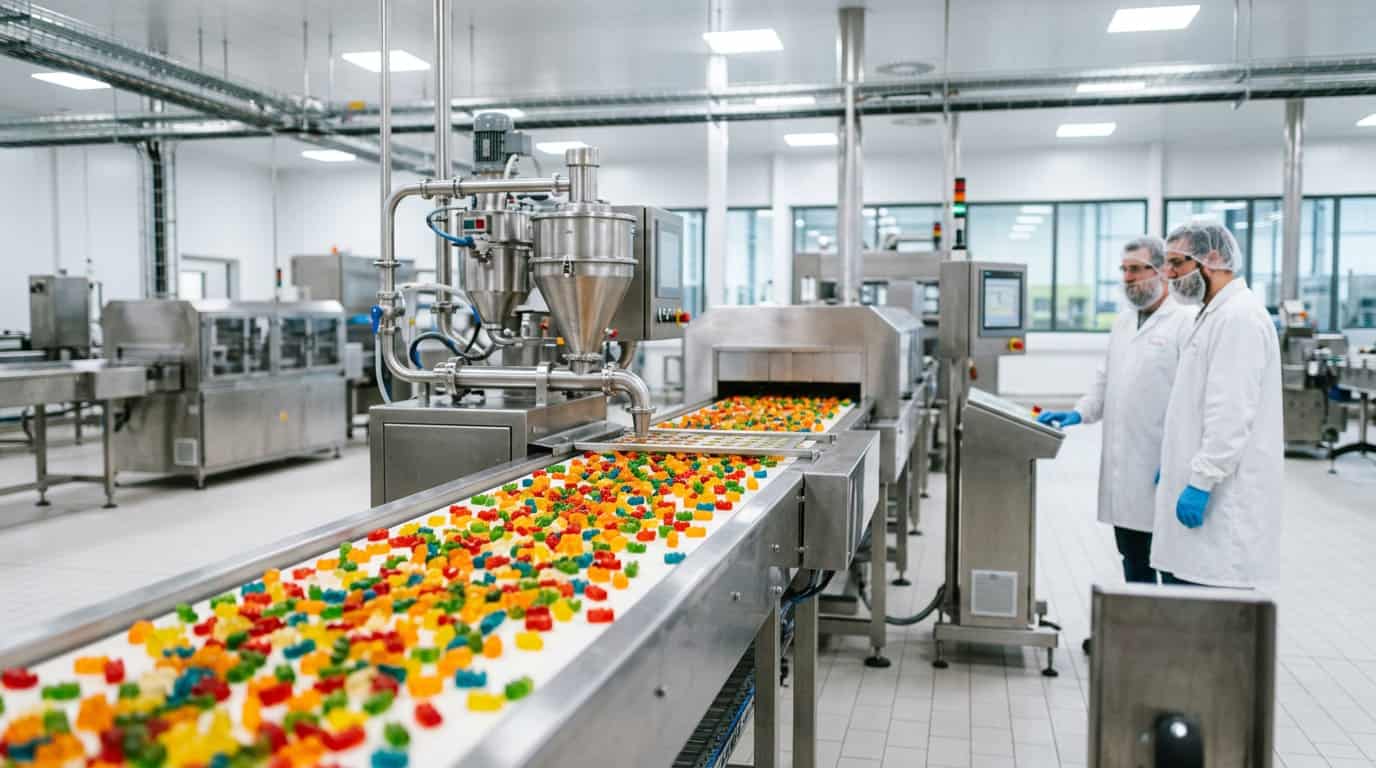
At commercial scale, the home method is replaced by continuous depositing lines, starch mogul systems, and automated demold — same chemistry, radically different precision.
This is where gummy candy machines become essential. Home production can manage 100–200 pieces per batch. A commercial gummy depositing machine produces 100,000–600,000 pieces per hour, with precise weight control (±0.1g), automated cooling tunnels, and programmable multi-color/multi-flavor depositing.
The Role of gummy candy machines
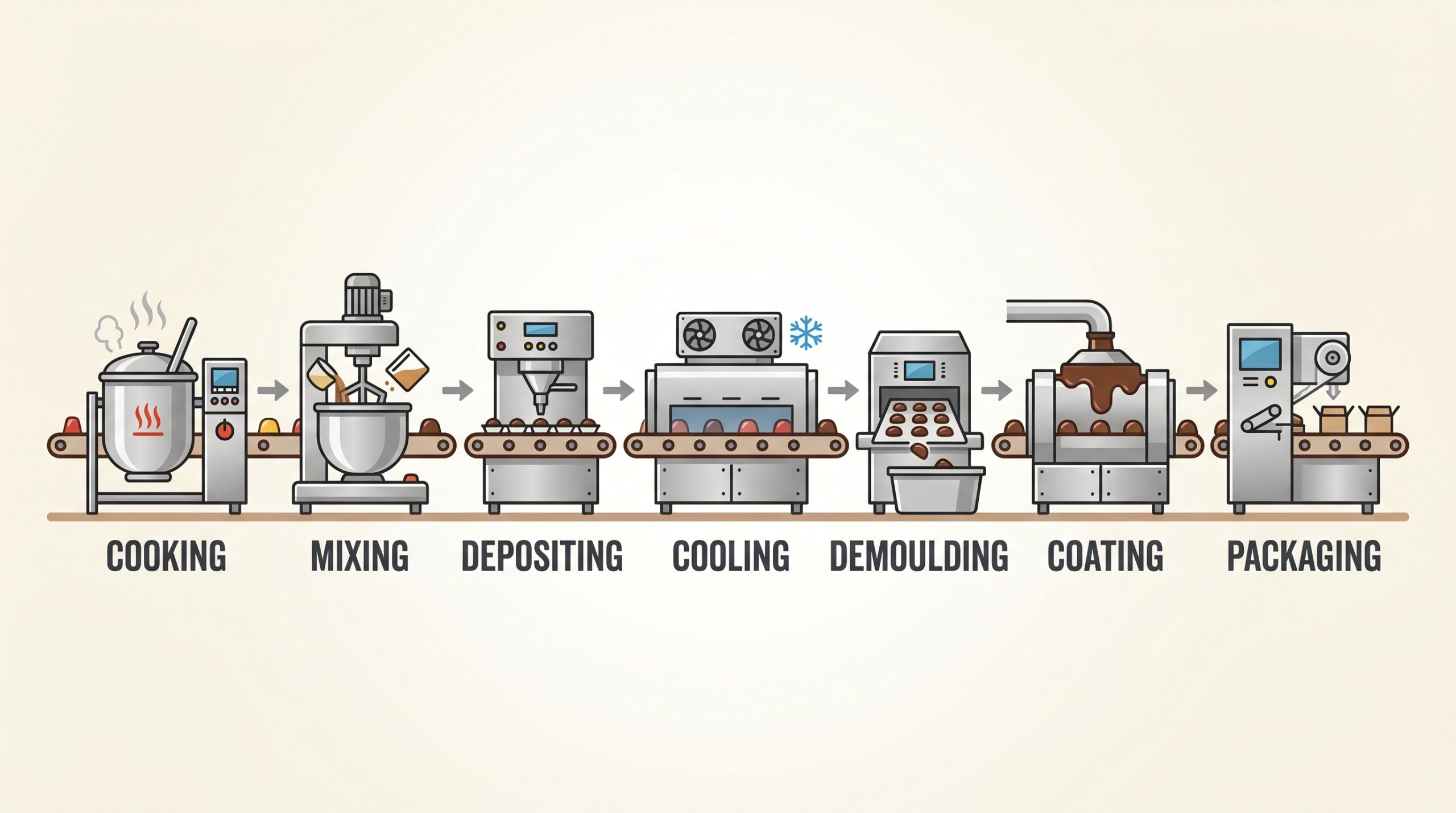
The commercial process for how to make gummy sweets at scale has these stages:
1. Batch cooking — Automated cookers dissolve gelatin, sugar, and glucose syrup in precise ratios at controlled temperatures (typically 105–115°C under pressure for gelatin systems). Continuous cookers are preferred over batch kettles above 500kg/hour capacity because they maintain tighter Brix control (°Brix measures dissolved sugar concentration — target is usually 74–78°Brix for gummies).
2. Conditioning — The hot syrup is held in a conditioning tank at 70–80°C with continuous agitation to degas and allow flavoring/acid/color dosing.
3. Depositing — The conditioned mass is pumped through heated pipes to a depositor head. Two types dominate:
- Starch mogul (Mogul machine): Deposits into starch-lined trays pressed with 3D impression dies. The starch absorbs surface moisture during setting, creating a dry, slightly matte finish. Industry-standard for traditional gummies.
- Silicone mold depositor: Deposits into reusable silicone molds on a continuous conveyor. Easier to clean, better for functional gummies (vitamins, CBD), but starch moguls are faster at scale.
4. Cooling and setting — Trays or molds move through a temperature-controlled cooling tunnel. Gelatin gummies typically set at 10–15°C; pectin systems require a slower, more controlled temperature drop to build the HM pectin network.
5. Demold and drying — Starch is tumbled off in a rotating drum; gummies go to a climate-controlled dryer (20°C, 30–40% relative humidity) for 24–48 hours to reach target moisture content (typically 17–20% final moisture).
6. Coating/oiling — Wax or oil coating is applied in a rotating pan to prevent sticking.
7. Quality control — Commercial lines include in-line weight checkers, vision systems for shape/color inspection, and metal detectors.
Starch Mogul Systems vs. Silicone Mold Depositors
| Feature | Starch Mogul | Silicone Mold Depositor |
|---|---|---|
| Output | Very high (up to 600,000 pcs/hr) | Moderate (50,000–200,000 pcs/hr) |
| Mold flexibility | High (any shape via die) | High (custom silicone molds) |
| Starch management | Requires starch handling, sieving, reconditioning | No starch needed |
| Finish | Slightly matte, dry surface | Smooth, glossy (if oiled) |
| Best for | Traditional gelatin gummies at volume | Functional gummies, clean production |
| Capital cost | Higher | Lower |
TABLE 3: Starch mogul vs. silicone depositor comparison for commercial gummy production
The choice between systems depends on production volume, product type, and facility footprint. For new operations producing under 500kg/day of gummy sweets, a silicone mold depositor line is generally the better starting point — lower capital cost, easier sanitation, and no starch-handling infrastructure needed.
Quality Control in Professional Gummy Production
Home cooks judge gummies by taste and feel. Professional production measures:
- Brix (refractometer): dissolved sugar content of the cooked mass before depositing
- Bloom strength verification on each gelatin batch received
- pH (pH meter): critical for pectin gummies and sour products where acid content affects gelatin integrity
- Water activity (Aw): target 0.60–0.65 for shelf stability; above 0.70, mold risk increases
- Texture profile analysis (TPA): instrumental testing of hardness, cohesiveness, springiness to ensure batch-to-batch consistency
According to food science guidelines published by the Institute of Food Technologists, water activity control is the single most important shelf-stability parameter in intermediate-moisture confections like gummies — more impactful than total sugar content or pH alone.
Gummy Sweet Variations and Special Formulas
Beyond the classic bear, gummy sweets span a wide spectrum of textures, ingredients, and functional additions.
Vegan Gummies: Pectin-Based Formula
Pectin gummies behave differently from gelatin gummies — they are firmer, have a higher melt point, and set faster once cooled. The formula requires:
- High-methoxyl (HM) pectin: 1.5–2.5% of total batch weight
- Sugar concentration: must be above 55% total solids to trigger HM pectin gelling
- pH: 2.8–3.5 (citric acid is both flavor and gelling activator)
- No fat: pectin is sensitive to lipid interference; avoid any fat-containing flavors
HM pectin gummies cannot be made by simply substituting pectin for gelatin in a gelatin recipe — the process, ratios, and temperature management are fundamentally different. The pectin must be dispersed in sugar first (not liquid) to prevent clumping, then brought to temperature with the water phase.
For commercial vegan gummy production, the pectin gummy formulation guide from Cargill’s food ingredient division provides detailed process parameters including Brix targets (78–82°Brix for standard fruit gummies using HM pectin) and minimum sugar requirements.
Functional Gummies: Vitamins, CBD, Collagen
The global gummy vitamin market was valued at approximately $5.1 billion in 2023 and is growing at over 12% annually, driven by consumer preference for gummies over traditional pill or capsule supplements. This growth has driven significant technical innovation in how to make gummy sweets that carry active ingredients.
Key formulation challenges:
– Heat-sensitive actives (vitamins C, B1, probiotics): added post-cook, below 60°C
– Hydrophobic actives (vitamin D, CBD): require emulsification (sunflower lecithin or polysorbate 80)
– Dose accuracy: active ingredients must be homogeneous throughout the batch; this requires mixing equipment capable of ±3% dose uniformity
– Regulatory compliance: gummy supplements are regulated as dietary supplements in the US (FDA 21 CFR Part 111 GMP requirements) or as food in the EU — labeling, batch testing, and facility standards differ significantly
Sour and Coated Gummy Sweets
Sour gummies have a short acid exposure time at the surface — the coating is pure citric acid (or citric-malic blend) mixed with fine sugar. The ratio: 1 part citric acid : 3–4 parts fine sugar by weight, dusted or tumbled onto the gummy surface immediately after demold.
The challenge with sour-coated gummies on the production line is timing. If you coat too early (while still moist), the acid dissolves into the gummy surface and you lose the sour hit. If you coat too late (after full drying), the coating won’t adhere. The window is typically 30–60 minutes post-demold while the surface is still slightly tacky.
Future Trends in Gummy Confectionery (2026 and Beyond)
The gummy sweets market is moving toward plant-based, functional, and precision-manufactured products.
Plant-Based and Clean-Label Gummies
Consumer demand for gelatin-free confectionery is accelerating. The EU market for vegan-certified gummies grew by 22% from 2022 to 2024 (data from Innova Market Insights). This is driving reformulation across the industry:
- Pea protein + pectin blends: deliver a chewier texture than pectin alone, closing the gap with gelatin
- Tapioca starch + carrageenan: used in Asian-market gummies; stable at higher temperatures
- Chicory root fiber (inulin): added for prebiotic claims without significantly altering texture
For manufacturers, the switch to plant-based gelling agents requires significant equipment recalibration — pectin and carrageenan systems set differently on the line, and starch mogul compatibility needs testing.
Precision Nutrition and Personalized Gummy Supplements
The intersection of gummy candy and precision nutrition is emerging: gummies where the dose of active ingredients (vitamins, adaptogens, nootropics) is individualized based on health data. While this is nascent, several DTC brands are already offering subscription gummy packs tailored to blood panel data or wearable device metrics. This requires flexible depositing equipment capable of small-batch, multi-formulation runs — the opposite of the high-volume commodity approach.
Frequently Asked Questions About Making Gummy Sweets
How do I make my own gummy sweets from scratch?
Start with 120ml of fruit juice, 22g of gelatin, 36g sugar, and 20g corn syrup. Bloom gelatin in cold juice for 5 minutes, heat gently until dissolved (never boil), stir in sweeteners and ½ tsp citric acid, fill silicone molds, and refrigerate 30 minutes. Air-dry for 24 hours for best texture.
What are the three main ingredients in gummy bears?
Gelatin, sugar, and a flavored liquid. Gelatin provides the elastic, chewy structure. Sugar (typically combined with corn syrup to prevent crystallization) provides sweetness and body. The liquid carries flavor and activates the gelatin. Citric acid and coloring are optional fourth and fifth ingredients.
What’s the secret to perfect homemade gummies?
The drying step. Most home recipes tell you to eat gummies straight from the mold. Commercial gummies are dried for 24–48 hours after demolding, which removes 5–8% additional moisture, firms the texture, and eliminates surface stickiness. Do this at room temperature on a wire rack, uncovered. It transforms the result.
How do you make gummy sweets without gelatin?
Use pectin (1.8% of total weight) combined with high sugar content (above 60% solids) and citric acid at pH 3.0–3.3. The process differs from gelatin: disperse pectin in sugar first, then add to hot liquid, and bring to 104–106°C before depositing. The result is firmer and sets faster than gelatin gummies.
Why are my homemade gummies sticky?
Two causes: insufficient drying time (solution: air-dry 24–48 hours on a rack), or high ambient humidity (solution: store in an airtight container with silica gel packets, or dust lightly with cornstarch). Do not refrigerate finished gummies in an open container — the condensation cycle makes stickiness worse.
What equipment do commercial gummy factories use?
Professional facilities use a gummy depositing line consisting of a batch cooker or continuous cooker, conditioning tanks, a depositor head (starch mogul type or silicone mold type), a cooling tunnel, a demold system, a climate-controlled dryer, and a coating drum. Output ranges from 50,000 to over 600,000 pieces per hour depending on line configuration and gummy size.
Can I scale up my home gummy recipe for small-batch commercial production?
Yes, but the process changes. At batch sizes above ~5kg, temperature management becomes critical — a domestic saucepan can’t maintain precise temperature control. You’ll need a jacketed kettle with agitation, a depositing pump or at minimum a temperature-controlled heated holding tank, and a calibrated refractometer to measure Brix. Reddit’s r/AskCulinary community has practical experience threads on scaling gelatin-based confections that are worth reviewing before investing in equipment.
Conclusion
Making gummy sweets is one of the most satisfying confectionery projects at any scale. At home, the recipe is forgiving and quick — the real secret is patience during the drying step that most guides skip. At commercial scale, the same chemistry becomes a precision engineering problem: Brix control, bloom verification, water activity management, and depositing line selection.
The gummy sweets market rewards quality and differentiation. Whether you’re perfecting a home batch or planning a production line, the formulation principles in this guide give you the foundation to iterate confidently. Start with the basic gelatin recipe, master the drying window, and — if you’re scaling — work backward from your target output volume to size the equipment correctly.
Internal links to review: related: gummy candy machine buyer’s guide, related: pectin vs gelatin in candy making, related: gummy vitamin production line setup
Related Articles
- How Do You Make Gummy Bears? From Home Kitchen to Commercial Production
- Red Lobster Cheddar Bay Biscuit Recipe: The Complete Guide from Home Kitchen to Commercial Bakery
- Gummy Snakes: The Complete Guide to Commercial Production and Market Trends
- Gummy Sweets Bulk Production: Technical Manufacturing Analysis 2025
- Gummy Candy Production Line
- Starch-Free Gummy Depositing Machine
- Are Skittles Gluten Free? Complete Guide 2026