Gluten free buttermilk biscuits use a GF flour blend with xanthan gum, cold butter, and acidic buttermilk to replicate the flaky, tender layers of Southern-style wheat biscuits. Same technique, different chemistry.
Southern buttermilk biscuits have a reputation for being impossible to make without wheat flour. That reputation is mostly wrong, but only if you understand what gluten was doing in the first place and what actually needs to replace it. Most GF biscuit failures aren’t technique problems. They’re flour problems, or leavening problems, or temperature problems. All fixable once you know which one you’re dealing with.
This guide covers home baking and commercial production. Whether you’re making gluten free buttermilk biscuits for a celiac household or evaluating GF formulation for a commercial bakery line, the science, the recipe, and the troubleshooting detail are all here.
What are gluten free buttermilk biscuits?
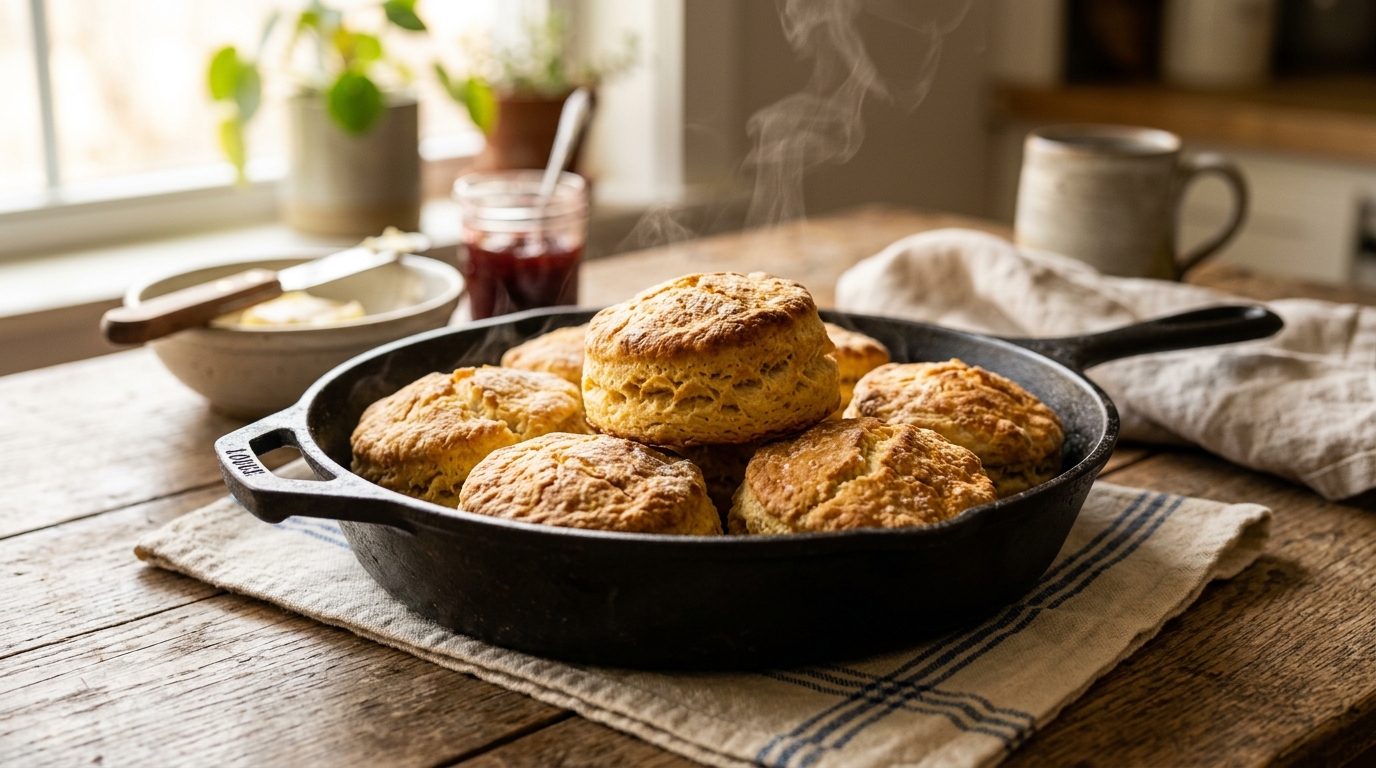
Gluten free buttermilk biscuits replace wheat flour with a starch-and-binder blend while preserving the cold-fat lamination and buttermilk acid reaction that give Southern biscuits their structure and rise.
To understand why GF biscuits behave the way they do, you need to look at what a traditional biscuit is actually built on. Three structural mechanisms work together: the protein network from gluten (which holds the dough together and traps gas during baking), the flaky pockets from cold fat cutting through flour layers (lamination), and the CO2 produced when baking powder and buttermilk acid react (rise). Remove gluten and one of those three legs disappears.
The gluten network in a wheat biscuit does two things worth naming. First, it holds the dough together while you roll and cut it. Second, it traps gas during the oven spring so the biscuit rises straight and tall rather than spreading flat. Without it, GF doughs tend to be sticky, fragile, and prone to spreading. The fix is a binder (xanthan gum, psyllium husk, or a combination) that mimics gluten’s cohesive properties without recreating its full elastic network.
How gluten functions in traditional biscuits
Gluten forms when glutenin and gliadin proteins in wheat flour hydrate and align into an elastic network. In biscuits (unlike bread), you deliberately limit gluten development by using cold fat and minimal mixing. Even a lightly developed gluten network provides enough structural scaffolding to hold a cut biscuit together during baking. Take it out entirely and you need something else to play that role.
The most common solution in commercial and home GF flour blends is xanthan gum, a polysaccharide produced by bacterial fermentation (Xanthomonas campestris). It functions as a hydrocolloid: it increases dough viscosity and creates cohesion that lets the dough be worked, cut, and handled before baking. The dosage matters a lot. Too little and the biscuit crumbles before it reaches the pan; too much and the baked interior turns gummy and dense.
Why buttermilk is doing real work here
Buttermilk isn’t just a flavor choice. In gluten free buttermilk biscuits, it’s doing active chemical work. Buttermilk is acidic (pH around 4.5), and that acidity reacts with baking soda to release CO2 quickly, before the biscuit even hits the oven. That quick early gas production creates the initial lift that sets the biscuit’s internal structure.
Buttermilk’s acidity also tenderizes the starches in GF flour blends, which is why biscuits made with plain milk are consistently tougher and less interesting in flavor. Full-fat buttermilk outperforms low-fat because the additional fat reinforces the tenderness the cold butter is building. According to dietary guidance from the Celiac Disease Foundation, most people with celiac can safely consume all forms of dairy unless they have secondary lactose intolerance, so buttermilk is typically fine for most GF eaters.
| Feature | Traditional biscuit | Gluten free buttermilk biscuit |
|---|---|---|
| Flour | All-purpose or pastry flour | GF blend (rice + tapioca + potato starch) |
| Structure agent | Gluten protein network | Xanthan gum or psyllium husk |
| Texture | Slightly chewy, very flaky | Tender, crumbly; flaky with correct technique |
| Rise reliability | Very high | Moderate, requires precise leavening ratio |
| Key challenge | Overworking (too much gluten) | Inadequate cohesion (too little binder) |
| Shelf life | 1-2 days at room temp | Best same-day; starches dry faster than gluten flour |
Choosing the right gluten-free flour blend
The flour blend is the single biggest variable in gluten free buttermilk biscuits. Technique barely matters if the flour ratio is wrong.
Different GF flour blends behave radically differently in a high-fat, quickly-leavened biscuit dough. Not all blends are designed for this application. Some are optimized for cookies (high starch, low protein) and produce flat, dense biscuits when you try to use them here. Others work exactly as needed.
Store-bought blends: King Arthur, Bob’s Red Mill, Cup4Cup
Three blends are worth knowing by name for gluten free buttermilk biscuits.
King Arthur Gluten-Free Measure for Measure is white rice flour, whole grain brown rice flour, tapioca starch, potato starch, and xanthan gum. Designed as a 1:1 swap for AP flour. The xanthan content is calibrated for quick breads (roughly 0.5% by weight), which is exactly the right level for cut biscuits: enough cohesion to hold a shaped edge without producing a gummy crumb. This is our go-to for recipe development because the results are consistent batch to batch.
Bob’s Red Mill 1-to-1 Baking Flour combines sweet white rice flour, whole grain brown rice flour, potato starch, tapioca flour, sorghum flour, and xanthan gum. The sorghum flour contributes a mild wheaty note and slightly more protein than a pure rice-starch blend. Results are consistently good; the biscuits come out slightly denser than King Arthur but well within the “good biscuit” range.
Cup4Cup Multipurpose Flour adds milk powder to its white rice flour, brown rice flour, cornstarch, tapioca starch, and potato starch base. The milk powder adds richness, improves browning, and contributes to crust color in a way that pure starch blends can’t match. It produces the closest result to a traditional biscuit in terms of crust and crumb. More expensive than the other two, and contains dairy, which matters if you’re making dairy-free biscuits.
Building your own GF flour blend
For commercial food service or manufacturing operations making gluten free buttermilk biscuits at scale, a custom blend is more economical and controllable than pre-mixed retail products. A biscuit-optimized GF flour formula that scales well:
- 40% white rice flour (neutral flavor, fine texture, provides bulk)
- 20% tapioca starch (adds slight chewiness, improves browning through Maillard reaction)
- 20% potato starch (lightens the crumb, reduces the starchy mouthfeel of rice-heavy blends)
- 15% sorghum flour (mild wheaty flavor, added protein, reduces glycemic index vs. pure starch)
- 5% arrowroot starch (helps crisp the exterior without drying the interior)
Add 0.5-0.75g xanthan gum per 100g of this blend if not already included.
Xanthan gum, psyllium husk, and other binders
In biscuits, xanthan gum is a precision ingredient. At 0.4-0.6% by flour weight, it provides enough cohesion for cut biscuits without making the crumb gummy. Go above 0.8% and you’ll feel the difference. The baked biscuit takes on an almost chewy, rubber-band quality that nobody wants.
Psyllium husk is a viable alternative for bakers who find xanthan causes GI irritation (a real issue for a subset of people with gut sensitivity). It works at about 1.5x the xanthan dosage (0.75-1g per 100g flour for biscuits) and produces a slightly denser, more bread-like crumb. Some bakers blend the two: a small amount of xanthan for cohesion plus a small amount of psyllium for moisture retention.
| Blend | GF flour composition | Xanthan included | Best for biscuits? | Approx. cost/lb |
|---|---|---|---|---|
| King Arthur M4M | Rice, tapioca, potato starch | Yes | Yes, excellent | ~$7-8 |
| Bob’s Red Mill 1-to-1 | Rice, potato, tapioca, sorghum | Yes | Yes, very good | ~$6-7 |
| Cup4Cup Multipurpose | Rice, cornstarch, tapioca, potato, milk powder | Yes | Best result | ~$10-12 |
| DIY rice-tapioca-potato | Fully customizable | Add separately | Yes, cost-effective at scale | ~$3-4 |
| Almond flour only | 100% almond meal | None | No, too dense, won’t rise | ~$10-14 |
Step-by-step recipe: gluten free buttermilk biscuits
The core recipe for gluten free buttermilk biscuits runs on the same principle as Southern wheat biscuits: cold fat, minimal mixing, high heat. The differences between wheat and GF versions are small but unforgiving.
Ingredients and what each one does
Makes 8-10 biscuits.
- 2 cups (280g) GF all-purpose flour blend (King Arthur or Bob’s Red Mill)
- 1 tbsp baking powder
- 1/2 tsp baking soda
- 1 tsp fine sea salt
- 1 tsp granulated sugar
- 6 tbsp (85g) cold unsalted butter, cubed to 1/4-inch pieces
- 3/4 cup (180ml) cold full-fat buttermilk, plus a little more for brushing the tops
The baking powder and baking soda work as a double-leavening system. The soda reacts with buttermilk’s acid at room temperature for immediate lift; the baking powder reacts with heat in the oven for sustained rise. GF flour is denser than wheat, so you need both.
Cold butter is the whole point. Butter that melts before baking smears into the flour and you lose your flaky pockets. You need distinct butter pieces that create steam and separate the dough layers. The 1 tsp of sugar isn’t for sweetness; it feeds the Maillard browning reaction that gives biscuits their golden crust. Without it, GF biscuits come out pale. And don’t reduce the salt: GF flours taste flat and starchy without enough of it.
The cut-in method for flaky layers
Work cold butter into the dry ingredients with a pastry cutter or two butter knives until the mixture looks like coarse crumbs with a few pea-sized butter pieces still intact. You’re not trying to produce a uniform sandy texture. Those uneven butter chunks become the flaky layers.
Add the cold buttermilk all at once. Stir with a fork until the dough just comes together, about 12 strokes, no more. GF dough will look shaggy and slightly wetter than a wheat biscuit dough. That’s correct. The xanthan gum needs about 30 seconds to fully hydrate after the liquid hits the flour, and the dough firms up noticeably in that time. If it still looks impossibly wet after 30 seconds, refrigerate it before adding more flour. Nine times out of ten, it doesn’t need more flour.
Refrigerate the dough for 15-20 minutes. This step is optional for wheat biscuit dough; for gluten free buttermilk biscuits it’s essentially mandatory. Chilling allows the xanthan gum to fully hydrate, firms the butter back to a workable temperature, and makes the dough manageable enough to cut without tearing.
Shaping, cutting, and baking
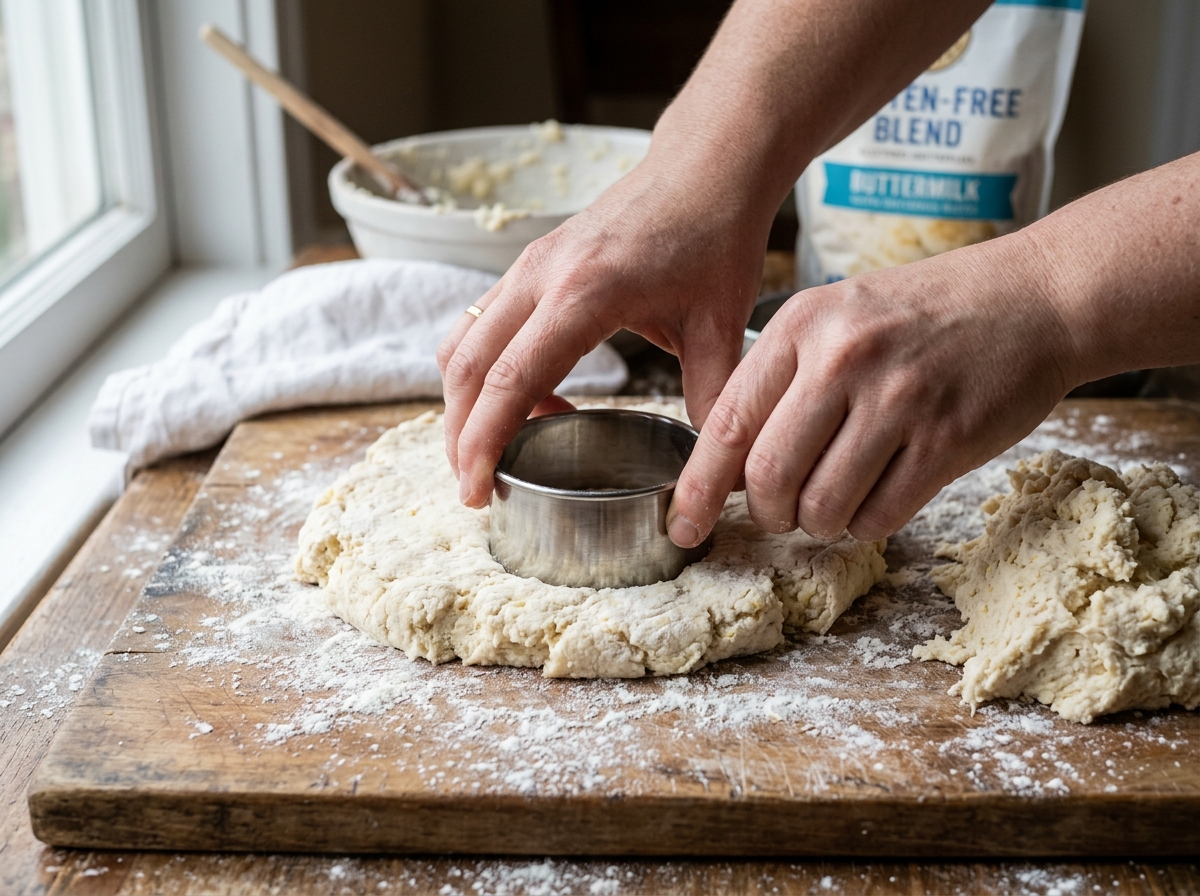
Turn the chilled dough onto a surface lightly dusted with GF flour. Pat it to 3/4-inch thickness with your hands. Don’t use a rolling pin yet, because GF dough tears under a roller rather than stretching. Fold the dough in thirds like a letter (one fold), then pat flat again to 3/4-inch. This adds a few more laminated layers without overworking the dough.
Cut with a sharp 2.5-inch biscuit cutter, pressing straight down and lifting straight up. No twisting. Twisting seals the cut edges and blocks the layers from separating during rise. Place biscuits touching each other on a parchment-lined sheet pan. The contact between biscuits forces them to rise vertically rather than spread horizontally.
Bake at 220°C (425°F) for 12-15 minutes until the tops are golden and the sides look set. Brush with melted butter immediately out of the oven while the crust is still warm enough to absorb it.
Troubleshooting: why your GF biscuits won’t rise
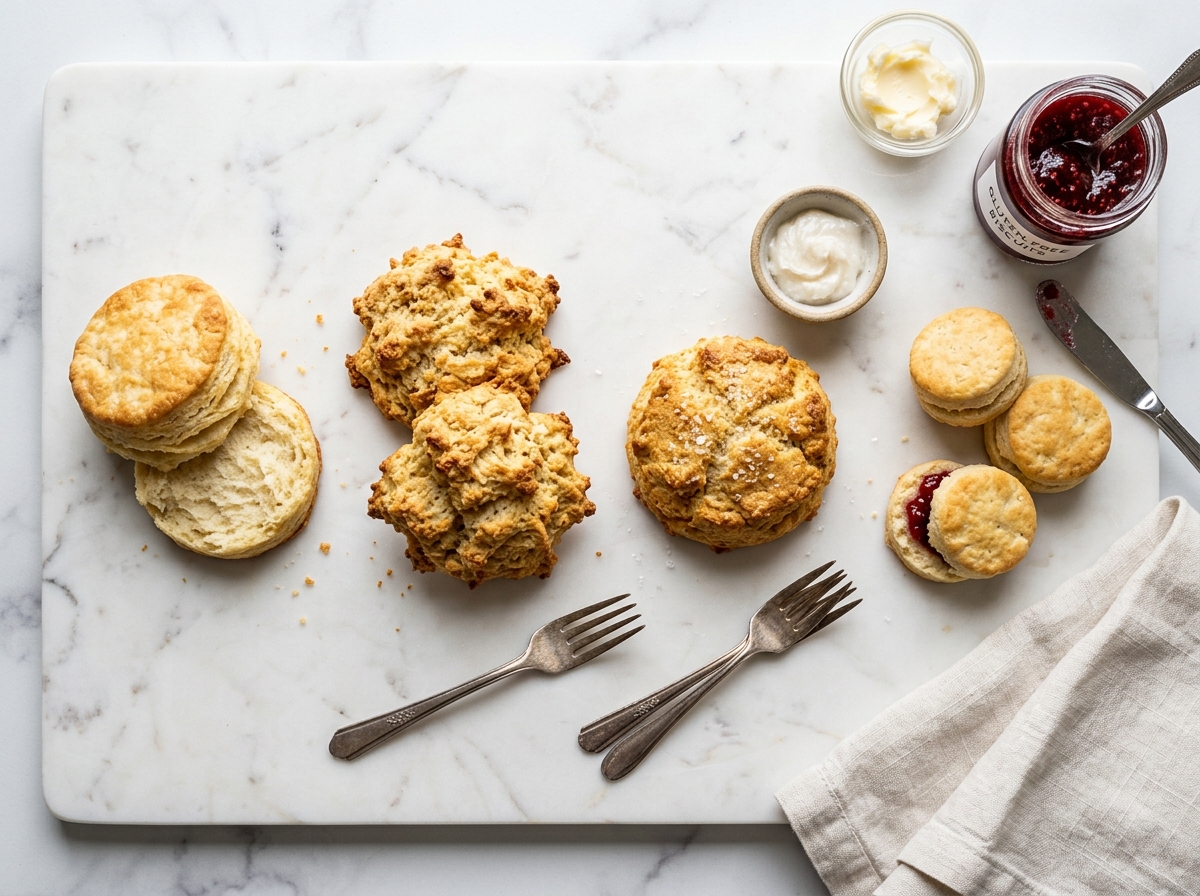
Most gluten free buttermilk biscuit failures trace back to five causes. The failures show dramatically when they happen: flat as a frisbee, gummy inside, crumbling before they hit the plate. These aren’t minor imperfections. They’re signals pointing at specific problems.
The five most common mistakes
1. Warm butter. If you work GF biscuit dough at room temperature for more than a few minutes, the butter softens into the flour rather than staying in separate chunks. No butter chunks, no steam, no flaky pockets. Keep the butter frozen until the moment you add it, and work fast.
2. Insufficient leavening. GF flours are denser than wheat flour by volume. Most home bakers under-leaven because they’re following a wheat recipe that specifies 1 tsp baking powder per cup of flour. For GF biscuits, you need 1.25-1.5 tsp per cup. If your biscuits look fine externally but are heavy and doughy inside, this is almost certainly the problem.
3. Overmixing after the liquid goes in. Once buttermilk touches the GF flour, xanthan gum begins activating. Keep stirring past 15 strokes and you over-develop the xanthan network, producing a rubber-band-tight crumb that bakes up dense and chewy. Stop when you see no more dry flour. It doesn’t need to look smooth.
4. Cutting without chilling. GF dough at room temperature won’t hold a clean edge. Without the 15-minute refrigeration step, biscuits spread sideways instead of rising upward.
5. Low oven temperature. GF biscuits need 420-450°F minimum. At 350°F, the butter melts and spreads before the crust can set, and the biscuit collapses. If your oven is set to 425°F but running cold (most home ovens are off by 15-25°F), invest in an oven thermometer.
Dairy-free and vegan adaptations
To adapt gluten free buttermilk biscuits for dairy-free or vegan diets, you need to address both the butter and the buttermilk.
For butter: solid refined coconut oil (refrigerator-cold) works best for texture. It stays firm long enough to cut into the dough and melts cleanly in the oven. Miyoko’s Creamery vegan butter is a close second. Just make sure it’s fully cold before cutting in.
For buttermilk: combine 1 cup oat milk with 1 tablespoon white vinegar or lemon juice, stir, and let it curdle for 5 minutes. Oat milk produces the most buttermilk-like acidity and flavor profile of the plant-based options. Almond milk works but produces thinner dough and a slightly flatter biscuit.
Under FDA’s gluten-free labeling regulations, any food labeled “gluten free” must contain less than 20 parts per million of gluten. If you’re making dairy-free gluten free buttermilk biscuits for someone with celiac, check both the oat milk (oats carry cross-contamination risk) and the flour blend for GF certification.
Drop biscuits vs. cut biscuits
Drop biscuits add about 1/4 cup more buttermilk to make the dough pourable rather than workable. You drop spoonfuls directly onto the pan. No rolling, no cutting, no chilling step. They’re faster, more forgiving, and almost impossible to overwork.
The trade-off: drop biscuits have an irregular, craggy shape and don’t produce the clean layered pull-apart that cut biscuits achieve. For home bakers on a weeknight, drop biscuits are the right call. For commercial food service or a retail product where appearance drives purchase decisions, cut biscuits are worth the extra 20 minutes.
| Problem | Most likely cause | Fix |
|---|---|---|
| Flat with no rise | Warm butter; under-leavening | Freeze butter 10 min before mixing; increase baking powder 25% |
| Dense, gummy interior | Excess xanthan; oven too cool | Reduce xanthan 20%; bake at minimum 425°F |
| Dough falls apart when cutting | Insufficient xanthan; dough too dry | Add 1/4 tsp xanthan per cup flour; add buttermilk 1 tbsp at a time |
| Tough, chewy crumb | Overmixed after adding liquid | Hard stop at 12-15 strokes after liquid is added |
| Pale, no crust browning | Low-fat fat substitute; oven too low | Full-fat vegan butter; add 1 tsp sugar for Maillard reaction |
| Bone dry the next day | Starches absorb moisture quickly | Store airtight; reheat in 350°F oven 5 min, not microwave |
Industry applications: commercial gluten-free biscuit production
Commercial gluten free buttermilk biscuit production requires different equipment tolerances than wheat biscuit lines. GF doughs are stickier, more fragile under heat buildup, and more sensitive to formula variability than their wheat equivalents.
The GF baked goods market is growing fast, and biscuits are part of that. According to the National Institute of Diabetes and Digestive and Kidney Diseases, approximately 1 in 100 people worldwide has celiac disease, with significantly more following a GF diet for non-celiac gluten sensitivity. That’s a substantial and growing consumer base for any biscuit manufacturer willing to invest in a compliant GF line.
Scaling from kitchen recipe to commercial production
Scaling a GF biscuit formula from 10 units to 500 isn’t linear multiplication. The differences compound at scale.
Binder concentration control becomes critical. At small scale, a nominal 0.5% xanthan ratio is forgiving. At industrial scale, if your GF flour supplier varies xanthan batch-to-batch (which happens more than most ingredient specs acknowledge), you’ll see biscuits that range from crumbling to rubbery within the same production day. Commercial producers working with gluten free buttermilk biscuit formulas typically source GF flour blends at guaranteed xanthan specifications, or add xanthan separately in a controlled premix step.
Temperature management during processing matters in ways it doesn’t at home. The mechanical energy from high-speed mixing and sheeting generates heat that’s irrelevant when you’re making a dozen biscuits by hand. On a commercial sheeter running at 40 cycles per minute, dough temperature rises measurably. GF dough is more sensitive to this than wheat dough because xanthan gum degrades at sustained temperature more quickly than a gluten network would. Industrial GF lines often run at reduced speeds or use jacketed dough troughs with circulating cold water to maintain dough below 10°C throughout processing.
Sheeting vs. depositing is the other major decision. Cut biscuits require sheeting the dough to consistent thickness before cutting. Standard commercial sheeting equipment calibrated for wheat tends to tear and stick to GF dough. Most industrial operators either increase dusting flour rates, switch to silicone-coated belts, or convert to depositor-style equipment that drops portioned dough without sheeting. Deposited GF biscuits look like drop biscuits, which is acceptable for most retail products but not for the cut-biscuit appearance that some premium segments expect. Manufacturers evaluating commercial biscuit production machinery should specify GF-compatible materials and clearances when sourcing equipment.
Equipment for dedicated GF biscuit lines
A dedicated GF line matters for contamination compliance. Using shared wheat equipment introduces cross-contamination risk that can push finished product above the FDA’s 20 ppm limit. For manufacturers targeting celiac consumers or medical GF claims, a dedicated line isn’t optional.
A complete dedicated gluten free buttermilk biscuit production line typically includes:
- Flour blending system: continuous mixer combining GF flour blend, xanthan gum, and dry leavening at controlled ratios with gravimetric dosing.
- Cold dough mixing tank: jacketed mixing bowl with refrigerated walls, keeping butter below 10°C throughout the mix cycle.
- Wire-cut depositor: portions dough without requiring a sheeted sheet; handles high-moisture GF formulas that would tear on a rotary moulder.
- Tunnel oven with zoned temperature control: critical for GF biscuits. High initial zone (230°C+) to set the crust fast, then reduced mid-zone to bake through without burning the bottom.
- Cooling conveyor: GF biscuits are significantly more fragile while hot than wheat biscuits. Premature stacking or rough transfer deforms them before the starch sets.
The choice between wire-cut and rotary mould equipment depends largely on the GF formula’s hydration. High-moisture formulas (needed for tender crumb) are wire-cut-only territory. Drier formulas can sometimes tolerate rotary moulding but typically require surface modifications to prevent sticking.
Future trends in gluten-free biscuit production (2026+)
The global gluten-free food market exceeded $6 billion in value in 2026 and is projected at 9%+ CAGR through 2030, with baked goods (biscuits, crackers, snacks) driving a significant share of that growth.
Market growth and consumer demand
The demand picture for gluten free buttermilk biscuits and GF baked goods broadly is strongest in the United States, where Southern biscuit culture intersects with one of the world’s highest voluntary GF adoption rates.
Celiac disease diagnosis rates are rising, not because the disease is becoming more common, but because diagnosis has improved. Historically, an estimated 80% of celiac patients were undiagnosed. Better antibody testing and gastroenterology protocols are catching cases that would have been missed a decade ago. Each new diagnosis creates a lifetime customer for GF products.
Non-celiac gluten sensitivity (NCGS) drives a larger share of GF food purchases than celiac disease does. This group tends to be less strict about cross-contamination but consistently buys GF products when conveniently available. For a biscuit manufacturer, this is a large and price-tolerant consumer segment.
Restaurant and food service demand is accelerating too. In 2026, most major US restaurant chains carry at least one dedicated GF item, creating commercial demand for GF biscuits as either a standalone menu item or a component.
New ingredients and formulation science
The next generation of gluten free buttermilk biscuits at commercial scale is moving beyond rice-starch-based blends. Several ingredient categories are worth tracking.
Chickpea flour, at 22g protein per 100g versus 7g in white rice flour, provides natural binding that reduces or eliminates xanthan gum dependency. The challenge is flavor: chickpea has an earthy note that needs managing in a delicate biscuit. Newer cold-pressed defatted chickpea flour varieties have significantly reduced that off-flavor problem.
Cassava flour is different from tapioca starch (which is just isolated cassava starch). Whole-grain cassava flour includes fiber and a protein fraction that improves texture and makes it behave more like wheat flour than any rice-based GF alternative. Less xanthan needed; crumb structure closer to a wheat biscuit.
Enzymatic protein cross-linking is still largely in the research phase in 2026, but it’s worth watching. Transglutaminase enzymes can cross-link proteins in GF flours to create a pseudo-gluten network without actual gluten. The functional texture improvement is documented in food science literature; processing-stable enzyme formulations are already available to industrial manufacturers.
Fermented GF flour starters are another developing area. Sourdough fermentation of GF flours (using naturally GF cultures) improves flavor complexity, extends shelf life, and reduces the perceived starchiness of rice-heavy blends. Several US artisan bakeries are working with this approach now; industrial adaptation is early-stage but moving.
For confectionery and baked goods manufacturers tracking these developments, working with food machinery specialists in GF-compatible production equipment is increasingly relevant to formula-to-production planning, since new flour types have different flow, hydration, and temperature profiles than rice-starch-based blends.
| Ingredient trend | Timeline | Commercial readiness | Impact on GF biscuit quality |
|---|---|---|---|
| Chickpea-based blends | Now | Retail + food service | Better protein, improved rise; flavor needs adjustment |
| Cassava flour integration | 2026 | Specialty/premium | Most wheat-like texture currently available |
| Enzymatic protein cross-linking | 2026-2027 | Early commercial | Significant crumb structure improvement; reduced xanthan need |
| Fermented GF starters | 2026 | Artisan only | Flavor complexity; extended shelf life |
| High-protein GF blends (20g+) | 2026+ | R&D phase | Natural structure, reduced additive dependency |
Frequently asked questions
What is the best gluten-free flour for buttermilk biscuits?
King Arthur Measure for Measure and Cup4Cup are the top two choices for home baking. King Arthur is widely available and produces consistent results; Cup4Cup comes closest to a traditional biscuit’s crust color and crumb, thanks to its milk powder content. For commercial or high-volume use, a custom rice-tapioca-potato starch blend is more cost-effective. Avoid 100% almond flour. It doesn’t carry the starch structure to hold a cut biscuit together and won’t produce meaningful rise.
Can I substitute regular milk for buttermilk in a GF biscuit recipe?
You can, but you’ll notice the difference. Buttermilk’s acidity (pH ~4.5) reacts with baking soda to produce CO2 quickly, before the biscuit reaches the oven, which creates a lighter interior. Without that acid, the biscuit relies solely on baking powder, producing a noticeably denser crumb. A workable substitute: 1 cup whole milk plus 1 tablespoon white vinegar, stirred and left 5 minutes to curdle. It’s not identical, but it’s close enough for most applications.
Why do my gluten free buttermilk biscuits come out dense every time?
Three most likely causes: warm butter going into the mix (the fat smears into the flour instead of staying chunky), oven temperature below 420°F, or too much xanthan gum. GF biscuits need cold fat and high heat for the steam lift that creates a light crumb. If your oven is set to 425°F but running 20°F cold (common in home ovens), get a thermometer before assuming the recipe is wrong.
How should I store gluten-free buttermilk biscuits?
Room temperature in an airtight container for up to 2 days, or freeze individually for up to 2 months. GF biscuits lose moisture faster than wheat biscuits because starch-based flours don’t hold water as efficiently as gluten flour. Reheat in a 350°F oven for 5 minutes; a microwave makes them gummy. For make-ahead convenience, cut and freeze unbaked biscuits, then bake directly from frozen at 425°F for 18-20 minutes.
Are gluten free buttermilk biscuits safe for celiac disease?
Yes, if every ingredient is certified GF. The main contamination risk is the flour blend. Look for products certified by the Gluten-Free Certification Organization (GFCO), which tests to below 10 ppm (more stringent than the FDA’s 20 ppm threshold). Also check your baking powder and any add-ins like shredded cheese or dried herbs, which sometimes use starch fillers that may contain gluten. The Academy of Nutrition and Dietetics recommends celiac patients work with a registered dietitian to identify all hidden gluten sources in a recipe before relying on it regularly.
What is the difference between gluten free drop biscuits and cut biscuits?
Cut biscuits require rolling the dough to an even thickness, folding it for layers, then cutting with a biscuit cutter. Drop biscuits use a wetter dough that gets spooned directly onto the pan. Drop biscuits are faster and more forgiving: no chilling step, no cutting failure risk. Cut biscuits produce more defined layers, a cleaner shape, and a better rise in our experience. For home bakers: drop biscuits on a weeknight. For commercial operations where product appearance matters: cut biscuits are worth the additional process steps.
Can gluten free buttermilk biscuits be made dairy-free?
Yes. Replace cold butter with solid refined coconut oil or a good vegan butter (Miyoko’s Creamery or Earth Balance work well, kept cold). Replace buttermilk with oat milk plus vinegar at 1 tablespoon acid per cup of milk, left to curdle 5 minutes. The result is slightly less rich than the dairy version but produces a fully functional, tender biscuit. If serving to celiac patients, double-check that the oat milk is certified GF, since oats are a common cross-contamination source.
How do commercial gluten free biscuits differ from homemade?
Commercial gluten free buttermilk biscuits typically contain emulsifiers (mono- and diglycerides), modified starches, and sometimes dough conditioners that help the product survive freezing, shipping, and reheating. These additives improve machinability during production and extend shelf life well beyond what a home recipe achieves. According to King Arthur Baking’s guide to gluten-free ingredients, commercial GF products also tend to lean heavily on rice-starch blends for cost reasons, while home bakers can use premium cassava or chickpea-forward formulas that produce significantly better texture at a price per batch that only makes sense at small volume.
Conclusion
Getting gluten free buttermilk biscuits right comes down to a few non-negotiable principles: cold butter throughout the entire process, the right GF flour blend for your application, and leavening scaled up to compensate for the density of starch-heavy flours. The techniques aren’t difficult. They’re similar to Southern wheat biscuit method, but they demand more precision because GF dough doesn’t forgive sloppy temperature management or overworking the way wheat dough sometimes does.
For home bakers: start with King Arthur Measure for Measure, keep everything cold, bake at 425°F minimum, and don’t skip the chill step. For commercial producers: the market for quality GF biscuits is real and growing, the technology for dedicated GF production lines exists today, and the consumer willingness to pay a premium for genuinely flaky gluten free buttermilk biscuits is proven. The gap between mediocre and excellent in GF biscuits is a formulation and equipment question, and both are solvable.