Gumdrops Candy: The Complete Guide to History, Production & Commercial Manufacturing
Gumdrops candy are soft, gelatin- or pectin-based confections coated in granulated sugar crystals, produced in dome or cone shapes with bright fruit and spice flavors.
Walk through the penny candy aisle of any old-fashioned sweet shop and you’ll spot them immediately — those jewel-bright, sugar-dusted domes that have been delighting candy lovers since the mid-1800s. Gumdrops candy is one of the oldest surviving confectionery formats in the world, yet most people can’t explain why they taste that way, how they’re made at industrial scale, or what separates a limp, low-quality gumdrop from a firm, flavor-packed premium one. This guide answers all of that — and if you’re a confectionery manufacturer or procurement professional, we go deeper into the commercial production process and machinery than any other resource online.
What Are Gumdrops Candy?
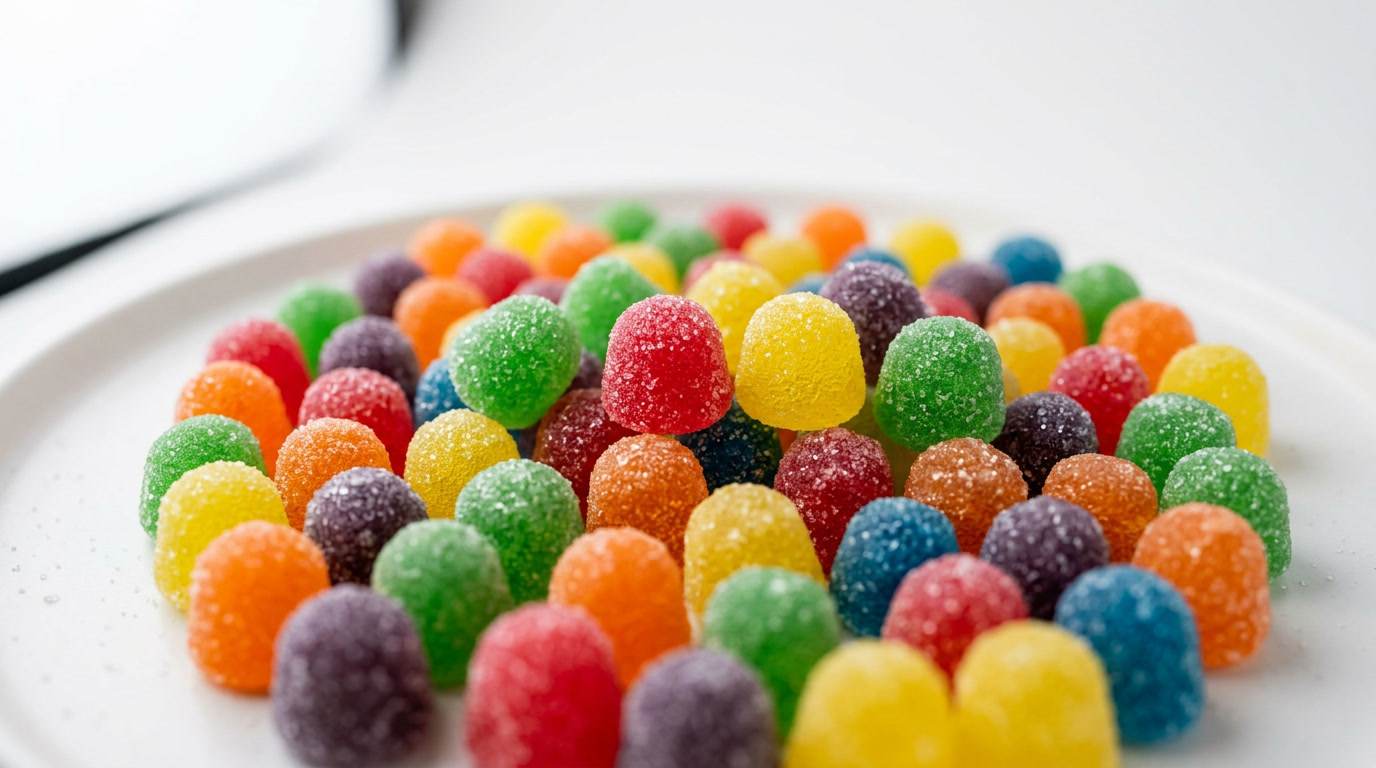
Gumdrops candy are a subcategory of jellied confections — soft-bodied sweets that hold their shape through a gelling agent (gelatin, pectin, starch, or agar) and are finished with a coating of coarse sugar crystals. The sugar coat does two jobs: it prevents the candies from sticking together and creates that signature crisp-then-chewy bite.
According to the Wikipedia entry on gumdrops, the candy’s origins trace to the mid-nineteenth century United States, where confectioners were experimenting with corn starch molding techniques imported from European sugar-boilers. The classic gumdrop shape — a truncated cone, flat on the bottom — was optimized for starch-mold casting, not aesthetics; the geometry releases cleanly from a powder impression without tearing.
The Anatomy of a Gumdrop
Every gumdrop candy has three structural layers:
| Layer | Material | Function |
|---|---|---|
| Core gel body | Gelatin (animal) or pectin (plant-based) + corn syrup + sugar | Provides chewy texture and flavor payload |
| Surface skin | Naturally formed during starch-mold curing | Creates a slight firmness at the exterior |
| Sugar coating | Coarse granulated or sanding sugar | Prevents sticking, adds crunch, enhances visual appeal |
Gumdrops vs. Gummy Bears — What’s the Difference?
The terms often get conflated, but the distinction matters for manufacturers.
- Gumdrops candy use a higher starch-to-gelatin ratio and are deposited into starch molds, producing a denser, less elastic chew. They are always sugar-coated.
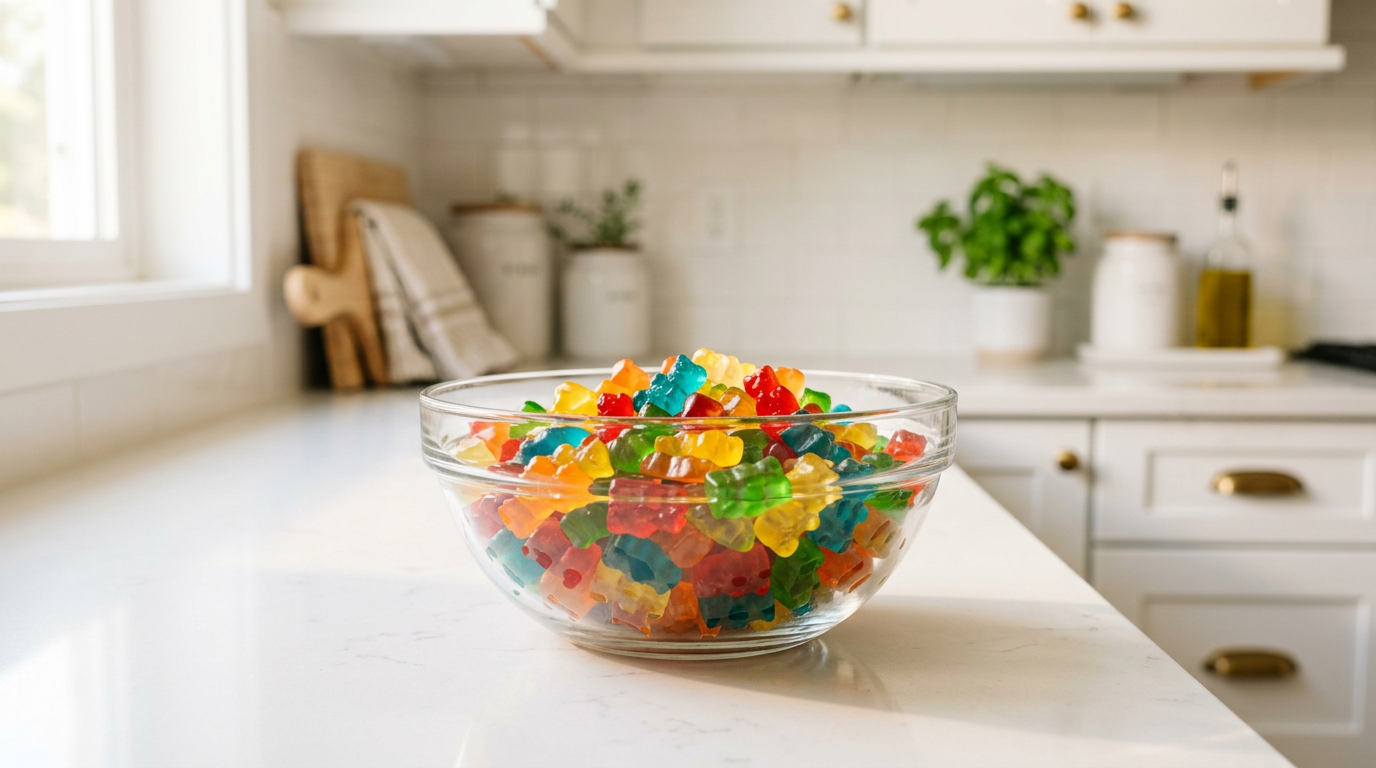
- Gummy bears use a higher gelatin concentration, are deposited into silicone or hard plastic molds, and are typically finished with a thin coating oil — not sugar.
- Pectin jellies (spiced gumdrops) use plant-derived pectin instead of gelatin, producing a shorter, more brittle texture that’s common in spiced gumdrop varieties.
In practice, we’ve found that the line between gumdrop and gummy is blurred most at the medium-softness range (Bloom gelatin 100–150). High-Bloom formulations trend toward gummy; low-Bloom, high-starch formulations stay firmly in gumdrop territory.
Types of Gumdrops Candy
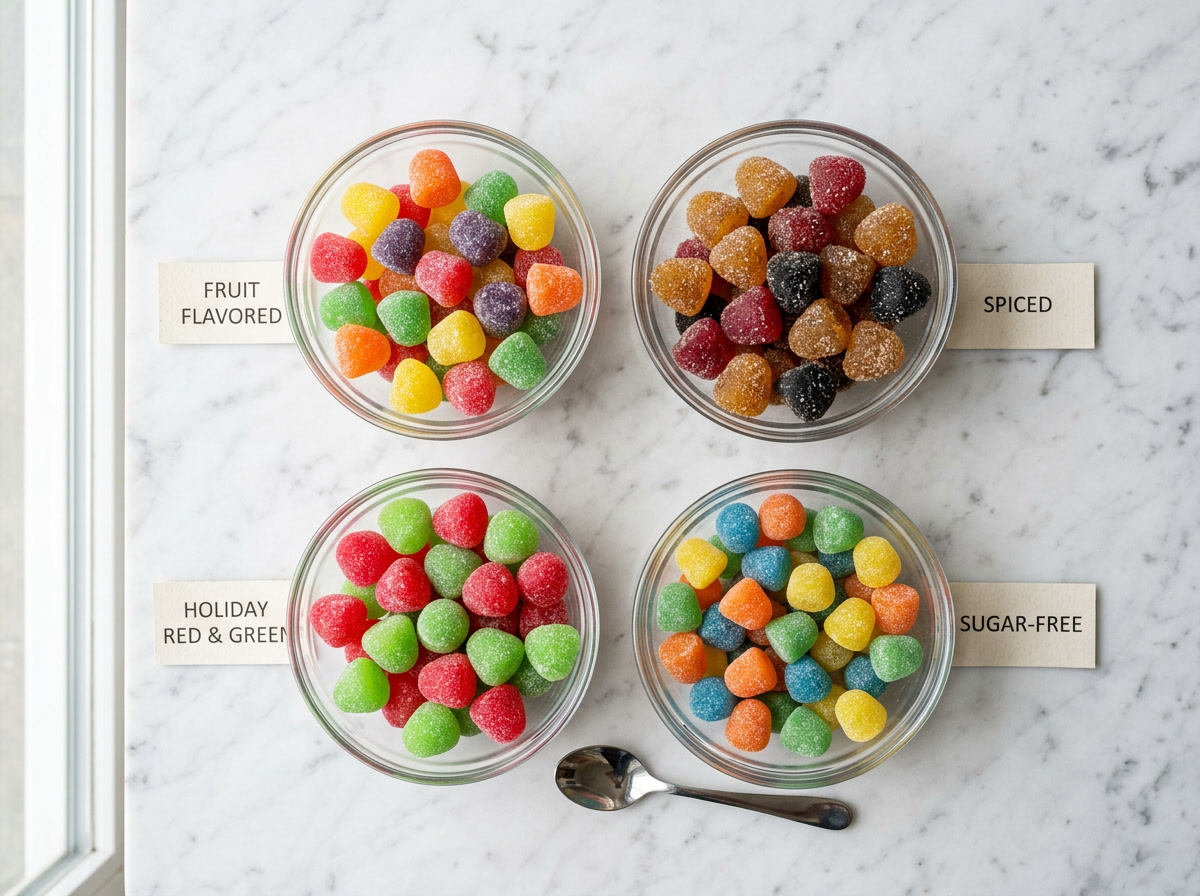
Not all gumdrops candy are the same. The category spans at least four distinct variants, each with different formulation requirements and, importantly, different production equipment needs.
1. Fruit-Flavored Gumdrops
The dominant category. These use artificial or natural fruit flavor concentrates — cherry, lime, orange, lemon, grape, and pineapple being the standard six-flavor set. Coloring is typically FD&C-certified (artificial) or annatto/spirulina/beet-derived (natural). Production hardness target is 200–250 grams penetrometry (firm enough to hold shape through packaging, soft enough to chew without jaw fatigue).
2. Spiced Gumdrops (Jelly Spices)
The original form, now the minority. Spiced gumdrops use cinnamon, clove, anise, spearmint, licorice, and violet flavors instead of fruit. They are nearly always pectin-based (not gelatin), which produces a shorter, more “snappy” bite. Old-fashioned confectionery shops still stock these heavily; they have a strong nostalgia market and command premium per-pound pricing.
3. Holiday and Seasonal Gumdrops
Christmas and Halloween gumdrops candy are among the highest-volume SKUs produced annually. These are standard fruit-flavored formulations repacked with seasonal colors — red/green for Christmas, orange/black for Halloween. The underlying confection is identical; the margin uplift comes entirely from seasonal packaging and limited availability signals.
4. Sugar-Free and Functional Gumdrops
A fast-growing segment. These substitute sucrose with maltitol, isomalt, or erythritol and use gelatin or agar as the gelling agent. The challenge: sugar alcohols behave differently under heat and moisture, requiring tighter process control (±2°C versus the ±5°C tolerable in conventional lines) and can produce laxative effects at high consumption volumes, requiring regulatory-compliant label disclaimers.
| Type | Gelling Agent | Sugar Coating | Typical Hardness |
|---|---|---|---|
| Fruit-flavored | Gelatin (Bloom 80–150) | Granulated sugar | 200–250 g |
| Spiced (pectin) | Pectin (high-methoxy) | Granulated sugar | 150–200 g |
| Holiday/seasonal | Gelatin (same as fruit) | Granulated sugar + color | 200–250 g |
| Sugar-free | Gelatin or agar | Isomalt or powdered erythritol | 180–220 g |
Gumdrops Candy Ingredients and Formulation
Understanding the formulation explains why mass-produced gumdrops candy from different brands taste noticeably different even at identical flavor profiles.
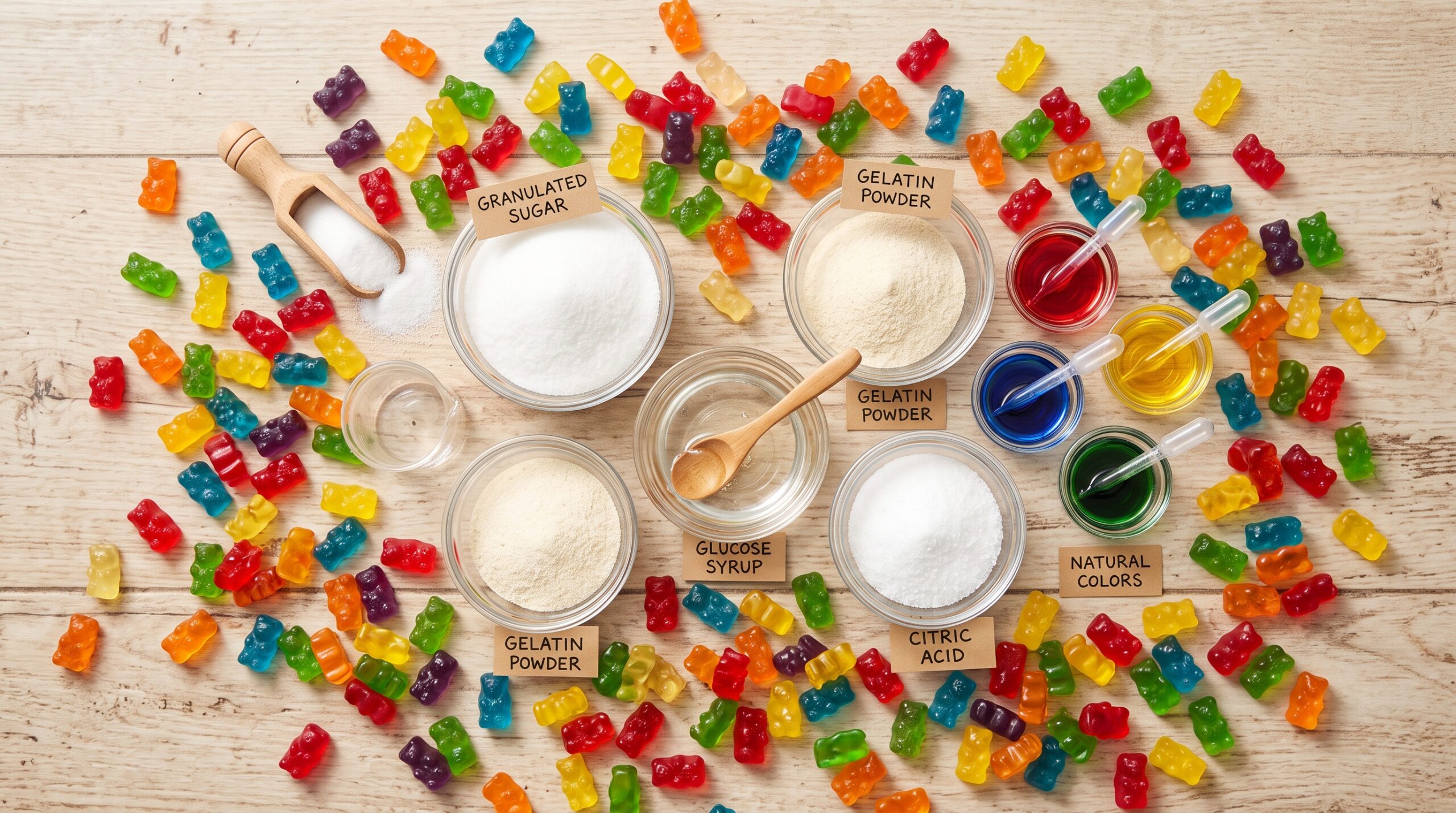
Core Ingredients
- Corn syrup (42 DE or 62 DE) — primary humectant, controls crystallization and shelf moisture. 42 DE gives softer texture; 62 DE firms up the gel and extends shelf life.
- Granulated sugar (sucrose) — sweetener and body-builder. Typical usage: 45–55% of the total recipe weight.
- Gelatin (pork or beef, Bloom 100–200) — gelling agent. Bloom strength controls firmness. Lower Bloom = softer, more yielding chew. Plant-based alternatives (pectin, agar, carrageenan) increasingly replace gelatin for kosher/halal/vegan markets.
- Water — hydration medium; boiled off during cooking to reach target moisture (typically 18–22% final moisture).
- Citric acid or malic acid — flavor enhancer and pH control. Acid brightens fruit flavor perception and slightly firms the pectin gel.
- Flavor concentrates — natural or artificial; added after cooking to prevent volatile loss.
- FD&C or natural colorings — added at low level (0.005–0.02% w/w).
- Buffering salts (sodium citrate, potassium citrate) — stabilize pH in pectin formulations; prevent premature gelation in the cooker.
Where Formulation Goes Wrong
In our experience working with confectionery producers, the two most common gumdrop quality failures are:
- Excessive moisture (>24%) — leads to stickiness in the coated sugar layer and clumping in packaging. Root cause is usually undercooked or incorrect cook temperature set point.
- Gelatin Bloom inconsistency — batch-to-batch Bloom variation from the gelatin supplier causes texture drift. Spec-in a ±10 Bloom tolerance from your gelatin supplier and test incoming lots before production.
How Gumdrops Candy Are Made Commercially
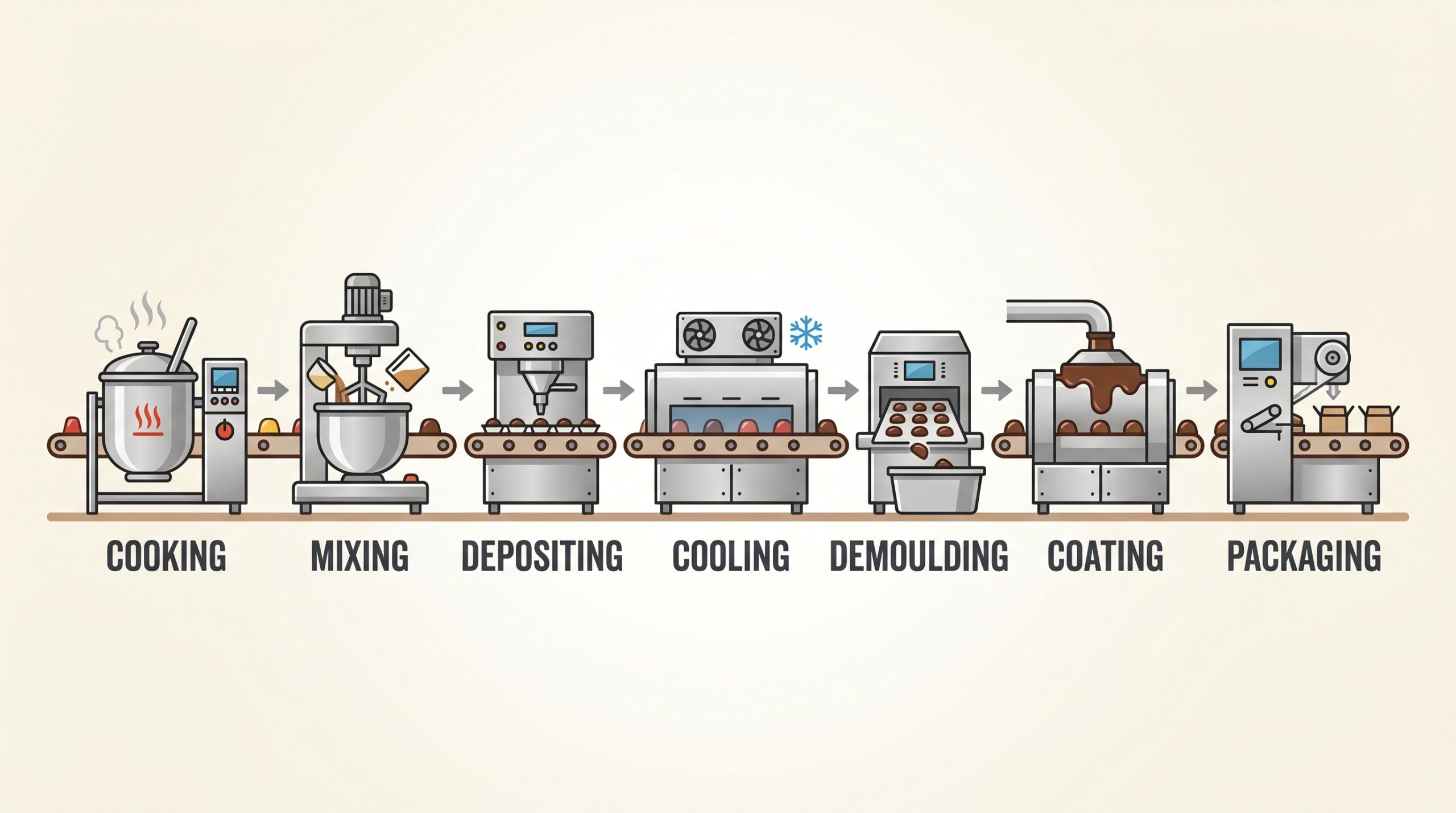
This is where home recipes and industrial production diverge completely. At commercial scale — 500 kg batches and above — gumdrops candy manufacture follows a tightly controlled sequence with specialized equipment at every stage.
Step 1: Syrup Cooking
Dissolve sugar and corn syrup in water, then cook to target solids (75–80° Brix) at 115–125°C using a continuous steam-jacketed cooker or vacuum cooker. Vacuum cooking (sub-atmospheric pressure) allows lower boil temperatures, preserving more volatile flavor compounds — this is why premium gumdrops taste more “fresh” than budget equivalents cooked at higher temperatures.
Pre-hydrated gelatin (bloomed in cold water for 30 minutes) is then added to the cooked syrup at 80–85°C and blended until fully dissolved. Flavors, acids, and colors are incorporated at this stage with low-shear mixing to prevent aeration.
Step 2: Starch Mold Deposition
This is the definitive step for gumdrops candy — and the one that distinguishes them from gummies. The cooked candy mass is pumped into a mogul starch depositing machine (also called a starch mogul or starch mold line).
The mogul machine:
- Fills trays with dried starch powder (corn or wheat starch, moisture ≤6%)
- Stamps impression molds into the starch surface using a plunger board with gumdrop-shaped dies
- Deposits precise volumes (typically 3–8 grams per piece) of liquid candy mass into the starch impressions using positive-displacement piston depositors
- Stacks trays in a conditioning room (24–48 hours at 35–55°C and 40–60% RH) to allow the candy body to gel and surface-skin to form
- Tumbles cured pieces out of the starch, separates starch from candy, and recycles starch
The starch moisture content and conditioning room parameters are the two most critical variables in gumdrop quality. Too-wet starch causes surface adhesion; too-dry starch causes cracking. Temperature during conditioning directly controls final texture hardness.
Step 3: Sugar Coating (Sanding)
De-starched gumdrops candy are fed into a sugar sanding drum or panning machine where they receive a light syrup application followed by a dusting of coarse sanding sugar (typically 30–50 mesh). Multiple passes build up the coating layer. The pieces then pass through a drying tunnel to set the coating before packaging.
Step 4: Sorting, Weighing, and Packaging
Finished gumdrops candy pass through optical sorters (color and shape grading), checkweighers, and then into the packaging line — pillow bags, theater boxes, or bulk totes depending on the sales channel.
| Production Stage | Key Equipment | Critical Parameter |
|---|---|---|
| Syrup cooking | Continuous cooker / vacuum cooker | Final Brix: 75–80; Cook temp: 115–125°C |
| Starch mold deposition | Mogul starch depositing line | Starch moisture ≤6%; deposit weight ±0.2g |
| Conditioning | Temperature/humidity-controlled room | 35–55°C, 40–60% RH, 24–48 hours |
| Sugar coating | Panning drum / sanding drum | Coating weight: 8–12% of piece weight |
| Packaging | VFFS or horizontal flow wrapper | Target headspace O₂ < 0.5% for shelf life |
Commercial Gumdrop Production Equipment
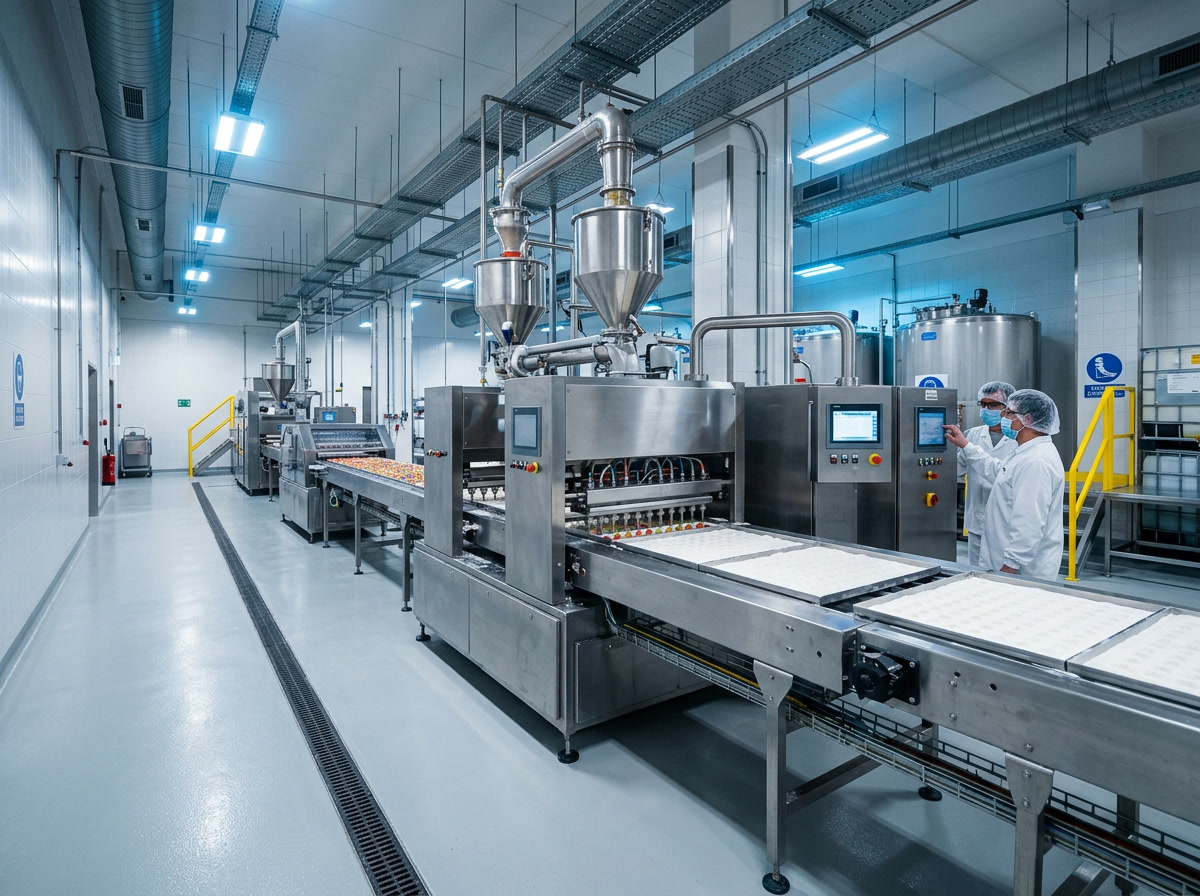
For confectionery manufacturers planning a gumdrops candy line, equipment selection has the biggest impact on output quality, scalability, and operating cost. Here’s what the line looks like in practice.
The Starch Mogul Line: The Core Investment
A starch mogul depositing line is the single most important piece of equipment in a gumdrop operation. Moguls range from compact 200 kg/hr units suitable for artisan or mid-scale producers, up to 2,000 kg/hr continuous lines for multinational candy brands. Key selection criteria:
- Depositor type: Piston depositors offer better accuracy (±0.5%) than gear pump depositors for high-viscosity gumdrop masses
- Starch management system: Integrated starch drying (forced-air or microwave), recycling, and sieving reduce moisture drift over multi-shift runs
- Tray handling: Automatic tray stacking and destacking reduces labor cost by 60–70% versus manual tray handling
- Changeover time: CIP-capable (clean-in-place) depositor heads allow flavor changeover in under 30 minutes on modern equipment
JY Machine’s gumdrop production lines are built to this specification, offering 300–1,500 kg/hr output with full PLC control and servo-driven depositors for piece-weight accuracy. Unlike some imported European moguls, the lines support tropical ambient conditions (up to 40°C ambient) without auxiliary cooling — a practical advantage for Southeast Asian and Middle Eastern confectionery producers.
Syrup Cooking Equipment
A vacuum cooker paired with a continuous dissolver is the production-standard configuration. The vacuum environment:
- Reduces cook temperatures by 8–12°C vs. atmospheric cooking
- Preserves 15–25% more volatile flavor compounds (measured by headspace GC analysis on test runs)
- Enables faster color development at lower temperatures, reducing color degradation in red and purple variants
Entry-level operations sometimes use open-kettle cookers, which work but require more operator monitoring and produce less consistent Brix readings across a shift.
Sugar Coating and Finishing Lines
A rotary panning drum with heated air supply is the standard for gumdrop sanding. The drum rotation tumbles the pieces; spray nozzles apply a thin syrup coat; granulated sugar is dropped in through a side chute. Typical cycle time is 4–6 passes over 20–35 minutes for full coating coverage.
For high-volume lines, continuous sanding belts replace batch drums entirely, feeding pieces through a spray station and sugar waterfall in a continuous ribbon. Output rates of 800–1,200 kg/hr are achievable with a correctly sized continuous sanding system.
Using Gumdrops Candy: Recipes and Decorations
Beyond eating straight from the bag, gumdrops candy has a deep secondary market in baking and decorating — one that drives meaningful impulse purchases at retail and online.
Holiday Baking Applications
Gumdrops candy are a staple decoration for:
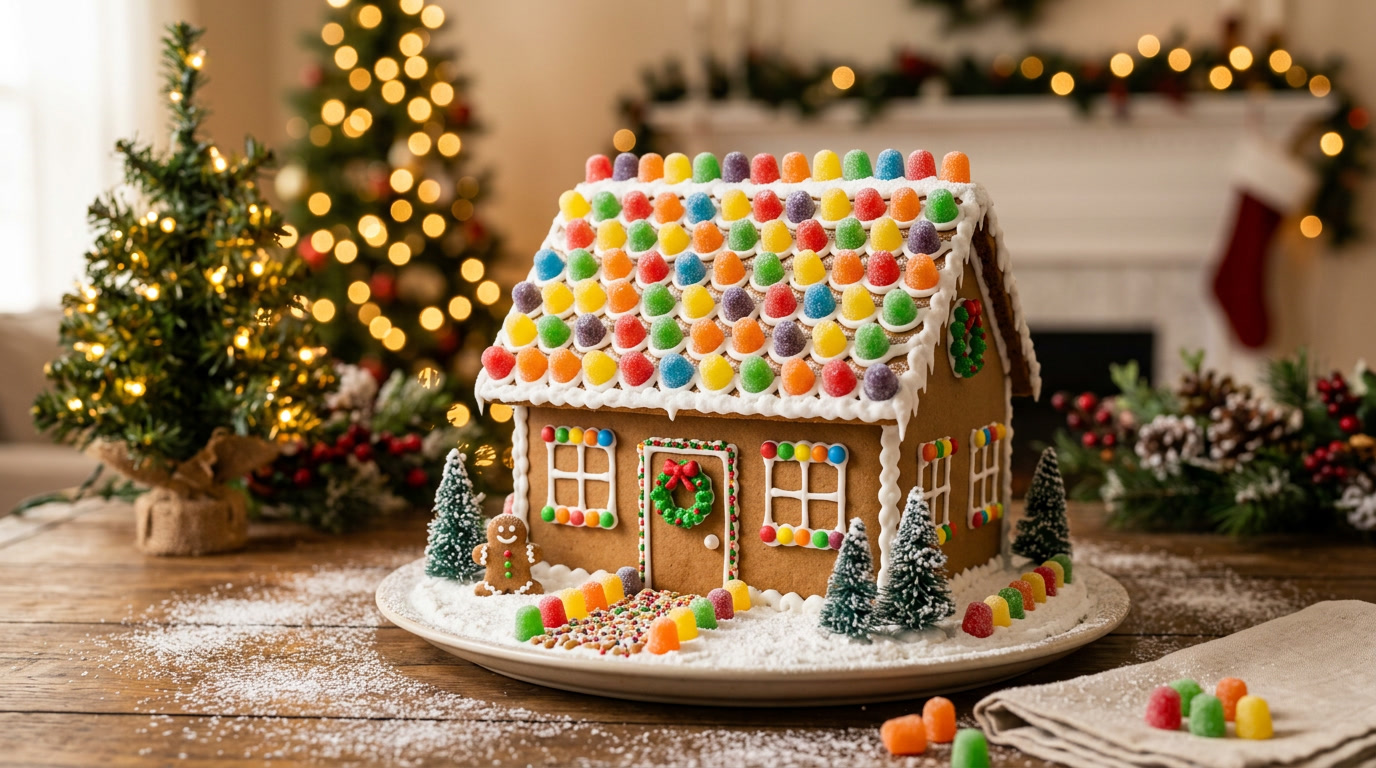
- Gingerbread houses — the architectural candy of choice; used as roof tiles, windows, and door accents
- Christmas tree cookies — sliced crossways to create “ornament” decorations on sugar cookies
- Gumdrop cake — a classic mid-century American layer cake decorated with gumdrops arranged as a pattern across frosting
- Spearmint leaf gumdrops specifically are used as “holly leaves” around chocolate truffles
Simple Gumdrops Candy Recipes
Gumdrop Fudge: Standard vanilla fudge base (sugar, butter, evaporated milk) cooled to 110°F, then stir in diced gumdrops. The sugar coating on the gumdrops dissolves partially into the fudge, adding flavor streaks and visual interest.
Gumdrops Bars: A pressed rice-cereal base (similar to rice crispy treats but with corn syrup) with whole and halved gumdrops candy pressed in during cooling. Cuts into bars. No baking required.
Spiced Gumdrop Cake: A traditional recipe calling specifically for spiced gumdrops (not fruit-flavored), diced and folded into a butter cake batter. The candy pieces soften during baking and release concentrated spice flavor into the crumb.
Future Trends in the Gumdrops Candy Market (2026 and Beyond)
The global gummies and jellied confectionery market is not static — several macro trends are reshaping what producers need from their formulations and equipment.
Plant-Based and Vegan Reformulation
Gelatin is animal-derived, which excludes gumdrops candy from vegetarian, vegan, halal, and kosher markets — a significant share of the global consumer base. Pectin and agar replacements are the most commercially viable substitutes, but they behave differently in mogul lines: pectin sets faster (shorter conditioning window, higher sensitivity to pH), and agar requires higher cook temperatures. Producers investing in new lines should specify equipment that handles both gelatin and pectin formulations without major changeover — this is the technical differentiator between equipment generations.
Functional and Fortified Variants
Vitamin C, zinc, and elderberry gumdrops candy are now a mainstream supplement delivery format, not a niche health food. Functional gumdrops require post-process addition of heat-sensitive actives (added after cooking, not during) and typically lower cook temperatures to preserve vitamin efficacy. Equipment with precise temperature-controlled holding tanks and cold-mix active dosing systems becomes relevant here.
Sustainability and Clean Label
Consumers and major retailer buyers are pushing for:
- Natural colorings (spirulina for blue/green, beet for red/pink, turmeric for yellow, paprika extract for orange)
- Cane sugar alternatives (organic evaporated cane juice, coconut sugar) for premium SKUs
- Compostable or recyclable packaging — a supply chain concern rather than a formulation change, but increasingly a buyer requirement
Natural colorings are noticeably less heat-stable than FD&C dyes. Red beet color degrades significantly above 80°C; spirulina above 70°C. This is another driver toward vacuum cooking (lower process temperatures) and away from conventional high-temperature open cooking.
Frequently Asked Questions About Gumdrops Candy
Are gumdrops candy still made?
Yes — gumdrops candy are actively produced and widely sold. While they’ve been somewhat overshadowed by newer gummy formats, the category remains a multi-hundred-million-dollar segment globally. Spiced gumdrops in particular have strong nostalgia demand and limited competition from newer candy formats.
What are gumdrops candy made of?
Standard gumdrops candy contain corn syrup, sugar, gelatin or pectin, water, citric acid, natural or artificial flavors, and FD&C or natural colorings. The sugar coating is granulated sanding sugar applied in a panning drum after the candy bodies have set.
What is the difference between gumdrops and gummy candies?
Gumdrops candy use higher starch ratios, are cast in starch molds, and are always sugar-coated. Gummy candies use higher gelatin concentrations, are cast in silicone or plastic molds, and are finished with an oil coating rather than sugar. Gumdrops have a denser, less stretchy texture.
How long do gumdrops candy last?
Properly stored gumdrops candy have a 12–18 month shelf life in sealed packaging. The sugar coating acts as a moisture barrier. The enemy is humidity: at above 65% RH, the coating absorbs moisture, becomes sticky, and the pieces clump. Store in a cool, dry location; once opened, use within 2–3 months.
What size machine do I need for commercial gumdrop production?
That depends on your target output. For a startup confectionery operation producing 50–100 kg/hr, a small-batch mogul line with 200 kg/hr capacity leaves room to grow. Mid-scale operations (300–500 kg/hr) need a fully automated mogul with integrated starch management. Large-scale lines (1,000+ kg/hr) require continuous cookers, automated tray handling, and downstream inline packaging. JY Machine offers configurations across all three tiers.
Can gumdrops candy be made without gelatin?
Yes. Pectin gumdrops (traditional spiced variety) and agar-based gumdrops are established commercial formulations. Pectin requires careful pH control (pH 3.0–3.5) and higher sugar concentrations for proper gel formation. Agar sets more firmly and can produce a slightly brittle texture. Both are commercially produced on standard mogul lines with minor recipe and parameter adjustments.
What equipment produces the sugar coating on gumdrops candy?
The sugar coating is applied in a rotary panning drum or continuous sanding belt after the candy bodies have been de-starched. A fine mist of warm syrup is applied to the tumbling pieces, followed by an addition of sanding sugar (30–50 mesh). Multiple light applications build up the final coating layer without cracking or clumping.
Conclusion
Gumdrops candy occupy a unique position in confectionery: older than gummy bears, simpler in formulation than chocolates, yet demanding in process control and equipment. The sugar-coated gumdrop looks deceptively simple — but consistent quality at commercial scale requires a well-designed starch mogul line, a controlled conditioning environment, and a formulation calibrated to your target hardness and flavor profile.
For consumers, that means checking the gelling agent (gelatin vs. pectin) and sugar coating quality as proxies for production standards. For manufacturers, it means investing in the right mogul specification before scaling output.
Whether you’re sourcing premium gumdrops candy for holiday baking or planning a confectionery production line to manufacture them, understanding the production fundamentals separates informed decisions from guesswork. If you’re exploring commercial gumdrop production equipment, JY Machine’s candy production lines are built specifically for this category, with configurations from artisan-scale to industrial output.
Related Articles
- French Candy: The Complete Guide to Types, Traditions & Commercial Production
- The Ultimate Guide to Cactus Candy: Commercial Production, Ingredients, and Industry Trends
- Ultimate Guide to Chinese Candy Manufacturing: From Tradition to Modern Production
- Candy Production Line in China – High Efficiency & Quality Manufacturing
- Gummy Candy Production Line
- Food Packaging Machine
- Skittles Manufacturing Process: Inside the Factory