The Sweet Science: A Technical Guide to Perfectly Chewy Gummy Candy Ice Cream
You’ve done it. You churned a batch of creamy, rich homemade ice cream. For the finishing touch, you mix in colorful gummy candies. You’re excited about those wonderful, chewy bursts of flavor.
You put it in the freezer to set. Hours pass. You take your first eager scoop. The ice cream tastes amazing, but the gummies are a disaster. They’re rock-hard, frozen chunks that could crack your teeth.
This happens all the time. It’s not because your recipe failed. It’s a predictable result based on food science. When gummy candies get hard in ice cream, it’s all about moisture and temperature.
The good news? There’s a clear solution. This guide explains why gummies freeze solid. It also gives you practical methods to keep gummies soft and chewy in every scoop.
The Science of Frozen Gummies
To fix this problem, we need to understand what’s happening. A soft gummy turns into a hard chunk because of two main scientific forces working against you in the freezer.
Water Migration and Crystallization
The first problem is osmosis. Think of it as nature trying to create balance.
Your ice cream has lots of water. Gummy şekerleme has much less water by design. This creates a powerful difference. Ice cream has high water activity (around 0.96). Gummy candy has much lower water activity (near 0.75).
Because of this imbalance, water moves from the ice cream into the gummy candy. The water wants to even out the difference.
When you freeze the ice cream, this new water inside the gummy freezes too. It doesn’t just get cold. It forms large, sharp ice crystals that expand and break the delicate structure. This completely destroys the gummy’s chewiness and makes it hard and icy.
Glass Transition and Texture
There’s another scientific principle at work: Glass Transition Temperature (Tg).
Every non-crystalline solid has a Tg. This includes the sugar and gelatin in gummies. The Tg is the exact temperature where the material changes from soft and bendable to hard and brittle.
Picture a rubber hose on a warm day. It’s flexible and easy to bend. Now imagine that same hose in freezing winter weather. It becomes stiff and brittle. It can easily crack. The hose dropped below its Glass Transition Temperature.
Standard gummy candy has a Tg well above normal freezer temperatures (around -18°C or 0°F). When you put gummies in ice cream and freeze them, you pull them far below their Tg. The gummy’s structure locks up. It becomes hard and glassy. This happens even without the extra water from osmosis.
Picture a temperature chart. Above the Tg line, the gummy stays in its “Rubbery State” (chewy). Below the Tg line, it enters the “Glassy State” (hard and brittle). Your freezer forces it deep into the glassy state.
Deconstructing the Gummy

Not all gummy candies work the same way. How they behave in ice cream depends on their main ingredients. This includes the gelling agent and the types of sugars used. Understanding these parts helps you choose or modify gummies for frozen treats.
Gelatin vs. Pectin
The ingredient that gives gummies their structure is the gelling agent. This is usually gelatin or pectin.
-
Gelatin: This comes from animal protein. It creates the classic, long-lasting, elastic “chew” you find in gummy bears. Unfortunately, its protein structure gets very tough and firm at low temperatures.
-
Pectin: This comes from plant carbohydrates, like apples and citrus fruits. Pectin creates a different texture. It has a “shorter” bite with a clean snap, like fruit jellies. Pectin-based gummies work slightly better when frozen. Their structure doesn’t get as tough as gelatin, though they still harden somewhat.
The Role of Sugars
cURL Too many subrequests. cURL Too many subrequests.cURL Too many subrequests.
cURL Too many subrequests.
cURL Too many subrequests.
cURL Too many subrequests.
cURL Too many subrequests.
cURL Too many subrequests.
cURL Too many subrequests.
cURL Too many subrequests.
cURL Too many subrequests.
cURL Too many subrequests.
cURL Too many subrequests.
cURL Too many subrequests.
cURL Too many subrequests. cURL Too many subrequests. cURL Too many subrequests.
cURL Too many subrequests. cURL Too many subrequests. cURL Too many subrequests.
cURL Too many subrequests.
cURL Too many subrequests.
cURL Too many subrequests.
cURL Too many subrequests.
cURL Too many subrequests.
cURL Too many subrequests.
cURL Too many subrequests.
cURL Too many subrequests.
cURL Too many subrequests.
cURL Too many subrequests.

cURL Too many subrequests.
cURL Too many subrequests.
|
Yöntem
|
cURL Too many subrequests.
|
Best For…
|
cURL Too many subrequests.
|
cURL Too many subrequests.
|
|
cURL Too many subrequests.
|
cURL Too many subrequests.
|
cURL Too many subrequests.
|
cURL Too many subrequests.
|
cURL Too many subrequests.
|
|
cURL Too many subrequests.
|
cURL Too many subrequests.
|
cURL Too many subrequests.
|
Can make ice cream noticeably sweeter
|
Soft, slightly dense
|
|
Oil Coating
|
Moisture Barrier
|
Preserving the gummy’s original flavor, kid-friendly
|
Can add a slight fatty mouthfeel if over-applied
|
Chewy, slightly firm
|
|
Gummy Selection
|
Ingredient Optimization
|
Simplicity, good results with minimal effort
|
Requires searching for specific products
|
Varies, but generally better than untreated gummies
|
Advanced Formulation and Process
To achieve truly professional-quality gummy candy ice cream, look beyond treating the gummy. Consider the entire system. Optimizing your ice cream base and your mixing process is the final step to mastery.
Optimizing Your Ice Cream Base
You can make an ice cream base that’s more “friendly” to all mix-ins, including gummies.
Stabilizers like guar gum or xanthan gum help manage free, unbound water in your ice cream base. By binding this water, stabilizers reduce the force that drives water migration into the gummies.
Using a mix of sugars in the base itself also helps. Replace some of the sucrose with corn syrup or dextrose. This lowers the freezing point of the entire ice cream. The result is a softer, more scoopable product that’s less harsh on mix-ins.
The Incorporation Process
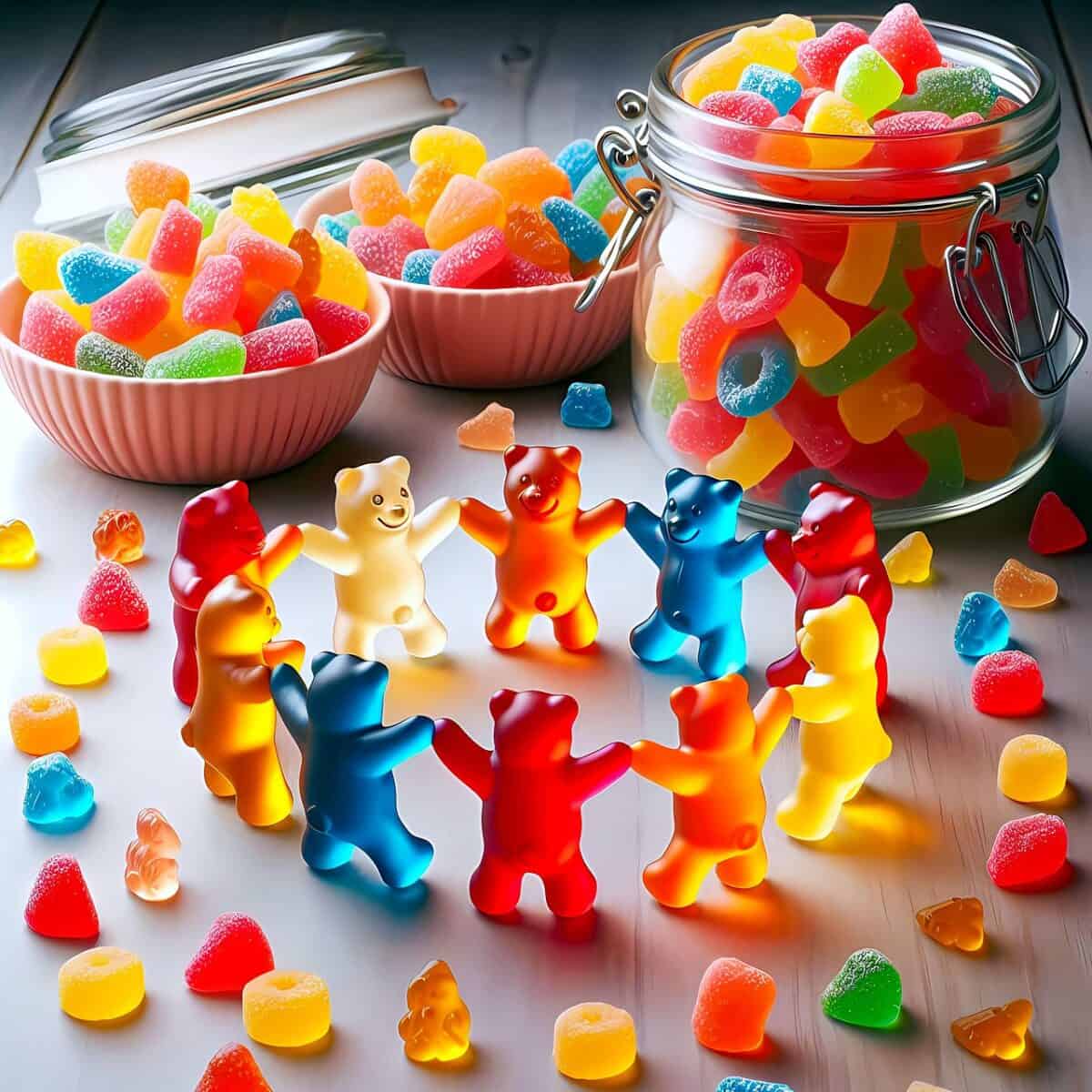
When and how you add the gummies matters. The golden rule is to add your pre-treated gummies at the very end of churning.
Churn your ice cream base until it reaches thick, soft-serve consistency. In the final 30 to 60 seconds of churning, add your cold, treated gummies.
This minimal mixing time spreads them evenly without shredding them with the dasher. We once tried adding gummies five minutes into churning. The result was shredded gummy pieces and strangely colored base. No satisfying chewy pieces remained.
Adding them cold also helps maintain the ice cream’s temperature. This leads to faster freezing and smaller ice crystals in the final product.
Conclusion: Achieving Mastery
Rock-hard gummies in homemade ice cream frustrate everyone. But it’s a problem with a clear, scientific explanation. Water migration and the gummy’s Glass Transition Temperature cause the trouble.
By understanding the “why,” you’re no longer just following a recipe. You’re controlling the outcome.
You can now confidently use one of the three core solutions. Lower the gummy’s freezing point with a soak. Create a protective moisture barrier with fat coating. Or select a gummy with better ingredients.
With this knowledge, you’ve moved from frustration to food science mastery. You’re now fully equipped to create delicious, professional-quality gummy candy ice cream. Every batch will have the perfect soft, chewy texture.
Referans Bağlantıları:
- Glass Transition and Re-Crystallization Phenomena of Frozen Materials and Their Effect on Frozen Food Quality – PMC (NIH) https://pmc.ncbi.nlm.nih.gov/articles/PMC7923164/
- Glass transition temperature and its relevance in food processing – PubMed https://pubmed.ncbi.nlm.nih.gov/22129345/
- The Influence of Polysaccharides on the Glass Transition in Frozen Sucrose Solutions and Ice Cream – ScienceDirect https://www.sciencedirect.com/science/article/pii/S0022030293774561
- Glass transitions as affected by food compositions and by conventional and novel freezing technologies: A review – ScienceDirect https://www.sciencedirect.com/science/article/abs/pii/S092422441930370X
- Osmotic dehydration of fruits and vegetables: a review – PMC https://pmc.ncbi.nlm.nih.gov/articles/PMC4152536/
- Exploring Osmotic Dehydration for Food Preservation: Methods, Modelling, and Modern Applications – PMC https://pmc.ncbi.nlm.nih.gov/articles/PMC11394940/
- Review of osmotic dehydration: Promising technologies for enhancing products’ attributes – Wiley Online Library https://ift.onlinelibrary.wiley.com/doi/10.1111/1541-4337.13346
- Osmotic Dehydration – ScienceDirect Topics https://www.sciencedirect.com/topics/agricultural-and-biological-sciences/osmotic-dehydration
- Food preservation – Wikipedia https://en.wikipedia.org/wiki/Food_preservation
- Preservation and Physical Property Roles of Sodium in Foods – NCBI Bookshelf https://www.ncbi.nlm.nih.gov/books/NBK50952/